
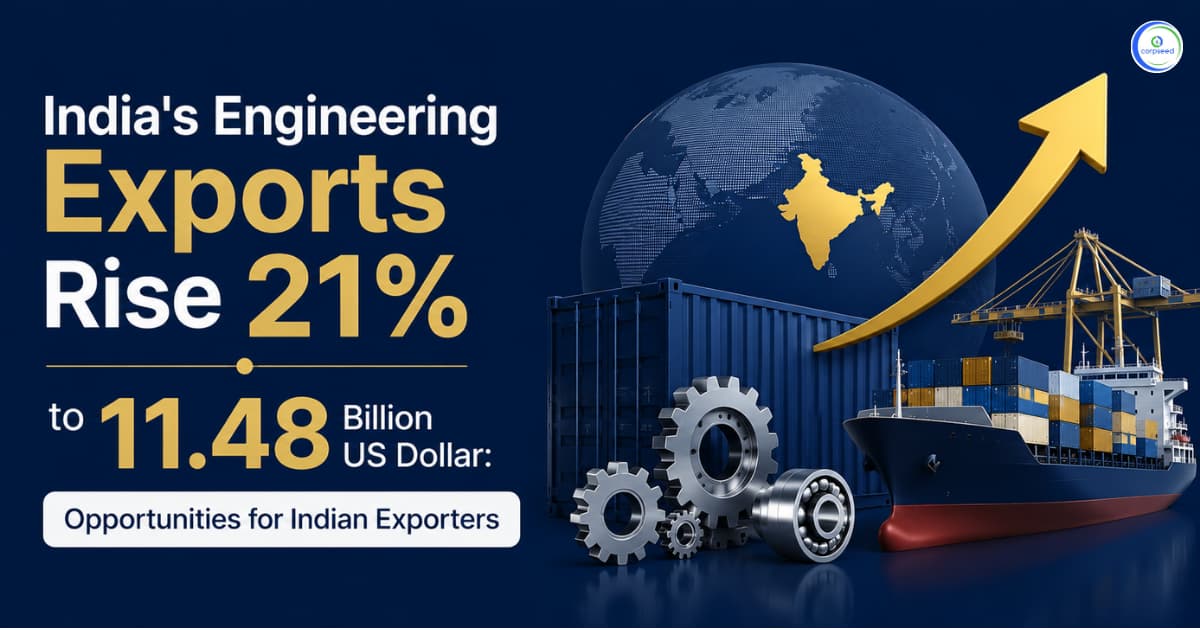
India's Engineering Exports Rise 21% to 11.48 Billion US Dollar: Opportunities for Indian Exporters
India's engineering goods exports recorded a 21% year-on-year growth, reaching USD 11.48 billion in June 2026, reflecting strong global demand despite supply chain disruptions and higher freight costs. The United States remained India's largest export destination, while exports to China increased by 74% and shipments to Oman witnessed exceptional growth.
Schedule a Call Back
Introduction
India's engineering goods exports touched US 11.48 billion dollars in June 2026, up 21% from US 9.51 billion dollars in June 2025. This is the third straight month that engineering shipments have crossed the US 10-billion-dollar mark, according to data released by the Engineering Export Promotion Council (EEPC) India.
The growth came from several markets at once. Exports to China jumped 74%, shipments to Oman more than quadrupled after the India-Oman free trade agreement came into effect, and the United States stayed the largest buyer at US 1.95 billion for the month. Engineering goods now make up 28.4% of India's total merchandise exports.
For Indian manufacturers, MSMEs, and first-time exporters, understanding the export process is crucial. This data indicates real demand for Indian-made machinery, components, and metal products across multiple continents. If you're new to exporting and wondering how to begin, this is an ideal moment to explore the steps involved and assess whether your business is ready to tap into these opportunities.
Schedule a Call Back
India's Engineering Exports Rise 21% in June 2026
India's engineering exports reached 11.48 billion US dollars, up from 9.51 billion US dollars in June 2025. That is a rise of 21% year-on-year.
This was not a one-time jump. Engineering exports have stayed above 10 billion US dollars for three months in a row, even with shipping delays caused by disruptions on the Red Sea and Strait of Hormuz routes.
The bigger picture also looks strong. In the first quarter of FY 2026-27 (April to June), engineering exports totalled 34.14 billion US dollars, up 18.09% from 28.91 billion US dollars in the same period last year. This is a solid jump for a sector that already makes up more than a quarter of India's total merchandise exports.
This means, out of every 4 dollars India earns from goods exports, 1 dollar now comes from engineering products, things like industrial machinery, auto parts, and electrical equipment. When this sector grows faster than overall exports, it usually means Indian factories are winning new orders, not just benefiting from currency changes or one-off deals.
Why Are India's Engineering Exports Growing?
The short answer is that demand picked up across several markets at the same time, not just one. That is a healthier pattern than growth driven by a single large buyer, because it spreads out the risk if any one market slows down.
Higher Demand from China
Exports to China rose 74% in June 2026 to reach US 361.47 million dollar. On its own, this is still a small slice of India's total engineering exports. But the direction matters. India's overall exports to China grew nearly 37% in the fiscal year ended March 2026, reaching close to US 20 billion dollar, so the engineering sector's China growth fits into a wider trend of stronger trade between the two countries.
This means there is room for Indian firms to look into the Chinese market for their engineering products, where they have an edge due to lower costs and shorter delivery times. This does not necessarily mean that there is a ready market for all categories of products in China, since buyers are selective.
Demand from the US and Germany
The USA continued to dominate as the largest importer of engineering goods from India in June 2026, having imported goods amounting to 1.95 billion US dollars. Germany was another major country that contributed to this export surge. These two countries have substantial manufacturing capabilities that always require spare parts and metal products from Indian exporters, making them key destinations for engineering goods exports from India.
They are mature and compliant markets. Buyers in these markets generally require good-quality goods, along with proper export documentation. While gaining access to these markets requires effort, meeting compliance standards can give you confidence that your products will be accepted, and export services can support you in this process.
Strong Growth in Oman
Exports to Oman more than quadrupled in June 2026, reaching close to US 259 million dollar. EEPC India linked much of this jump to the India-Oman free trade agreement, which reduces or removes tariffs on many product categories traded between the two countries.
This is a useful reminder for smaller exporters: it is not only the large, well-known markets like the US or the European Union that offer opportunity. Countries with active trade agreements with India, such as Oman, can offer real tariff advantages that make Indian goods more price-competitive almost overnight.
Wider Demand Across Engineering Products
EEPC India's commentary highlights that demand exists across various markets, but small exporters often face challenges like understanding export documentation or compliance. To begin exporting, verify current trade information for your commodity segment from DGFT or EEPC India, and consider utilizing export facilitation services to navigate requirements effectively.
Which Countries Are Buying More Engineering Goods from India?
| Country/Market | Latest Export Trend | Why It Matters |
| United States | Largest market, US 1.95 billion dollars in June 2026 | Large, stable demand base; high compliance and quality expectations |
| China | Up 74% to US 361.47 million in June 2026 | Fast growth off a smaller base; part of a broader rise in India-China trade |
| Germany | Among top contributing markets | Strong industrial and engineering import demand within the EU |
| Oman | More than quadrupled, near US 259 million dollar | Tariff benefits from the India-Oman FTA make Indian goods more competitive. |
| Singapore | Named among key growth markets by EEPC India | Serves as a regional trade and re-export hub in Southeast Asia |
| Turkey | Established engineering goods buyer for India | Bridges European and West Asian markets; useful for diversification |
Each of these markets behaves differently. The US and Germany reward exporters who invest in quality systems and documentation. China and Oman show what happens when demand or tariff conditions shift quickly. For a business new to exports, this table is really a map of where to start research first, based on your product and your capacity to meet each market's requirements.
Which Engineering Products Are Driving India's Export Growth?
India's engineering exports cover a wide basket of goods, and the June 2026 growth was not limited to one category. Broad groups that typically contribute to this sector include:
- Industrial machinery and mechanical equipment
- Electrical machinery and equipment
- Auto components and parts
- Iron and steel products
- Other metal products, including fabricated items
- Transport equipment
EEPC India's June update highlighted that the growth was supported by demand across several of these categories rather than being carried by a single product line. This is worth noting because it lowers the risk for the sector as a whole, if one category slows down due to a change in a buyer country's policy, others can still hold up overall numbers.
On the other hand, growth does not always occur evenly in all categories at all times. Some products might experience faster growth than others. In contrast, some products may even experience reduced or stagnating growth due to worldwide commodity price movements, buyer inventory trends, or currency exchange rate changes. Exporters must look up the latest information from DGFT or EEPC India about the HS code category they are working in before making any decision.
What Does Engineering Export Growth Mean for Indian MSMEs?
A 21% jump in a national export figure does not automatically mean more orders for every small manufacturer. But it does say something useful: overseas buyers are actively sourcing engineering products from India right now, across multiple countries and product categories.
For MSMEs, this creates a few practical openings:
Market diversification becomes more realistic. If your business currently sells only within India, or to one or two overseas buyers, growth in markets like Oman, Germany or China gives you more places to test demand for your product.
Smaller manufacturers can benefit from trade agreements. FTAs like the one with Oman are not only useful for large exporters. A small manufacturer of machine parts or metal fittings can benefit from the same reduced tariffs as a large company, provided the product qualifies and the paperwork is done correctly.
Compliance becomes non-negotiable once you sell abroad. In-country customers in India might be satisfied with simple product quality testing. Exporting to other countries, such as the US and Germany, may involve certification against certain technical standards, proper labelling, and proper export documentation. Otherwise, there is a risk that the consignment will be detained at the border or even refused by the customer.
Product quality and market research matter more than enthusiasm. Before chasing an export order, it helps to check whether your product already meets the destination country's technical standards, whether similar Indian products are already selling there, and what price competition looks like. A rushed first shipment without this groundwork often creates more problems than it solves.
Growth in national export data is an invitation to look into exporting seriously, not a guarantee that orders will follow automatically.
How Can a Business Start Exporting Engineering Goods from India?
Starting an engineering goods export business from India is easier when broken into simple steps.
1. Choose Your Business Structure
Pick a Proprietorship, Partnership, LLP, or Private Limited Company. Most exporters start small and upgrade later for better bank support.
2. Find the Right HS Code
Every product needs a Harmonized System (HS) Code. This decides your customs duty and export eligibility. Get it right to avoid delays.
3. Get Your IEC Registration
An Import Export Code (IEC) is a 10-digit number from DGFT (Directorate General of Foreign Trade). Most exporters need IEC registration to clear customs and receive payments. This is one of the most important export licence steps for engineering exporters.
4. GST Registration
Exports are normally zero-rated for GST. The exporter can register for LUT to avoid paying tax at the time of exports.
5. Check Licence Requirement
Some engineering products will require additional licences depending on the use or destination country.
6. Export Documents
Make sure that you have your invoice, packing list, shipping bill, and Certificate of Origin ready.
7. Destination Country Requirements
Check the destination country requirements.
What Registrations and Licences May Engineering Exporters Need?
| Registration / Requirement | Why It May Be Needed |
| Business registration | Establishes the legal entity for your export business |
| PAN | Required for tax identification and as the base for your IEC |
| GST registration | Needed for tax compliance on export transactions |
| Import Export Code (IEC) | Enables eligible import-export activities and customs clearance |
| HS Code classification | Determines duty treatment and applicable regulations for your product |
| Product-specific licence | May be required for certain controlled, regulated or strategic goods |
| Certificate of Origin | May be needed to claim tariff benefits under trade agreements |
| Other certifications | Depends on the specific product and the destination country's rules |
Requirements differ based on the product, the destination market, and the applicable regulations at the time of export. Not every item in this table applies to every shipment, it is best treated as a checklist to verify against your specific product and market rather than a universal rulebook.
What Role Does DGFT Play in Engineering Exports?
The DGFT (Directorate General of Foreign Trade), which operates under the Ministry of Commerce and Industry, is the key body responsible for framing India's foreign trade policy. The functions of the DGFT that are related to engineers' export business are:
- Issuing the Import Export Code (IEC) that businesses need to trade internationally
- Framing and updating India's Foreign Trade Policy, which sets out rules for exports and imports
- Maintaining the list of restricted, prohibited and freely exportable goods
- Authorization for exports of goods requiring specific authorization
- Periodic notification and issuance of circulars altering duties and documentation requirements
- Exporter compliance supervision under the provisions of the Foreign Trade (Development & Regulation) Act, 1992
Because DGFT rules and notifications can change, engineering exporters should get into the habit of checking the DGFT website or working with a compliance advisor before finalising large export orders, rather than relying on information that may be outdated.
What Government Support Is Available for Engineering Exporters?
Several government channels help engineering exporters. But schemes and benefits can change, so always check the latest details before you rely on them.
EEPC India is the export promotion council for the engineering sector. It speaks up for exporters, shares trade data like the June 2026 numbers, and helps member companies meet overseas buyers through trade fairs and delegations.
DGFT schemes, like duty remission and export promotion schemes under the Foreign Trade Policy, get updated from time to time. Rates and eligibility rules change with new notifications. So check the DGFT portal directly for schemes that apply to your product, instead of using old information.
MSME support comes through central and state government programmes. These help small manufacturers with credit, technology upgrades and market development, which can make a business more export-ready.
Trade agreements, like the India-Oman FTA seen in the June 2026 data, can cut tariffs for Indian goods in partner countries. This gives exporters a real price advantage, but only if their product meets the agreement's rules of origin.
What Should Indian Engineering Exporters Do Next?
For a business considering entry into engineering exports, a practical starting checklist looks like this:
- Identify which of your products have realistic export potential based on current demand.
- Research target markets, starting with countries showing strong recent demand for your product category.
- Confirm the correct HS Code for each product you plan to export.
- Check current DGFT rules and Foreign Trade Policy provisions relevant to your product.
- Obtain an IEC where required for your business activity.
- Complete applicable GST and other tax registrations.
- Check whether your product needs any specific licences or certifications.
- Understand the destination country's product standards, labelling and customs requirements.
- Prepare accurate export documentation for each shipment.
- Keep monitoring changes in foreign trade rules, tariffs and scheme eligibility.
This is a starting framework, not a guarantee of export success. Each business should assess its own product, capacity and target market before committing resources, and consult qualified professionals for company-specific compliance advice.
Conclusion
India's engineering exports reached US$11.48 billion in June 2026, growing 21% from a year earlier. Demand from China, the US, Germany and Oman pushed this growth, and the sector now makes up more than a quarter of India's total merchandise exports. For Indian manufacturers and MSMEs, this is a good time to look at engineering goods exports from India as a real business opportunity, not just a trend in the news.
It is important to understand some basic facts: IEC registration with DGFT, GST compliance, proper HS code classification, and relevant export documentation for the product and market being targeted. Each of the above-mentioned points may not be difficult to do by itself; however, the cumulative importance of each cannot be understated. Businesses that take care of their DGFT registration, export license requirements and compliance in advance find themselves in an easier situation when actual orders start coming in.
For exporters of engineering products from India requiring expert guidance for IEC registration, DGFT registration, or export documentation, it is better to get such advice in advance rather than during a customs problem with the first shipment.
About the Author

Mahek Sancheti
Content WriterMahek Sancheti, BAJMC graduate with a deep passion for writing. As a content writer, video content creator, creative content creator, and scriptwriter, I bring stories to life through words and visuals. I honed my skills by working with a prominent news agency, where I excelled in crafting compelling narratives and engaging content. Coming from a journalism and mass communication background I have skills to craft engaging narratives that captivate audiences. With a keen interest in writing and creativity, I aim to deliver impactful and meaningful content that resonates with diverse audiences.
https://www.linkedin.com/in/mahek-sancheti-837196212
Related articles
What Is a DGFT License? Meaning and Its Importance in Exports and Imports
2026-11-16

DGFT SCOMET Rules 2026: GAER Validity Extended to 3 Years and New Export Eligibility
2026-11-12

India-New Zealand FTA: How Startups Can Export Duty-Free and Enter the New Zealand Market
2026-10-23

Exporting Handicrafts & Home Decor from India: IEC, DGFT & Customs Compliance Checklist
2026-10-14

How to Export Through Amazon Global & Etsy From India: Complete MSME Export Guide
2026-10-13

Textile & Apparel Testing in India: Export Compliance with REACH, Azo Dyes & ISO 105 Guide 2026
2026-09-02