
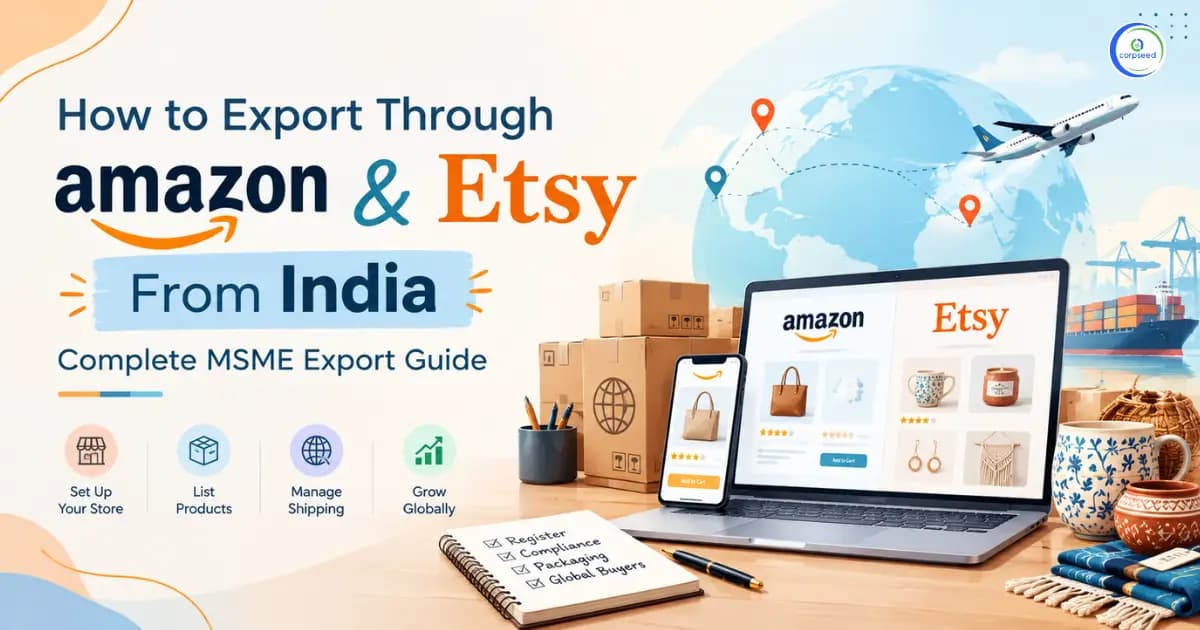
How to Export Through Amazon Global & Etsy From India: Complete MSME Export Guide
Exporting through online marketplaces gives Indian businesses, including Micro, Small and Medium Enterprises (MSMEs), a way to reach international customers without building their own overseas sales network.
Schedule a Call Back
Introduction
If you want to understand how to export from India, Amazon Global Selling and Etsy offer different routes depending on the products you sell, your target market and the type of business you want to build.
Amazon Global Selling suits businesses looking to sell products through international Amazon marketplaces. Etsy is more suitable for products that meet its creativity standards, including qualifying handmade items, original designs, craft supplies and vintage goods.
Before opening a seller account, check the export rules, marketplace requirements, payment options and shipping arrangements for your chosen country. Sorting out these details early can help prevent problems with product listings, delayed shipments, and extra expenses.
Amazon Global Selling vs Etsy: Which Platform Should You Choose?
The right marketplace depends on your products and how you plan to sell them internationally.
| Factor | Amazon Global Selling | Etsy |
| Best suited for | Brands, manufacturers, traders and product businesses | Sellers of qualifying handmade, designed, vintage and craft-related products |
| Product eligibility | Depends on marketplace policies and product restrictions | Products must meet Etsy’s Creativity Standards Customer reach International Amazon marketplaces Buyers shopping through Etsy |
| Customer reach | International Amazon marketplaces | Buyers shopping through Etsy |
| Seller onboarding | Amazon seller registration and verification | Etsy shop setup, identity verification and payment onboarding |
| Payments | Depends on the selected marketplace and payment arrangements | Indian sellers need Etsy Payments through Payoneer |
| Important consideration | Product compliance, listing rules, fulfilment and destination-market requirements | Product eligibility, GSTIN verification, payment setup and international shipping |
Amazon explains its registration process in its official Amazon Global Selling registration guide. Etsy outlines the rules for eligible products in its Creativity Standards.
How to Start Export Business in India
If you are researching how to start export business in India, begin with your product and target market rather than opening a marketplace account immediately. Your product category determines which registrations, documents, licences and shipping arrangements may apply.
For MSMEs planning to enter international markets, checking these requirements early can help them prepare for export operations and estimate the costs involved.
- Select Your Product and Target Country
Demand, competition, production capacity, packing requirements, and shipping viability should all be taken into consideration while selecting items. Examine the nations in which you plan to sell your goods to see whether there are any import restrictions or other requirements.
For example, products such as cosmetics, food items, toys, electrical goods and products containing certain materials may require specific approvals or documentation in the destination market.
Also check the marketplace’s product eligibility rules before investing in inventory or listing preparation.
- Set Up Your Business and Export Documentation
Decide whether you will operate as a proprietorship, or through another suitable business structure. Prepare your PAN, identity, and address documents, bank details and any business registration or tax documents required for your circumstances.
An Importer Exporter Code (IEC) is generally required for exporting goods from India unless a specific exemption applies. Other requirements can depend on the product, transaction and shipping method.
You may also need to review GST requirements, export declarations, bank-related export formalities and product-specific licences. Exporters should verify the current requirements with the Directorate General of Foreign Trade (DGFT) and other relevant authorities before shipping.
For guidance on the application process, see Corpseed’s IEC registration guide.
- Check Product and Destination-Country Requirements
Indian export permission does not automatically mean that a product can be sold in every overseas market.
Check the product’s classification, labelling, packaging, testing and certification requirements. Review both Indian export rules and the importing country’s requirements. Confirm whether the product is freely exportable or requires an authorisation or other approval.
Keep the relevant invoices, product specifications, certificates and supporting documents ready for marketplace verification and shipment processing.
Planning to start exporting but unsure which registrations or documents your business needs? Consult Corpseed’s experts for guidance on IEC registration and applicable export requirements before moving ahead with your first international order.
How to Register for Amazon Global Selling India
With Amazon Global Selling, Indian businesses can sell their products in overseas markets through Amazon. To get started, you need to register as a seller and provide the details, and documents requested by Amazon.
Follow these steps to get started.
Step 1: Choose Your Target Marketplace
First, decide where you want to sell, such as the US, UK, or UAE. Check whether your product can be sold in that marketplace and research its demand, competitors, shipping options and local requirements before registering.
Step 2: Prepare Your Documents
Amazon’s registration guide lists identity proof, business or registration information, address proof and bank account details among the information sellers may need. Payment-card requirements and other account details can depend on the selected marketplace.
Check the latest Amazon registration requirements before beginning the application. Requirements can differ, so do not assume that every marketplace follows an identical process.
Step 3: Create and Verify Your Seller Account
Register through Amazon Global Selling and enter your business and seller information accurately. Submit the requested documents and complete the verification steps shown in the registration process.
Keep names, addresses and business details consistent across your documents wherever applicable. Incomplete or mismatched information may delay verification.
Step 4: Create Your Product Listings
For each product, add a title, description, images, specifications, and the other details required by your chosen marketplace. Before listing it, check whether you need a barcode, a product identifier exemption, brand approval or any additional documentation.
Descriptions and images should accurately represent the product, and comply with Amazon’s listing policies.
Step 5: Select a Fulfilment and Shipping Method
Review the available fulfilment options. Depending on the marketplace and product, you may be able to manage international orders yourself or use Amazon fulfilment services.
Before choosing a shipping method, check the delivery time, storage needs, customs responsibilities, return process and overall cost. Also, find out who will manage the export documentation and the import formalities in the destination country.
How to Sell on Etsy From India
If you want to know how to sell on Etsy from India, start by checking whether your products qualify under Etsy’s rules. Etsy is not a general marketplace for every type of resold or mass-produced product. Sellers must meet the platform’s applicable product eligibility and creativity requirements.
Step 1: Check Whether Your Products Qualify
Before opening an Etsy shop, read Etsy’s Creativity Standards to see if your products are allowed. Etsy accepts eligible handmade products, original designs, vintage items and craft supplies, subject to its platform rules.
Do not assume that a product is eligible simply because it is made or sourced in India. Check the specific product category, and applicable rules.
Step 2: Open Your Etsy Shop
Follow Etsy’s official shop-opening instructions. Enter your seller information and complete the onboarding process shown for India.
Etsy currently allows new shops in India to sell to international customers only. Check Etsy’s latest seller guidelines before registering to confirm the requirements for Indian sellers.
Step 3: Complete GSTIN and Payment Setup
According to Etsy’s India seller payment guidance, Indian sellers must verify their GSTIN and use Payoneer to receive Etsy Payments.
Complete the requested identity and financial verification. Review the current Etsy and Payoneer fee schedules, withdrawal arrangements and currency-conversion terms before deciding your selling price.
Step 4: Prepare Listings and International Delivery
Upload clear product photographs along with their dimensions, materials and processing time. Choose your delivery destinations and shipping charges according to the products you can reliably fulfil.
Account for packaging, transit time, tracking, customs documentation, returns and possible damage. Your delivery promise should reflect your actual production and dispatch capacity.
What Documents Are Required to Export Through Amazon or Etsy?
The documents required depend on the marketplace, product, destination country and shipping arrangement. Sellers should prepare the relevant documents before accepting orders that they may not be able to fulfil.
Common documents and records may include:
- PAN and identity proof
- Business registration or other seller details requested by the marketplace
- IEC, where required for the export
- GST registration and relevant tax records, where applicable
- Bank account and payment verification details
- Commercial invoice and packing list, where applicable
- Shipping bill or other required customs documentation
- Product-specific licences, test reports or certificates, where applicable
- Transport, tracking and delivery records
This is a general checklist, not a universal document list. Confirm the exact requirements for your product and shipment with the relevant authorities, marketplace and logistics provider.
How Much Does It Cost to Export Through Amazon or Etsy?
The cost of exporting through Amazon or Etsy depends on the product, destination country, marketplace fees and shipping method. Before setting your selling price, calculate the full cost of fulfilling an international order rather than considering only the product and delivery charges.
| Cost Item | What to Consider |
| Product cost | Manufacturing, sourcing or purchasing the product |
| Packaging | Export-grade packaging, labels and protective materials |
| International shipping | Courier or freight charges based on destination, weight and dimensions |
| Marketplace fees | Listing, transaction, selling, fulfilment or subscription fees, where applicable |
| Payment charges | Payment processing, currency conversion and withdrawal fees |
| Returns and damage | Refunds, replacement shipments and damaged goods |
| Compliance expenses | Testing, certificates, licences or other product-specific requirements, where applicable |
| Taxes and customs | Applicable taxes, duties and clearance charges, depending on the shipment and sales arrangement |
Calculate the total cost for each product and destination before setting your selling price. Review the current fee schedules of your chosen marketplace and obtain shipping quotations for your target destinations. Charges vary by product category, package dimensions, fulfilment method and destination, so avoid using a single cost estimate for every export order.
Common Mistakes to Avoid When Starting an Export Business
- Opening a seller account before checking product eligibility: A marketplace may restrict a product even when it can legally be exported from India.
- Assuming one registration covers every requirement: IEC, GST, product approvals and destination-country rules serve different purposes.
- Ignoring the importing country’s rules: Labelling, safety, packaging and certification requirements can differ between markets.
- Underestimating delivery costs: Package dimensions, remote delivery locations, customs handling and returns can affect profitability.
- Using inaccurate product descriptions: Incorrect claims, specifications or images can lead to customer disputes and marketplace action.
- Ignoring payment and currency-conversion terms: Review how sales proceeds are received, converted and transferred to your bank account.
- Shipping without checking the documentation: Confirm the applicable invoice, packing, customs and transport requirements before dispatch.
How Can Corpseed Help with Export Registration?
Setting up an export business involves more than registering on a marketplace. For MSMEs planning to sell internationally, the process may also involve IEC registration, export documentation and product-specific approvals, depending on the business activity and destination country.
Corpseed can assist businesses seeking guidance on export-related registrations and documentation.
Our support can include:
- Guidance on the IEC application process and related documentation
- Help identifying registrations or product approvals that may apply to your business
- Assistance with understanding applicable regulatory requirements
- Guidance on documentation needed for your proposed export activity
If you need an export consultant in India, consult Corpseed to discuss the requirements for your product and business model. Businesses looking for an IEC registration consultant can also review our Import Export Code service before proceeding.
Requirements may vary depending on your product, transaction and destination country, so check which rules apply to your business before exporting. Amazon and Etsy also have their own verification processes and approval policies that sellers must follow.
Need help with your export documentation or IEC application? Connect with Corpseed’s export compliance experts to discuss your requirements and get guidance suited to your product and business activity.
Final Checklist Before Your First Export Order
Before accepting and dispatching an international order, confirm that:
- Your product is eligible for sale on the selected marketplace.
- Required registrations, and product approvals have been checked.
- Your seller account and payment details are verified.
- The destination country’s import and labelling requirements have been reviewed.
- Shipping, packaging, customs documentation and returns have been planned.
- Your selling price accounts for the relevant costs and fees.
Preparing these details before your first order can help you launch with a clearer understanding of the work involved in selling internationally.
Conclusion
Amazon Global Selling and Etsy give Indian sellers a way to reach buyers in other countries. Before choosing either platform, look at the products you want to sell, the rules for listing them, and the requirements for sending them overseas. You may also need to arrange IEC registration, payment facilities, shipping and product-related approvals.
Amazon Global Selling works for eligible products sold through international Amazon marketplaces. Etsy is worth considering if your products meet its Creativity Standards. The steps involved will depend on what you sell, and where your customers are located.
If you need help with how to export from India, Corpseed can guide you on IEC registration and relevant export requirements. Consult our experts to discuss the registrations and documents your business may need before shipping its first order.
About the Author

Parul Bohral
Legal Content WriterParul Bohral, a BALLB graduate and experienced legal researcher and content writer with expertise in various legal areas, including corporate law and intellectual property. I have gained valuable experience in esteemed legal environments, where I have strengthened my research skills, allowing me to approach legal writing with precision and depth.
As a legal content writer, I am committed to delivering work that not only informs but also engages readers. By staying informed about the latest trends in content marketing and regulatory developments, I ensure that my writing remains sophisticated and meets industry standards. My dedication to thorough research enables me to craft content that is both insightful and impactful.
Related articles
DGFT SCOMET Rules 2026: GAER Validity Extended to 3 Years and New Export Eligibility
2026-11-12
India-New Zealand FTA: How Startups Can Export Duty-Free and Enter the New Zealand Market
2026-10-23
Exporting Handicrafts & Home Decor from India: IEC, DGFT & Customs Compliance Checklist
2026-10-14

Textile & Apparel Testing in India: Export Compliance with REACH, Azo Dyes & ISO 105 Guide 2026
2026-09-02
India's Engineering Exports Rise 21% to 11.48 Billion US Dollar: Opportunities for Indian Exporters
2026-07-31
Export Compliance Checklist for Oman: A Complete Guide for Indian Exporters to Avoid Customs Delays
2026-07-29