
Exporting Handicrafts & Home Decor from India: IEC, DGFT & Customs Compliance Checklist
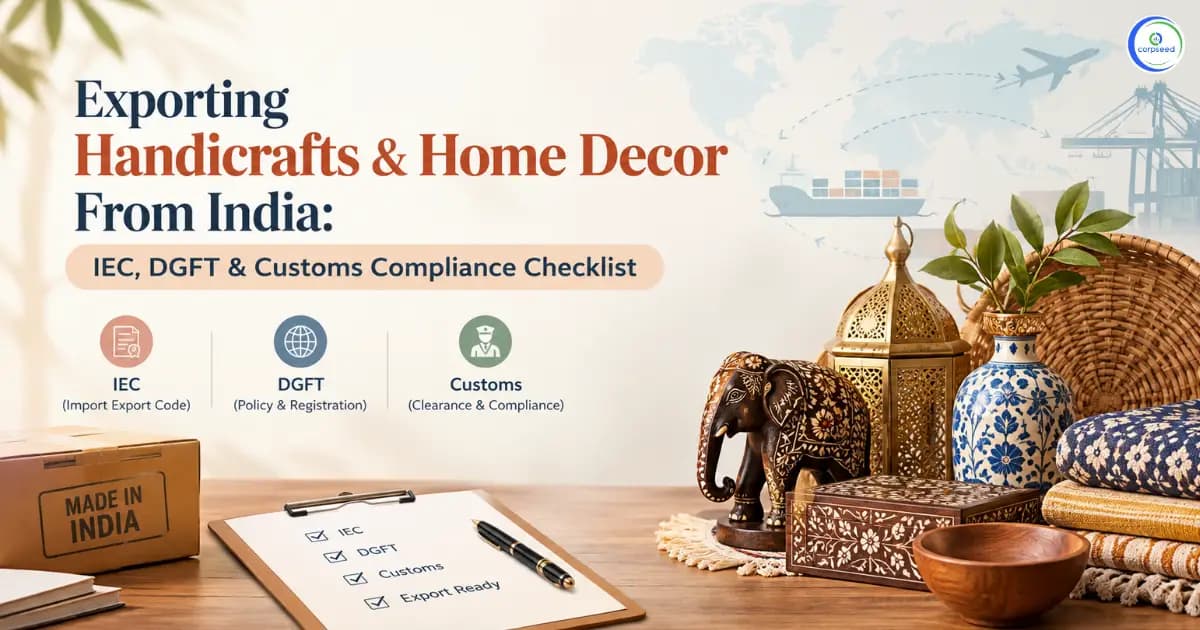
Exporting handicrafts and home decor from India requires an IEC, the correct HS code and the shipping documents required for customs clearance.
Schedule a Call Back
300+ import-export and DGFT assignments since 2018
Clients include Advantech Industrial Computing India, Smiths Detection Systems, Areca Embedded Systems, Motorola Solutions India, Trinity Mobile APP Lab, Motorica India, Glocal Healthcare Systems, Tablets (India)Limited, Auroras TEA Company, Surabhi Aqua Minerals, Solankili Logistics Management, ATG Freight India (12 of 250+ served since 2018).
A few more clients we've served in this industryHide the list
- Electronics and technology
- Advantech Industrial Computing India · Smiths Detection Systems · Areca Embedded Systems · Motorola Solutions India · Trinity Mobile APP Lab
- Pharma and healthcare
- Motorica India · Glocal Healthcare Systems · Tablets (India)Limited
- Food and consumer goods
- Auroras TEA Company · Surabhi Aqua Minerals
- Logistics and trade
- Solankili Logistics Management · ATG Freight India
- Jewellery
- Janki Jewellers · Viindhya Bullion
- More clients
- Esskay Compuservices · Welgrow Technologies · Ample Technologies · Aprodite Infotech · Floroma Infinity · Moonlight Technology · NJ Power · Ample Digital · Augustdevices India · Automap Software and Technologies · SNS Metpro Industries · Webmeditech Healthcare · Anagh Traders · Meritech India · Zipped Solutions · Metanovo Health · Kapemai Lifestyle · Zexcorp Services · Agricapita Innotech · Meticulous Networks · Nexavarge · Arng · D13 Business Ventures · Datalux Systems India
Introduction
Exporters must also check DGFT export rules and any restrictions on the materials used in their products. Wooden decor, metal artefacts, ceramics and textile furnishings may have different requirements, depending on their classification and destination. Checking these details before dispatch helps prevent documentation errors, and shipment delays.
How to Export Handicrafts and Home Decor from India in 2026?
To export handicrafts and home decor from India, a business must identify the product, check its export policy and classification, obtain the required registrations, prepare the shipping documents and complete customs formalities. The process becomes more specific when a product contains regulated materials or is being shipped to a country with additional safety, labelling or import requirements.
Here is the process an exporter should follow before accepting an overseas order.
- Identify the product and destination market: Define the product's material, intended use, construction and country of destination. A wooden wall decoration, a brass candle holder and a ceramic vase may fall under different tariff classifications and regulatory requirements.
- Check the applicable export policy: Review the current ITC (HS) export policy through the Directorate General of Foreign Trade (DGFT). Confirm whether the product is freely exportable, restricted or subject to a specific condition or authorisation.
- Obtain an IEC: An Importer Exporter Code is generally required to export goods from India, except in specifically exempted cases. Apply through the official DGFT website.
- Review tax and registration requirements: Determine the applicable GST treatment, export invoicing requirements and whether a Letter of Undertaking (LUT) is relevant to the chosen tax route. Check whether registration with the Export Promotion Council for Handicrafts (EPCH) or another authority is needed for the intended activity or export benefit.
- Confirm the HS code and prepare documents: Establish the correct tariff classification and prepare the commercial invoice, packing list, shipping bill and transport document, along with any additional documents required for the product or destination.
- Arrange customs clearance and shipment: Coordinate with the customs broker, freight forwarder or carrier, as applicable. Check the shipping bill details, package information, consignee details and supporting documents before the shipment leaves India.
- Complete post-shipment formalities: Retain export and payment records, reconcile shipping documents with invoices and complete applicable GST reporting, refund or export-benefit procedures.
Following these steps in sequence helps exporters identify missing requirements before goods are packed and dispatched. It also reduces the risk of having to correct product descriptions, invoice details or shipping declarations after a shipment has been prepared.
Which Registrations Are Required to Export Handicrafts from India?
The registrations required for handicrafts export from India depend on the business structure, tax position, product and export activity. IEC is the main starting point for most exporters of goods, but it does not replace customs documentation, tax requirements or product-specific approvals.
| Registration or Requirement | When it Matters |
| Importer Exporter Code (IEC) | Generally required for exports of goods, subject to specified exemptions |
| GST registration | Depends on the business's applicable GST obligations and circumstances |
| Letter of Undertaking (LUT) | Relevant when an eligible registered taxpayer exports without payment of IGST under the applicable GST route |
| EPCH membership and RCMC | Relevant to handicraft exporters seeking the corresponding council registration or applicable Foreign Trade Policy benefits |
| Product-specific approval or certificate | Required where the product, material, export policy or destination-market rules call for it |
| Customs and carrier documentation | Required for the applicable export and transport process |
IEC registration for exporters
The IEC is issued by DGFT and is generally required for commercial exports of goods from India unless an exemption applies. Under the Foreign Trade Policy 2023, the IEC is linked to the entity's PAN, and is issued separately by DGFT.
An exporter should apply through the official DGFT portal and check that the business details, PAN information and bank details are accurate. IEC holders must also comply with the prescribed annual IEC confirmation or update requirements during the April–June period, including confirmation where details have not changed.
Do handicraft exporters need EPCH membership?
EPCH supports the promotion of handicraft exports and provides membership and registration facilities for eligible exporters. Its registration process distinguishes between merchant exporters, manufacturer exporters and merchant-cum-manufacturer exporters.
However, EPCH membership should not be described as a universal prerequisite for every handicraft shipment. An exporter should check whether EPCH registration or an RCMC is required for the specific activity, authorisation or benefit being pursued. The requirement depends on the applicable Foreign Trade Policy provisions and the purpose for which the registration is sought.
What about GST and LUT?
If your business is GST-registered, you can generally export goods under an LUT without paying IGST at the time of export, subject to the applicable conditions. Alternatively, you may use the permitted route of paying IGST and claiming a refund. Check which option applies to your business before raising the export invoice.
The correct procedure depends on the taxpayer's eligibility, and current GST rules. Exporters should also check invoicing, return reporting and refund requirements rather than assuming that obtaining an IEC completes every tax-related formality.
The GST portal provides instructions for filing a Letter of Undertaking.
What Are the DGFT Export Requirements for Handicrafts and Home Decor?
DGFT administers India's foreign trade policy and publishes the export policy applicable to goods. Before exporting handicrafts or decorative products, a business should check the current ITC (HS) classification and policy conditions for the specific item.
The description used in a sales catalogue may not be sufficient to establish the correct export classification. For example, a decorative wooden article could be classified differently from a wooden household article, depending on its construction, use and tariff description.
Exporters should check the following before confirming an order:
- Export Policy Status: Determine whether the item is freely exportable, restricted or subject to a specific condition.
- Authorisation Requirements: Check whether an export authorisation or another approval applies to the product.
- Applicable Export Benefits: Review eligibility and conditions before claiming a benefit under an export scheme.
- Product-specific Restrictions: Examine requirements relating to materials, protected species, cultural property or other regulated categories where relevant.
- Destination-market Rules: Confirm whether the importing country requires particular declarations, certificates, labels or product testing.
A product being commonly sold as a handicraft does not automatically mean that every material or variation can be exported without additional checks. For example, an article containing a regulated wildlife-derived material may require a different assessment from a similar-looking item made from an ordinary synthetic material.
The relevant policy should be checked for the actual product and its current specifications. Exporters can begin with DGFT's official portal.
How to Find the Correct HS Code for Handicrafts and Home Decor?
The HS code identifies a product for customs and trade purposes. Its classification can affect the export declaration, tariff treatment in the destination country, import duties and the documents required for the shipment.
There is no single HS code that applies to all handicrafts or home decor products. The classification depends on the product's material, function, construction and the wording of the applicable tariff headings.
Consider these examples:
| Product Category | What to Examine before Classification |
| Wooden wall decor and ornaments | Whether the item is decorative, functional, carved or otherwise manufactured |
| Brass decorative articles | The product's form, intended use and applicable classification notes |
| Ceramic vases and ornaments | Whether the article is ornamental, tableware or another type of ceramic product |
| Textile wall hangings and cushion covers | The textile construction, intended use and relevant tariff description |
| Glass decorative items | The form of the article, its intended use and applicable glassware classification |
These are examples of classification considerations, not confirmed tariff codes for every item in each category.
Before selecting an HS code, exporters should document the product's material composition, dimensions, intended use, manufacturing method and available technical specifications. They should then compare those details with the applicable Indian export tariff and the destination country's import tariff.
An incorrect classification can lead to amendments, questions from customs authorities, incorrect duty calculations or delays in clearance. If a product combines multiple materials or has an unusual function, obtaining a classification review before shipment is preferable to relying on a supplier's informal description.
What Documents Are Required to Export Handicrafts from India?
An export documentation checklist India businesses can use should begin with the documents required for the export declaration and transport of goods. Additional documents may be necessary depending on the product, shipping method, destination and any export benefit being claimed.
Paragraph 2.06 of the Foreign Trade Policy 2023, lists the main documents required for exports: a transport document, a commercial invoice and packing list, and a shipping bill, or bill of export. For postal shipments, a postal bill of export applies. The invoice as well as packing list can also be prepared separately under the applicable customs rules.
| Document | Purpose |
| Commercial invoice | Records the goods sold, quantities, prices, buyer and seller details, and other transaction information |
| Packing list | Describes the packages, contents, quantities, weights and dimensions |
| Shipping bill or applicable export declaration | Records the goods declared for export to customs |
| Bill of lading, airway bill or other applicable transport receipt | Records the transport arrangement and shipment details |
| Certificate of origin, where required | Establishes the declared origin of goods for a relevant trade or import requirement |
| Product-specific certificate or permit, where applicable | Supports compliance with a particular product, material or destination requirement |
| Insurance and payment-related records, where applicable | Supports the commercial and financial arrangements for the shipment |
The invoice and packing list should match the goods actually being shipped. Product descriptions, quantities, package counts, weights and values should be checked before the shipping bill is filed.
Check the invoice and packing list before the goods leave India. For example, both documents should show the same quantity of brass candle holders. Product descriptions matter too. Writing “brass candle holders” tells customs more than “decorative items”, and helps identify the correct HS code, and any product-specific export rules.
The exporter should also confirm whether the buyer, bank, freight forwarder or destination-country authority has requested additional documents. These commercial requests should be distinguished from statutory requirements so that the business knows which documents are legally required and which form part of the transaction.
How Does Customs Clearance Work for Handicraft Exports?
Customs clearance for exports involves declaring the goods, submitting the required information and supporting documents, and completing the applicable customs checks before export permission is granted.
The process commonly involves the following stages:
- Prepare the shipping details: Confirm the exporter and consignee information, product descriptions, quantities, values, packages and destination.
- File the shipping bill: The exporter or authorised customs representative submits the applicable export declaration through the customs system.
- Provide supporting documents: The commercial invoice, packing list and other required records must support the information in the declaration.
- Respond to customs checks: Customs authorities may assess the declaration, examine goods or request clarification, depending on the shipment and applicable procedure.
- Obtain clearance for export: The goods can proceed under the applicable export procedure once the necessary formalities are completed.
- Coordinate the shipment: The exporter, or logistics provider completes the relevant carrier and transport arrangements.
The exporter remains responsible for the accuracy and completeness of the information declared, even when a customs broker, or freight forwarder handles the filing process. Section 50 of the Customs Act, 1962, addresses entry of goods for export and the accuracy of the declaration and supporting documents.
The official Customs Act provisions on export clearance provide the legal reference. For electronic filing information, exporters can refer to ICEGATE.
Before dispatch, review the declared value, product description, HS code, package details and supporting records. Corrections made before filing are generally easier to manage than discrepancies discovered after the goods have reached the port or cargo terminal.
What Compliance Requirements Apply to Different Types of Home Decor?
Home decor is a broad product category. Two products sold for the same decorative purpose may face different requirements because of their material, construction, intended use or destination.
Wooden handicrafts
For wooden decor, establish the type of wood and the exact product being exported. Where the article contains protected timber, wildlife-derived material or another regulated component, additional checks may be necessary. Wooden packaging may also be subject to separate requirements in the destination market.
Do not assume that every wooden handicraft needs the same certificate. Identify the material and check the rules that apply to the particular item and shipment.
Metal and brass decor
For brass candle holders, metal figurines, wall hangings and similar items, classification depends on the article's form and intended use. If the product is designed for food contact, electrical use or another regulated function, additional requirements may apply beyond those for a purely decorative article.
The exporter should provide a precise product description and verify the relevant tariff and destination-market requirements before confirming the shipping documents.
Ceramic and glass products
Ceramic vases, glass ornaments and decorative tableware should not automatically be treated as the same product category. Their intended use, composition and construction can affect classification and applicable safety requirements.
Pack fragile items according to how they will be shipped. Ceramics and glass decor, for example, need enough cushioning to reduce the risk of breakage during handling and transit. Check any product-specific packaging rules separately, as protective packing does not replace them.
Textile-based decor
Cushion covers, textile wall hangings, table runners and similar goods require classification based on the textile material, construction and intended use. The destination market may also have applicable fibre-composition, labelling or product-safety rules.
The exporter should confirm these requirements for the particular product and market instead of applying a single checklist to every textile item.
The practical approach is to maintain a product file containing the material composition, intended use, product photographs, specifications, HS classification rationale and relevant certificates or declarations. This makes it easier to provide consistent information to the customs broker, buyer and other authorities.
What Should Indian Exporters Check Before Shipping to the USA, UK and EU?
The importing country's rules can differ from India's export requirements. An exporter should therefore check the destination market before accepting an order, particularly where the product contains regulated materials or is intended for a specific consumer use.
- For the USA: Check the product’s classification, import duties and customs rules before shipping. Products made with regulated timber or materials derived from wildlife may also need additional declarations or permits.
- For the UK: Review the requirements relevant to the product category, including applicable safety, labelling and material-specific rules. Confirm whether the buyer, or importer needs particular information or supporting documentation.
- For the European Union: Verify the product's applicable safety and labelling requirements, and determine whether material-specific restrictions, or other product rules apply. Do not assume that the requirements for a decorative ornament are identical to those for a product intended for food contact or children's use.
These checks should be completed for the actual product, not merely its broad category. A decorative wooden figurine, a children's wooden toy and a wooden kitchen utensil can have different compliance considerations even when made by the same manufacturer.
The overseas buyer or customs representative can help identify destination-specific obligations, but the exporter should obtain clear written requirements, and verify the relevant official rules before dispatch. Contractual responsibilities should also be agreed in advance, including who will arrange any required testing, certificates, labels or import authorisations.
What Mistakes Can Delay a Handicraft Export Shipment?
Export delays often arise from details that could have been checked before dispatch. The following issues deserve particular attention:
- Using an unsuitable HS code: A product's commercial name may not match its correct tariff classification.
- Submitting inconsistent documents: Differences in quantity, value, weight or product description between the invoice, packing list and shipping bill can trigger questions.
- Overlooking product restrictions: Materials or product features may be subject to additional conditions or approvals.
- Assuming IEC is the only requirement: An IEC does not replace customs declarations, applicable GST formalities or product-specific compliance.
- Checking destination rules too late: Labels, certificates or importer requirements discovered after production can delay the order.
- Making unsupported export-benefit claims: A business should verify eligibility and scheme conditions before claiming a benefit.
- Leaving responsibility unclear: The exporter, buyer, customs broker and freight forwarder should understand who will provide each document and complete each task.
A useful way to prevent these problems is to review the product, classification and destination requirements before quoting the final price. This allows the business to account for the actual documentation and logistics requirements before production and dispatch.
Also Read: How to Export Through Amazon Global & Etsy From India: Complete MSME Export Guide
When Should You Consult an Export Compliance Consultant in India?
An export compliance consultant India can help businesses identify applicable export requirements before dispatch. Professional guidance is useful when you need an IEC registration consultant, are unsure about DGFT export policy conditions, or need help preparing documents for customs clearance.
Consider consulting an expert when:
- You need an IEC registration consultant to understand IEC application or prescribed update requirements.
- You need a DGFT consultant for exporters to review the applicable export policy and product-specific conditions.
- You require export documentation services to review invoices, packing lists and other shipment documents.
- You are unsure about the correct HS code or whether your product requires additional approval.
- You need to check whether EPCH membership or an RCMC is relevant to your export activity.
- You are entering a new overseas market and need to identify applicable product requirements.
How Can Corpseed Help with Export Compliance?
Corpseed can help businesses discuss their export compliance consultant India requirements, including relevant registration, DGFT compliance and export documentation needs. The appropriate support depends on the product, destination country and specific requirements of the shipment.
Planning your first export shipment? Consult Corpseed's experts for guidance on your export compliance requirements.
Conclusion
Exporting handicrafts and home decor from India involves more than arranging transport and finding an overseas buyer. Businesses need to check the applicable export policy, obtain the required registrations, confirm the product's HS code and prepare accurate shipping documents before dispatch.
The best starting point is a product-specific compliance review. By identifying the requirements early, exporters can address documentation gaps before the shipment reaches customs and avoid relying on assumptions about registrations, certificates or destination-market rules. Where the requirements are unclear, professional guidance can help the business determine the appropriate next steps.
About the Author

Parul Bohral
Legal Content WriterParul Bohral, a BALLB graduate and experienced legal researcher and content writer with expertise in various legal areas, including corporate law and intellectual property. I have gained valuable experience in esteemed legal environments, where I have strengthened my research skills, allowing me to approach legal writing with precision and depth.
As a legal content writer, I am committed to delivering work that not only informs but also engages readers. By staying informed about the latest trends in content marketing and regulatory developments, I ensure that my writing remains sophisticated and meets industry standards. My dedication to thorough research enables me to craft content that is both insightful and impactful.
Related articles

DGFT SCOMET Rules 2026: GAER Validity Extended to 3 Years and New Export Eligibility
2026-11-12

India-New Zealand FTA: How Startups Can Export Duty-Free and Enter the New Zealand Market
2026-10-23
How to Export Through Amazon Global & Etsy From India: Complete MSME Export Guide
2026-10-13

Textile & Apparel Testing in India: Export Compliance with REACH, Azo Dyes & ISO 105 Guide 2026
2026-09-02

India's Engineering Exports Rise 21% to 11.48 Billion US Dollar: Opportunities for Indian Exporters
2026-07-31
Export Compliance Checklist for Oman: A Complete Guide for Indian Exporters to Avoid Customs Delays
2026-07-29