
Delhi Electric Vehicle Policy 2026: Complete Guide to Subsidies, Incentives and Compliance
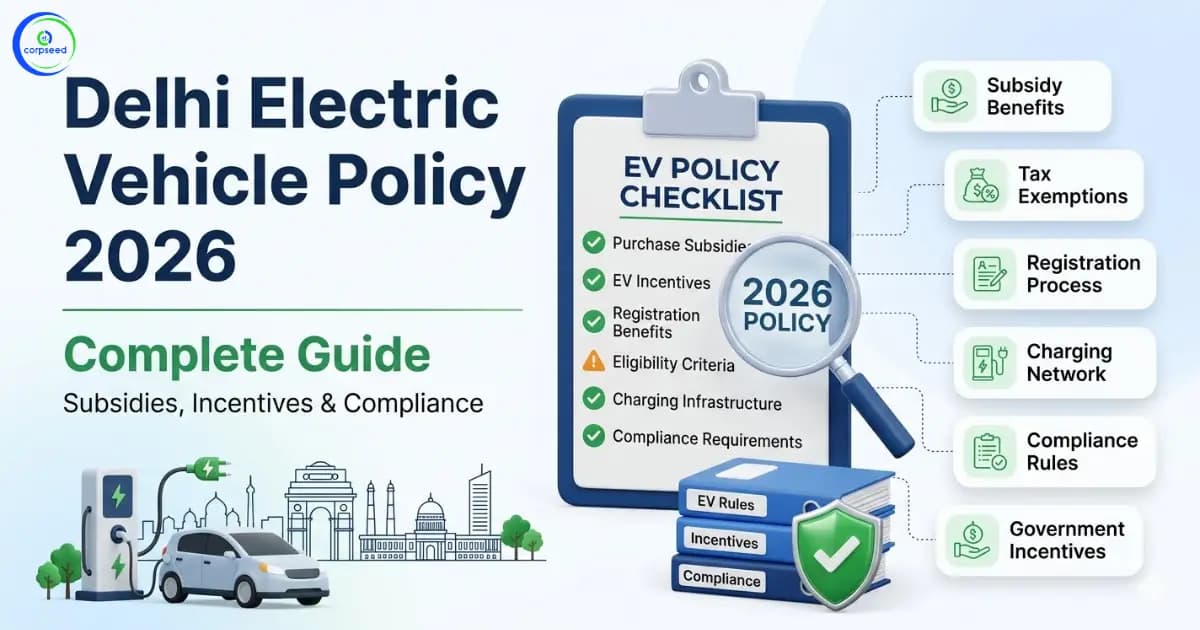
The Delhi Electric Vehicle Policy 2026 introduces a comprehensive framework to accelerate electric mobility by offering purchase incentives, road tax and registration fee exemptions, scrappage benefits, and major investments in EV charging infrastructure.
Schedule a Call Back
Introduction
India is witnessing an EV revolution, with Delhi taking charge at the forefront. Pollution in winters has been choking Delhi for years, and emissions from vehicles have emerged as one of the biggest reasons for the deteriorating air quality index in the city. The Delhi Electric Vehicle Policy 2026, or EV Policy 2.0, will come into force from July 1, 2026.
The four-year plan is set to expire by March 31, 2030. Short-term solutions will be substituted by a systematic approach towards offering subsidies on purchases, abolishing incentives, tax exemptions, and mandatory dates for electrification. The new policy not only offers a guide but is obligatory for all business operators, financiers, and other relevant parties in Delhi.
What is the Delhi Electric Vehicle Policy 2026?
The Delhi Electric Vehicle Policy 2026 is an instrument that aims to ensure the growth of the adoption of electric vehicles, increase charging facilities, and promote phased electrification requirements from 2026 to 2030 in the National Capital Territory.
Notified by the Lieutenant Governor of Delhi under Section 67(3) of the Motor Vehicles Act, 1988, the policy draws constitutional backing from Article 21's right to a clean environment. It also responds directly to a Commission for Air Quality Management (CAQM) report, which found vehicles responsible for 23% of Delhi NCR's winter air pollution.
Here's what defines the Delhi EV Policy 2026 at its core:
- Legal foundation: Motor Vehicles Act 1988 and Environment Protection Act 1986
- Priority segments: Two-wheelers (67% of the total vehicle population in Delhi), three-wheelers, passenger cars, and N1 trucks.
- Core levers: Subsidies for purchase and disposal, tax exemptions, extension of charging facilities, and prohibition of ICE vehicle registration.
- Validity period: July 1, 2026, to March 31, 2030, unless extended or amended by the Delhi Government
Schedule a Call Back
Objectives of the Delhi Electric Vehicle Policy 2026
The policy sets five clear, measurable objectives for its four-year run:
- Facilitate widespread uptake of EVs for all categories of vehicles, including two-wheelers and goods transport vehicles.
- Develop a network of EV charging stations throughout all of Delhi.
- Ensure an efficient supply chain of EVs by establishing a battery recycling, maintenance, and component collection system.
- Minimize reliance on internal combustion engine (ICE) vehicles to reduce air pollution in cities.
- Ensure financial and paperless execution of the plan through digital mechanisms.
Key Highlights of the Delhi EV Policy 2026
Here are the standout provisions defining this policy cycle:
1. Financial Incentives
- Purchase subsidies for two-wheelers, three-wheeler autos, and N1 goods carriers
- Scrapping incentives for BS-IV and older vehicles across categories
- 100% lifetime road tax and registration fee exemption for eligible EVs
2. Charging & Infrastructure
- Delhi Transco Limited (DTL) is designated as the nodal agency for public charging and battery swapping.
- Single-window clearance for charge point and swapping station operators
- Mandatory EV-charging-readiness for new government civil infrastructure projects
3. Compliance Mandates
- Electric-only registration for three-wheelers (L5) and N1 goods carriers from January 1, 2027
- Electric-only two-wheeler registration from April 1, 2028
- Fleet aggregator restrictions on new ICE vehicle induction from January 1, 2026
4. Institutional Backing
- A dedicated EV Fund maintained under the Transport Department
- A Delhi EV Apex Committee chaired by the Minister (Transport) overseeing implementation
Eligible Vehicle Categories Under the Delhi EV Policy 2026
Here is a breakdown of the vehicle categories covered and the type of support each one qualifies for.
| Vehicle Category | Incentive Type Available | Key Eligibility Condition |
| Electric Two-Wheelers | Purchase incentive + scrapping incentive | Ex-showroom price ≤ ₹2.25 lakh |
| Electric Three-Wheeler Auto (L5M) | Purchase incentive + scrapping incentive | Minimum 4 kWh battery capacity |
| Electric N1 Goods Carriers | Purchase incentive + scrapping incentive | Incentive tiered by gross vehicle weight (GVW) |
| Electric Cars (Non-Transport) | Scraping incentive only | Ex-showroom price ≤ ₹30 lakh |
| Electric N2 Trucks (Private) | No-entry timing exemption | Limited to the first 1,000 registered trucks |
| Gramin Sewa Vehicles | Scrapping incentive | Li-ion or advanced battery technology required |
| School Buses (all types) | Compliance mandate, no direct subsidy | 10%-30% fleet electrification by 2030 |
| Government & DTC Fleet | Mandatory electrification | Applies to new buses, N1/N2/N3 trucks, M2/M3 vehicles |
Purchase Subsidies and Financial Incentives in the Delhi EV Policy
Here is the complete, year-wise incentive structure across every eligible vehicle category.
| Category | Year 1 Incentive | Year 2 Incentive | Year 3 Incentive | Scrapping Incentive |
| Two-Wheelers | ₹10,000/kWh, up to ₹30,000 | ₹6,600/kWh, up to ₹20,000 | ₹3,300/kWh, up to ₹10,000 | ₹10,000 |
| Three-Wheeler Auto (L5M) | ₹50,000 | ₹40,000 | ₹30,000 | ₹25,000 |
| N1 Goods Carrier (>1.75T GVW) | ₹1,00,000 | ₹75,000 | ₹50,000 | ₹50,000 |
| N1 Goods Carrier (≤1.75T GVW) | ₹50,000 | ₹37,500 | ₹25,000 | ₹50,000 |
| Electric Car (Non-Transport) | Not applicable | Not applicable | Not applicable | ₹1,00,000 (capped at first 1,00,000 applicants) |
| Gramin Sewa Vehicle | Not applicable | Not applicable | Not applicable | ₹15,000 |
Key financial terms apply uniformly across categories:
- All incentives are disbursed via Direct Benefit Transfer (DBT) directly to the buyer's account.
- The vehicle must be purchased and registered in Delhi to qualify.
- Only EV models empanelled by the Model Approval Committee are eligible.
- A vehicle availing a purchase incentive cannot be transferred or re-registered outside Delhi for three years from the notification date.
- Scrapping incentives require the purchase of the new EV within six months of the Certificate of Deposit (CoD) issuance.
EV Charging Infrastructure Under the Policy
The policy treats charging infrastructure as a parallel priority to purchase incentives, with clearly assigned institutional roles.
- Nodal agency: Delhi Transco Limited (DTL), operating through the Power Department, plans, coordinates, and monitors all public charging and battery-swapping infrastructure across Delhi.
- Single-window clearance: DTL will run a dedicated facility for charge point and battery swapping operators, enabling faster approvals and expedited electricity connections.
- OEM dealership mandate: Every OEM operating in Delhi must ensure at least one public charging station per dealership, with a minimum of three charging points for two/three-wheelers and two points for four-wheelers.
- Demand Aggregation and Planning: DTL will aggregate demand for charging, suggested sites, and loading capacity needs among all departments to allow for systems-level phase-by-phase installation.
- Standard Operating Procedures: DTL will inform about SOPs regarding technical standards, approval timeframes, performance measures, and mechanisms for charging and swapping stations.
- Digital portal: There shall be a digital portal designed in conjunction with PM E-DRIVE or any other system specific to Delhi that will facilitate site onboard, approval, monitoring, and reporting.
- Community & private charging: RWAs, group housing societies, and other private parties are encouraged to install semi-public/private chargers within residential properties.
- Grid readiness: DISCOMs can look into Time-of-Day (ToD) Tariffs and differential pricing through the DERC to cut down on charging costs.
- Institutional structure: The High Powered Committee, which the Chief Secretary heads, GNCTD, will facilitate coordination among Transport, Power, Planning, Environment, Finance, DTL, and DISCOM.
Eligibility Criteria for Availing Incentives
Applicants must satisfy several conditions before claiming any subsidy under this policy.
1. Residency and Registration Requirements
- The applicant must be a resident individual, proprietary firm, agency, or company based in the NCT of Delhi.
- The vehicle must be both purchased and registered within Delhi to qualify for any incentive.
2. Vehicle Model Requirements
- Only vehicle models empanelled by the Model Approval Committee under the Transport Department are eligible.
- The committee verifies technical specifications, pricing, and other conditions before approval.
3. Price and Specification Thresholds
- Two-wheelers must have an ex-showroom price at or below ₹2.25 lakh
- Electric cars claiming scrapping incentives must be priced at or below ₹30 lakh ex-showroom
- Three-wheeler autos need a minimum battery capacity of 4 kWh to qualify
4. Scraping-Specific Conditions
- The new EV purchase must occur within six months of the Certificate of Deposit (CoD) issuance from an authorised scrapping facility.
- The old vehicle scrapped must be BS-IV or below and registered in Delhi.
- Scrapping incentives apply only to the registered owner of the scrapped vehicle.
How to Apply for Delhi EV Subsidies
The entire application journey runs through a paperless, digital-first process.
- Purchase and Register: Buy the eligible, empanelled EV model and complete registration within the NCT of Delhi.
- Submit the Purchase Incentive Application: File the application within 30 days of the Registration Certificate (RC) generation through the digital portal notified by the Transport Department.
- Verification: Eligibility, documentation, and compliance with price and specifications thresholds will be verified by the Transport Department.
- Subsidy Release: After verification of the eligibility criteria, the amount of subsidy is released within 60 days from the date of application submission through the DBT process.
- Scrapping Incentive Claims: The Certificate of Deposit, along with proof of purchase of a new EV, is to be submitted within six months of issuance of the certificate of deposit, through the notified mechanism.
- Online Track of Applications: All approvals, verifications, releases, and grievance redressal are done online without the need for physical documents.
Compliance Requirements Under the Delhi EV Policy 2026
Various parties have separate and time-bound obligations regarding compliance with this policy.
For OEMs
- Provide adequate and timely EV supply for all eligible vehicle categories
- Set up at least one charging point per dealership, following the minimum charging point standards
- Comply completely with the Battery Waste Management Rules 2022, particularly the EPR requirements
- Provide periodic EPR compliance and battery traceability reports to DPCC
For Fleet Aggregators and Delivery Providers
- No new ICE-only 4-wheeler LCVs, LGVs (N1 up to 3.5 tons), or two-wheelers can be inducted from January 1, 2026
- BS-VI two-wheelers get a limited induction window until December 31, 2026
- All other provisions of the existing Delhi Motor Vehicle Aggregator Scheme (2023) continue to apply
- For School Operators
- Achieve 10% electric fleet share by the end of year 2 from notification
- Reach 20% by the end of year 3, and 30% by March 31, 2030
- The mandate applies to owned, leased, and hired buses alike
For Registration Categories
- Only electric three-wheelers (L5) and N1 goods carriers can register new vehicles from January 1, 2027
- Only electric two-wheelers can register new from April 1, 2028
- Four-wheeler electrification mandates are planned but not yet enforced
- For Government and Institutional Fleets
- All new DTC intra-state buses must be electric from the notification date
- All N1/N2/N3 trucks and M2/M3 vehicles purchased, leased, or hired by GNCTD bodies must be electric
- Hired or leased non-transport, light passenger vehicles must be electric wherever feasible
Challenges and Implementation Considerations
Delivering this policy at scale brings several operational hurdles worth tracking closely.
- Issues relating to Grid capacity constraints: An increase in EV charging demand can put pressure on DISCOM infrastructure in the absence of proper load planning and ESS at the depot.
- Model empanelment delays: A sluggish model empanelment process can delay subsidy claims by customers and dealers.
- Coordination issues: Coordination among DTL, DISCOMs, District Magistrates, and land-owning authorities is essential for setting up charging stations.
- Problems associated with Monitoring compliance: Monitoring of compliance in decentralised aggregators, private institutions, and RWAs is difficult.
- Funding predictability: The EV Fund depends partly on PM E-DRIVE allocations and state budgets, which can fluctuate year to year.
- Affordability pressure on OEMs: Manufacturers must stabilise EV pricing even as raw material and battery costs shift globally.
- Infrastructure gaps for battery recycling: The battery collection centers based on the PPP model need to be rolled out more quickly to ensure compliance with EPR regulations and traceability criteria.
- Bans on ICE vehicle registration: Prohibition of registering ICE-powered three-wheelers and N1 carriers by 2027 requires iron-clad online registration controls.
Impact of the Delhi EV Policy on Businesses
Here is what this policy means for businesses operating in certain categories.
- The logistics industry should hasten the process of switching to N1 fleets prior to 2027 registration restrictions.
- Automobile dealers need upfront charging infrastructure investment to stay compliant with OEM dealership norms.
- Fleet aggregators face immediate restrictions on ICE vehicle induction starting January 1, 2026
- Battery recycling and swapping MSMEs get an officially sanctioned runway for growth through collection centers facilitated by DPCC.
- Fleets benefit from road tax exemptions, but need to budget their purchases based on price-cap regulations.
- School transport companies need to have capital plans for meeting their phase-wise electrification targets by 2030
- Charging infrastructure players can enter the market faster through single-window clearance and demand aggregation from DTL.
- Real estate developers have a new incentive to integrate EV-ready charging capacity into upcoming residential and commercial projects.
Conclusion
Delhi Electric Vehicle Policy 2026 moves the city away from incentive schemes to compulsory electric vehicle (EV) policies. The policy, which runs until 31st March 2030, involves purchase subsidies, scrapping incentives, and lifelong tax exemptions for ICEs, along with the phased banning of two-wheelers, three-wheelers, and N1 vehicles.
The economics of moving to an electric option have become much more compelling for individual consumers. For logistics providers, OEMs, and charging infrastructure providers, the compliance deadline has begun ticking down to 2027 and 2028. Those who are able to act early in the areas of model empanelment, dealership charging facilities, and electric vehicle fleets will benefit the most in the period ahead of stricter enforcement.
About the Author

Mahek Sancheti
Content WriterMahek Sancheti, BAJMC graduate with a deep passion for writing. As a content writer, video content creator, creative content creator, and scriptwriter, I bring stories to life through words and visuals. I honed my skills by working with a prominent news agency, where I excelled in crafting compelling narratives and engaging content. Coming from a journalism and mass communication background I have skills to craft engaging narratives that captivate audiences. With a keen interest in writing and creativity, I aim to deliver impactful and meaningful content that resonates with diverse audiences.
https://www.linkedin.com/in/mahek-sancheti-837196212
Related articles
Compliance Checklist for Manufacturing Businesses in India
2026-08-24

Why Should You Invest in Hydrometallurgy for High Purity Recovery in Lithium Battery Recycling?
2026-08-21
Is a Lithium Battery Recycling Plant Profitable with 2026 Metal Price Volatility?
2026-05-04
Does Your Solar Waste Storage Actually Meet the New CPCB Guidelines of 2026?
2026-03-19

How to Apply for PCI Registration in Telangana
2025-12-23
MNRE Guidelines for Storage Battery Testing for Solar Systems
2025-10-03