9311255283
×

Welcome to Corpseed. Please type your query, and we shall provide immediate assistance.

×

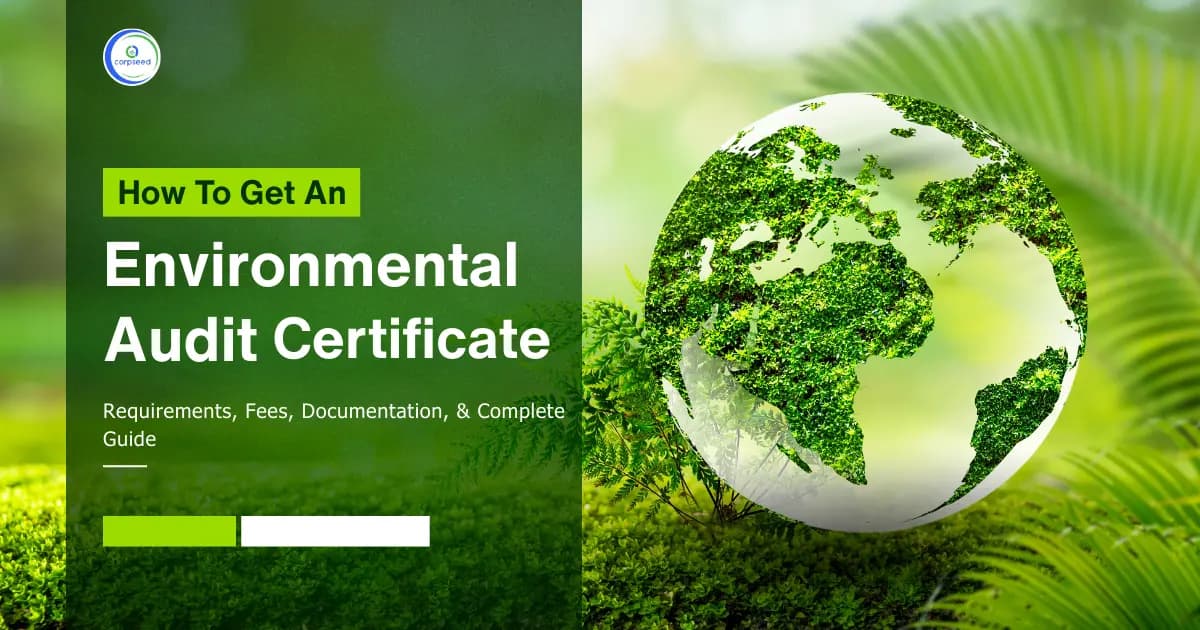
How To Get An Environmental Audit Certificate: Requirements, Fees, Documentation, & Complete Guide

How_To_Get_An_Environmental_Audit_Certificate_Corpseed.webp
Last updated : 2026-01-05

One of the most significant reforms in India’s environmental compliance framework is the Environment Audit Rules, 2025, which was passed on 29th August 2025, by the Ministry of Environment, Forest, and Climate Change (MoEFCC). India has introduced a structured and certified ecological auditing system. It ensures that industries, infrastructure projects, and other entities that strictly follow environmental safeguards under laws like the Environment (Protection)Act, Water Act, Air Act, Forest (Conservation) Act, 1980, and the Wildlife Protection Act, 1972.
This reform boosts accountability and creates new careers as Certified/ Registered Environmental Auditors (REAs), who will serve as the government’s extended arm to enforce pollution prevention, ensure legal compliance, and drive sustainable growth through systematic, expert-led environmental checks.

What Is An Environmental Audit?

An environmental audit is a comprehensive review of your company’s operations to check if they comply with the laws and standards related to the environment. It reviews your processes, records, and facilities to ensure you’re meeting legal requirements and following sound environmental practices. An ecological audit acts like a performance check. Where the process of improvement is needed, auditors have to identify risks, gaps, and areas. It also helps organisations to reduce environmental impact, avoid penalties, and improve overall sustainability.

--------------Blog Contact Form-------------

Why Environmental Auditors Are Important

Before discussing the career pathway, it is essential to understand why these auditors matter:

  • Bridging regulatory gaps: Making it difficult to monitor thousands of industries, State Pollution Control Boards (SPCBs), and the Central Pollution Control Board (CPCB) face workforce and resource shortages. Auditors help bridge this gap.
  • Strengthening compliance: Independent third-party audits improve credibility and reduce the chances of false reporting by industries.
  • Transparency in governance: Auditors have to prevent conflicts of interest, ensuring unbiased assessments.
  • Supporting emerging frameworks: Auditors will play a vital role in schemes like the Green Credit Programme, Eco-mark Certification, EPR for waste management, and ESG ratings.
  • Data-driven policy making: Regular audits will generate reliable environmental data for regulators, industries, and the public.

Different Kinds Of Environmental Audits

The main objective of the companies is to carry out audits to assess their environmental practices and ensure adherence to rules and regulations. There are three types of ecological audits, which are given below-

  • Environmental Management Systems Audit: The primary focus of this audit is to evaluate an organization’s environmental management system and determine its efficacy in meeting goals. It involves various systems such as examining policies, procedures, training initiatives, and documentation concerning management. 
  • Compliance Audit: The second most crucial audit is the compliance audit. Its primary function is to confirm whether an organization complies with the rules and regulations and permits. It also has the authority to review all the operations, practices, and records of the companies for the purpose of verifying compliance with obligations.
  • Risk-Based Audit: This audit is to evaluate the risks of an organization. It also assesses the effectiveness of the strategies related to risk management. It identifies threats, considers the company’s readiness in handling such risks, and suggests measures for mitigation.

Each type of audit has its own role to fulfil, providing insights into a company’s environmental performance. Organizations have the full choice to carry out any of the types of audits according to their needs and regulatory obligations.

Eligibility And Requirements For Organization

These are the following requirements for an organization:-

  • Environmental Management System: If seeking ISO 14001 certification, EMS policies must cover planning, implementation, monitoring, and improvement. It establishes an EMS aligned with ISO 14001 standards.
  • Documentation- Key documents which typically include:
  1. Objectives and Environmental Policy
  2. Legal Compliance registers
  3. Waste and Emissions Records
  4. Reports of Internal Audits
  5. Result of Monitoring and measurement
  6. Management Review records.
  • Audits: There are two kinds of audits, such as internal audits and external audits. The concept of Internal Audits is to evaluate the EMS before external certification. In comparison, an External audit is conducted by a third-party accredited body to verify conformity with ISO or regulatory requirements.
  • Corrective Action: Address non-conformities identified during audits with corrective actions and evidence before certification.

Benefits Of Environmental Compliance Audits

Environmental compliance audits offer advantages for organizations. 

  • Ensuring Legal Compliance by doing regular audits helps organizations identify compliant areas and take necessary steps to fulfill their legal obligations. This proactive approach helps prevent fines, penalties, and legal issues.
  • Identifying Areas for Improvement and Audits offers insights into how an organization manages its practices and points out areas that could use some enhancement. By addressing these areas, organizations can boost their performance. Reduce risks effectively
  • Improving Performance, Audits enable organizations to evaluate their impact and devise strategies to lessen their footprint. Through the adoption of sustainable practices, organizations can play a role in promoting an environment and showcasing their dedication to sustainability.
  • Proactively conducting environmental compliance audits allows organizations to keep abreast of mandates, mitigate risks, and elevate their ecological performance levels.

Phases Of Environmental Audit

Conducting an environmental audit doesn’t have to be complicated. To paint a clearer picture of the process of conducting one within a company. The phases of an environmental audit are the systematic steps followed to assess an organization’s environmental compliance, performance, and risk management. These phases ensure the audit is planned, conducted, and reported effectively.

  • Pre-Audit Phase: This phase is also known as the Planning Phase, which defines the objectives, scope, and criteria. The audit team has to review the environmental laws, standards, permits, and previous audit reports. Audit plan and checklist are prepared, and communication is made with the organization regarding timelines and data requirements.
  • On-Site Audit phase: This phase is also known as the Execution Phase. Auditors are supposed to visit the facility to gather information through site inspections, interviews with staff, and verification of records. Some of the environmental practices, which are related to waste management, air and water emissions, hazardous materials handling, and energy use, are assessed against legal and regulatory requirements.
  • Evaluation and Analysis Phase: The gathered data is analysed to identify non-compliances, environmental risks, and performance gaps, and findings are evaluated against legal and statutory requirements, consent conditions, and environmental management systems. 
  • Audit Reporting Phase: A comprehensive audit report is produced outlining observations, legal gaps, and improvement areas. The report of the environmental audit includes recommendations, corrective actions, and timelines to achieve compliance related to the environment and improved sustainability performance.
  • Post-audit or Follow-up phase: This final phase ensures corrective and preventive actions are implemented. Management reviews progress, verifies compliance status, and closes audit findings. To ensure environmental improvement, follow-up audits may be conducted.

Fees Of Environmental Audit

The fee structure of environmental audit is determined by the specific regulatory bodies, which include the MoEFCC and other State Environment Impact Assessment Authority (SEIAA)/State Pollution Control Boards (SPCs). It can vary based on the project's nature, scope, and scale. 

  • Application and Processing Fees: These are submitted online through the official portal or relevant state portals.
  • Auditor Fees: As per the guidelines provided by some of the states, when a registered environmental auditor is engaged, their fees are set by the relevant authorities or negotiated, with an example range of ₹1,00,000 to ₹1,50,000.

Conclusion

In conclusion, having a certificate of an environmental audit, for an organization’s environmental performance or as a professional auditor, is a structured process that requires adherence to standards, documentation, audits, and fees. Understanding the requirements and procedures from EMS setup to certification audits or professional accreditation is crucial to success. With the proper preparation and compliance, you can achieve certification that enhances legal compliance, operational sustainability, and professional credibility.

This portion of the site is for informational purposes only. The content is not legal advice. The statements and opinions are the expression of author, not corpseed, and have not been evaluated by corpseed for accuracy, completeness, or changes in the law.

BOOK A FREE CONSULTATION

Get help from an experienced legal adviser. Schedule your consultation at a time that works for you and it's absolutely FREE.

Author

Experienced Digital Marketer with a demonstrated history of working in the Internet industry. He likes to write about the latest technology trends, Skilled in Digital Marketing likes. Search Engine Optimization, SMO...

Learn More >>