9311255283
×

Welcome to Corpseed. Please type your query, and we shall provide immediate assistance.

×

India Secures Duty Concessions for Agricultural, Marine, and MSME Exports

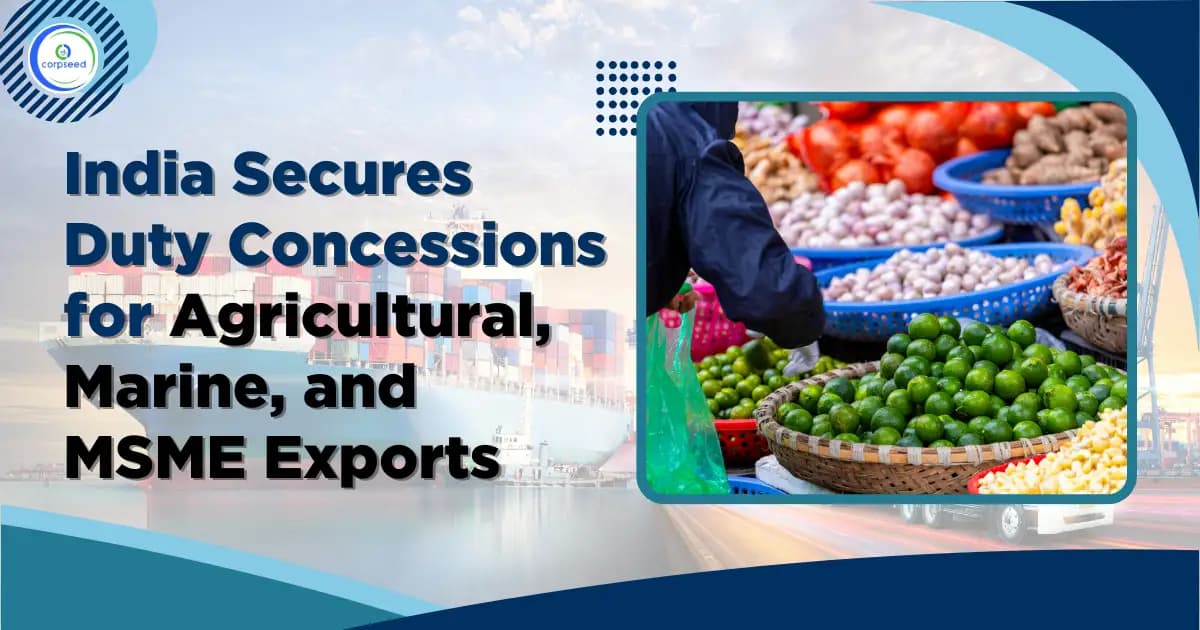
India_Secures_Duty_Concessions_for_Agricultural,_Marine,_and_MSME_Exports_Corpseed.webp

India has taken a major step in global trade. Under the India–EU free trade agreement, Indian agricultural exports will receive duty concessions across several product categories. The Commerce Ministry said the move will enhance price competitiveness and strengthen India’s presence in all 27 EU countries.

The benefits cover major export items such as processed foods, tea, coffee, spices, table grapes, and sheep and lamb meat. Numerous fruit and vegetable products, including gherkins, cucumbers, sweet corn, and dried onions, will also gain preferential market access. These segments form a robust base of India’s agri-export economy.

The agreement balances export growth with domestic protection. Sensitive sectors like dairy, cereals, poultry, soymeal, and selected fruits and vegetables remain protected to prevent pressure on local producers.

Stronger Access, Clearer Rules

A key feature of the India-EU FTA is its emphasis on origin-based eligibility. To claim duty benefits, goods must go through sufficient processing or manufacturing in India. This ensures value addition within the country and supports domestic supply chains.

Product-specific rules (PSRs) set clear criteria for compliance. These rules align with existing production systems and permit limited flexibility in sourcing inputs globally. At the same time, they ensure significant processing takes place in the exporting country, minimizing uncertainty for exporters.

The agreement also introduces self-certification through a statement of origin. This change is expected to minimize paperwork, lower compliance costs, and shorten export timelines, especially for smaller businesses.

Boost for MSMEs and Marine Exports

MSMEs receive targeted support through product quotas for shrimps, prawns, and downstream aluminium goods. This allows them to source certain non-originating inputs without losing preferential access, helping them compete in global value chains.

Marine exports are set to gain significantly. The EU will cut duties of up to 26 per cent on selected marine products. With the EU’s marine import market valued at over Rs 4.67 lakh crore, India’s current export level of Rs 8,715 crore shows strong growth potential.

Exports of shrimp, frozen fish, and value-added seafood are expected to rise, benefiting coastal communities in Andhra Pradesh, Gujarat, and Kerala, where livelihoods depend heavily on the sector.

Conclusion

The India-EU FTA reshapes export opportunities by blending duty relief with smarter rules. With simpler compliance, MSME support, and wider market access, Indian exporters are better placed to grow sustainably in Europe.

This portion of the site is for informational purposes only. The content is not legal advice. The statements and opinions are the expression of author, not corpseed, and have not been evaluated by corpseed for accuracy, completeness, or changes in the law.

5431804048Parul_Bohral_Corpseed.jpg

Parul Bohral, a BALLB graduate and experienced legal researcher and content writer with expertise in various legal areas, including corporate law and intellectual property. I have gained valuable experience in esteemed legal environments, where...

Learn More >>