9311255283
×

Welcome to Corpseed. Please type your query, and we shall provide immediate assistance.

×

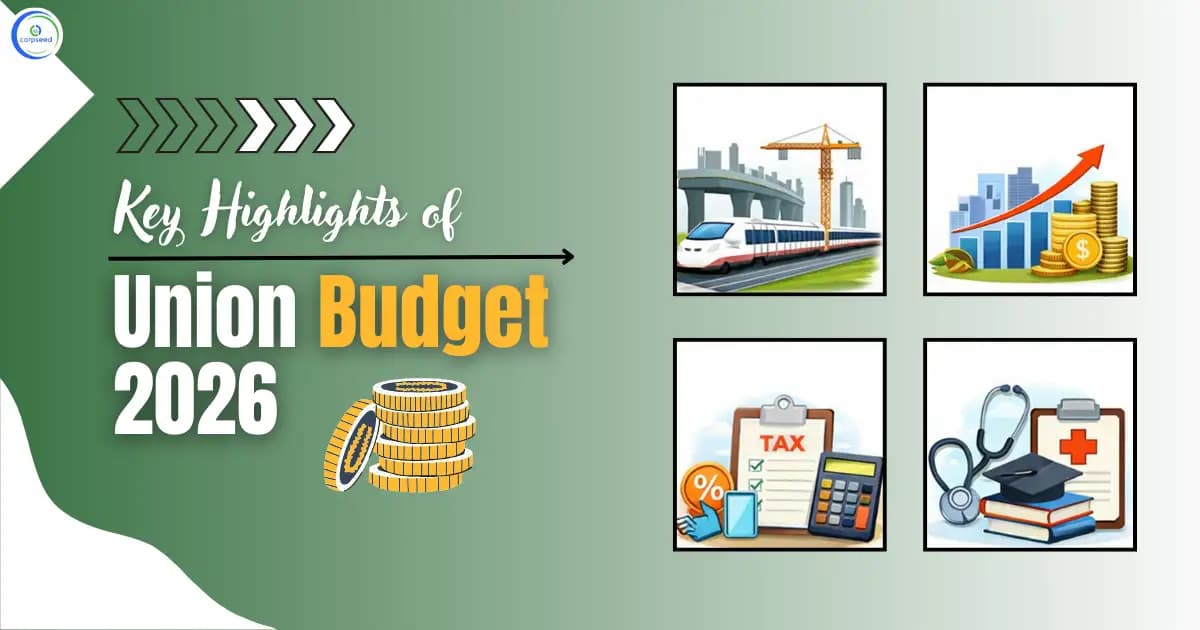
Key Highlights of Union Budget 2026

Key_Highlights_of_union_budget_2026_corpseed.webp
Last updated : 2026-02-02

Union Budget 2026 comes at a time when policy expectations are evident and realistic. Citizens desire stability, businesses desire predictability, and the economy requires a steady momentum. This budget aims at balancing between growth and responsibility so that development can be extended to larger parts of the society and that long-term fiscal discipline is always within the sight. Rather than radical changes, the focus is on continuity, reforms, and interventions that can be used to boost confidence within sectors.

Overview of Union Budget 2026

Union Budget 2026 signifies the effort by the government to match the economic growth with the real-life issues of households and businesses. The budget is inspired by three main kartavyas and is also highly focused on fiscal prudence.

First, the budget focuses on maintaining economic growth by capital investment, infrastructure development, and manufacturing support, which will provide long-term momentum in all sectors.

Second, it aims at enhancing compliance and inclusion through simplification of regulations, enhancing support to MSMEs and startups, and increasing access to finance and digital systems.

Third, the budget focuses on job creation and future readiness by expanding digitally, green growth, skills development, and technological advancement.

Instead of showing separate announcements, the budget is based on a linked strategy in which infrastructure investments are used to promote manufacturing, digital growth is used to enhance service delivery, and sustainability is used to inform future development. In general, Union Budget 2026 is a facilitator, which seeks to eliminate bottlenecks and enable economic activity to grow organically across the economy.

--------------Blog Contact Form-------------

Key Tax and Compliance Changes for Individuals and Businesses

The tax and compliance proposals in Union Budget 2026 are designed with one major key responsibility, i.e. to make the system more user-friendly. It is not about changes in the headlines but rather about making the taxpayers and businesses less frictional. Key highlights include:

  • Simplification of tax procedures: The budget continues efforts to simplify the process of tax filing and assessment and making the procedures less complex, and encouraging people and small businesses more willing to comply voluntarily.
  • Compliance relief for small and mid-sized enterprises: MSMEs also have an added advantage of rationalised compliance requirements, which enable them to concentrate more on operations and growth and less on regulatory paperwork.
  • Greater clarity in tax administration: Policies focused at enhancing the transparency in assessments and dispute management help develop trust between taxpayers and the government while minimizing prolonged litigation.
  • Encouragement for formalisation: Policy nudges keep drawing more businesses into the formal economy by providing convenience, predictability and long-term payoffs instead of enforcing compliance.
  • Stable tax framework for businesses: By avoiding sudden changes, the budget reinforces certainty, enabling companies to plan investments and expansion with greater confidence.

Major Growth Push: MSMEs, Infrastructure, and Manufacturing

One of the key kartavyas of the Union Budget 2026 is the maintenance of the economic growth with productive investment. This is addressed through empowering MSMEs, boosting infrastructure development, and facilitating domestic manufacturing.

The budget does not separate the areas but treats them as integrated issues because they have a combined effect on the employment and supply chains. Key focus areas include:

  • Stronger Support for MSMEs: Policy measures aim to enhance access to credit, minimize operational barriers, and incorporate smaller businesses into larger value chains in sectors.
  • Continued Infrastructure Investment: Capital expenditure is one of the priorities, and it is used to facilitate transport, logistics, and urban development to reduce costs and enhance economic efficiency.
  • Boost to Manufacturing Competitiveness: The manufacturing sector is supported by policy stability, infrastructure availability, and incentives that promote scale, efficiency, and adoption of technology.
  • Supply Chain Resilience: Focuses on national capacity-building minimizes reliance on imports and boosts India’s position as a global manufacturing hub.
  • Regional Development Balance: Infrastructure and industrial initiatives are structured to enhance growth outside the major cities, to create a more balanced economic growth.

Digital Economy, Green Growth, and Employment Focus

The other fundamental duty that is exhibited in the budget is the preparation of the economy for the future. Union Budget 2026 puts the digital transformation, sustainability, and creation of employment at the centre of long-term planning.

The budget does not address these as distinct themes, but incorporates them into the overall economic policy. 

  • Expansion of the Digital Economy: Continued investment in digital public infrastructure enhances service delivery, financial inclusion, and access to government platforms by citizens and businesses.
  • Support for Green Growth Initiatives: Sustainable policies promote cleaner production, better utilization of resources, and slowing down the shift to low-carbon economic models.
  • Employment-linked Growth Strategies: Infrastructure, manufacturing, and services-based growth are consistent with job creation, especially among the youth and skilled workers.
  • Skill Development Alignment: Higher focus on skilling will make sure that workforce competencies are aligned with the new industry demands in terms of technology and manufacturing.
  • Innovation-driven Ecosystems: Startups and technology-based businesses have the advantage from an ecosystem that promotes innovation while ensuring responsible development.

Fiscal Outlook and Government Spending Priorities

Maintaining fiscal discipline is also one of the primary tasks under Union Budget 2026. The government balances the expenditure on development and manages deficits and revenue expectations with great care.

The budget is an indication of a deliberate attempt to channel expenditure into productive areas as opposed to consumption-oriented policies that are short-term in nature. Capital expenditure continues to receive attention due to its multiplier effect on growth and employment.

Meanwhile, revenue mobilisation aims on enhancing efficiency and not raising the tax burden. This approach is supported by better compliance, digitisation, and system-driven administration. Overall, the fiscal perspective is expected to maintain macroeconomic stability while leaving room for future policy flexibility.

Conclusion: Key Takeaways from Union Budget 2026

Union Budget 2026 can be interpreted in three distinct kartavyas, which are empowering growth, ensuring inclusion, and future preparedness. The budget is dedicated to consistency, clarity, and execution, rather than radical policy changes. It supports businesses by reducing friction, strengthens the economy through infrastructure and manufacturing, and invests in digital and sustainable ways for long-term resilience.

The budget 2026 is intended to provide an environment in which people are able to plan with confidence, businesses are able to develop with less hindrances, and the economy can grow responsibly. By doing so, Union Budget 2026 strengthens the significance to have gradual reforms instead of abrupt ones.

This portion of the site is for informational purposes only. The content is not legal advice. The statements and opinions are the expression of author, not corpseed, and have not been evaluated by corpseed for accuracy, completeness, or changes in the law.

BOOK A FREE CONSULTATION

Get help from an experienced legal adviser. Schedule your consultation at a time that works for you and it's absolutely FREE.

Author

Parul Bohral, a BALLB graduate and experienced legal researcher and content writer with expertise in various legal areas, including corporate law and intellectual property. I have gained valuable experience in esteemed legal environments, where...

Learn More >>