
DGFT Removes Physical Duty Payment Challans for EODC Applications under AA and EPCG
DGFT removes physical duty challans for EODC applications under AA and EPCG from 1 August 2026. Understand the new digital verification process with expert guidance.
Schedule a Call Back
300+ import-export and DGFT assignments since 2018
Clients include Advantech Industrial Computing India, Smiths Detection Systems, Areca Embedded Systems, Motorola Solutions India, Trinity Mobile APP Lab, Motorica India, Glocal Healthcare Systems, Tablets (India)Limited, Auroras TEA Company, Surabhi Aqua Minerals, Solankili Logistics Management, ATG Freight India (12 of 250+ served since 2018).
A few more clients we've served in this industryHide the list
- Electronics and technology
- Advantech Industrial Computing India · Smiths Detection Systems · Areca Embedded Systems · Motorola Solutions India · Trinity Mobile APP Lab
- Pharma and healthcare
- Motorica India · Glocal Healthcare Systems · Tablets (India)Limited
- Food and consumer goods
- Auroras TEA Company · Surabhi Aqua Minerals
- Logistics and trade
- Solankili Logistics Management · ATG Freight India
- Jewellery
- Janki Jewellers · Viindhya Bullion
- More clients
- Esskay Compuservices · Welgrow Technologies · Ample Technologies · Aprodite Infotech · Floroma Infinity · Moonlight Technology · NJ Power · Ample Digital · Augustdevices India · Automap Software and Technologies · SNS Metpro Industries · Webmeditech Healthcare · Anagh Traders · Meritech India · Zipped Solutions · Metanovo Health · Kapemai Lifestyle · Zexcorp Services · Agricapita Innotech · Meticulous Networks · Nexavarge · Arng · D13 Business Ventures · Datalux Systems India
Introduction
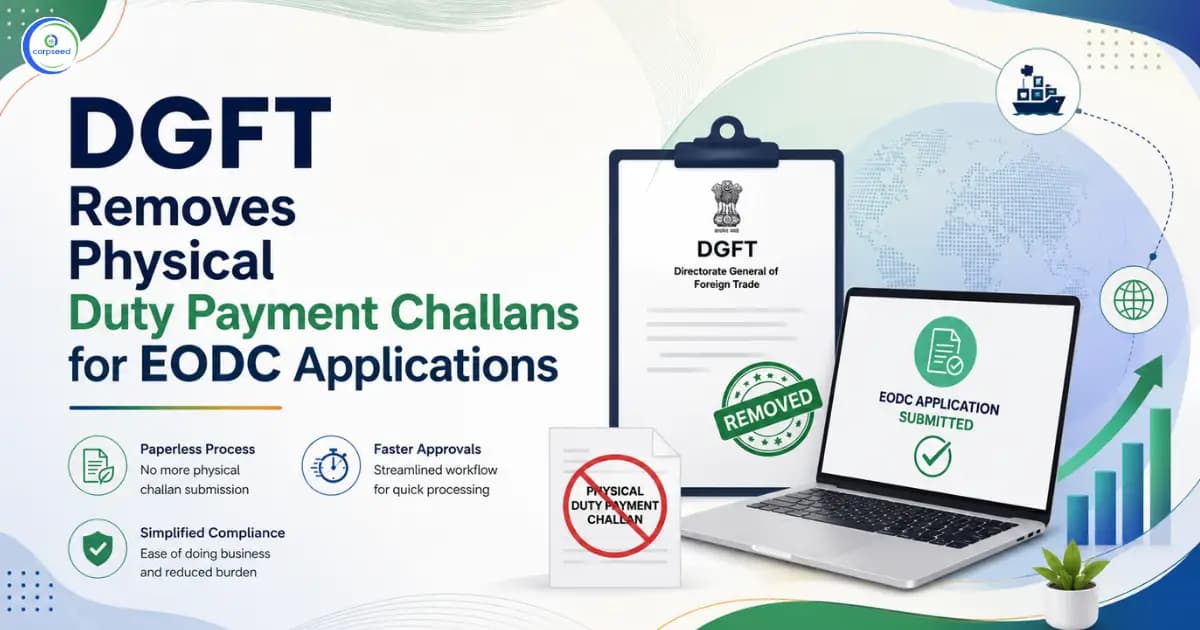
The Directorate General of Foreign Trade (DGFT) has introduced a digital change in the Export Obligation Discharge Certificate (EODC) process under the Advance Authorisation Scheme and EPCG Scheme.
From 1 August 2026, exporters making voluntary duty payments will no longer need to attach the physical duty payment challan when filing an EODC application. DGFT has now connected its system with Customs through ICEGATE, so the payment details can be picked up and checked digitally.
The change comes under DGFT Trade Notice 15/2026-27 dated 5 August 2026. Exporters can log in to the DGFT Customer Portal and check whether their payment has been picked up against the right authorisation. The Regional Authority will also be able to see the same payment details in its DGFT Back Office. This means exporters can check the payment record before filing instead of relying on a physical challan.
This is an important Ease of Doing Business measure because it replaces a manual proof-of-payment step with digital verification.
Notification at a Glance
| Particular | Verified details |
| Issuing authority | Directorate General of Foreign Trade (DGFT), Department of Commerce |
| Document | Trade Notice |
| Trade Notice number | 15/2026-27 |
| Date of issue | 5 August 2026 |
| Main schemes covered | Advance Authorisation and EPCG |
| Process covered | EODC application and authorisation closure |
| Key change | Physical duty payment challan requirement removed for eligible voluntary payments |
| Applicable payment date | Voluntary duty payments made on or after 1 August 2026 |
| Digital integration | ICEGATE-DGFT API integration |
| Exporter interface | DGFT Customer Portal |
| Regional Authority interface | DGFT Back Office |
| Regional Authority interface | Authenticated Customs payment records |
| Main objective | Reduce paperwork and manual verification |
| Expected benefit | Faster processing, fewer queries and lower compliance burden |
The notification changes the method of payment verification. It does not remove the underlying duty, interest or export obligation requirements attached to the authorisation.
What Changed in the EODC Process?
The DGFT EODC physical challan removal primarily affects how exporters prove voluntary duty payments during authorisation closure.
Earlier, an exporter making a voluntary duty payment for regularisation had to provide the relevant duty payment challan as part of the EODC documentation. The Regional Authority would then manually verify the payment particulars.
The new system allows DGFT to receive the authenticated payment record electronically from Customs.
| Compliance area | Business impact |
| Duty payment evidence | Less paperwork |
| Payment data | Reduced manual handling |
| Payment verification | Faster checking |
| Exporter access | Better visibility |
| RA access | Easier verification |
| Data exchange | Better system connectivity |
| EODC closure | Lower compliance burden |
The key change is simple: eligible exporters can complete an EODC application without submitting the physical duty payment challan for covered voluntary payments.
How the ICEGATE-DGFT Integration Works
The ICEGATE DGFT integration allows payment information generated through the Customs system to be transmitted electronically to DGFT.
The broad process works as follows:
Voluntary duty payment - Customs/ICEGATE record - API-based data exchange - DGFT system - Authorisation mapping - Exporter verification - EODC application
The exporter can view the authenticated payment information on the DGFT Customer Portal before filing.
At the same time, the DGFT Back Office makes the same payment record available to Regional Authorities for verification.
This reduces the need for the exporter and Regional Authority to compare a physical challan with the authorisation records manually.
What Is the Impact on Advance Authorisation EODC?
The Advance Authorisation Scheme permits the duty-free import of eligible inputs intended for use in the export product, subject to the applicable conditions and export obligation.
Once the exporter completes the required export obligation, the authorisation can move towards closure.
However, where the exporter has not fulfilled the obligation fully or needs to regularise a duty liability, applicable customs duty and interest may have to be paid.
The new process makes the payment-verification stage easier.
For Advance Authorisation EODC, exporters should now focus on ensuring that the payment is correctly reflected against the relevant authorisation in the DGFT system.
What remains unchanged?
- Export obligation must still be fulfilled as required.
- Any applicable customs duty must still be paid.
- Applicable interest must still be considered.
- The payment must relate to the correct authorisation.
- Other EODC documents and conditions continue to apply.
- The authorisation is not automatically closed merely because payment information is digitally available.
Therefore, the Advance Authorisation EODC closure process 2026 is becoming more digital, but the substantive compliance requirements remain.
What Is the Impact on EPCG EODC?
The new digital payment verification makes EPCG authorisation closure simpler by reducing physical paperwork and making duty payment records easier to check before filing.
- No physical challan for eligible payments: Exporters do not need to submit physical duty payment challans for voluntary payments covered by the new facility.
- Digital payment verification: The relevant payment details can be checked through the DGFT system instead of relying on physical documents for verification.
- Export obligation still matters: EPCG holders must fulfil the prescribed export obligation and comply with the conditions attached to their authorisation.
- Duty and interest still apply: If an export obligation shortfall creates a duty liability, the applicable customs duty and interest still need to be paid.
- Easier closure tracking: Businesses handling several EPCG authorisations can use the digital payment record to keep track of individual payments while preparing for EPCG EODC closure process 2026.
Voluntary Duty Payment Verification through DGFT
The new process places greater importance on checking the payment record before submitting the EODC application. Exporters should not assume that a successful payment automatically means that the EODC file is ready.
The payment should be correctly reflected and mapped to the concerned authorisation.
| Checkpoint | What to verify |
| Authorisation | Correct AA or EPCG authorisation number |
| Payment | Correct payment amount |
| Duty | Applicable duty liability properly accounted for |
| Interest | Applicable interest considered |
| Payment mapping | Payment linked to the relevant authorisation |
| Customs record | Information matches the Customs/ICEGATE record |
| Internal records | Payment matches finance and accounting records |
| EODC application | Details are consistent across the application and supporting records |
This voluntary duty payment verification through DGFT can help identify discrepancies before they result in a query from the Regional Authority.
Does the New Rule Remove Duty Liability?
No. The new DGFT facility only removes the need to submit a physical duty payment challan for eligible voluntary payments. It does not remove the underlying duty or interest liability.
If an exporter has an export obligation shortfall and customs duty becomes payable, the applicable amount must still be paid before the authorisation can be regularised.
Businesses should keep the following distinction in mind:
- Physical challan: No longer required for eligible voluntary payments made on or after 1 August 2026.
- Customs duty: Still payable wherever a duty liability arises.
- Interest: Applicable interest must still be paid wherever required.
- Export obligation: The exporter must continue to meet or regularise the applicable export obligation.
- Duty saved: The duty benefit under the Advance Authorisation or EPCG authorisation is not changed by this procedural reform.
- EODC closure: Removing the challan requirement does not automatically close the authorisation or complete the EODC process.
What Exporters Should Keep in Their Records
Although an EODC without a physical duty payment challan is now possible for covered payments, businesses should continue to maintain a complete compliance file.
The physical submission requirement should not be confused with a record-keeping exemption.
Businesses should retain:
- Advance Authorisation or EPCG authorisation.
- Export obligation calculation.
- Shipping bills and relevant export records.
- Bills of entry and import records.
- Customs duty calculation.
- Voluntary duty payment details.
- Interest calculation and payment details.
- DGFT Customer Portal records.
- Payment references.
- EODC application and acknowledgement.
- Correspondence with DGFT, or Regional Authorities.
- Documents supporting any clarification, or discrepancy resolution.
Maintaining these records can help businesses respond quickly if the authorisation is reviewed later.
What If the Payment Is Not Showing on the DGFT Portal?
Digital integration can reduce manual work, but exporters should still check the payment record before filing.
If a payment does not appear or appears against the wrong authorisation, the exporter should reconcile the payment details with the Customs record and internal accounting records.
| Issue | Recommended action |
| Payment not visible | Check payment reference and Customs record |
| Payment mapped incorrectly | Check payment reference and Customs record |
| Amount mismatch | Reconcile the duty and interest calculation |
| Duplicate entry | Compare DGFT, Customs and internal records |
| Technical issue | Raise the issue through the applicable DGFT/Customs support mechanism |
| EODC filing is pending | Resolve the discrepancy before filing, where practicable |
Businesses should not simply proceed with filing because the physical challan is no longer required. The objective should be to have a correct and traceable digital payment record, before submitting the EODC application.
Compliance Impact on MSME Exporters
The change can be especially useful for MSMEs that manage export compliance without a large in-house regulatory team.
Earlier, the exporter had to collect physical payment evidence and provide it for manual verification. The new digital mechanism reduces this administrative step.
It can potentially reduce:
- Physical documentation.
- Manual payment verification.
- Follow-up on missing challans.
- Repeated submission of payment evidence.
- Data-entry errors.
- Unnecessary correspondence with Regional Authorities.
- Processing friction during authorisation closure.
For MSMEs with several authorisations, an authorisation-wise reconciliation sheet can help keep payment, export obligation and EODC information organised.
What Businesses Should Do Now
Businesses with pending AA or EPCG authorisations should review their closure pipeline rather than treating the new change as only a portal update.
| Priority | Action | Responsible team | Expected outcome |
| High | Identify AA and EPCG authorisations pending closure | Export compliance team | Clear closure pipeline |
| High | Check whether voluntary duty payment is required | Compliance and finance | Correct liability assessment |
| High | Verify payment on DGFT Customer Portal | DGFT team | Correct payment mapping |
| High | Reconcile Customs and internal records | Finance/customs team | Consistent payment trail |
| Medium | Review export obligation fulfilment | Export compliance team | Complete EODC file |
| Medium | Resolve discrepancies | Compliance team | Lower risk of queries |
| Medium | Prepare and file EODC application | Authorised signatory | Closure process initiated |
| Ongoing | Preserve digital records | Compliance team | Closure process initiated |
The immediate priority should be to update internal EODC checklists and remove the outdated requirement of submitting physical challans for payments covered by the new mechanism.
What This Means for DGFT Compliance Teams
Companies should update their internal SOPs for the EODC application 2026 process.
An older checklist may still ask the team to collect and submit physical duty payment challans. That step should be reviewed for covered voluntary payments.
The updated workflow can be:
- Identify the authorisation pending closure.
- Review export obligation fulfilment.
- Determine whether any duty and interest are payable.
- Complete the voluntary duty payment, where applicable.
- Check the payment information on the DGFT Customer Portal.
- Confirm correct authorisation mapping.
- Reconcile the Customs and internal records.
- Prepare the remaining EODC documents.
- File the EODC application.
- Track the Regional Authority's response and preserve the final closure record.
This approach helps businesses use the digital facility without overlooking the wider compliance requirements.
How Corpseed Can Help
EODC closure can involve multiple records across DGFT, Customs, finance and export documentation. Businesses with several authorisations may benefit from professional review before filing.
Corpseed can support businesses with:
- DGFT EODC compliance services for Advance Authorisation and EPCG authorisations.
- EODC filing services and documentation review.
- Advance Authorisation compliance services.
- EPCG compliance services.
- DGFT authorisation closure services.
- Export obligation reconciliation and compliance review.
- Duty and interest payment record review.
- DGFT Customer Portal payment verification.
- Assistance with DGFT queries and deficiencies.
- Review of authorisation-wise closure documentation.
A DGFT compliance consultant can also help businesses identify inconsistencies between export obligation records, Customs data, payment information and the EODC application before submission.
For businesses with complex or multiple authorisations, an export obligation compliance consultant can help structure the closure process and reduce avoidable documentation gaps.
Key Takeaways
DGFT has simplified the EODC process by removing the physical duty payment challan requirement for eligible voluntary duty payments made on or after 1 August 2026.
The change under Trade Notice 15/2026-27 is supported by an ICEGATE DGFT integration that allows authenticated Customs payment records to reach DGFT electronically.
- Physical duty payment challans are no longer required for covered voluntary payments.
- The payment record is transmitted electronically through the API integration between Customs/ICEGATE and DGFT.
- Exporters can check the record through the DGFT Customer Portal.
- DGFT Regional Authorities can access the payment information through the DGFT Back Office.
- The reform supports the government's broader Ease of Doing Business objective.
- The underlying customs duty, interest and export obligation requirements remain applicable.
- Exporters should verify that the payment is correctly mapped before filing the EODC application.
- Businesses should continue maintaining complete authorisation-wise records even when physical challan submission is no longer required.
- The change can reduce paperwork and manual verification, particularly for MSMEs.
- Businesses handling multiple AA or EPCG authorisations should review their internal EODC SOPs and compliance checklists.
Need help with EODC closure under Advance Authorisation or EPCG? Get support with export obligation reconciliation, duty payment verification, documentation and DGFT filing. Book a free consultation with our DGFT compliance experts today.
About the Author

Parul Bohral
Legal Content WriterParul Bohral, a BALLB graduate and experienced legal researcher and content writer with expertise in various legal areas, including corporate law and intellectual property. I have gained valuable experience in esteemed legal environments, where I have strengthened my research skills, allowing me to approach legal writing with precision and depth.
As a legal content writer, I am committed to delivering work that not only informs but also engages readers. By staying informed about the latest trends in content marketing and regulatory developments, I ensure that my writing remains sophisticated and meets industry standards. My dedication to thorough research enables me to craft content that is both insightful and impactful.