
Corporate Mitra Scheme 2026: Complete Guidelines
The Corporate Mitra Scheme is a 1-year government-run training and placement program for graduates aspiring to enter the field of MSME compliance & advisory. In simple terms, it can be understood as a link between graduates with no exposure to the subject matter and MSME entrepreneurs who require a chartered accountant but cannot afford one.
Schedule a Call Back
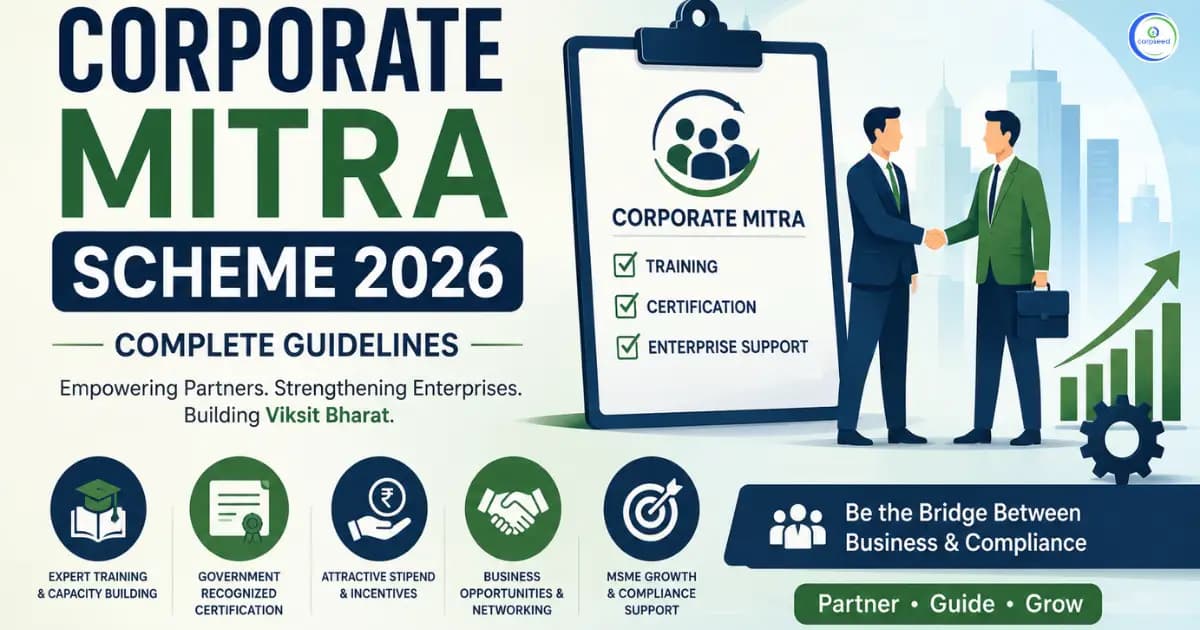
If you are looking for a government scheme that provides actual training, stipend and a career option in the domain of compliance and MSME advisory services, then you must look at the Corporate Mitra Scheme. Introduced in the Union Budget 2026-27 and implemented in detail by the Ministry of Corporate Affairs (MCA) via the guidelines in June 2026, this scheme is designed to address two issues in one - the problem of small business firms being unable to afford professional compliance assistance, and the problem of graduates not being able to get job opportunities that provide them with practical skills training.
In layperson's terms, the Corporate Mitra Scheme is the programme that trains young Indians to become paraprofessionals in helping MSMEs with GST and accounting, as well as secretarial and regulatory compliance. It is not a certification that is issued without any effort required. It includes an online learning process, a six-month paid internship with an actual company and a joint certification issued by ICAI, ICSI and ICoAI, which MCA supervises.
This article explains who can apply, the course format, the cost, the registration procedure on the Swayam Plus website, the stipend, and the certification that will be provided. It will also discuss the impact the scheme will have on the compliance support provided to small businesses in India, particularly in Tier-II and Tier-III cities.
Schedule a Call Back
What is the Corporate Mitra Scheme 2026?
The Corporate Mitra Scheme is a 1-year government-run training and placement program for graduates aspiring to enter the field of MSME compliance & advisory. In simple terms, it can be understood as a link between graduates with no exposure to the subject matter and MSME entrepreneurs who require a chartered accountant but cannot afford one.
The scheme was first announced as part of the Union Budget 2026-27, and the MCA followed up with detailed operational guidelines on June 26, 2026. It is jointly implemented by three of India's leading professional bodies: The Institute of Chartered Accountants of India (ICAI), the Institute of Company Secretaries of India (ICSI), and the Institute of Cost Accountants of India (ICoAI), with the MCA acting as the overall regulator through a Steering Committee.
Every part of the programme, from registration to certification, runs through a single digital gateway: the Swayam Plus portal, the government's large-scale online learning platform that already hosts courses from IITs and other national institutions. Once trained and certified, candidates are called Corporate Mitras, literally "friends of the corporate world", and they are expected to work mainly in smaller cities where professional advisory services are hard to find.
Why Has the Government Introduced the Corporate Mitra Scheme?
Most small business owners in India do not skip GST filings or annual compliance because they do not care. They skip them, delay them, or get them wrong because hiring a qualified CA or CS firm is too expensive for a business earning 50 lakhs to 2 crore rupees in a year. At the same time, thousands of commerce and law graduates pass out every year without the practical, hands-on training that employers actually look for.
The Corporate Mitra Scheme was designed to close both gaps in one move. Instead of creating another generic skilling programme, the government built a scheme with a very specific compliance mandate, training people to handle exactly the kind of work MSMEs need help with, at a price they can afford.
There is definitely a regional dimension to this as well. Compliance and advisory services generally congregate in major urban centers. At the same time, Tier II and Tier III cities remain underserved, even though a large percentage of MSMEs in India are located in those areas. This is where the Mitra initiative seeks to bridge the gap through skill development and placement of Corporate Mitras in such regions.
What Are the Key Objectives of the Corporate Mitra Scheme?
The official guidelines lay out four clear goals behind the scheme:
- Build a skilled paraprofessional workforce that can support MSMEs with regulatory compliance, GST, accounting, cost accounting, secretarial services, and basic corporate governance.
- Improve ease of doing business for small enterprises by giving them affordable, structured professional guidance instead of leaving them to figure out compliance on their own.
- Create real employment for graduates by making them industry-ready and giving them a direct path into MSME-facing roles, rather than handing out a certificate with no job prospects attached.
- Raise the overall quality of paraprofessional advisory work through standardised training content, consistent assessment, and joint certification from three respected professional institutes.
- Notably, the scheme's guidelines make it clear that Corporate Mitra runs independently of every other Central or State internship and skilling scheme. It has its own platform, its own syllabus, and its own certification; it does not overlap with or replace other programmes a candidate might already be part of.
Who is Eligible for the Corporate Mitra Scheme?
Eligibility for the Corporate Mitra Scheme is kept fairly simple on purpose, so that the programme stays accessible to a wide pool of graduates across the country.
| Eligibility Criteria | Requirement |
| Nationality | Must be an Indian citizen |
| Age Limit | 30 years or below, as on the date of application |
| Educational Qualification | Graduate from a recognised university, or a student currently in the final year of graduation |
| Certificate Rule for Final-Year Students | Certificate is issued only after the candidate successfully completes graduation |
A point worth remembering here is the age cut-off date. It is calculated as on the date you submit your application, not the date the course begins or the date your on-the-job training starts. If you are close to turning 31, it is worth applying sooner rather than later.
Final-year students can also register and start the course, but the actual Corporate Mitra certificate is held back until they complete their degree. This keeps the programme fair to everyone while still allowing students to start early instead of waiting an entire extra year.
The Corporate Mitra programme runs for a full 12 months, split neatly into two six-month phases. There is no overlap between the two you finish the academic phase before moving into on-the-job training.
| Phase | Duration | What It Involves |
| Phase 1: Academic Course | Months 1-6 | 144 hours of self-paced online learning + 6 hours of webinars/physical sessions (150 hours total) |
| Phase 2: On-the-Job Training (OJT) | Months 7-12 | Six months of practical training at an ICAI, ICSI, or ICoAI member-in-practice firm |
The academic phase is delivered through the Swayam Plus portal in both English and Hindi, which makes it genuinely accessible to candidates from smaller towns who may be more comfortable learning in Hindi. The course covers regulatory compliance, GST, accounting, financial guidance, cost accounting, and secretarial services essentially the exact toolkit an MSME owner needs help with. The detailed subject-wise syllabus is published separately as an annexure on the Swayam Plus portal and the websites of the three professional institutes, so it is worth checking there before you enrol.
Once the academic phase and its assessments are cleared, candidates move into the OJT phase. Here, you pick a host firm from a list on Swayam Plus, filtered by your preferred city and area of interest, and spend six months working in a real MSME advisory environment.
How to Apply for the Corporate Mitra Scheme?
Corporate Mitra registration is handled entirely online through the Swayam Plus portal. The MCA website and the ICAI, ICSI, and ICoAI websites all redirect candidates to Swayam Plus for the actual sign-up, so there is no separate application form to hunt for elsewhere.
Here is how the process generally works:
1. Check the official listing. Visit the official MCA website, Swayam Plus portal, or your relevant professional institute's website to confirm that the scheme is open for registration and also review the latest instructions.
2. Register on Swayam Plus. Create your profile, fill in your personal and educational details, and upload the required documents (proof of age, nationality, and educational qualification, plus any documents needed for a fee concession).
3. Pay the registration fee. The course fee is paid online through the payment gateway at the time of registration.
4. Get selected and start learning. Once registered under the first-come-first-served process, you get access to the 150-hour online academic course.
5. Choose your OJT firm. After finishing the academic phase, select a host firm from the Swayam Plus list based on location and specialisation.
6. Complete OJT and get certified. After six months of on-the-job training and clearing the overall assessment threshold, you receive the official Corporate Mitra certificate.
However, there is one thing that candidates need to consider: the first set of candidates allowed will be limited to 2,000, of whom 200 will be reserved for candidates from the North East Region. All other 1,800 candidates can apply from any region, but it is purely on a first-come, first-served basis.
What Training, Stipend and Certification Will Candidates Receive?
Once you clear the academic phase, you move into six months of on-the-job training at a firm registered with ICAI, ICSI, or ICoAI as a "member in practice." This is where classroom learning turns into real client-facing work helping small businesses with actual GST filings, bookkeeping, and compliance paperwork.
Unlike most internships, which do not provide payment, this on-the-job training is not unpaid. According to the rules, the host company must pay the trainee some allowance in accordance with the standards set out by the professional organization.
Importantly, this OJT is not unpaid. The guidelines make it mandatory for host firms to pay a stipend, based on the norms set by the relevant professional institute. This is a meaningful shift from the typical unpaid internship model many graduates are used to.
Certification depends on a weighted assessment formula that candidates should understand clearly before they begin:
To earn the Corporate Mitra certificate, you need a minimum aggregate score of 50% across these three components, and you must complete the OJT phase in full. Scoring well academically is not enough on its own a candidate who skips or does not complete OJT will not be certified, no matter how strong their exam performance was. The certificate itself is jointly issued and carries the recognition of ICAI, ICSI, and ICoAI.
How Will the Corporate Mitra Scheme Benefit MSMEs?
For MSMEs, the biggest promise of this scheme is affordable access to trained help. A huge number of small businesses currently rely on untrained local agents for GST filing and basic accounting, simply because a full-service CA or CS firm is out of budget. Corporate Mitras are meant to sit right in that gap, trained to a recognised standard, but priced for a small business, not a large corporation.
Some of the practical benefits MSMEs can expect include:
- Easier access to help with GST filings, statutory returns, and basic bookkeeping.
- Better understanding of compliance deadlines and documentation requirements.
- Support with day-to-day financial record-keeping and cost tracking
- Guidance on secretarial and basic governance matters without hiring a full-time professional.
A local, trained resource, particularly useful for businesses in Tier-II and Tier-III cities where professional firms are scarce.
| Assessment Component | Weightage |
| Module-wise assessments during the academic phase | 10% |
| Final academic assessment | 50% |
| OJT performance rating by the host firm | 40% |
Because Corporate Mitras go through a structured 150-hour course and six months of supervised practical training before certification, MSMEs are not simply hiring untested help they are engaging someone who has already been assessed against a recognised national standard.
What Role Will Corporate Mitras Play in MSME Compliance and Business Growth?
Once certified, a Corporate Mitra is expected to function as a trusted first point of contact for a small business on compliance matters. This does not replace a chartered accountant or company secretary for complex work. Still, it fills the everyday gap: routine GST returns, basic accounting entries, document organisation, and general regulatory guidance that MSMEs need on an ongoing basis.
By taking this recurring compliance burden off business owners' shoulders, Corporate Mitras free up MSMEs to spend more time on what actually grows their business sales, production, and customer relationships instead of chasing paperwork and deadlines. Over time, as more Corporate Mitras get placed across smaller cities and towns, the scheme is expected to build a genuinely local support network for MSMEs, rather than one concentrated only in big metros.
For the Corporate Mitras themselves, this is also a career on-ramp. Many are expected to be retained by the firms they train with, move into full-time compliance or accounting roles, or eventually set up their own small advisory practice once they have built enough experience and client relationships.
Which Organisations Are Implementing the Corporate Mitra Scheme?
The scheme runs under a two-tier governance structure, with clear roles for each stakeholder.
| Organisation | Role |
| Ministry of Corporate Affairs (MCA) | Overall regulator, chairs the Steering Committee with authority to modify guidelines, eligibility, and selection processes |
| ICAI | Implements the accounting and GST-related components, hosts OJT placements through member firms |
| ICSI | Implements the secretarial and corporate governance components, hosts OJT placements through member firms |
| ICoAI | Implements the cost accounting components, hosts OJT placements through member firms |
| Swayam Plus Portal | Single digital platform for registration, learning, OJT firm selection, and grievance redressal |
Below the Steering Committee sits a Coordination Committee made up of representatives from ICAI, ICSI, and ICoAI, with its secretariat based in Delhi/NCR. This committee handles day-to-day operational matters, reviewing how the course modules are developing, resolving issues that come up during implementation, and helping match candidates with OJT placements.
A digital grievance redressal system is also built directly into the Swayam Plus portal, allowing both candidates and host firms to raise and track complaints in real time. This is particularly useful for OJT-related issues, such as a firm not paying the mandated stipend.
Conclusion
The Corporate Mitra Scheme 2026 is an exceptional government program that links training directly to a genuine market requirement. For MSMEs, the scheme will ensure easy access to a low-cost compliance service. For the graduates, it provides a proper and well-paid avenue for pursuing a career and not just earning another certificate. As applications for the program can be made through the Swayam Plus portal and only 2,000 seats are available in the first batch, eligible candidates should register early enough to secure their position in a potential employment bridge of India.
About the Author

Anshika Jindal
Content WriterAnshika Jindal, a Legal Content Writer with strong expertise in legal research and a solid academic background in BA LLB and LLM (Criminal Law). I specialize in researching statutes, case laws, and legal developments and presenting them in clear, accurate, and engaging written content. With strong analytical skills and attention to detail, I create reliable, well-structured legal content while maintaining professional and ethical standards.
I specialize in conducting in-depth legal research using credible sources and presenting legal information in a structured, reader-friendly manner while maintaining precision and authenticity. My work focuses on simplifying legal language without compromising its meaning, making legal content accessible to a wider audience.
Related articles
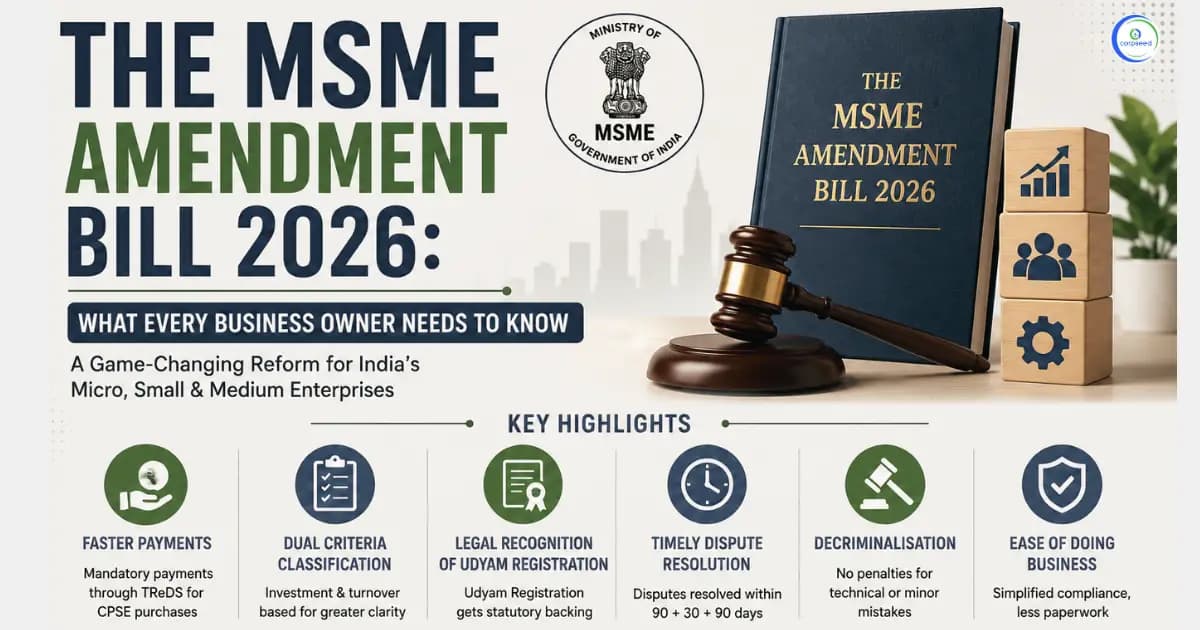
The MSME Amendment Bill 2026: What Every Business Owner Needs to Know
2026-08-11
SVEP: Building a Grassroots Start-up Ecosystem Across Rural India
2026-07-29
How To Register A Startup Under Startup India?
2026-12-31
How to Register on the GeM Portal?
2025-12-26
How to Find the Right NIC Code for Udyam Registration (Step-by-Step Guide)
2025-12-16

How SARAL SIMS Changes Import Clearances for MSMEs
2025-12-03