
SVEP: Building a Grassroots Start-up Ecosystem Across Rural India
The Start-up Village Entrepreneurship Programme (SVEP) is a sub-scheme under the Deendayal Antyodaya Yojana- National Rural Livelihoods Mission (DAY-NRLM), which falls under India's Ministry of Rural Development. SVEP was approved in 2015, and on-ground enterprise formation began in 2017 as part of the broader NRLM framework focused on rural poverty reduction.
Schedule a Call Back
Businesses we've worked with on Startup India
Clients include Pontus Pack, Cmp Security Services, Rays Global Energypower, Kapemai Lifestyle, Mobi Tech, Quantara Battery Recycling, Escarl Jewels, Goldquest Global HR Services, Milton Elevator, Mayfair Events, RMJ Fresh Hypermart24 by 7, StoreHouse Export Services (12 of 40+ served since 2018).
A few more clients we've served in this industryHide the list
- Clients include
- Pontus Pack · Cmp Security Services · Rays Global Energypower · Kapemai Lifestyle · Mobi Tech · Quantara Battery Recycling · Escarl Jewels · Goldquest Global HR Services · Milton Elevator · Mayfair Events · RMJ Fresh Hypermart24 by 7 · StoreHouse Export Services · Zoyo Learning
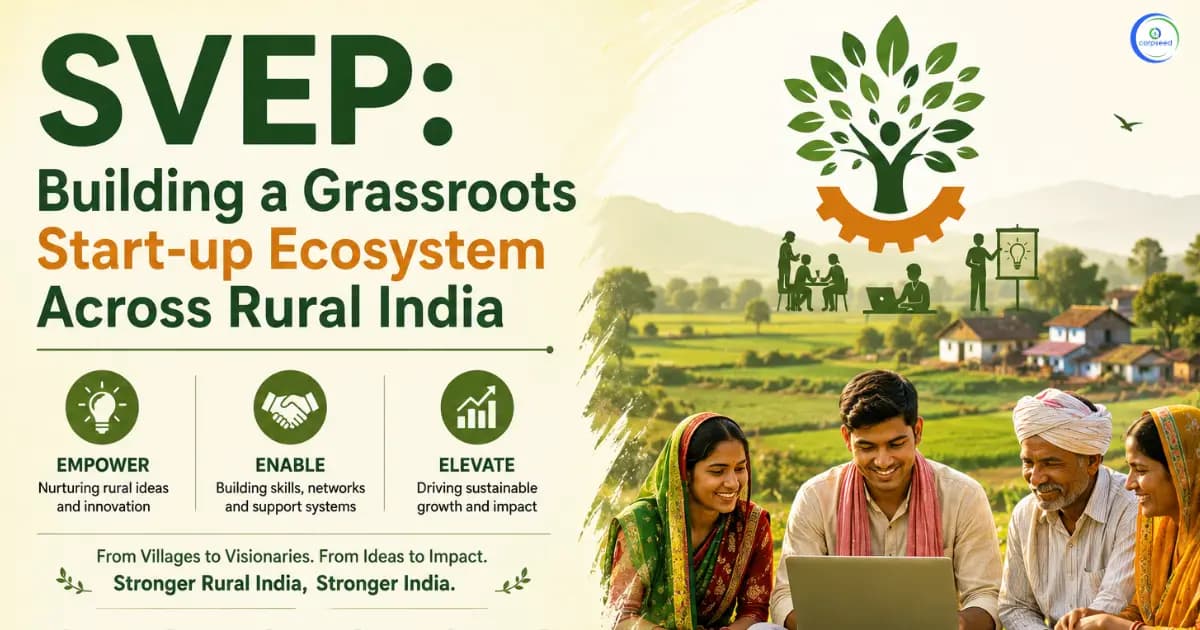
Enter any Indian village nowadays, and chances are high that you will see people selling something that they have crafted with their bare hands: pickles, bamboo products, custom-made clothing, or ready-to-eat snacks made for sale in the local market. However, what some of these small businesspersons do not know is that there exists an Indian government initiative that caters to their needs by helping them convert their small ideas into profitable ventures. This is SVEP (Start-up Village Entrepreneurship Programme).
SVEP isn't a loan scheme in the traditional sense, and it isn't just another training workshop either. It's a full ecosystem that combines money, mentorship, and market access, designed to help rural India's poorest and most overlooked entrepreneurs build businesses that actually survive beyond their first year. In this article, we'll break down what SVEP is, who it helps, how it works, and why understanding it properly (with the right guidance) can make the difference between a struggling business and one that thrives.
Schedule a Call Back
What is the Start-up Village Entrepreneurship Programme (SVEP)?
The Start-up Village Entrepreneurship Programme (SVEP) is a sub-scheme under the Deendayal Antyodaya Yojana- National Rural Livelihoods Mission (DAY-NRLM), which falls under India's Ministry of Rural Development. SVEP was approved in 2015, and on-ground enterprise formation began in 2017 as part of the broader NRLM framework focused on rural poverty reduction.
It is an amazing concept in itself, suggesting that rather than providing job opportunities or other forms of temporary assistance to rural families, it helps them establish their non-agricultural micro-enterprises. These can be small-scale manufacturing units, services-based business units, food processing plants, or any other form of retail business.
SVEP exists because rural India has never lacked ambition or skill. What it has lacked is access to startup capital, formal business training, markets beyond the village, and a mentor to guide a first-time entrepreneur through the confusing early months of running a business. SVEP was designed to close exactly that gap.
The programme works closely with the Self-Help Group (SHG) network that DAY-NRLM has built across rural India over the years. This is important because SHGs already have trust, structure, and financial discipline built into their communities. SVEP layers entrepreneurship support on top of that existing foundation.
Why does this matter for India's rural economy? Because roughly 60% of India's population still lives in rural areas, and non-farm employment opportunities in villages remain limited. Every rural enterprise that SVEP helps establish doesn't just support one family it often creates jobs for others in the community too, while keeping money circulating locally instead of flowing entirely into cities.
Objectives and Key Features of the SVEP Scheme
SVEP is built around a few clear, practical objectives rather than vague policy language. Understanding these objectives helps explain why the programme is structured the way it is.
Main objectives of SVEP include:
- Helping rural poor households set up sustainable non-farm enterprises
- Reducing dependence on seasonal agricultural income
- Creating local employment opportunities within villages and blocks
- Building a cadre of trained community members who can support entrepreneurs long-term.
- Strengthening financial inclusion by connecting entrepreneurs to banks, SHGs, and federations.
- Encouraging women and marginalized groups to become business owners, not just employees.
Key features that set SVEP apart:
- Community-based approach: SVEP doesn't rely only on outside consultants or government officers. It trains local youth, known as Community Resource Persons – Enterprise Promotion (CRP-EPs), who live in the same block and understand the local economy, language, and challenges.
- Support for first-time entrepreneurs: Many SVEP beneficiaries have never run a business before. The programme is built around handholding rather than assuming prior business knowledge.
- Enterprise promotion at the block level: Support is organized through Block Resource Centres (BRCs), which coordinate training, credit facilitation, and business plan approval for an entire block.
- Capacity building: Entrepreneurs receive structured training in business planning, bookkeeping, pricing, and basic management skills that are often the real reason small businesses fail.
- Financial inclusion: SVEP connects entrepreneurs to formal credit sources, including SHGs, federations, and banks, rather than leaving them dependent on informal moneylenders.
- Sustainable livelihoods focus: The goal isn't just to launch a business, but to keep it running profitably well after the initial support period ends.
This combination of finance, incubation, and skill-building is often described as the three pillars of SVEP's design, and it's what separates it from a simple subsidy scheme.
Eligibility Criteria for the Start-up Village Entrepreneurship Programme
SVEP is intentionally designed for people who are usually left out of formal entrepreneurship support, not urban startups with degrees and investor pitch decks. Still, rural families looking for a genuine shot at self-employment.
Broadly, any rural individual willing to become self-reliant through entrepreneurship can be considered for SVEP, with specific preference given to vulnerable and marginalized groups.
| Category | Eligibility Details |
| Self-Help Group (SHG) members | Existing SHG members and their family members are core beneficiaries, since SVEP is built on the DAY-NRLM SHG network |
| Rural youth | Young people from rural blocks looking to start a non-farm enterprise, including those who may also become trained CRP-EPs |
| Women entrepreneurs | Given strong priority, as SVEP places heavy emphasis on women-led enterprises and financial independence for women |
| SC/ST and OBC households | Given specific preference, in line with NRLM's broader social inclusion goals |
| MGNREGA beneficiaries | Highly vulnerable households already engaged in wage employment schemes are prioritized for enterprise support |
| Existing micro-entrepreneurs | Small business owners looking to formalize, expand, or stabilize an existing venture may also be eligible for support |
| Rural artisans | Traditional craftspeople looking to scale production or reach new markets |
To actually access SVEP support, applicants generally need to be part of, or willing to join, the local SHG and federation structure, since these community institutions play a central role in identifying beneficiaries and vouching for their creditworthiness.
Benefits of SVEP for Rural Entrepreneurs and MSMEs
SVEP's benefits go well beyond a one-time cash grant. Here's what participation in the programme can practically mean for a rural entrepreneur.
Employment generation- SVEP doesn't just aim to help individuals, each supported enterprise can create additional local jobs. A small food-processing unit, for example, might employ two or three other villagers once it scales up.
Financial assistance- Entrepreneurs get help accessing working capital and start-up funds through NRLM, SHGs, federations, and the banking system, reducing dependence on high-interest informal lending.
Skill development- Training covers not just how to make a product, but how to run a business: costing, quality control, basic accounting, and customer relationships.
Handholding support- CRP-EPs typically stay closely involved with a new enterprise for the first several months of operation, visiting regularly to troubleshoot problems as they come up something most first-time entrepreneurs desperately need but rarely get.
Market linkage- SVEP helps connect rural producers to buyers beyond their immediate village, including local markets, government procurement channels, and in some cases digital platforms.
How to Apply for the SVEP Scheme: Step-by-Step Process
There is no single web portal application method for SVEP, unlike some centrally sponsored schemes. It is a community-based scheme that follows the SHG structure and block-level implementation. It goes thus:
1. Check if SVEP is active in your block. SVEP is implemented block-by-block, not uniformly across all districts, so the first step is to confirm whether your block has an approved SVEP project.
2. Connect with your local SHG or federation. Since SVEP works through the DAY-NRLM SHG network, joining or engaging with your local SHG is usually the entry point.
3. Get in touch with the Block Resource Centre (BRC) or CRP-EP. The trained Community Resource Person-Enterprise Promotion for your area will guide you through initial eligibility and idea discussion.
4. Undergo SHG/federation verification. Your local SHG or federation typically verifies your background and helps validate that you're a genuine candidate for enterprise support.
5. Prepare your documentation. This usually includes identity proof, address proof, SHG membership details, and bank account information.
6. Develop your enterprise/business plan. With help from the CRP-EP, you'll outline what business you want to start, expected costs, and how you plan to generate income.
7. Business plan review and approval. The plan is typically reviewed at the block level before funds or credit facilitation are approved.
8. Loan and fund facilitation. Once approved, working capital support is arranged through NRLM, SHG/federation funds, or linked bank credit.
9. Skill and management training. Before or alongside setup, you'll receive structured training in running the specific type of enterprise you've chosen.
10. Business setup and launch. With funding and training in place, the enterprise formally begins operations.
11. Ongoing monitoring and handholding. CRP-EPs continue supporting the enterprise through its early, most vulnerable months, helping troubleshoot problems as they arise.
12. Post-establishment support. Even after the initial support period, entrepreneurs often retain access to market-linkage assistance and occasional mentoring.
As the entire process goes through local organizations instead of a centralized application process, timelines and procedures may vary by state and district, that is precisely where professional advice can help entrepreneurs register their name in government schemes
Challenges and Opportunities Under the SVEP Scheme
No government programme is without friction, and SVEP is no exception. Being realistic about the challenges actually helps entrepreneurs plan better.
Common challenges:
- Awareness gaps: Many eligible rural families don't know SVEP exists or how to access it, especially outside the blocks where it's already been rolled out.
- Access to sufficient funding: While SVEP does facilitate credit, funding amounts may not always match the full capital needs of a growing enterprise.
- Market access beyond the village: Producing a good product is only half the battle, reaching buyers outside the immediate area remains genuinely difficult for many rural enterprises.
- Infrastructure limitations: Poor roads, inconsistent electricity, and limited storage facilities can slow down enterprises, particularly in food processing and manufacturing.
- Digital literacy: As markets shift online, entrepreneurs without digital skills can find themselves at a disadvantage.
- Business mentoring capacity: With a limited pool of CRP-EPs relative to the number of entrepreneurs needing support, handholding quality can vary from block to block.
Real opportunities:
- Agri-business and food processing: Value-added agricultural products remain one of the most natural fits for rural entrepreneurship.
- Handicrafts and traditional skills: Many regions have artisan traditions like specific textile, footwear, or woodcraft clusters that SVEP-linked enterprises can help scale commercially.
- Digital enterprises: Even in rural areas, demand is growing for basic digital services like mobile repair, photocopying/printing, and e-commerce assistance.
- Local manufacturing: Small-scale manufacturing for local consumption (furniture, packaging, basic goods) reduces dependence on goods brought in from cities.
- Women-led enterprises: With deliberate support, women's participation in SVEP has grown substantially, opening opportunities in sectors where women in rural India were previously underrepresented.
How is SVEP Transforming Rural Entrepreneurship in India?
From being limited to only a few blocks at the launch of SVEP, the programme has now expanded to cover many blocks across various states and union territories of India, with even more blocks receiving approval to implement it. Through its trained cadre of community workers, SVEP can now assist more than a lakh rural enterprises across India.
What makes the success of SVEP all the more remarkable is not the establishment of a large number of enterprises, but the type of people who own these enterprises. Independent evaluations of SVEP show that the vast majority of entrepreneurs who have benefitted from the programme belong to the Scheduled Castes, Scheduled Tribes, and Other Backward Classes.
The program further showcased its sustainability amid the coronavirus pandemic, with SHGs formed under NRLM (and strengthened through SVEP-supported firms) emerging as frontline actors in rural areas, manufacturing masks, sanitizers, and essential goods when other supply channels failed.
In the coming years, the big dream that is associated with SVEP will be challenging: to help set up lakhs of village enterprises and provide employment to millions of rural Indians. All this, however, will depend a great deal on proper implementation of the scheme at the state level, adequate funding, and, more importantly, on how well entrepreneurs use the program.
Conclusion
SVEP is a totally new dimension in the development saga of rural India. The concept of ‘hand-ups’ rather than mere ‘handouts’ in the process of economic empowerment of the rural population is being introduced by SVEP through a combination of capital, training, and mentoring.
But like most government schemes, SVEP's paperwork, eligibility documentation, business plan approvals, and compliance requirements can be confusing to navigate on one's own, particularly for someone starting their very first enterprise. Missing a step in registration, misunderstanding eligibility criteria, or submitting incomplete documentation can delay access to funding and training for months.
And here comes the relevance of having a good consultant. Whether you are an SHG trying to formalize an entrepreneurial venture, an NGO helping rural entrepreneurs or an already running micro enterprise looking to grow with the backing of the government’s schemes, getting yourself associated with professional consultancy services to register for the government schemes, to comply with MSME requirements and to document your business in rural areas can help you save a lot of time, money and effort. If you and your organization are considering SVEP, NRLM or MSME registration schemes, then a government scheme consultancy will be very helpful indeed.
About the Author

Anshika Jindal
Content WriterAnshika Jindal, a Legal Content Writer with strong expertise in legal research and a solid academic background in BA LLB and LLM (Criminal Law). I specialize in researching statutes, case laws, and legal developments and presenting them in clear, accurate, and engaging written content. With strong analytical skills and attention to detail, I create reliable, well-structured legal content while maintaining professional and ethical standards.
I specialize in conducting in-depth legal research using credible sources and presenting legal information in a structured, reader-friendly manner while maintaining precision and authenticity. My work focuses on simplifying legal language without compromising its meaning, making legal content accessible to a wider audience.
Related articles
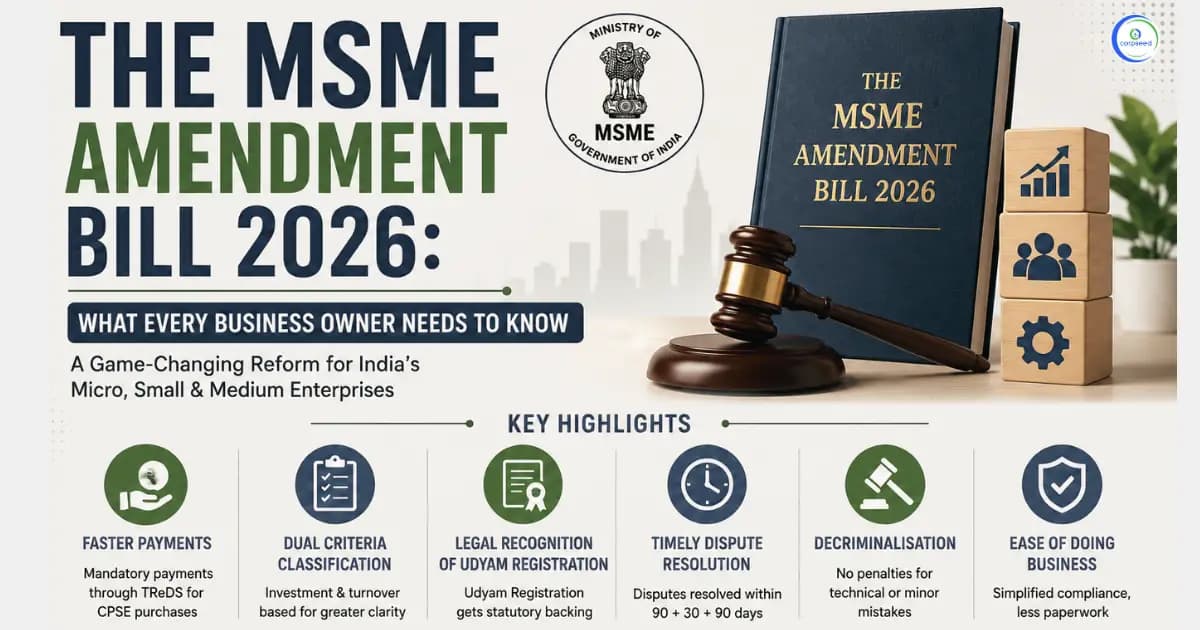
The MSME Amendment Bill 2026: What Every Business Owner Needs to Know
2026-08-11
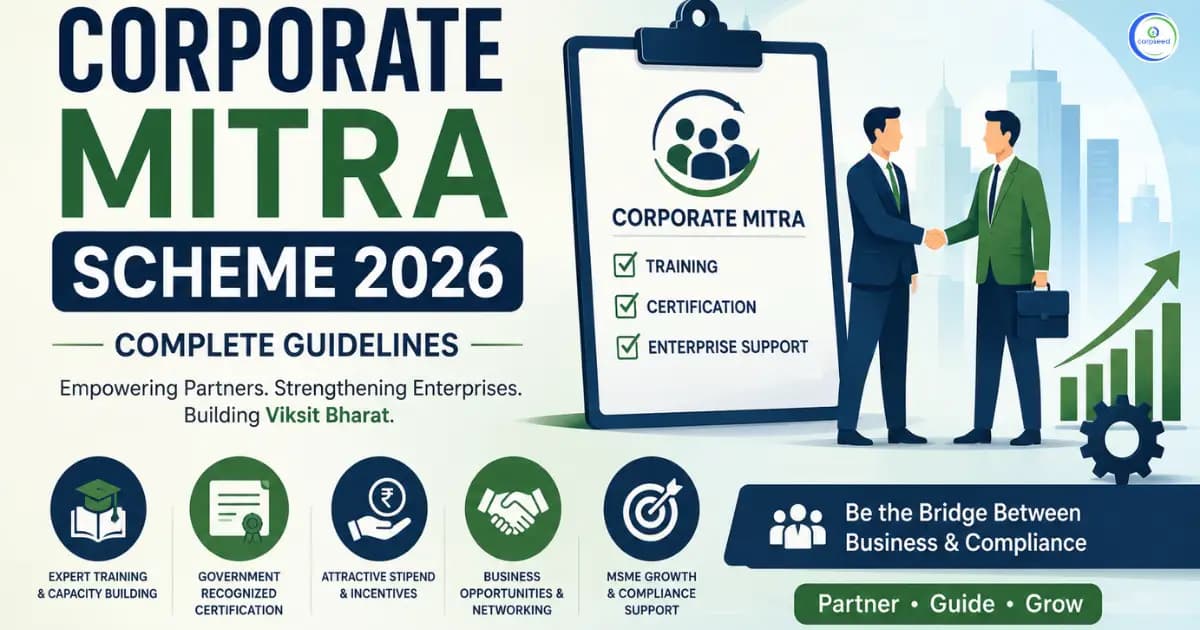
Corporate Mitra Scheme 2026: Complete Guidelines
2026-07-29
How To Register A Startup Under Startup India?
2026-12-31
How to Register on the GeM Portal?
2025-12-26
How to Find the Right NIC Code for Udyam Registration (Step-by-Step Guide)
2025-12-16
How SARAL SIMS Changes Import Clearances for MSMEs
2025-12-03