9311255283
×

Welcome to Corpseed. Please type your query, and we shall provide immediate assistance.

×

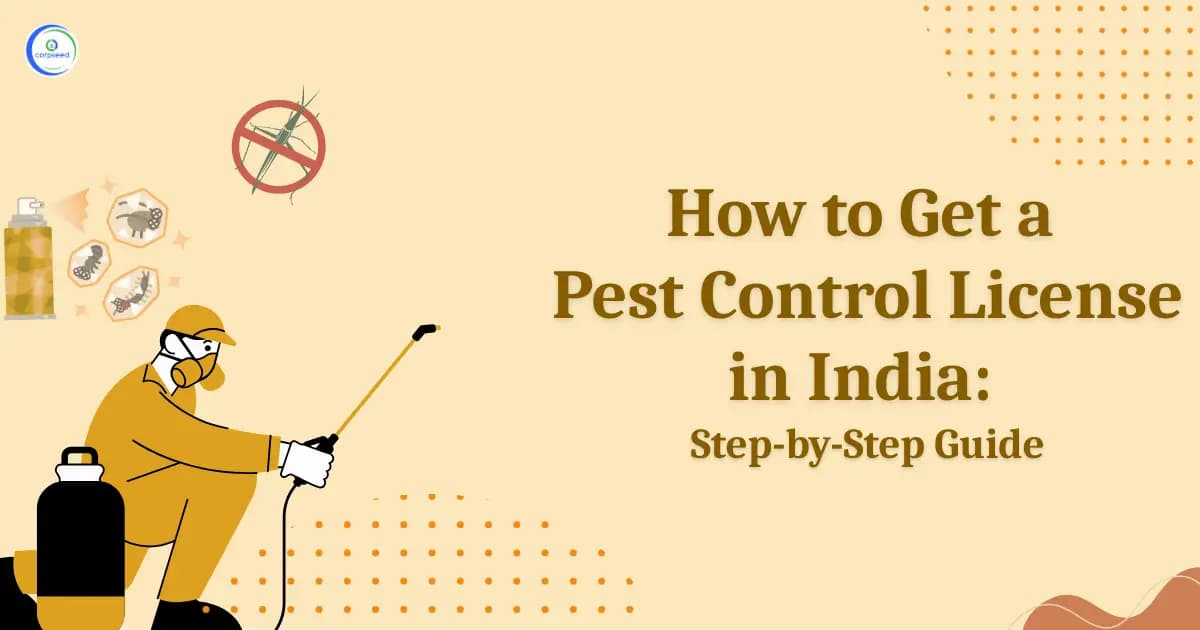
How to Get a Pest Control License in India: Step-by-Step Guide

How_to_Get_a_Pest_Control_License_in_India_Corpseed.webp
Last updated : 2025-12-24

Managing a pest control business does not only focus on getting rid of pests. It concerns safety, accountability, and legal authorization to work with chemical solutions in the open and domestic areas. There are several individuals who enter into this profession without having the knowledge that one needs a government license. If you are considering starting a  pest control service, it is better to learn about the process of licensing in time and save time, money, and legal complications.

What Is a Pest Control License?

The pest control license is a formal permission issued by the State Agriculture Department to allow an individual or a firm to lawfully offer pest management services in the use of insecticides. In India, the pest control activities come under the Insecticides Act, 1968, which is in place to control the storage, handling, and application of chemical substances. The license also promotes the protection of the work of pest control by providing the safety, responsibility, and authorization of the activity to trained personnel.
Pesticides may be poisonous when applied wrongly. They can also impact the health of human beings, contaminate the food or cause harm to the immediate environment. Due to the risks, the government requires pest control operators to satisfy certain standards to be able to provide the services. The possession of a valid license will ensure that the business has trained employees, adheres to accepted safety procedures, and applies the insecticides that are in accordance with the law.

Customers are also safeguarded by the license. It guarantees them that the service provider is knowledgeable about pest behaviour, the level of chemicals to be used, and the method of working on the pests. The licensed operators are supposed to undergo the right practices when conducting treatments in their homes, offices, factories, hospitals, and in public places. In the absence of this license, the pest control services cannot be offered and will result in fines, closure of the business, or prosecution. The pest control license is thus not only a form, but it is a legal and professional requirement.

Who is supposed to obtain the Pest Control License?

Any person who wishes to offer pest control services on commercial premises must hold this license. This comprises people just getting into small pest control businesses, partnerships, private limited companies, and service agencies that deal with residential or commercial customer bases.

Although pest control may not be your main business, the license is still a must when you use insecticides as a service. Pest treatment as an add-on service should also be licensed, and this is required to be done by the housing societies, facility management firms, and contractors.

--------------Blog Contact Form-------------

Eligibility Criteria to Obtain Pest Control License

The government has established a certain level of eligibility for pest control businesses to take place safely. Educational standards, training standards, and infrastructure standards are some of the requirements that the applicant must satisfy before licensing. The eligibility requirements are:

  • The applicant should employ a qualified technical individual to carry out pest control.
  • A technical person must possess a science background, either chemistry or biology.
  • Compulsory attendance of government-approved pest control training.
  • Adequate office space and facility of secure insecticides.
  • Accessibility of safety gear and authorized pest management tools.

Documents required to obtain a pest control license

The adequate documentation will help the authorities to ensure business legitimacy, safety arrangements, and technical competence of the business before it is authorized. The following documents are needed:

  • Registration certificate of the business or incorporation evidence.
  • Address and identity evidence of the applicant.
  • Certificates of educational qualification of a technical person.
  • Completion certificate of pest control training.
  • Plan of the insecticide storage area layout.
  • Tools list and personal protective equipment.
  • Affidavit of adherence to regulations on the use of insecticides.

Steps to obtain Pest Control License

The licensing process follows a structured sequence of actions that makes it both legally suitable and operationally safe. The following is the step-by-step process:

Step 1: Register Your Business: Sometimes you need to open your own business as a proprietorship, partnership, LLP, or private limited company. An entity that is registered legally is a requirement when seeking the pest control license. The authorities confirm the status of the business when the business is being applied to.
Step 2: Name a Qualified Technical Person: Appoint a technical person who has the education and training requirements. This person will monitor the pest management activities. Their credentials will support your license issuance.
Step 3: Finalize Approved Pest Control Training: Enroll the technical person in a government-approved pest control training programme. The course includes the use of insecticides, dose regulation, safety measures, and emergency management. The issuance of the license will require the training certificate.
Step 4: Prepare Office and Storage Facility: Install an office with a storage facility for insecticides. This should be a safe storage that is well-ventilated and does not violate safety protocols. These arrangements will be inspected by the officers, who will have to check them physically before they are approved.
Step 5: File Application with the Licensing Authority: File the application with the state agriculture department and have it accompanied with necessary documents. Unfinished or wrong submissions will most likely result in a delay or rejection during scrutiny.
Step 6: Inspection and Granting of a License: Once document verification is made, authorities inspect the place. In case the requirements are met in storage conditions, equipment, and safety standards, the pest control license is issued with a definite validity and renewal terms.

Key Considerations

Prior to applying for a license in pest control, several practical considerations must be taken into consideration. These aspects are useful to prevent some delays, refusals, and later compliance problems.

  • Ensure technical staff qualifications and approved training certificates are complete and verifiable before submission.
  • Properly store insecticides with safety signs, ventilation, and limited access as required.
  • Only government-approved chemicals and application equipment are to be used to achieve compliance and inspection standards.
  • Monitoring of license validity and renewal schedules in order to avoid service halt or legal fines.

Conclusion

Pest control license acquisition in India is not complicated, however, it requires preparation and responsibility. The process will make sure that the delivery of pest control services is safe, professional, and does not harm the people or the environment. With the accomplishment of appropriate training, compliance with qualifications, and legal processes, you develop a reliable and sustainable business. Not only would a valid license shield you against penalty, but also enhance your credibility amongst clients. It is the ultimate and most essential step that one should get a license if one is serious about pest control services.

This portion of the site is for informational purposes only. The content is not legal advice. The statements and opinions are the expression of author, not corpseed, and have not been evaluated by corpseed for accuracy, completeness, or changes in the law.

BOOK A FREE CONSULTATION

Get help from an experienced legal adviser. Schedule your consultation at a time that works for you and it's absolutely FREE.

Author

Parul Bohral, a BALLB graduate and experienced legal researcher and content writer with expertise in various legal areas, including corporate law and intellectual property. I have gained valuable experience in esteemed legal environments, where...

Learn More >>