
How CSR Registration Can Boost Your Brand’s Reputation and Trust?
CSR has emerged as a fundamental element of modern business strategy in today's competitive business landscape.
Schedule a Call Back
150+ NGO, 80G and 12A assignments since 2018
Clients include Pramiti Education & Knowledge Society, Jeevan Aadhar Charitable Trust, Nimal Maula Foundation, Sudarshan Munjal Trust, World Mission Society Church of God, 3Rd Eye Foundation, Khayerpati Mukunda Lal Education Society, Hopeful Hearts Foundation, Aarambh Development Foundation, Karmaa Foundation, Garapati Moshe Memorial Trust, One Globe Foundation (12 of 100+ served since 2018).
A few more clients we've served in this industryHide the list
- Non-profits and education
- Pramiti Education & Knowledge Society · Jeevan Aadhar Charitable Trust · Nimal Maula Foundation · Sudarshan Munjal Trust · World Mission Society Church of God · 3Rd Eye Foundation · Khayerpati Mukunda Lal Education Society · Hopeful Hearts Foundation · Aarambh Development Foundation · Karmaa Foundation · Garapati Moshe Memorial Trust · One Globe Foundation · Samarpit Sewa Sansthan · Sri Vidya Vikas Foundation · Aaruh Foundation
- More clients
- Witcorp India Advisors · SLS Sungrace Power · Bharateeya Sanathana Aadhunika Dharma Pariposhanam Trust · D P Sarawgi Foundation · Dyutima Foundation · Ileep Foundation · Kannan Animal Welfare Foundation · Maa Annapurna Sewa Trust · Ramani Education and Charity Trust · Real Smile Foundation · REY Foundation · S.N. Educational Trust · Saans Foundation · Sahara Education and Welfare Foundation · Shanti Samarpan Foundation · Shiv Bhavani Seva Trust · Shivani Seva Society · Shri Ravinder Joshi Charitable Foundation · Shri Shakiti Charitable Trust · Shri Varni Siksha Prasar Samiti · Smyle Mysha Welfare Society · Social Action and Voices for Integrated Development Trust · Srinivasa Perumal Trust · Thisai Charitable Trust
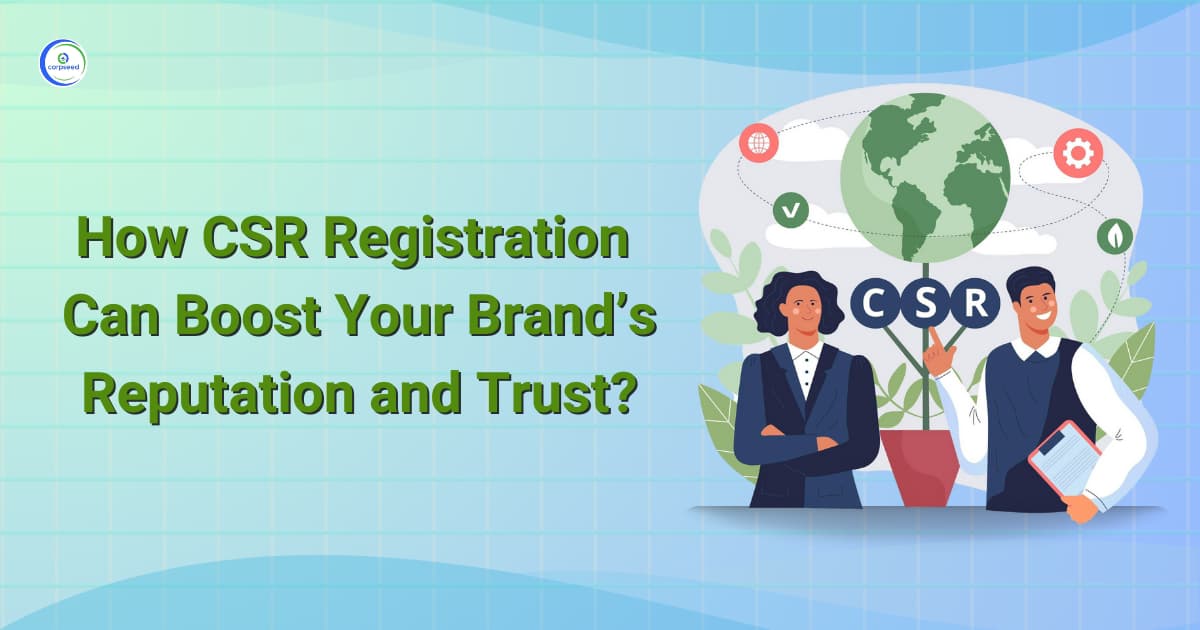
CSR has emerged as a fundamental element of modern business strategy in today's competitive business landscape. Since customers are increasingly looking for brands that share their values, CSR registration provides a formalized manner in which a firm can express its social and environmental responsibilities.
Schedule a Call Back
What is CSR?
As a business model, CSR places much emphasis on ethical practice and social accountability within the firm. It's an activity of conducting business operations that will benefit shareholders, employees, customers, and communities in which the business operates.
CSR covers four key aspects: environmental accountability, social accountability, giving back, and economic responsibility. Companies take up CSR in ways that ensure environmental responsibility, fair stakeholder treatment, charity work, and transparency. CSR promotes good business practices because it boosts the image of companies, earns their customers' trust, and contributes positively to society.
How Can CSR Registration Boost your Brand Reputation?
In today's competitive business environment, CSR registration plays a crucial role in enhancing brand reputation. Below are the key ways in which it can boost your brand’s reputation:
1. Trust of Consumers: One of the biggest advantages of registration of CSR is the establishment of consumer trust. When Indian consumers are becoming increasingly sensitized towards corporate ethics and social responsibility, the actively engaged brands in CSR will attract more consumer confidence. According to research, "87% of consumers reported that they would be likelier to purchase from or recommend a company that matched their values." This can be done through enrolment in CSR activities and displaying a keen interest in social responsibility, hence winning their loyalty.
2. Market Differentiation: In a cluttered market, differentiation is the key. CSR can act as a differentiator among brands by demonstrating commitment towards ethical practice through ethical practices and social responsibility. Unilever, for example, has differentiated itself through its Sustainable Living Plan, reducing environmental impact while strengthening its brand image.
3. Talent Attraction and Retention: A high-quality CSR strategy can add to the strength of a business in attracting and retaining skilled employees. Research has pointed out that 82% of Gen-Z workers believe CSR is an important consideration for an employer. Demonstrating social responsibility, companies attract the best employees by providing a workplace culture that matches the vision of the employee.
4. Positive Media Coverage: Effective CSR can lead to publicity in the media, elevating brand awareness and public view. Authentic stories about the positives of a company can gain a lot of press, in turn making it an example of a socially responsible player.
5. Investor Confidence: Investors are increasingly factoring social responsibility into their investment decisions. CSR commitment by a firm may boost investor confidence and ethical investments. According to studies, companies with sound CSR practices tend to outperform others in terms of their financial performance.
6. Risk Management: Performing CSR identifies social and environmental risks faced by companies it aids companies in finding ways to deal with these kinds of situations in advance of crises before a disaster hits.
7. Enhanced brand equity: CSR enhances brand equity positively as a good reputation translates into real value added to the business. Brands with high equity outperform stock market benchmarks and are more resilient in times of volatility than others.
Read Our Blog: The Importance of Corporate Social Responsibility (CSR) for Modern Businesses
Implementing Effective CSR Strategies
Developing a successful CSR strategy depends much on effective planning and delivery
- Set Goals and Targets: Companies ought to formulate clearly defined objectives relating to CSR, such as reduced carbon footprint and greater community involvement.
- Stakeholder Engagement: Consultation with stakeholders, be it employees, customers, or suppliers, concerning communities, may aid a successful CSR program.
- Measure Impact: The Brands should measure and report their CSR impact regularly through clear transparency. This will boost confidence on the part of customers as well as investors.
- Collaboration with Non-profits: Partnering with other Non-Profits can highlight the impact of a given set of CSR activities by leveraging expertise and resources.
- Communicate Effectively: It requires the brands to convey information about their CSR through platforms in social media, Press statements, and sustainability reports, among others.
Benefits of CSR Registration
CSR registration benefits NGOs substantially in India, especially at the funding level, and raises their credibility. Here is the list of key CSR registration benefits for NGOs:
- Accessing Funding: A registered NGO is eligible to receive corporate donations, which are enforced to spend on CSR activities.
- Building Public Image: Being on the list of registered agencies enhances credibility among donors and various stakeholders.
- Networking: The registration process opens up the possibility of collaborating with other organizations that operate in the same fields.
- Resource Sharing: Registered NGOs get access to resources and expertise from the corporations, which are searching for efficient partners in their CSR programs.
- Transparency: The registration process ensures that funds are spent transparently on different projects.
Conclusion
Corporate Social Responsibility registration is not a legal obligation but a necessary tool to improve brand reputation and win the trust of customers in India's dynamic marketplace. Meaningful CSR activities undertaken by companies that connect with stakeholders help them retain consumer loyalty, attract quality employees, and win over investors. Such companies avoid risks related to reputational damage, and at the same time, contribute positively to society.
As businesses chart this changing landscape, the integration of authentic CSR strategies into the core operations will be crucial for long-term success. Brands embracing this change will most likely reap rewards in terms of building closer relationships with customers, investors, and employees while making contributions to society at large.
About the Author

Parul Bohral
Legal Content WriterParul Bohral, a BALLB graduate and experienced legal researcher and content writer with expertise in various legal areas, including corporate law and intellectual property. I have gained valuable experience in esteemed legal environments, where I have strengthened my research skills, allowing me to approach legal writing with precision and depth.
As a legal content writer, I am committed to delivering work that not only informs but also engages readers. By staying informed about the latest trends in content marketing and regulatory developments, I ensure that my writing remains sophisticated and meets industry standards. My dedication to thorough research enables me to craft content that is both insightful and impactful.
Related articles
Pvt Ltd vs LLP vs OPC: Which Is the Best Business Structure in India?
2026-10-08
MCA Introduces New CSR Funding Route Through Zero-Coupon Zero-Principal Instruments
2026-05-30
How to Register a Startup in India (2026): A Step-by-Step Legal & Compliance Guide
2026-05-07

How to Secure 12A Registration in 2026?
2026-04-18

MCA Invites Stakeholders' Feedback to Simplify SPICe+ Part B Resubmission and Linked Forms
2026-01-03

Annual Compliance Checklist For Private Limited Companies And LLPs In India
2026-12-31