
Pvt Ltd vs LLP vs OPC: Which Is the Best Business Structure in India?
Choosing between a Private Limited Company (Pvt Ltd), Limited Liability Partnership (LLP), and One Person Company (OPC) depends on your growth objectives, funding requirements, and willingness to handle regulatory compliance. A Private Limited Company is the preferred structure for scalable tech startups seeking venture capital and equity funding, offering strong investor credibility and limited liability alongside higher compliance demands. An LLP provides limited liability with flexible agreement-based governance and lower operating costs, making it ideal for professional service firms, agencies, and self-funded partnerships. Meanwhile, an OPC allows solo entrepreneurs and single founders to enjoy corporate legal protection and full decision-making control without requiring a co-founder.
Schedule a Call Back
200+ company registration assignments since 2018
Clients include Hopeful Hearts Foundation, Aarambh Development Foundation, Karmaa Foundation, Meal Project Foundation, One Globe Foundation, Elevate Foundation, Cmp Security Services, RKD Financial Service, Rathi Group Industries, Ten Construction (India), Neosmoothies Design Consult, Viion Systems (12 of 150+ served since 2018).
A few more clients we've served in this industryHide the list
- Non-profits and education
- Hopeful Hearts Foundation · Aarambh Development Foundation · Karmaa Foundation · Meal Project Foundation · One Globe Foundation · Elevate Foundation
- Professional services and finance
- Cmp Security Services · RKD Financial Service
- More clients
- Rathi Group Industries · Ten Construction (India) · Neosmoothies Design Consult · Viion Systems · RGK Crop Science · S S Engineering Corporation · Anagh Traders · Metanovo Health · Granny?s Pickle · Pia Lifesciences · Arng · Maker & Coder India · APR Consultants · Finndit Digitech · Growel Impex · Mentis Systems · Prosares Solutions · Ravapa Global Enterprises · Round the Clock Technologies · Tourist Tech India · Twiclo Technologies · Vance Techlabs
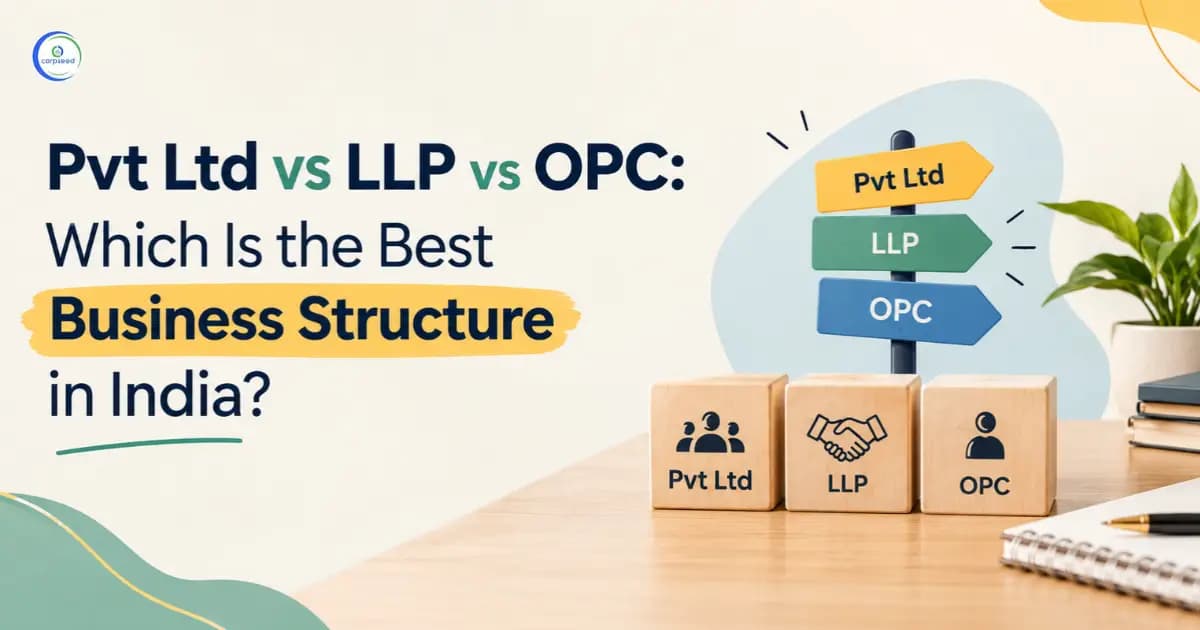
While setting up a business in 2026 has become simpler for everyone, choosing the appropriate form of the company remains one of the toughest decisions that people face. Beginners have many confusions regarding which form of the company should be chosen, and they find themselves stuck among different forms of companies.
Questions like: Should a person start a Private Limited Company? Is it better to choose the LLP form for a smaller service-based business? Or should a person go for OPC if starting up on their own? In reality, there are no fixed options available to everyone rather, each one is unique depending upon the nature of the business, growth plans, need for funding, and compliance. Here is a complete comparison between Private Limited Company, LLP, and OPC in the simplest manner possible so that one can decide easily.
Why Choosing the Right Business Structure Matters in 2026?
When deciding to register your company in India, it is very important to decide on a proper business structure. It is common practice for many to neglect this stage and select anything randomly. However, this decision will have a long-lasting effect on the operation of your business.
It is indeed possible to change the structure of a company in India after registration. However, the process will require additional efforts and expenses. Various business structures have their unique compliance procedures, tax systems and fundraising opportunities. Therefore, your decision will influence the daily activities of your company as well as its growth potential.
The decision has become even more important in 2026. The investors, banks and governmental authorities have started to pay attention to the compliance of your business and structure. This is generally done through the MCA (Ministry of Corporate Affairs). As a result, most of the documents and records will be kept there. Hence, your correct business structure will ease your life greatly in the future.
Schedule a Call Back
What Is a Private Limited Company?
A Private Limited Company (Pvt Ltd) is the most popular business structure in India for startups and growing businesses. It is registered under the Companies Act, 2013 with the Ministry of Corporate Affairs (MCA).
It is a separate legal entity. That means the company can own property, sign contracts, take loans and sue or be sued in its own name. Your personal assets stay protected if the business faces losses or legal trouble.
Key features of a Pvt Ltd company
- Minimum 2 directors and 2 shareholders (the same person can be both a director and a shareholder).
- Maximum 200 shareholders.
- At least one director must be a resident of India (stayed in India for 182 days or more in the previous year).
- No minimum paid-up capital is required.
- The name must end with "Private Limited" or "Pvt. Ltd."
- Shares cannot be offered to the public.
Advantages of a Private Limited Company
- Easy to raise funding. Angel investors, venture capitalists and private equity firms prefer investing in companies because shares can be issued, transferred and valued easily.
- Limited liability. Your personal property is safe from business debts.
- Perpetual succession. The company continues even if a director or shareholder leaves or passes away.
- Credibility. Banks, vendors, large clients and government tenders trust a Pvt Ltd more.
- ESOP and share-based growth. You can attract talent by offering employee stock options.
- Lower corporate tax option. Many companies opt for the concessional tax regime under Section 115BAA (about 25.17% including surcharge and cess), subject to conditions.
Disadvantages of a Private Limited Company
- Higher compliance: annual ROC filings, board meetings, statutory audit and income tax returns.
- Higher setup and running costs compared to an LLP.
- Restrictions on transferring shares and on public fundraising.
Best for: tech startups, e-commerce brands, manufacturing units, and any business planning to raise investment or scale across states or countries.
Planning to register? Our experts handle everything from name approval to your Certificate of Incorporation. Start your private limited company registration online.
What Is an LLP (Limited Liability Partnership)?
An LLP combines the flexibility of a traditional partnership with the limited liability of a company. It is governed by the LLP Act, 2008.
Like a company, an LLP is a separate legal entity. Partners are not personally liable for the business's debts beyond their agreed contribution, and they are also not responsible for the misconduct of other partners.
Key features of an LLP
- Minimum 2 partners, with no maximum limit.
- At least 2 designated partners, of whom one must be a resident of India.
- No minimum capital requirement.
- Internal management is decided by an LLP Agreement, which gives you a lot of freedom.
- The name must end with "LLP."
Advantages of an LLP
- Lower compliance burden. There is no mandatory board meeting requirement, and an audit is needed only if turnover exceeds ₹40 lakh or contribution exceeds ₹25 lakh.
- Lower running cost than a Pvt Ltd.
- Limited liability protection for all partners.
- Flexible management. Profit sharing and roles are set by the LLP agreement.
- No dividend distribution tax issues. Profits are taxed once at the LLP level, and partners' share is not taxed again.
- Ideal for professionals such as chartered accountants, lawyers, architects, consultants and agencies.
Disadvantages of an LLP
- Difficult to raise equity funding. Most venture capital firms and angel investors prefer companies.
- No ESOPs, since there are no shares.
- Taxed at a flat 30% plus surcharge and cess, which can be higher than the company rate.
- Less brand recognition than a Pvt Ltd in some industries.
- Partners cannot easily be replaced without amending the agreement.
Best for: professional service firms, family businesses, trading firms, small agencies, real estate partnerships and businesses that will self-fund without outside investors.
Want a low-compliance structure? Get your LLP registration online in a few simple steps.
What Is an OPC (One Person Company)?
An OPC, one person company was introduced under the Companies Act, 2013 for solo entrepreneurs. It lets one person run a company with limited liability, without needing to find a partner.
You get the benefits of a company, including a separate legal identity and limited liability, while staying the sole owner.
Key features of an OPC
- Only 1 member (shareholder) and 1 director, who can be the same person.
- You must appoint a nominee, who steps in if the owner becomes incapable or passes away.
- Only a natural person who is an Indian citizen can form an OPC. Since 2021, NRIs are also allowed, and the residency requirement was reduced to 120 days.
- The name must end with "(OPC) Private Limited."
- No minimum capital is required.
- An OPC generally cannot carry on non-banking financial investment activities and cannot be converted into a Section 8 (non-profit) company.
- As a general rule, one person cannot own more than one OPC.
Advantages of an OPC
- Complete control. You are the sole decision-maker.
- Limited liability. Your personal assets are separate from the business.
- Easier compliance than a Pvt Ltd. Board meeting requirement are relaxed, and the filings are simpler.
- Better credibility than a sole proprietorship. Banks and clients take a registered company more seriously.
- Easy upgrade. Since 2021, you can voluntarily convert an OPC to a Private Limited Company at any time, with no turnover or capital cap forcing you to.
Disadvantages of an OPC
- A statutory audit is mandatory, regardless of turnover.
- Raising funding is hard, since you cannot issue shares to investors without converting.
- Only one owner, so there is no shared risk or shared capital.
- Cannot do certain activities such as NBFC business.
Best for: freelancers, consultants, solo e-commerce sellers, single-founder startups, and small business owners who want to move from proprietorship to a safer structure.
Running a business on your own? Register your OPC online and protect your personal assets.
Documents and Eligibility Requirements
The paperwork differs across all three structures. Here is what you typically need for each:
For Pvt Ltd Registration:
- Minimum 2 directors (at least one must be an Indian resident)
- Minimum 2 shareholders (directors and shareholders can be the same people)
- DIN (Director Identification Number) for all directors
- Digital Signature Certificate (DSC) for filing
- PAN and Aadhaar of all directors
- Proof of registered office address (utility bill plus NOC from owner)
- Memorandum of Association (MoA) and Articles of Association (AoA)
For LLP Registration:
- Minimum 2 designated partners (at least one must be a resident Indian)
- DPIN (Designated Partner Identification Number)
- DSC for all designated partners
- PAN and address proof for all partners
- LLP Agreement (filed within 30 days of incorporation)
- Proof of registered office
For OPC Registration:
- Only 1 director and 1 shareholder (can be the same person)
- A nominee must be appointed (someone who takes over if the founder is incapacitated or passes away)
- DIN, DSC, PAN, and Aadhaar of the sole director
- Nominee's written consent (Form INC-3)
- Registered office proof
Step-by-Step Process for Business Incorporation
Regardless of the structure you choose, the incorporation process in India runs through the MCA portal. Here is how it works:
1.Obtain a Digital Signature Certificate (DSC) for all directors or partners. This is your electronic identity for government filings.
2. Apply for DIN or DPIN through the MCA portal if you do not already have one.
3. Check name availability using the RUN (Reserve Unique Name) service on the MCA portal. Your proposed company or LLP name must not conflict with existing registered entities or trademarks.
4. Prepare the incorporation documents MoA and AoA for Pvt Ltd or OPC, and the LLP Agreement for an LLP.
5. File the SPICe+ form (Simplified Proforma for Incorporating Company Electronically) for Pvt Ltd or OPC. For an LLP, file the Form for Incorporation of LLP.
6. The Registrar of Companies (RoC) under MCA reviews the application. If everything is in order, you receive the Certificate of Incorporation along with a CIN (Corporate Identification Number).
7. Apply for PAN and TAN for the new entity this is now integrated within the SPICe+ form for companies.
8. Open a current bank account in the company or LLP name using the Certificate of Incorporation.
Typical timelines range from 7 to 15 working days for straightforward applications, though this can vary based on RoC workload and document accuracy.
Pvt Ltd vs LLP vs OPC: Complete Comparison (2026)
| Factor | Private Limited Company | LLP | OPC |
| Governing Law | Companies Act, 2013 | LLP Act, 2008 | Companies Act, 2013 |
| Minimum Members | 2 shareholders + 2 directors | 2 designated partners | 1 member + 1 director + 1 nominee 1 member only |
| Maximum Members | 200 shareholders | No limit | 1 member onlyNo minimum |
| Minimum Capital | No minimum | No minimum | No minimum |
| Liability | Limited to share capital | Limited to capital contribution | Limited to share capital |
| Perpetual Succession | Yes | Yes | Yes (via nominee) |
| Tax Rate | 25% (up to Rs400 Cr) / 22% (115BAA) | 30% flat + surcharge | 25% (same as Pvt Ltd) |
| Dividend/Profit Distribution Tax | Dividends taxable in shareholder hand | No tax on partner drawings | Same as Pvt Ltd |
| Mandatory Audit | Yes, every year | Only if turnover > Rs 40 lakh or capital > Rs 25 lakh | Yes, every year |
| Annual Compliance Cost | Rs15,000 to Rs50,000 | Rs 8,000 to Rs 25,000 | Rs 12,000 to Rs 35,000 |
| Equity Funding (VC/Angel) | Ideal (shares, ESOPs, RSUs) | Not suitable (no shares) | Limited (single member, conversion needed) |
| Foreign Ownership | Allowed (FDI via automatic route) | Allowed (FDI with conditions) | Not allowed (Indian residents only) |
| Board Meetings | 4 per year (2 for small companies) | Not required | 2 per year |
| Closure Process | STK-2 (3 to 6 months) | Form 24 (30 to 45 days, Rs 50 fee) | STK-2 (3 to 6 months) |
| Startup India Eligible | Yes | Yes | Yes |
Common Mistakes to Avoid While Choosing a Business Structure
- Choosing only on the basis of cost. The cheapest option today may block funding tomorrow.
- Ignoring future funding plans. An LLP is a poor fit if you will need venture capital.
- Skipping the partner or shareholder agreement. Clear terms avoid disputes later.
- Ignoring annual compliance. Late filings attract heavy penalties and can lead to disqualification of directors.
- Picking a name that is already trademarked. Always check trademark databases first.
- Not getting professional advice. A short consultation can save lakhs in restructuring.
Conclusion
Choosing between Pvt Ltd vs LLP vs OPC comes down to three things: how you want to fund the business, how many owners you have, and how much compliance you can handle.
- Want to scale and raise investment? Go with a Private Limited Company.
- Want flexibility and low compliance with partners? Choose an LLP.
- Running solo with limited liability? An OPC is your answer.
Whichever you choose, registering your business properly is the first step towards credibility, legal protection and long-term growth.
Ready to take the next step?
Contact Corpseed today for a free consultation and get your Pvt Ltd, LLP, or OPC registered online quickly and hassle-free.
About the Author

Anshika Jindal
Content WriterAnshika Jindal, a Legal Content Writer with strong expertise in legal research and a solid academic background in BA LLB and LLM (Criminal Law). I specialize in researching statutes, case laws, and legal developments and presenting them in clear, accurate, and engaging written content. With strong analytical skills and attention to detail, I create reliable, well-structured legal content while maintaining professional and ethical standards.
I specialize in conducting in-depth legal research using credible sources and presenting legal information in a structured, reader-friendly manner while maintaining precision and authenticity. My work focuses on simplifying legal language without compromising its meaning, making legal content accessible to a wider audience.
Related articles
MCA Introduces New CSR Funding Route Through Zero-Coupon Zero-Principal Instruments
2026-05-30
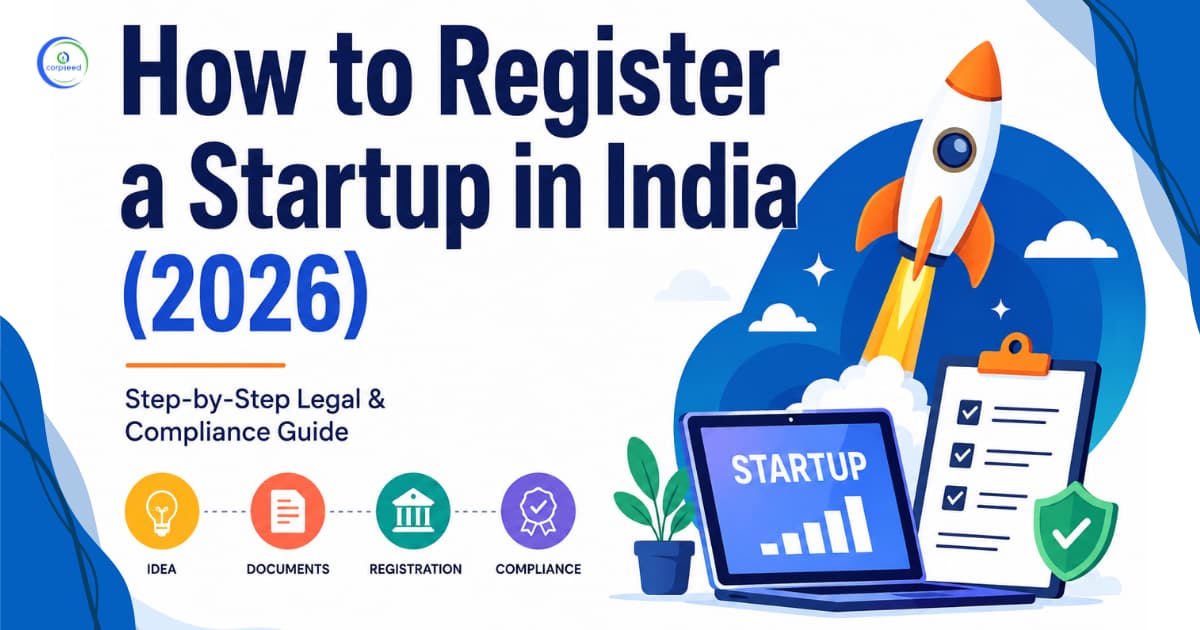
How to Register a Startup in India (2026): A Step-by-Step Legal & Compliance Guide
2026-05-07
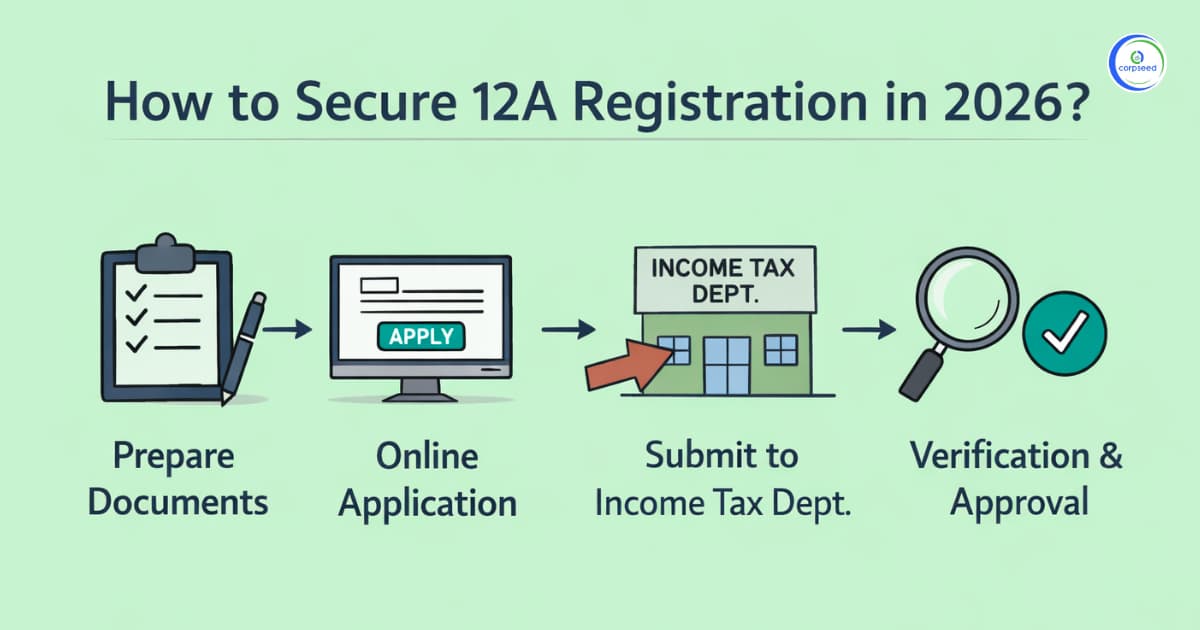
How to Secure 12A Registration in 2026?
2026-04-18

MCA Invites Stakeholders' Feedback to Simplify SPICe+ Part B Resubmission and Linked Forms
2026-01-03
Annual Compliance Checklist For Private Limited Companies And LLPs In India
2025-12-31

Step-by-step Guide to Registering a Company Online in 2026 (in India)
2025-12-29