
FSSAI ONDC Compliance 2026: New Obligations for E-Commerce Food Businesses
FSSAI has now released a new order that changes how e-commerce food businesses must follow rules, especially for a new kind of platform called ONDC (Open Network for Digital Commerce). These new rules take effect from April 1, 2026.
Schedule a Call Back
500+ FSSAI licence assignments since 2018
Clients include Bidada Foods, Silvertip Foods, Good Food Innovations, Minimal Food, Alluring India Foods and Beverages, Auroras TEA Company, Ania Consumer Products, Ginger Foods Company, Magnalis Foods, ND Spices, Antara Assisted Care Services, Aggriveda Pharmaceutical (12 of 350+ served since 2018).
A few more clients we've served in this industryHide the list
- Food and consumer goods
- Bidada Foods · Silvertip Foods · Good Food Innovations · Minimal Food · Alluring India Foods and Beverages · Auroras TEA Company · Ania Consumer Products · Ginger Foods Company · Magnalis Foods · ND Spices
- Pharma and healthcare
- Antara Assisted Care Services · Aggriveda Pharmaceutical
- Logistics and trade
- Solankili Logistics Management · 23North Logistics Solutions
- Non-profits and education
- All India Hindu Mahajot Foundation · Manovikas Charitable Society
- More clients
- Cure and Care Wellness · Seven Turns · Akshamaala Solutions · Krisba Healthcare · Matha Exports International · Indo Gulf Company · Crescent Biologicals · Cura Consumer Health · Biolush · Cura Consumer · Ethics Prosperity · Rocking Deals · Subohi Agriparks · Aurous International Merchants · Anagh Traders · Shin Traders · Zexcorp Services · Aprodite Infotech · Grandmaz Organics · Instruments and Chemicals · Aaravbabbar Enterprises · DUA OLD Age Caring Institution · Goenka Scrapco · Prime Health
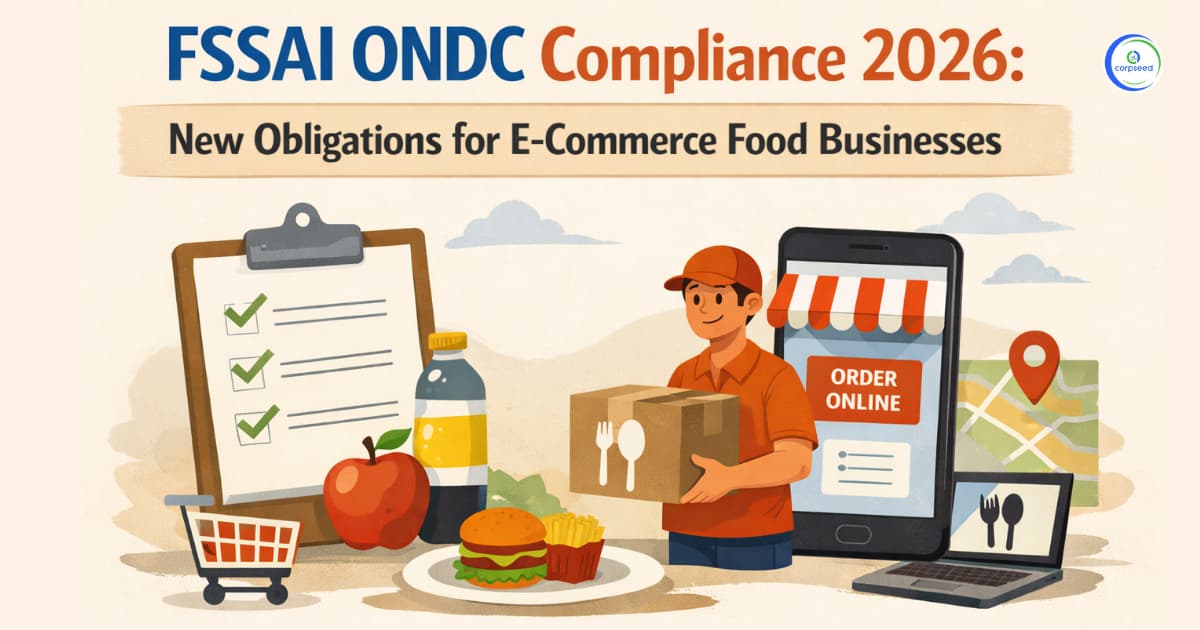
The food delivery market in India is growing very fast. Millions of people order food online every day. Apps like Swiggy, Zomato, and many others help people buy food from their phones. But who makes sure that food is safe? Who checks the rules? The Food Safety and Standards Authority of India (FSSAI) does this job.
FSSAI has now released a new order that changes how e-commerce food businesses must follow rules, especially for a new kind of platform called ONDC (Open Network for Digital Commerce). These new rules take effect from April 1, 2026.
This blog breaks down everything in simple words, what ONDC is, what FSSAI says about it, who is responsible for what, and what food businesses must do to stay compliant.
Schedule a Call Back
What Are FSSAI Regulations for E-Commerce Food Business Operators?
As per the FSS (Licensing and Registration of Food Business) Amendment Regulations, 2021, an e-commerce FBO refers to all those food business operators who engage in the activities associated with food using e-commerce. These include the following:
- Food order websites
- Food delivery applications
- Websites selling food items
- Sites displaying food menus and accepting online orders
These businesses need to be licensed with the FSSAI license in addition to observing all the food safety standards. The 2026 order lays down special provisions for the ONDC model.
What is the ONDC Model in E-Commerce?
ONDC stands for Open Network for Digital Commerce. It is a government project started by the Department for Promotion of Industry and Internal Trade (DPIIT). The goal of ONDC is to make online shopping open and fair for everyone, not just for big companies.
In the usual e-commerce model, one company handles everything: the app, the sellers, the delivery, and the payment. Think of how Swiggy or Zomato works. One platform does everything.
ONDC works differently. In the ONDC model, a single food order can involve multiple separate platforms:
- Buyer App: The app that the customer uses to place the order (example: Paytm, PhonePe, Magicpin)
- Seller App: The app that the restaurant or food seller uses to list their products and receive orders
Because multiple companies are involved in one transaction, FSSAI had to create new rules, making it clear who is responsible for food safety at each step.
Central FSSAI License Requirement for E-Commerce Platforms
One of the most important requirements is getting a central FSSAI license. Under FSSAI rules, any e-commerce platform that lists food products or allows food orders must get a central FSSAI license, not just a state license. This means:
- Seller Apps that list food products must hold a central FSSAI license
- Buyer Apps, which showcase food items and place food orders, should have a central FSSAI license as well.
- Both these kinds of applications will come under the ambit of FBOs for e-commerce purposes.
The requirement for the central license helps in making sure that such apps are registered at the national level and thus can be held liable throughout the country.
Liability of Seller Apps and Buyer Apps Under the ONDC Model
FSSAI has created a clear list of who is responsible for what under the ONDC model. Here is a simple summary:
| S.No. | Compliance Obligation | Seller App Responsibility | Buyer App Responsibility |
| 1 | Display FSSAI license/registration & hygiene grading | Provide the information and ensure accuracy | Display the provided information |
| 2 | Agreement with sellers confirming FSS Act compliance | Sign an agreement with sellers/brand owners/manufacturers | Not applicable |
| 3 | Show a clear picture of the principal display panel of pre-packed food | Provide a legible, clear image of the display panel | Display the provided image |
| 4 | Food shelf life must be 30% or 45 days before expiry at delivery | Provide shelf life info at time of order placement | Ensure no expired products are listed, display shelf life info |
| 5 | Mandatory food information available before purchase | Provide accurate mandatory food information | Display the provided information |
| 6 | Last mile delivery by trained staff, food safety maintained | Shared between the delivery entity and the seller/buyer app, facilitating delivery | Shared between the delivery entity or seller/buyer app, facilitating delivery |
| 7 | No misleading info, false claims, or misleading food images | Full obligation with the seller app | Not applicable |
| 8 | Delist non-compliant food products immediately | Full obligation with the seller app | Notify the seller app if any non-compliance info is received |
| 9 | Display seller app details for the consumer | Provide the seller app name and FSSAI license number | Display seller app info, including license/registration |
| 10 | FSSAI license number on invoices/bills/receipts | Ensure the FSSAI number appears on the invoice issued to consumers | Provide a digital invoice download facility to consumers |
| 11 | Display calorie, allergen, veg/non-veg logo, nutrition info | Provide accurate information | Display the provided information |
| 12 | Central License requirement | Yes | Yes |
| 13 | Consumer grievance handling | Address grievances from its own FSS Act responsibilities | Register & track complaints, forward to Seller App, resolve own-responsibility grievances |
Key Compliance Obligations for E-commerce FBOs under ONDC
The FSSAI ONDC compliance 2026 framework clarifies responsibilities for Buyer and Seller Apps. Here are the essential mandates for E-commerce FBOs:
- License Visibility: Seller Apps must provide FSSAI license details, and buyer apps must display them to consumers.
- Legal Agreements: Seller Apps must sign stays with brands/manufacturers to ensure FSS Act adherence.
- Digital Labelling: Clear pictures of the Principal Display Panel (PDP) of pre-packed food are required before purchase.
- Shelf Life Rule: Food that is delivered should have 30% or 45 days left from their life span (except fresh food from restaurants).
- Pre-Purchase Details: All information about food items, along with their nutritional details, should be available at no charge.
- Hygienic Delivery: Trained staff should deliver only during the last mile.
- Authentic Product Listing: No misleading pictures or unhealthy food information should be displayed.
- Immediate Product Removal: The Seller App should remove non-conforming products within minutes after receiving a notice.
- Invoice Conformity: All invoices should include the registration number of FSSAI.
- Calorie Counts: The calorie count, along with a vegetarian or non-vegetarian sign, should be available on the Buyer App.
- Buyer Grievance Resolution: Buyer Apps should include a tracking service for grievances in the Seller App.
FoSCoS Updates and E-Commerce KoB for Traceability
FoSCoS stands for Food Safety Compliance System. It is the online portal that FSSAI uses to manage food business licenses, registrations, and compliance records across India.
As part of the FSSAI ONDC compliance 2026 update, FSSAI has revised the Kind of Business (KoB) categories in FoSCoS. The existing e-commerce KoB has been updated to capture:
- Information about buyer apps involved in food transactions
- Information about seller apps involved in food transactions
- Traceability data linking buyers and sellers in ONDC-based transactions
This update helps FSSAI track every food transaction on the ONDC network. It also helps identify who is responsible at each step if something goes wrong with a food product.
Traceability is one of the most important parts of food safety. When a food safety issue happens, like contamination, the authorities need to quickly find out where the food came from, who sold it, and who delivered it. The FoSCoS KoB update makes this process faster and more accurate for the ONDC model.
Conclusion
The FSSAI ONDC Compliance Order 2026 marks a shift in India's digital food ecosystem by clarifying the liabilities of buyer and Seller Apps. In this decentralized system, all E-commerce FBOs are required to acquire a centralized FSSAI license. Whereas Seller Apps are accountable for providing nutritional information and maintaining shelf life standards, Buyer Apps should display this information without any hassle. With the implementation of FoSCoS, which has the ability to track the traceability for ONDC, the breach of these regulations under the FSS Act on or before April 1, 2026, will automatically lead to the revocation of the licenses. It is no longer the duty of the Seller Apps alone, but also of both parties involved.
About the Author

Mahek Sancheti
Content WriterMahek Sancheti, BAJMC graduate with a deep passion for writing. As a content writer, video content creator, creative content creator, and scriptwriter, I bring stories to life through words and visuals. I honed my skills by working with a prominent news agency, where I excelled in crafting compelling narratives and engaging content. Coming from a journalism and mass communication background I have skills to craft engaging narratives that captivate audiences. With a keen interest in writing and creativity, I aim to deliver impactful and meaningful content that resonates with diverse audiences.
https://www.linkedin.com/in/mahek-sancheti-837196212
Related articles
FSSAI State License Renewal in India 2026: Process, Fees & New Rules
2026-11-12
FSSAI Central License Renewal in 2026: Rules, Fees, Documents & Process
2026-11-12
FSSAI Draft Packaging Rules 2026: New Standards for Recycled Plastic in Food Packaging
2026-11-04

Selling Food Online? FSSAI Rules for Amazon, Flipkart, Swiggy, Zomato & Marketplace Sellers (2026)
2026-10-15
FSSAI Diwali Drive 2026: Food Safety Inspection Checklist for Food Businesses
2026-10-14
FSSAI Licence vs Registration for Sweet Shops, Bakeries & Home Bakers
2026-10-13