
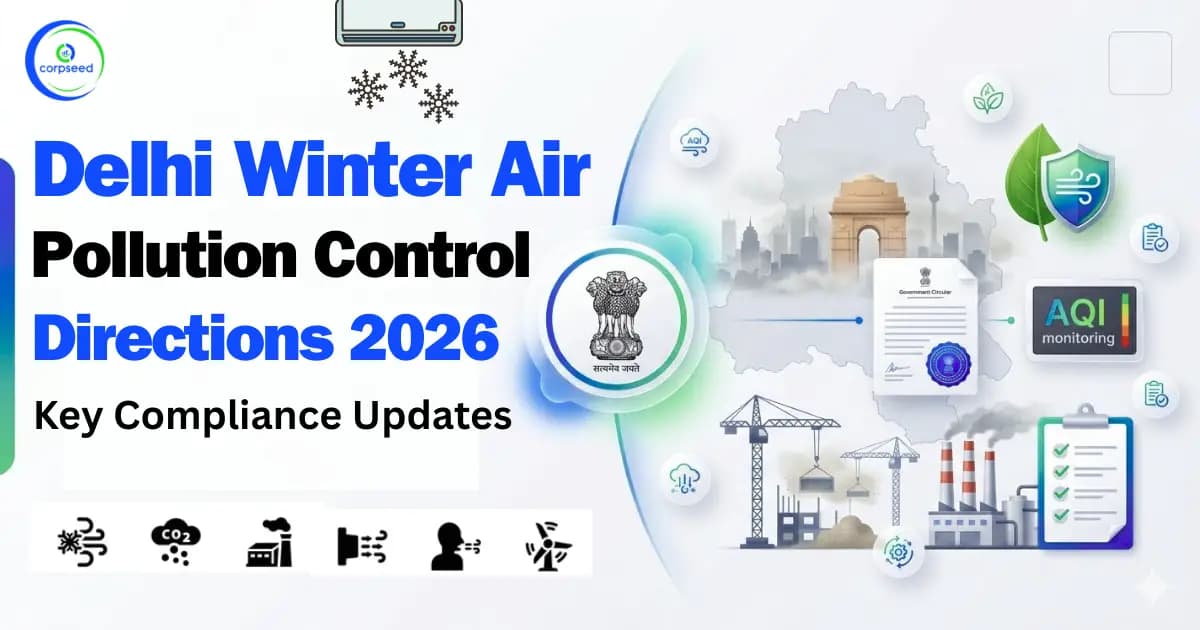
Delhi Winter Air Pollution Control Directions 2026: Key Compliance Updates
The Delhi Winter Air Pollution Control Directions 2026 establish a permanent winter pollution control framework that will be enforced annually from 1 November to 28 February. The directions introduce mandatory compliance measures for construction activities, commercial establishments, industries, offices, and vehicle owners to reduce seasonal air pollution.
Schedule a Call Back
1,800+ CTE/CTO and plant setup assignments since 2018
Clients include Magnum Aluminium, Enershell Alloys and Steel, Ganesh Foundry & Cast, Inland Speciality Metals, JK Cement, Sskbp India Alloy, Denso India, Neometrix Defence, PMS Waste Management, Daebak India Recycler, Ganix Rubber Recycling, Pashidaa E Waste Copper Battery Recycling PLT Company (12 of 1,100+ served since 2018).
A few more clients we've served in this industryHide the list
- Engineering and manufacturing
- Magnum Aluminium · Enershell Alloys and Steel · Ganesh Foundry & Cast · Inland Speciality Metals · JK Cement · Sskbp India Alloy · Denso India · Neometrix Defence
- Recycling and waste management
- PMS Waste Management · Daebak India Recycler · Ganix Rubber Recycling · Pashidaa E Waste Copper Battery Recycling PLT Company · Upcycle Debris Management · Ficusa Ewaste Recyclers · Shuchaye Recyclers · Quantara Battery Recycling
- Logistics and trade
- 20Cube Logistics Solutions · Airsurge Logistics · Green Space Logistics · Saap Logistics
- Food and consumer goods
- Bake Wish · Kokora Spices · Babi Beverages · Indraj Beverages and Distilleries · Adheshwar Agro Dairy Products · Venco Research and Breeding Farm · Explore Food · IFF India Frozen Foods
- Energy and power
- Servotech Renewable Power System · Saurya Urja Company of Rajasthan · Sun Mobility · Sun Max Solar · Maxvolt Energy Industries · Rays Power Infra
- Chemicals and materials
- Venkateshwara Roto Pack · Lami Tube · M C Bauchemie I · Pro Flexi Packaging · Rustchem Corrosols · SVN Polymers · Kairaa Polypack · Sanctum Chemicals
- More clients
- Intangles Lab · Alten India · Adit Buildwell · Ecowise Trading · GS E-Commerce · Beaucience India
Introduction
By every October, the skies over Delhi begin their grey shift. In November, it is an emergency. There are three years of AQI data that support the trend. Over those years, from November 1 to mid-February, air quality has deteriorated annually. The median AQI was between 312 and 342. The maximum AQI was between 461 and 494.
The Government of NCT of Delhi issued under Section 5 of the Environment (Protection) Act, 1986. It replaces every earlier winter pollution order with one unified rulebook, giving businesses, developers, and residents a single, predictable compliance framework each winter.
What are the Delhi Winter Air Pollution Control Directions 2026?
Think of this notification as Delhi's pollution rulebook reset button.
For years, winter pollution control ran on scattered orders - separate circulars for construction, vehicles, and offices. Enforcement suffered because nobody had a clear reference point.
Notification 160 rectifies this problem. It is a supersession of any prior order, notification, or administrative order on air pollution control made from November to February. All this information is compiled together in one notification according to the five pillars mentioned before.
It is further subject to the amended GRAP guidelines released on November 21, 2025, by CAQM. The GRAP categorizes the pollution levels into four categories as follows: Stage I: (AQI 201 - 300), Stage II: (AQI 301 - 400), Stage III: (AQI 401 - 450), and Stage IV: (AQI >450).
Schedule a Call Back
Objectives of the Delhi Winter Air Pollution Control Directions 2026
The notification is built around four core goals. Below is a quick breakdown of what the government is trying to achieve.
- Reduce PM2.5 and PM10 concentrations during the peak pollution window
- Adopt season-based field interventions in place of reactive orders
- Maintain the balance between protecting public health and economic continuity to avoid disrupting business
- Institute an accountable system in all government departments, municipalities, and the private sector
Key Highlights of the Delhi Winter Air Pollution Control Directions 2026
Five compliance pillars anchor this notification. Here's a summary of each, with more detail in later sections.
- Year-round PUCC enforcement at every petrol, diesel, and CNG/LPG outlet in NCT Delhi
- Strict entry filters for vehicles not meeting BS-VI emissions standards from other states
- 50% working from home for both government and private organizations from November 1 to January 31
- Phase-wise ban on civil construction/demolition, with further tightening during peak winters
- Obligatory anti-smog gun or mist system deployment on qualifying high-rise and under-construction properties
Vehicle Restrictions Under the Delhi Winter Air Pollution Control Directions 2026
From November 1 to January 31 each year, Delhi shuts its doors to non-BS-VI vehicles registered outside the National Capital Territory.
This restriction targets high-emission commercial trucks, freight carriers, and private vehicles crossing in from neighbouring states. The Transport Department, GNCTD, along with MCD and Delhi Traffic Police, enforces this strictly at every entry point.
Three exemption categories apply:
- Vehicles running on Compressed Natural Gas (CNG) or Electric power
- Emergency and sovereign-duty vehicles - ambulances, fire tenders, and police vehicles
- Any additional category specifically exempted by the Environment Department, GNCTD
PUC Certificate Requirements Under the Delhi Winter Air Pollution Control Directions 2026
Unlike the seasonal vehicle-entry ban, PUCC enforcement runs all year, not just during winter.
Every petrol, diesel, and CNG/LPG retail outlet across NCT Delhi must confirm a valid Pollution Under Control Certificate before dispensing fuel. Vehicles caught fuelling without one face penalties.
Verification happens through three parallel channels:
- Physical certificate checks are conducted at the pump
- ANPR camera verification, which automatically flags non-compliant number plates
- Electronic database checks via VAHAN or any other centralized government database
Major fuel retailers named in the notification - Indian Oil Corporation, Bharat Petroleum, Hindustan Petroleum, Indraprastha Gas, and Reliance Industries - must ensure strict compliance, alongside the Transport Department, MCD, and Delhi Traffic Police.
BS-VI Vehicle Rules and Restrictions for Out-of-State Vehicles in Delhi
Enforcement here is a joint operation between the Transport Department and Delhi Traffic Police, who filter incoming traffic directly at the city's border points.
This regulation has some serious substance for logistics firms and fleet owners. Any vehicle carrying goods and registered outside Delhi that does not meet the BS-VI norms shall be stopped from entering the city during the period from November 1 to January 31.
This is a direct corporate legal compliance concern. Businesses dependent on interstate supply chains should audit fleet emission ratings well ahead of winter and build BS-VI upgrade plans into their annual budget.
Parking Charges, Traffic Management, and Office Timing Changes in Delhi
From November 1 to February 28, every authorized parking site must double its existing charges, discouraging private vehicle use in favour of public transport.
DMRC-owned parking spaces are excluded, since they support park-and-ride and metro connectivity. Urban Local Bodies (ULBs) enforce this change strictly.
Government offices also shift to staggered timings to reduce peak-hour congestion, as shown below.
| Authority | Office Timing |
| Municipal Corporation of Delhi (MCD) | 8:30 AM to 5:00 PM |
| Government of NCT of Delhi (GNCTD) | 10:00 AM to 6:30 PM |
Work-from-Home Guidelines for Government and Private Offices in Delhi
From November 1 to January 31, both government and private offices must cap in-person attendance at 50% of total staff strength.
GNCTD Administrative Secretaries and Heads of Departments continue attending regularly, but total office strength cannot exceed 50%. They may call in additional officers only to keep essential or emergency services running.
The same cap applies to private offices, that is, no more than 50% physical presence, with the remainder being mandatory work from home. In addition to the above, the notification specifies additional compliance obligations for businesses in Delhi:
- Implement staggered working hours across departments and shifts.
- Enforce strict adherence to work-from-home norms for the remaining 50% of staff.
- Actively reduce commute-linked vehicular movement through car-pooling, ride-sharing, common bus arrangements, and public transport promotion.
Compliance Requirements for Businesses Under the Delhi Winter Air Pollution Control Directions 2026
Construction-linked compliance runs on two overlapping timelines.
Demolition and outdoor civil constructions that produce dust will not be allowed from November 1 to January 31, except for critical public works. However, interior activities like finishing work, plumbing, and electrical installations can still proceed provided that they comply with the Construction & Demolition Waste Management Regulations. It is also forbidden to store materials outside of the construction site boundaries.
From December 10 to January 20, it becomes a total ban. No construction or demolition activity is permitted at all, except for emergency work by the government. Vehicles that transport any of the following are not allowed to enter NCT Delhi: sand, aggregates, stone, bricks, cement, RMC, or debris.
Qualifying buildings must also meet anti-smog gun installation guidelines. Any commercial high-rise with a built-up area exceeding 3,000 sq. m - malls, hotels, office towers, and institutional buildings of G+5 and above - must install anti-smog guns or mist systems. The table below shows the minimum deployment scale.
| Built-Up Area | Minimum Anti-Smog Guns |
| Less than 10,000 sqm | At least 3 |
| 10,001 - 15,000 sqm | At least 4 |
| 15,001 - 20,000 sqm | At least 5 |
| 20,000 - 25,000 sqm | At least 6 |
Beyond 25,000 sqm, one additional gun is required for every extra 5,000 sqm of built-up area.
These systems must stay operational year-round, breaking only from May 1 to September 15 during monsoon and peak summer. Installations were due by August 15. Nozzle apertures must measure 5 to 20 microns - fine enough to trap PM2.5 and PM10 particles - with a horizontal throw of 75 to 100 metres and water use capped at 1,000-1,200 litres/hour, up to 10,000 litres a day.
Under-construction sites with a plot area exceeding 1,000 sqm face a parallel requirement - mandatory mist systems to control dust during the build phase itself.
Exemptions Under the Delhi Winter Air Pollution Control Directions 2026
Several categories of activity remain outside the attendance cap and construction restrictions. These include:
- Hospitals and other public or private healthcare establishments
- Fire services and prisons
- Public transport operations
- Electricity, water supply, sanitation, and allied municipal services
- Disaster management and related emergency response teams
- Departments and agencies engaged in forest, environment, and air pollution enforcement work, including biomass-burning prevention and GRAP implementation teams.
- Projects of national or strategic importance
How do the Delhi Winter Air Pollution Control Directions 2026 Impact Residents and Businesses?
Real estate developers must budget for anti-smog guns and mist system installation well before winter, factoring in built-up area thresholds. Logistics operators must upgrade fleets to BS-VI standards or plan alternate routing for the December 10 to January 20 material-entry ban.
The corporate office will have to modify the roster of attendance, the commutation policy, and the work-from-home facilities every winter season. The residents will experience this with increased parking charges, PUCC inspections at the fueling station, and RWAs responsible for open burning.
Penalties for Non-Compliance with the Delhi Winter Air Pollution Control Directions 2026
Violators face penal action under Section 15 of the Environment (Protection) Act, 1986, covering formal prosecution of individuals and entities.
Beyond prosecution, authorities retain additional powers:
- Imposing and recovering Environmental Compensation (EC)
- Sealing or shutting down non-compliant commercial premises
- Taking any other action permissible under applicable environmental laws
This leads to financial risk for businesses. Non-compliance can result in increasing pollution control fines in Delhi, which get worse due to reputational loss and operational problems caused by the closure of facilities, an expense much higher than simply complying with the regulation.
Conclusion
The Delhi Winter Air Pollution Control Directions 2026 represent a definitive movement towards stringent and technology-based enforcement measures. ANPR cameras, VAHAN verification, and night-time surveillance by drones add technological monitoring to the traditional written instructions.
For corporate compliance officers, developers, and logistics managers, the message is clear: consider this notice an annual cycle, and do not leave everything for the eleventh hour. Anti-smog gun deployment, BS-VI vehicle audits, and WFH facilities will all require preparation in advance.
Businesses that plan by scheduling construction work, fuel consumption, and employee attendance based on these dates well in advance do not face any EC penalties, premises closure, or legal risks at all. Compliance with Delhi GRAP is no longer a seasonal hassle but a regular statutory requirement with real economic implications, which the most forward-thinking companies are now incorporating into their yearly compliance calendar.
About the Author

Mahek Sancheti
Content WriterMahek Sancheti, BAJMC graduate with a deep passion for writing. As a content writer, video content creator, creative content creator, and scriptwriter, I bring stories to life through words and visuals. I honed my skills by working with a prominent news agency, where I excelled in crafting compelling narratives and engaging content. Coming from a journalism and mass communication background I have skills to craft engaging narratives that captivate audiences. With a keen interest in writing and creativity, I aim to deliver impactful and meaningful content that resonates with diverse audiences.
https://www.linkedin.com/in/mahek-sancheti-837196212
Related articles
Why Your Pollution NOC Application Gets Rejected: Common Mistakes to Avoid in 2026
2026-05-27
How to Get Pollution NOC from the State Pollution Control Board?
2026-04-29

Environment Ministry Revised White Category Industries under the Air and Water Acts
2025-10-27
What are the Standards for Emission or Discharge of Environmental Pollutants for Thermal Power Plants - Emission
2025-06-24
What are the Standards for Emission or Discharge of Environmental Pollutants for Automobile Service Station, Bus Depot or Workshop
2025-06-21
Understanding the Revised Methodology for Classification of Industrial Sectors by CPCB
2025-04-15