9311255283
×

Welcome to Corpseed. Please type your query, and we shall provide immediate assistance.

×

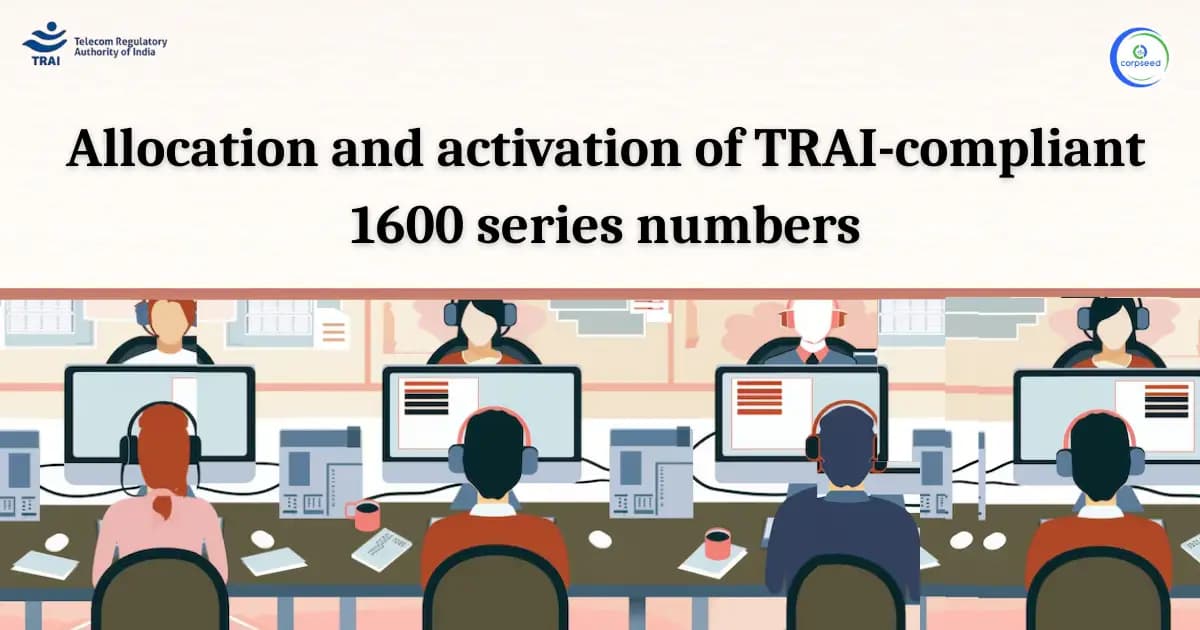
Allocation and Activation of TRAI-Compliant 1600 Series Numbers

Allocation_and_activation_of_TRAI-compliant_1600_series_numbers_Corpseed.webp
Last updated : 2026-12-30

For a long time, phone calls were the simplest way for financial institutions, investment companies, and pension offices to reach their customers. In recent times, due to a rise in spam and fraud calls, customers have to think twice before answering calls from unknown numbers. As a result, even genuine calls from trusted banks are missed. To solve this issue, the Telecom Regulatory Authority of India (TRAI) has introduced the 1600 series to help people instantly recognise genuine financial institution calls, without any fear or confusion.

What is the 1600 Series Number?

The 1600 is a dedicated series number that TRAI has introduced to identify between genuine service calls and fraud and spam calls. These numbers are not used for sales or promotion purpose, it will be used for transaction-related matters only.

In the past, banks, mutual funds, and pension organisations used regular phone numbers, which increased the number of daily financial fraud cases. These calls pressure customers to share their sensitive information or make an urgent payment. Over time, this made it easier for scammers to copy calling patterns and pose as trusted institutions. Customers had no reliable way to tell whether a call was genuine, which led to ignored calls and growing risk.

With the 1600 series, that uncertainty reduces. The set series number range will inform the customer that the call is coming from a verified source. Hence, this will make consumers aware and also protect them from serious financial loss. 

Role of DoT, TRAI, and Sector Regulators

The 1600 series is implemented through a coordinated framework for the Banking, Financial Services, and Insurance (BFSI) sector. The Department of Telecommunications (DoT) has reserved the 1600 range for verified institutional calls.

The Telecom Regulatory Authority of India (TRAI) has defined adoption timelines, while regulators like the Reserve Bank of India (RBI), Securities and Exchange Board of India (SEBI), and Pension Fund Regulatory and Development Authority (PFRDA) validate eligible entities. Telecom Service Providers (TSPs) assign numbers only after regulatory validation.

Adoption Status and Industry Readiness

Before announcing mandatory deadlines, TRAI held regular consultations with Telecom Service providers and financial regulators through the Joint Committee of Regulators. 

As a result, around 485 regulated entities have already adopted the 1600 series, collectively using more than 2,800 numbers. This ensured that technical integration is stable and operationally workable.

On the basis of this progress, TRAI decided that the ecosystem is ready for time-bound, mandatory adoption across the financial sector.

--------------Blog Contact Form-------------

1600 Series Mandate for RBI-Regulated Entities

Entities regulated by the Reserve Bank of India must migrate to the 1600 series through a phased timeline. This approach ensures uninterrupted customer communication while allowing institutions adequate time for technical and operational adjustments.

  • Commercial Banks: Public sector banks, private banks, and foreign banks must shift all service and transactional calls to the 1600 series by 1 January 2026, ensuring early adoption across major banking institutions.
  • Large NBFCs and Digital Banks: NBFCs with asset size above INR 5,000 crore, along with payments banks and small finance banks, must complete onboarding by 1 February 2026, balancing scale with readiness.
  • Other RBI-Regulated Entities: Remaining NBFCs, cooperative banks, and regional rural banks must migrate by 1 March 2026, allowing smaller institutions sufficient time to update systems and inform customers.

1600 Series Mandate for SEBI-Regulated Entities

For capital market institutions, trusted voice communication is essential for investor confidence. SEBI-regulated entities are required to adopt the 1600 series within defined timelines to ensure clarity in investor-facing calls.

  • Mutual Funds and AMCs: All mutual funds and asset management companies must adopt the 1600 series by 15 February 2026, covering investor service, transaction-related, and operational communications.
  • Qualified Stockbrokers: Stockbrokers classified as Qualified Stockbrokers by stock exchanges must migrate to the 1600 series by 15 March 2026, improving the reliability of investor interactions.
  • Other SEBI Intermediaries: Other SEBI-registered intermediaries may voluntarily adopt the 1600 series after verification of registration details, supporting wider adoption without immediate compulsion.

1600 Series Mandate for PFRDA-Regulated Entities 

Pension-related communication involves long-term savings and sensitive personal decisions. Clear identification of service calls is essential.

Central Recordkeeping Agencies and Pension Fund Managers must adopt the 1600 series by 15 February 2026.

This helps pension subscribers confidently engage with official calls regarding contributions, account changes, and retirement benefits.

Insurance Sector Adoption Status

The adoption timeline for insurance companies is currently under discussion between TRAI and the Insurance Regulatory and Development Authority of India. Mandatory deadlines for insurance entities will be notified separately once consultations are completed.

Allocation and Activation Process Explained

The allocation and activation of 1600 series numbers follow a structured process. Each stage is designed to ensure regulatory compliance, technical readiness, and smooth migration without disrupting ongoing customer communication.

  • Number Allocation: Eligible entities apply for 1600 numbers through their Telecom Service Provider. The provider verifies regulatory status and approvals before allocating numbers to ensure only authorised usage.
  • Number Activation: Allocated numbers are activated and integrated with existing call infrastructure, including IVRs, call routing systems, and CRM platforms, enabling seamless handling of customer calls.
  • Call Migration: Institutions gradually shift service and transactional calls from regular numbers to the 1600 series, while informing customers to avoid confusion or missed communication.

What the 1600 Series Changes for Customers

For customers, the shift to the 1600 series delivers immediate clarity and confidence. It simplifies how people identify genuine financial calls and reduces uncertainty when receiving service-related communication.

Calls from a 1600 number are easier to trust, reducing hesitation and increasing the likelihood that customers answer important service and transaction-related calls.
Customers receive timely updates without fear of fraud, improving engagement with banks, investment firms, and pension institutions.
The 1600 series becomes a clear visual signal of legitimacy, helping customers quickly identify and avoid suspicious or impersonation-based calls.

Why Financial Institutions Must Prioritise Compliance

Beyond meeting regulatory requirements, adopting the 1600 series strengthens everyday operations.

Call pickup rates improve as customers feel safer answering verified numbers. Repeat call attempts are reduced, saving time and resources for service teams. Customer interactions become more efficient, with conversations starting on a foundation of trust. 

In financial services, where credibility shapes long-term relationships, using a recognised and trusted number range directly supports service quality, reputation, and customer confidence.

Conclusion

The allocation and activation of TRAI-compliant 1600 series numbers represent a practical step toward safer financial communication in India. By clearly separating genuine institutional calls from fraudulent ones, the system addresses a real public concern.

Timely adoption of the 1600 series helps regulated entities protect customers, rebuild trust, and ensure that essential voice communication remains effective, reliable, and secure.

This portion of the site is for informational purposes only. The content is not legal advice. The statements and opinions are the expression of author, not corpseed, and have not been evaluated by corpseed for accuracy, completeness, or changes in the law.

BOOK A FREE CONSULTATION

Get help from an experienced legal adviser. Schedule your consultation at a time that works for you and it's absolutely FREE.

Author

Parul Bohral, a BALLB graduate and experienced legal researcher and content writer with expertise in various legal areas, including corporate law and intellectual property. I have gained valuable experience in esteemed legal environments, where...

Learn More >>