
MNRE Extends Self-Certification Deadline for 200+ kW Solar Inverters till 31 Dec 2026
MNRE extends self-certification for 200+ kW solar inverters till 31 Dec 2026. Understand the impact and get expert compliance support today.
Schedule a Call Back
Introduction
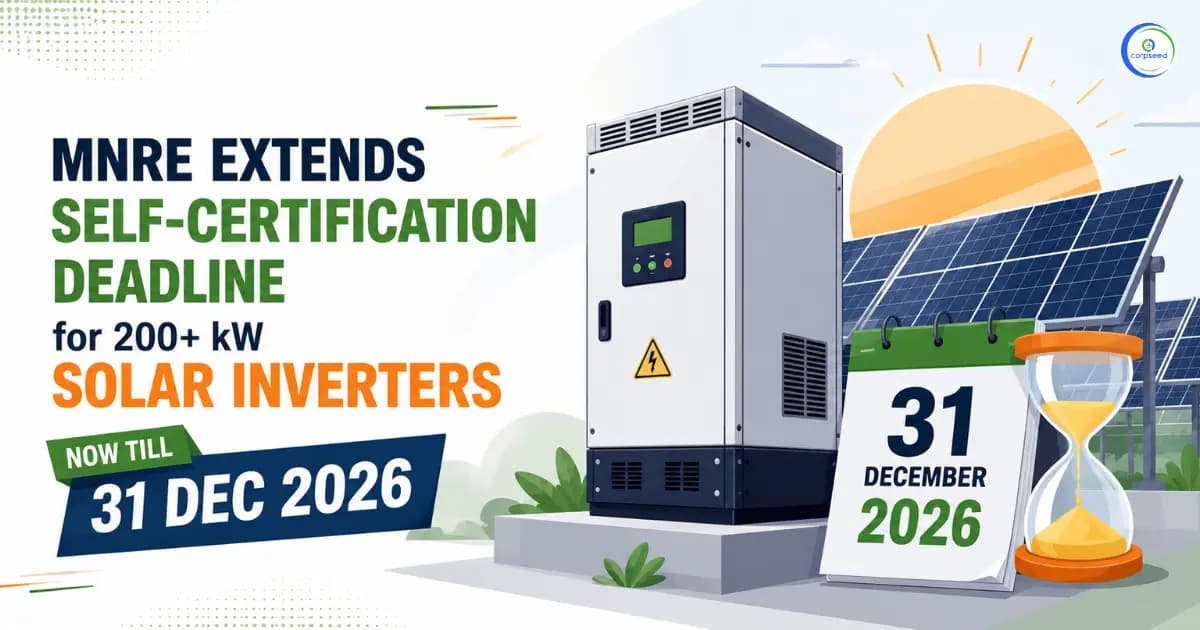
The Ministry of New and Renewable Energy (MNRE) has given manufacturers more time to comply with the BIS requirements for Solar Photovoltaic (SPV) inverters above 200 kW. Under a notification issued on 3 July 2026 the self-certification facility will now remain available until 31 December 2026 or until further orders, whichever is earlier.
This extension allows manufacturers to continue supplying eligible high-capacity solar inverters without interruption while they complete the BIS registration process. However, the relaxation applies only to the registration timeline. Manufacturers must still meet the set technical standards as well as maintain the required certifications and test reports to qualify for self-certification.
What Has MNRE Announced?
The notification amends the Solar Systems, Devices and Components Goods Order, 2025, which prescribes mandatory Indian Standards (IS/BIS) for various solar products.
Under the latest amendment:
- Manufacturers of SPV inverters above 200 kW can continue using the self-certification route until 31 December 2026.
- This relaxation is limited to Items 4 and 5 covered under the Solar Systems, Devices and Components Goods Order, 2025.
- Manufacturers are still required to comply with the applicable technical standards and maintain valid test reports and supporting documents.
- The relaxation applies only to BIS registration requirements, and does not dilute product quality or safety standards.
Which products are covered and what are the conditions?
The notification applies to:
SPV inverters (solar inverters) with a capacity of more than 200 kW (items 4 and 5 of the 2025 Order).
To use self-certification, manufacturers must have:
For item 4 inverters:
Valid IEC certificates corresponding to:
- IS 16221 (Part 2): 2015 / IEC 62109-2: 2011- Safety of power converters for PV systems.
- IS/IEC 61683: 1999- efficiency/performance of inverters.
For item 5 inverters:
Valid IEC certificates corresponding to:
- IS 16221 (Part 2): 2015 / IEC 62109-2: 2011 (safety).
- IS 16169: 2019 / IEC 62116: 2014 (anti-islanding protection).
- IS 17980: 2022 / IEC 62891:2020 (monitoring/control aspects).
Plus:
- Test reports from accredited test laboratories that match these standards.
So, quality requirements are not removed; only the formal BIS registration step is temporarily relaxed.
Why Has MNRE Extended the Deadline?
MNRE has extended the self-certification deadline to ensure that the shift to mandatory BIS registration does not disrupt the supply of high-capacity solar inverters or delay ongoing solar projects. The extension provides manufacturers with additional time to complete the required compliance process, along with maintaining the availability of compliant products in the market.
Limited Testing Infrastructure
One of the primary reasons for the extension is the limited number of accredited laboratories in India capable of testing solar PV inverters exceeding 200 kW against all prescribed standards. Since these facilities are limited, manufacturers have experienced delays in obtaining test reports and completing the certification process. The additional time helps ease this bottleneck and allows testing laboratories to handle the growing demand more efficiently.
Additional Time for Compliance
The extension also gives manufacturers more time to complete the remaining compliance requirements, including:
- Product testing at accredited laboratories
- Obtaining the required IEC certifications
- Preparing technical documentation
- Completing the BIS registration process
This allows businesses to plan their compliance activities without unnecessary pressure while ensuring products continue to meet the required quality and safety standards.
Without this extension, many utility-scale and commercial solar projects could have faced equipment shortages, project delays, and increased procurement challenges due to the limited availability of BIS-registered high-capacity solar inverters.
How does this Impact Businesses in India?
The extension of the self-certification deadline for solar inverters above 200 kW provides significant relief to multiple stakeholders in India’s solar industry. It helps manufacturers, EPC companies, project developers, investors and testing laboratories continue operations smoothly while preparing for full BIS compliance. The move also reduces the risk of project delays and supply chain disruptions in the rapidly growing renewable energy sector.
Solar Inverter Manufacturers (>200 kW)
Manufacturers of high-capacity solar inverters can continue selling and deploying eligible products in India under the self-certification framework until 31 December 2026.
Benefits:
- Can continue selling and deploying high-capacity inverter models in India under self-certification up to 31 December 2026.
- Gain time to plan BIS registration properly instead of rushing.
- Can spread testing costs and lab workload over several months.
- Reduce the risk of having products suddenly blocked from the market because BIS registration is not yet completed.
This helps both:
- Global OEMs supplying inverters to Indian solar plants.
- Indian manufacturers scaling up to >200 kW products.
EPC Contractors and Project Developers
EPC companies and solar project developers:
- Do not have to redesign plants or delay projects due to inverter compliance issues.
- Can continue using familiar >200 kW inverter models that already have IEC certificates and lab reports.
- Face less risk of last-minute changes to equipment due to regulation gaps.
This is especially helpful for:
- Utility-scale solar parks.
- Large rooftop and commercial/industrial (C&I) projects.
- Solar plants under tight commissioning deadlines.
Project Owners and Investors
Project owners and investors:
- Get more regulatory certainty that planned projects can proceed on time.
- Can sign contracts with confidence that inverter compliance is covered under this extension.
- Are less likely to face financing delays due to technical regulatory bottlenecks.
Testing Laboratories and BIS Ecosystem
Accredited labs and BIS:
- Get more time to expand capacity and invest in equipment and staff.
- Can slowly build robust processes for SPV inverter testing.
MNRE and BIS can refine registration systems before full enforcement for >200 kW inverters kicks in.
How Can Businesses Make the Best Use of This Extension?
The extended self-certification period gives businesses valuable time to prepare for mandatory BIS compliance. Companies should use this opportunity to complete pending compliance activities, organise technical documentation, and plan to ensure a smooth transition before the extension expires.
For Manufacturers
Manufacturers should use this period to prepare for mandatory BIS certification by:
- Reviewing IEC certifications for every inverter model
- Maintaining updated accredited laboratory reports
- Creating comprehensive self-certification documentation
- Booking testing slots well in advance
- Preparing BIS application documents
For EPCs and developers
- Ask inverter suppliers for:
- IEC certificates.
- Accredited lab reports.
- A clear statement explaining the MNRE extension and how their inverter is covered.
- Include clauses in contracts that suppliers will:
- Maintain compliance.
- Move to BIS registration when required.
For Lenders and Insurers
Financial institutions should verify:
- The inverter capacity exceeds 200 kW
- Products qualify under the extension
- Valid technical documentation is available
- Self-certification is properly supported by laboratory reports
Is the MNRE Extension a Fair Decision?
The extension has raised questions about whether it gives an unfair advantage to certain manufacturers. However, the notification is a targeted measure aimed at addressing testing, and compliance challenges specific to solar inverters above 200 kW. It is intended to support the smooth implementation of large solar projects without compromising quality, or creating long-term regulatory exemptions.
Why it is a sensible decision
- It targets only >200 kW SPV inverters, where:
- Testing is complex and capacity is limited.
- The impact on big solar projects is highest.
- It keeps quality requirements intact via IEC standards and lab tests.
- It avoids sudden project disruption, which could hurt India’s solar targets.
- It is time-bound (till 31 December 2026 or further orders), showing it is a temporary support, not permanent leniency.
Impact on other inverter types
Other inverter manufacturers (for:
- Smaller solar inverters.
- Non-solar inverters.
- Consumer UPS, etc.)
are not directly affected:
- Their own regulations and BIS rules continue as before.
- They do not lose anything; they simply do not get this particular time-bound procedural relaxation.
So, this is not “injustice”; it is a targeted adjustment to fix a real bottleneck in a specific segment (large solar inverters) that is critical for utility-scale renewable growth.
How Does This Extension Affect Quality, Customer Satisfaction, and the Environment?
Although the extension delays mandatory BIS registration, it continues to emphasize product quality, customer confidence and India's commitment to expanding renewable energy responsibly.
Quality and safety
Quality is protected because:
- The extension is conditional:
- Manufacturers must have valid IEC certificates aligned to Indian BIS standards.
- They must have test reports from accredited labs.
- The referenced standards cover:
- Converter safety.
- Efficiency and performance.
- Anti-islanding (so inverters disconnect correctly when grid fails).
- Monitoring and control of PV systems.
So, even under self-certification, inverters must meet strong technical standards.
Customer and project-sponsor satisfaction
Project owners, utilities, and large customers:
- Avoid delays caused by a lack of BIS-registered >200 kW models.
- Gain confidence that products are tested and certified internationally, plus checked by accredited labs.
Result: smoother commissioning and fewer last-minute surprises.
Environmental conditions
Large solar projects need high-capacity inverters. Allowing these inverters to continue under a controlled self-certification regime:
- Helps India install more solar capacity without administrative delays.
- Supports national renewable energy and climate goals.
- Reduces longer-term dependence on thermal (coal/gas) generation.
So the extension supports environmental improvement, not the opposite.
Impact on the Indian Economy
The extension is expected to support investment, manufacturing and project execution across India's solar sector while reducing compliance-related disruptions during the transition period.
Positive economic impacts
- Protects investment pipelines in utility-scale and large C&I solar projects.
- Keeps EPC, manufacturing, and construction activity moving without inverter-related bottlenecks.
- Supports domestic and foreign investment confidence in India’s solar sector.
- Encourages manufacturers and labs to build capacity for high-end testing and compliance.
Risks if misused
- If companies misuse self-certification and do not actually comply with IEC standards and lab testing, there could be:
- Performance failures.
- Safety incidents.
- But the notification’s technical conditions aim to prevent this.
Overall, the net economic effect is positive if MNRE and BIS monitor compliance properly.
Impact on Other Countries
The notification also has implications for international manufacturers and testing agencies that supply products or compliance services to the Indian solar market.
Foreign inverter manufacturers:
- Benefit because their existing IEC certifications can still be used to access the Indian market during the extension.
- Gain more time to plan Indian BIS registration.
Foreign test labs:
- May work with Indian manufacturers to provide IEC-aligned test evidence.
Global climate and energy goals:
- India’s solar growth remaining stable helps global renewable and climate commitments.
No foreign country is disadvantaged, instead, suppliers of high-quality inverters and testing services find India a more predictable market.
Implementation Timeline
Understanding the implementation timeline helps businesses plan their compliance activities and prepare for mandatory BIS registration before the extension expires.
- MNRE notification is dated 3 July 2026.
- The extension for >200 kW SPV inverters (items 4-5 of the 2025 Order) runs:
- Till 31 December 2026, or
- Till further orders, whichever is earlier.
Earlier:
- Self-certification had already been extended till 30 June 2026.
So, companies now have six more months (July–December 2026) with controlled self-certification.
Business Opportunities Created by the Extension
The additional compliance window creates new opportunities for manufacturers, service providers, testing laboratories, and other businesses supporting India's growing solar industry.
Inverter Manufacturers: Manufacturers can use this period to strengthen product compliance while expanding their presence in India's utility-scale solar market. Use this window to:
- Increase sales of >200 kW models for utility-scale projects.
- Finalize BIS registration strategies.
- Strengthen designs to fully meet Indian standards.
EPC Companies and Developers: Developers and EPC contractors can continue executing projects while preparing procurement strategies for future BIS compliance requirements.
- Secure contracts and plan projects using known >200 kW models.
- Make sure documentation for IEC certificates and lab reports is complete for all projects.
Testing Laboratories: The extension provides laboratories with additional time to enhance testing capabilities and meet the increasing demand for high-capacity inverter certification.
Invest in:
- Equipment.
- Accreditation.
- Expertise for SPV inverter testing.
Become preferred labs for manufacturers preparing for full BIS compliance
Compliance and Consulting Firms: Regulatory consultants can support manufacturers by simplifying compliance requirements and preparing them for the mandatory BIS certification process. Offer services:
- Mapping IEC standards to Indian IS.
- Helping manufacturers create self-certification documentation.
- Planning BIS registration pathways and timelines.
Financial Institutions and Insurers: Banks, lenders, and insurers can strengthen due diligence processes while continuing to finance compliant renewable energy projects.
Design project finance and insurance products that:
- Recognize this self-certification regime.
- Require proof of IEC compliance and accredited test reports
Key Takeaway for Businesses
The extension provides businesses with valuable additional time to prepare for mandatory BIS compliance. Companies that use this period to strengthen their compliance processes and complete pending requirements will be better positioned for a smooth transition once the self-certification window closes.
- The extension is a temporary measure to support the uninterrupted supply of high-capacity solar inverters and keep large solar projects on track.
- It does not reduce or relax the applicable quality and safety requirements.
- Businesses should use this opportunity to:
- Strengthen compliance with the applicable Indian Standards and IEC requirements.
- Complete BIS registration well before the extended deadline.
- Position themselves as reliable and compliant suppliers when mandatory BIS certification comes into full effect.
About the Author

Parul Bohral
Legal Content WriterParul Bohral, a BALLB graduate and experienced legal researcher and content writer with expertise in various legal areas, including corporate law and intellectual property. I have gained valuable experience in esteemed legal environments, where I have strengthened my research skills, allowing me to approach legal writing with precision and depth.
As a legal content writer, I am committed to delivering work that not only informs but also engages readers. By staying informed about the latest trends in content marketing and regulatory developments, I ensure that my writing remains sophisticated and meets industry standards. My dedication to thorough research enables me to craft content that is both insightful and impactful.