
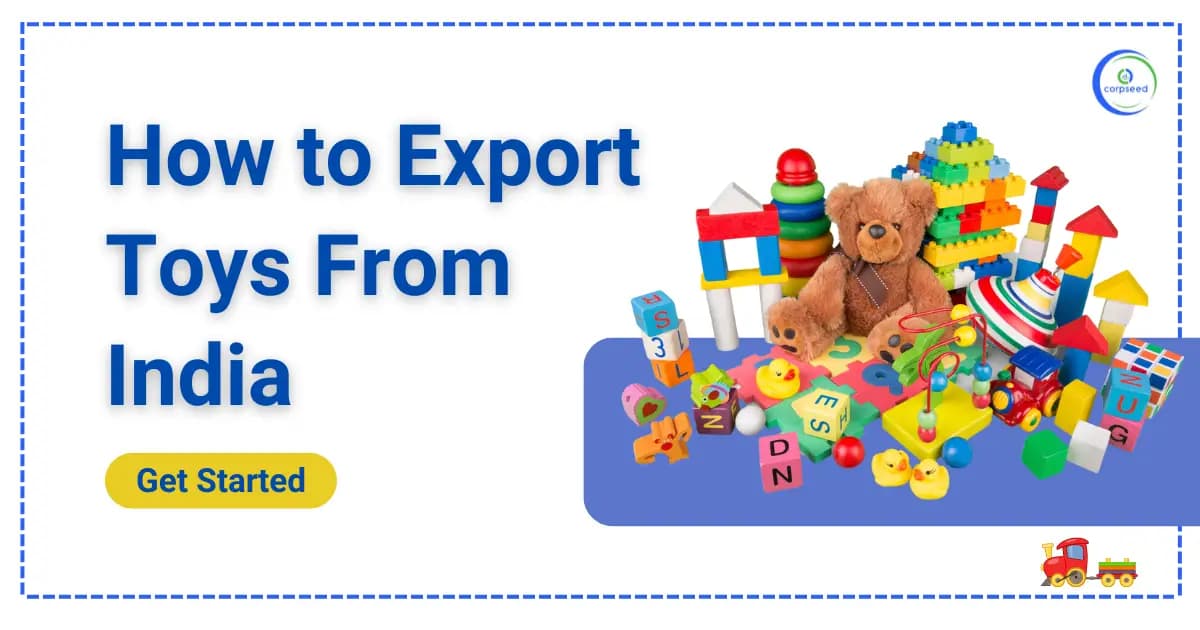
How To Export Toys From India
You must adhere to the terms of payment, delivery, and other preform invoices in order to export toys and plastic goods.
Schedule a Call Back
Introduction: Export Toys
Toys and the sale of plastic products constitute a sizable market economy in a country that exports toys. Government agencies look at the safety and hygienic standards of the toys exported from India. Relevant compliance by the importing countries is necessary before the export of the products to such countries because the countries that import toys from India also have different principles and tests for the import of toys, such as the United Kingdom adhering to the EU Toys Direct, the United States Consumer Product Safety Improvement Act (CCPSA), etc.
Schedule a Call Back
Background of the Toys Businesses
The government has undertaken a number of initiatives to support toy manufacturing in the nation, including setting up toy labs, allocating plots, and hosting fairs to encourage the formation of new businesses. The Indian exporter must locate the market where there is an opportunity for the pertinent business from India and must attend numerous expos and meetings to market and comprehend international standards. It would then be easy to sell the product.
The Uttar Pradesh government has organized a number of fairs and taken action to upgrade the MSME sector, the apparel industry, and the manufacturing of toys (handmade, wooden toys). It has also provided support for these companies' high-level business operations. Ensuring that the toys are compliant with import and export regulations requires adherence to International Standard EN 71-1. Since each country has its own certification, this is not enough for the export of the products to that nation. The fundamental procedures of that nation must be followed if you are exporting your goods to foreign customers.
In this lesson, we will discover the legal requirements that must be met by toy exporters in order to export their products to another nation. It is necessary to look into all export clearance formalities, documents needed for them, and the customs clearance process.
You must adhere to the terms of payment, delivery, and other preform invoices in order to export toys and plastic goods. Once these conditions have been confirmed, you will receive an export clearance order. After the quality check, the packaging process is done. The Generalized System of Preference (GSP), the Certificate of Origin, and other paperwork are completed in accordance with the category of toy being exported (games, sports, plastic, wooden). The HTS code and ITS code are given for the export of toys.
The government is streamlining export procedures by approving a number of international agreements and resolving the exporters' complexity issues to ensure smooth export procedures. Trade agreements of all kinds, including unilateral trade agreements, bilateral trade agreements, multilateral trade agreements, etc., are very beneficial to the exporter.
Types Of Toys That Could Be Sent To The International Market
Toys are generally available for export by Indian exporters in two types: the large variety of toys available in India are classified into two categories based on the purpose, use, and application of the toys.
- Educational toys - This includes mind games and cards, where the application of the mind and skill of the players is largely required.
- Recreational toys - This includes luck-based games where the chance of winning and losing cannot be defined based on your luck and chance and the probability of the same. They include toy games such as remote control games, battery toys, and electrical toys.
Governing Bodies For The Toy Business In India
The following are the prominent and governing organizations and committees for the toy market:
- Toy Association of India (TAI)
The TAI was formed in 1995 with the objective of bringing together traders, manufacturers, and users on a platform to promote businesses. It works with the business community and the government to resolve problems that come up in trading businesses and to assist in the establishment of upgraded technology in those businesses.
- BIS Standard for the Grant of License
Toy Quality Control Order, 2020
The Department of Promotion of Industry and Internal Trade (DPIIT), Ministry of Commerce and Industry, has made the quality check compulsory for the safety of toys for the use of children below the age of 14 years of age. Except for businesses that operate entirely for export purposes, they are subject to mandatory BIS certification.
The following are the Indian certification standards for goods, articles, and toys:
| S. No. | Indian Standard | Title |
| 1 | Part 1: IS 9873: 2018 | Part 1: relates to the safety of the physical properties of the toys |
| 2 | Part 2: IS 9873: 2017 | Part 2: Safety from Flammability of toys |
| 3 | Part 3: IS 9873: 2017 | Part 3: safety for migration of products |
| 4 | Part 4: IS 9873: 2017 | Part 4: Safety of toys from swings, slides, and other indoor and outdoor use. |
| 5 | Part 7:IS 9873: 2017 | Part 7: for the safety of toys through the requirement, testing for use |
| 6 | Part 9: IS 9873: 2017 | Part 9: safety of Toys from Certain phthalates esters used in toys and related products |
| 7 | IS 15644: 2006 | For the Safety of E-toys |
- Import-export Code (IEC)
The Import-export code is the business identification code for the export of products from India. Until they are exempted by the board, all businesses operating from or to an international boundary must obtain IEC. The board grants licenses to limited companies, proprietorship firms, partnership firms, LLPs, HUFs, trusts, and societies. Even non-registered businesses need to obtain the IEC for their import and export businesses. In this way, the DGFT makes the import and export processes easy and legal and marks the businessmen as verified.
Registration Process at DGFT for IEC
- Register and Login to the DGFT website.
- Fill out the IEC application
- Mention personal information, PAN number, etc.
- Verify the Email address and mobile number.
- Attach the required documents in the prescribed format such as
- Address proof (Aadhar card)
- A canceled cheque of the applicant
- GST registration number and incorporation certificate
- Digital signature certificate of the applicant
- Submit the application
- The certificate shall be granted within five working days from the date of filing the application.
- Link the IEC with DGFT
- GSTIN certification
Businesses have to obtain the GST registration number, which is unique for every business. This is mandatory for the taxation of goods and services.
Prior to production, various legal compliances must be completed regarding the goods necessary for the export of toys, such as wood products, chips, dyes, extracts, red sanders, extracts, powders, musical instruments, furniture (limited size), dolls, and handicrafts.
Documents Necessary For Exporting Toys From India
For the export business, the exporter must obtain the following documents, including:
- PAN number provided by the Income Tax Division
- License from DGFT (IEC number) as per the EXIM policy
- BIS registration certificate (if required)
- A copy of the toys' legal status certificate, which was issued by the principal chief conservator at the state-of-production unit. Toys are verified by the party issuing the export license and adding additional conditions.
- GST registration certificate
- Bank account in the name of the firm.
- Valid address proof of the firm
License Fees For Export Of Toys
- Each product's license from the licensing body, BIS, costs Rs. 1000 plus GST.
- The BIS license must be renewed on an annual basis for an additional fee of Rs. 1000.
- According to the product specification, which is subject to annual upgrades, the cost for IEC licensing ranges from Rs. 1,000 to Rs. 100,00.
Conclusion
The manufacturer, who is in the export business, is required by law to use the ISI standard and obtain the BIS certification for the toys they are producing. Businesses operating solely for export are exempt from the certification requirement for articles. Electronic and non-electronic toys, gaming products, etc. are required for the stages of assembly, collection, and production. While running the business from India, it is necessary to take IEC licensing and import country compliance into consideration. For more information on licensing and successfully operating the business, get in touch with our team. Every compliance requirement, which is difficult for the business owner to meet himself, is taken care of by one of our team members.
About the Author

Ravikant Rai
Content WriterHi, I am Ravikant Rai, a Technology Lawyer, who graduated with B. A. LL. B. (Hons.) from the school of law and legal affairs at Noida International University I have two years of experience writing about law as a freelancer and aspiring lawyer. In addition, I have experience writing, Content creation and researching legal information. Various articles on business and corporate law, cyber law and cyber security have been authored by me. I currently work in technology deals, corporate, fintech, and cyber law, etc. I have written documents on a variety of subjects, including software licensing, license to use, terms of service, privacy policy, cloud computing service, data security, confidentiality, and data protection, as well as shareholder and founder requirements.
Related articles
India-New Zealand FTA: How Startups Can Export Duty-Free and Enter the New Zealand Market
2026-10-23
Exporting Handicrafts & Home Decor from India: IEC, DGFT & Customs Compliance Checklist
2026-10-14
How to Export Through Amazon Global & Etsy From India: Complete MSME Export Guide
2026-10-13
Textile & Apparel Testing in India: Export Compliance with REACH, Azo Dyes & ISO 105 Guide 2026
2026-09-02
India's Engineering Exports Rise 21% to 11.48 Billion US Dollar: Opportunities for Indian Exporters
2026-07-31
Export Compliance Checklist for Oman: A Complete Guide for Indian Exporters to Avoid Customs Delays
2026-07-29