
GOBARdhan Scheme 2026: Complete Guide to India’s National CBG Plan
The Union Cabinet has approved the GOBARdhan Scheme 2026, India’s National Circular Bioenergy Scheme, with a total outlay of 23,731 crore rupees. Implemented from FY 2026-27 to FY 2035-36, the plan aims to increase domestic Compressed Biogas production nearly ten-fold. It will turn cattle dung, agricultural residue, press mud, municipal organic waste and other biomass resources into clean fuel and organic manure.
Schedule a Call Back
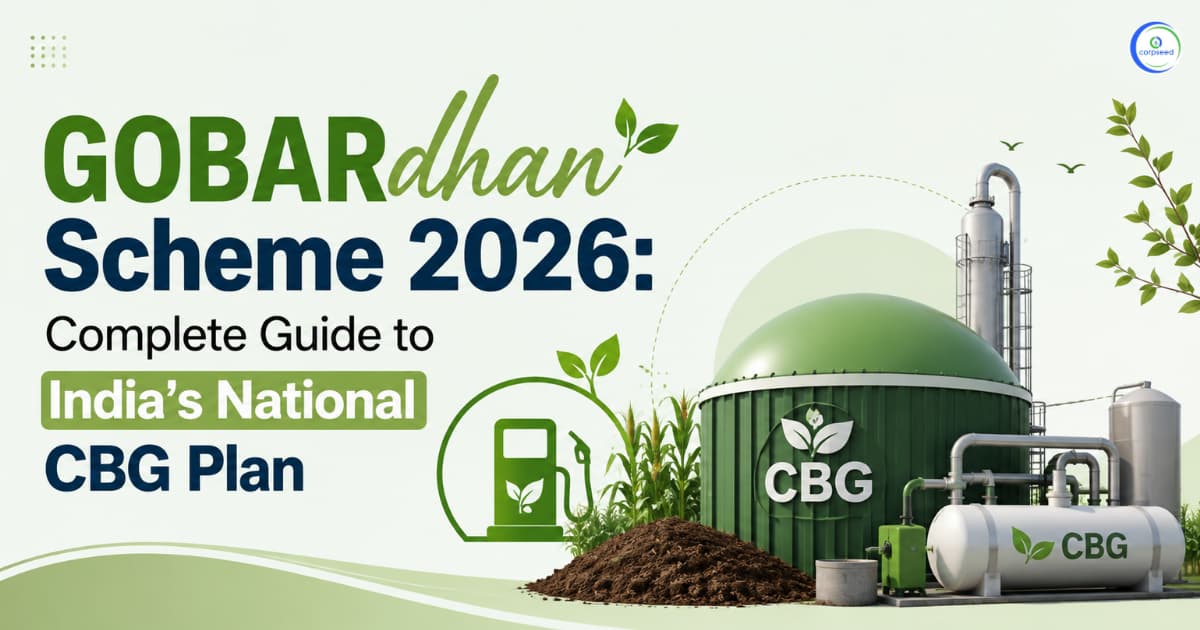
The Union Cabinet has approved the GOBARdhan Scheme 2026, India’s National Circular Bioenergy Scheme, with a total outlay of 23,731 crore rupees. Implemented from FY 2026-27 to FY 2035-36, the plan aims to increase domestic Compressed Biogas production nearly ten-fold. It will turn cattle dung, agricultural residue, press mud, municipal organic waste and other biomass resources into clean fuel and organic manure.
The scheme combines assured CBG offtake, a stable CBG price of 2,110 rupees per MMBTU, capital assistance, pipeline infrastructure and credit support. Eligible greenfield CBG projects may receive capital assistance of up to 2 crore rupees per TPD, subject to official conditions and project approval. Brownfield expansion projects may also qualify.
The scheme aims to elevate the living standards of the rural population by creating new employment opportunities for farmers, cooperatives, MSMEs, women entrepreneurs, and rural businesses in areas such as gathering, transportation, plant operations, pipeline operations, and manure processing.
Schedule a Call Back
What Is the GOBARdhan Scheme and Why Was It Introduced?
CBG is produced from feedstock, meaning the organic material used to make biogas. Feedstock may include agricultural residue, cattle dung, press mud from sugar mills, municipal organic waste, and other biomass resources.
The gas is cleaned and compressed so it can work like natural gas. The process also produces organic manure. This creates a circular bioeconomy, where biological waste becomes energy, useful products and income.
The need for gas in India is increasing for transport, domestic, and industrial uses. Increased use of domestic CBG can help reduce India’s dependence on foreign fossil fuels. This program will also help attract huge investment from the private sector.
How Earlier Programmes Built India’s CBG Sector?
The plan builds on the SATAT initiative, which helped develop CBG production and offtake systems. Offtake is an arrangement under which a buyer purchases the gas produced.
Other measures included Market Development Assistance for organic manure, the Biomass Aggregation Machinery Scheme and the Development of Pipeline Infrastructure Scheme. Central Financial Assistance was also provided under the National Bioenergy Programme.
Together, these programmes helped commission more than 200 CBG plants, according to the PIB release. GOBARdhan now brings the main parts of the value chain under one national framework.
Six Growth Engines Under GOBARdhan
1. Assured CBG Offtake
The CBG Offtake Commitment Framework is designed to provide producers with a dependable market. City Gas Distribution (CGD) companies will purchase CBG to meet the notified obligations.
The obligation applies to CNG used in transport and domestic PNG. CNG means Compressed Natural Gas for vehicles. PNG means Piped Natural Gas supplied to homes.
| Financial Year | CBG Obligation |
| FY 2026-27 | 3% |
| FY 2027-28 | 4% |
| FY 2028-29 onward | 5% |
This CBG blending obligation creates a long-term demand signal. Predictable buying may improve a project's bankability, meaning its ability to attract loans and investment. Developers must still check the final offtake conditions.
2. CBG Price: 2,110 rupees per MMBTU
In India, the administered price of CBG is 2,110 rupees per MMBTU in the announced pricing policy. MMBTU stands for Million British Thermal Units; it is a unit used to measure energy in gas. Pricing policy in India is based on Government support and market costs.
The announced pricing policy provides a minimum 10-year horizon for the 2,110 rupees-per-MMBTU price. This may help producers plan sales and lenders assess project finance.
3. Capital Assistance for CBG Projects
Eligible greenfield CBG projects may receive CBG capital assistance of up to 2 crore rupees per TPD of installed capacity. TPD means tonnes per day. A greenfield project is a completely new project.
Eligible brownfield projects expanding their production capacity may also receive support. A brownfield project is an existing project being expanded.
Assistance may extend beyond core machinery to certain feedstock-aggregation assets, organic-manure processing and value-addition equipment. People often search for a “CBG plant subsidy in India”, but the official release calls this benefit capital assistance.
This is subject to certain conditions and the project's approval. This will be contained within the “up to” range mentioned. Developers should review the final eligibility criteria before developing an investment strategy.
4. Development of Pipeline Infrastructure
The scheme supports both cluster-based and standalone CBG pipeline infrastructure. These pipelines may connect CBG plants with trunk pipelines or City Gas Distribution networks.
Improved pipeline connectivity may reduce gas transportation costs and increase reliability. The final guidelines will set out the technical criteria and eligibility criteria for eligible infrastructure.
5. Credit Guarantee Support
An exclusive credit guarantee will assist eligible CBG MSME-related CBG projects. Credit guarantees share part of the risk of lending institutions, provided that certain conditions are fulfilled.
The credit guarantee mechanism can improve lending institutions' confidence, reduce collateral requirements, and facilitate MSME funding for CBG projects. This may improve access to formal finance for eligible MSMEs, women entrepreneurs and first-time developers, subject to lender assessment and applicable conditions.
6. CBG Ecosystem Challenge Fund
The CBG Ecosystem Challenge Fund will facilitate feedstock assessment and mapping, aggregation systems, and district-level planning. It will also support technology adoption, process optimization, value-added manure production, and stakeholder training.
These activities may strengthen local supply chains. Better mapping can show what feedstock exists, where it is found and when it is available. District planning may improve collection routes and reduce competition for limited material.
Who Is Eligible for GOBARdhan Scheme 2026?
The announced framework identifies support for the following project categories and participants across the CBG value chain:
- Eligible greenfield CBG projects: Completely new CBG projects may receive capital assistance of up to 2 crore rupees per TPD.
- Eligible brownfield projects: Existing CBG plants may receive support when expanding their production capacity.
- Eligible MSME-based CBG projects: These projects may benefit from the proposed credit-guarantee mechanism.
- Private CBG developers: Private developers may participate in plant development and related value-chain activities.
- Cooperatives and rural entrepreneurs: They may explore opportunities in feedstock collection, transport, plant operations, and manure processing.
- Women entrepreneurs and first-time developers: The credit-support framework aims to widen their participation.
- Farmers and feedstock aggregators: They may benefit from supplying cattle dung, crop residue, and other organic materials.
Key Benefits of GOBARdhan Scheme 2026
The key benefits of this scheme are:
- Assured CBG offtake through a long-term demand framework
- Administered CBG price of 2,110 rupees per MMBTU
- Capital assistance for eligible projects
- Pipeline infrastructure support for eligible connections
- Credit guarantee for eligible MSME-based projects
- Feedstock consolidation and ecosystem development at local level
- Employment generation and manure utilization in rural areas
These advantages may enhance the viability of the project, but are not a guarantee for approval, funding, or profits.
Expected Economic, Rural and Environmental Impact
The Government expects nearly ten-fold growth in domestic CBG production. If achieved, this may increase private investment in bioenergy and reduce dependence on imported fossil fuels.
Farmers and rural businesses may gain opportunities in feedstock supply, transport, plant operations and manure processing. This waste-to-wealth activity may support rural employment. Better use of farm and municipal waste may also reduce dumping and greenhouse-gas emissions.
There are expectations of faster project execution using digital governance and simpler institutions. The above are only expectations, not achievements yet. Success will be measured by factors such as feedstock, technology, financing and infrastructure.
What CBG Developers Should Check Before Applying
The cabinet announcement is not the total guideline for how to apply. Developers need to look at the final official rules for information on eligibility, eligible costs, how to apply, documentation, technical standards, financial requirements, and off-take requirements. Approval and disbursement procedures must also be confirmed.
Conclusion
The GOBARdhan Scheme 2026 provides a national framework to increase CBG production by converting organic waste into energy and useful products. With an outlay of 23,731 crore rupees, the scheme brings together CBG offtake support, an administered price framework, capital assistance, pipeline connectivity, credit-guarantee support and ecosystem development.
These measures may improve the bankability of projects and make investment in compressed biogas in India more attractive to suitable developers and lenders. Farmers and rural entrepreneurs may gain opportunities in feedstock supply, transportation, plant services, and organic manure processing. MSMEs, cooperatives, women entrepreneurs and first-time developers may also find stronger access to the CBG value chain. However, the announcement does not guarantee loans, project approval, profits or investment returns.
Success will depend on reliable feedstock, sound technology, careful financial planning and effective implementation. Prospective developers should study the final operational guidelines for eligibility, eligible costs, application procedures, technical standards, offtake conditions and disbursement rules before making any CBG plant investment decision. Careful verification can protect both borrowers and investors.
About the Author

Mahek Sancheti
Content WriterMahek Sancheti, BAJMC graduate with a deep passion for writing. As a content writer, video content creator, creative content creator, and scriptwriter, I bring stories to life through words and visuals. I honed my skills by working with a prominent news agency, where I excelled in crafting compelling narratives and engaging content. Coming from a journalism and mass communication background I have skills to craft engaging narratives that captivate audiences. With a keen interest in writing and creativity, I aim to deliver impactful and meaningful content that resonates with diverse audiences.
https://www.linkedin.com/in/mahek-sancheti-837196212
Related articles
What Are the Best Government Funding Schemes for Startups in India in 2026?
2026-08-27
Maharashtra Unveils Ambitious Renewable Energy & Storage Policy 2025-36
2026-05-18

Gujarat Biotechnology Policy 2022-27: Incentives, Eligibility, Benefits & Complete Guide
2026-05-01

Government Has Introduced Startup India Fund of Funds 2.0: What Does this ₹10,000 Crore Boost Mean for You?
2026-04-16
What Makes Phase II of the Capital Goods Scheme a Game-Changer for Industry?
2026-03-25
Aadhaar made Mandatory for Price Stabilisation Fund (PSF) Scheme Beneficiaries
2025-10-31