Oncology medical devices play a crucial role in the diagnosis, treatment, monitoring, and management of cancer patients, ranging from basic diagnostic equipment to advanced radiation and therapeutic systems. In India, these devices are governed by the Medical Devices Rules, 2017, however, a significant number of oncology products previously lacked a clearly defined risk classification framework, resulting in regulatory ambiguity for manufacturers and importers.
Table of Contents
- Regulatory Background and Legal Basis
- Purpose of the Oncology Risk Classification List
- CDSCO Risk Classification List for Oncology Medical Devices
- Impact on Manufacturers and Importers
- Relevance for Digital Health and AI-Based Oncology Devices
- Post Market Surveillance and Compliance Expectations
- Conclusion
To address this gap, the Central Drugs Standard Control Organization (CDSCO) has released a dedicated risk classification list for oncology medical devices. The classification categorizes devices into appropriate risk classes based on their intended use and potential risk to patients, thereby determining applicable licensing requirements, medical device registration pathways, and compliance obligations. This development enhances regulatory clarity and strengthens oversight under India’s medical device regulatory framework.
This blog examines the scope of the CDSCO risk classification, outlines the different risk categories, provides examples of devices under each class, and explains the regulatory implications for manufacturers and importers.
Regulatory Background and Legal Basis
In India, medical devices are governed by the Medical Devices Rules, 2017, which is risk based framework. There are four types of devices, namely Class A, Class B, Class C, and Class D. The classification defines the degree of scrutiny used in the manufacturing, import, and post-market surveillance.
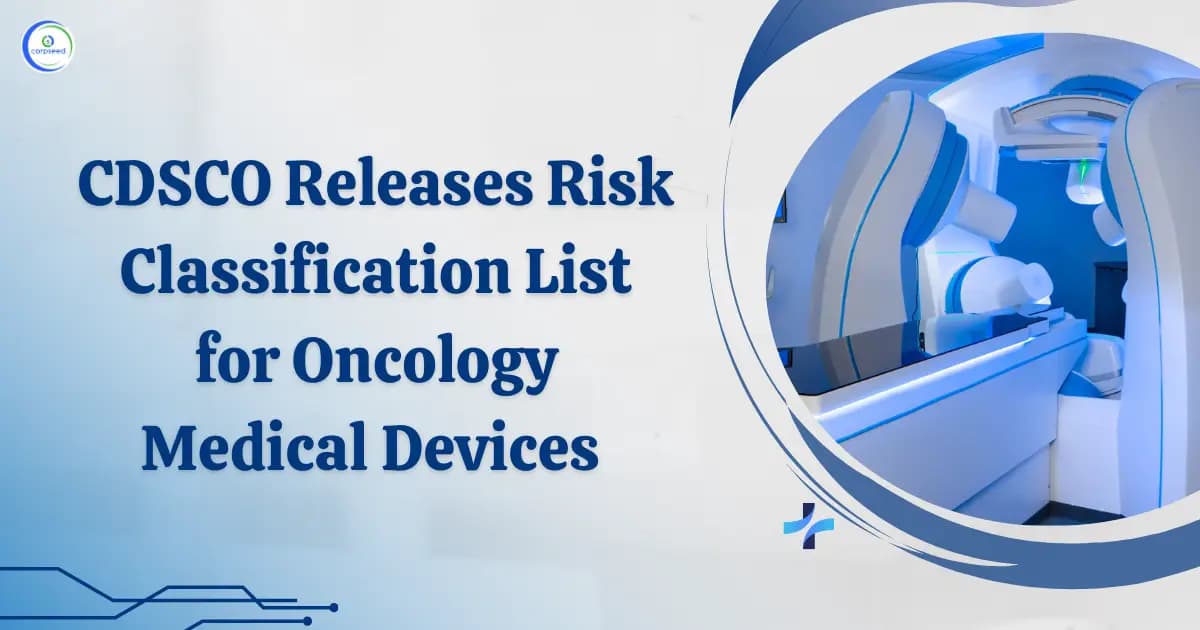
The oncology device risk classification list has been published in accordance with the Medical Devices Rules that enable CDSCO to inform and explain the device classifications. The list determines particular oncology-related equipment and attributes them to the corresponding risk category depending on factors like invasiveness, duration of use, therapeutic purpose, and the potential impact on patient safety.
By issuing this list, CDSCO has officially defined oncology devices as a unique and complicated category that must be treated with precise regulatory treatment rather than general interpretation.
Purpose of the Oncology Risk Classification List
The main goal of publishing a separate list of oncology device classifications is to remove ambiguity. In the past, manufacturers used to experience delays or inconsistent interpretations of whether a device was in low risk category or high risk category.
The classification list is intended to provide consistent regulatory decisions, predictable approval schedules, and better alignment between device risk and compliance requirements. It also helps in patient safety by confirming that higher-risk oncology equipment is evaluated and monitored more stringently.
The other significant role is to introduce new technologies like software-based cancer detection devices into a specific regulatory environment.
CDSCO Risk Classification List for Oncology Medical Devices
India follows a globally aligned risk-based classification model. Devices are categorised according to the level of risk they pose to patients and users. As the risk increases, the regulatory controls become more stringent. The four classes are-
- Class A representing low risk
- Class B represents low to moderate risk
- Class C represents moderate to high risk
- Class D represents high risk
The oncology classification list assigns devices to these classes based on their intended clinical role rather than their technological complexity alone. This classification also determines the applicable medical device registration requirements for manufacturers and importers, ensuring compliance with CDSCO regulations.
--------------Blog Contact Form-------------
Class A Low Risk
Class A oncology devices present minimal risk to patients and are generally used for basic procedural support or diagnostic assistance without directly influencing treatment outcomes.
- Surgical Consumables: Low-risk, single-use devices used for basic diagnostic or procedural support in oncology, including cervical cytology scrapers and cervical cone knives used for tissue sampling.
- External Therapeutic Accessories: Devices such as extracorporeal hyperthermia applicators that are applied externally to deliver controlled heat without invasive interaction with the body.
Class B Low to Moderate Risk
Class B oncology devices involve increased patient interaction and are commonly used for diagnostic evaluation, supportive care, or procedural assistance in cancer management.
- Diagnostic and Visualisation Devices: Products used to support cancer diagnosis and clinical evaluation, including breast transilluminators and flexible video bronchoscopes used in oncological examinations.
- Supportive Care Systems: Devices designed to manage treatment-related side effects, such as scalp cooling systems used to reduce chemotherapy-induced alopecia.
- Minimally Invasive Surgical Kits: Procedure-specific kits like balloon kyphoplasty systems are used in the management of cancer-related vertebral compression fractures.
Class C Moderate to High Risk
Class C oncology devices are directly involved in cancer diagnosis, treatment, or long-term patient management, where performance failures may significantly impact patient safety or clinical outcomes. Due to their higher risk, these devices require strict adherence to medical device registration procedures before being marketed or imported in India.
- Software-Based Medical Devices: Artificial intelligence and machine learning driven software applications used for cancer detection, image interpretation, or diagnostic decision support, regulated as Software as a Medical Device.
- Active Therapeutic and Surgical Systems: Devices directly involved in tumour treatment or oncology-related surgical procedures, including microwave ablation systems, robotic guidance platforms, and linear accelerator quality assurance devices.
- Implantable Medical Devices: Invasive or long-term implantable products such as vascular access ports, catheters, and polymer-metal oesophageal stents that maintain prolonged interaction with the human body.
Class D High Risk
Class D oncology devices are critical to life-sustaining or lifesaving cancer treatment, where any failure or malfunction may result in serious injury or fatal outcomes.
- Advanced Radiotherapy Systems: Highly specialised devices such as stereotactic radiosurgery systems used in the treatment of central nervous system tumours.
- Active Therapeutic Implants: Life-sustaining cancer treatment systems, including alternating electric field therapy devices designed to disrupt cancer cell division.
- Brachytherapy and Embolisation Products: Critical oncology treatment components such as brachytherapy source spacers and embolisation particles, including both bioabsorbable and non-bioabsorbable variants.
Impact on Manufacturers and Importers
Publication of the oncology risk classification list has major consequences for the device manufacturers and importers functioning in the Indian market.
- First, it enables companies to be able to correctly identify the risk category and regulatory route to follow before product development or market entry. This minimizes time wastage due to misclassification and regulatory rework.
- Second, it allows to plan compliance costs, documentation activities, and approval schedules better. Firms with greater risk equipment can invest upfront in clinical evidence creation and quality system reinforcement.
- Third, importers will have the advantage of understanding whether their products need a central license and what documents should be provided during the import registration.
Relevance for Digital Health and AI-Based Oncology Devices
Among the most striking features of the classification list is the official inclusion of software-based oncology devices. Class C has been assigned to artificial intelligence-based tools for cancer detection and diagnostic software.
This is an indication of an increased awareness that software may have a direct impact on clinical decision-making and thus needs to be controlled as seriously as physical medical equipment. Oncology software developers are now required to adhere to medical device regulations such as validation, risk management, and post-market monitoring.
This action puts India on par with the global regulatory trends and enhances patient safety in digital oncology solutions.
Also Read: CDSCO Registration for Oncology Medical Devices
Post Market Surveillance and Compliance Expectations
Risk classification also shows post-market obligations. High-risk oncology equipment is under more vigilance requirements such as adverse event reporting, regular safety updates, and regulatory inspections.
Manufacturers need to have strong mechanisms to keep track of the performance of the device after it has been used and take corrective measures where necessary. Proper risk classification guarantees that these obligations are proportionate to the potential harm posed by the device.
Conclusion
The publication of the CDSCO risk classification list for oncology medical devices is a significant step towards enhancing India's medical device regulatory system. CDSCO has given much-needed clarity to manufacturers, importers, and regulatory professionals by categorizing risk in oncology-specific products.
Such classification facilitates improved compliance planning, promotes responsible innovation, and improves patient safety in cancer care. For companies operating in the oncology medical device space, understanding and aligning with this classification is now a critical component of regulatory strategy and market access in India.
This portion of the site is for informational purposes only. The content is not legal advice. The statements and opinions are the expression of author, not corpseed, and have not been evaluated by corpseed for accuracy, completeness, or changes in the law.
BOOK A FREE CONSULTATION
Get help from an experienced legal adviser. Schedule your consultation at a time that works for you and it's absolutely FREE.