
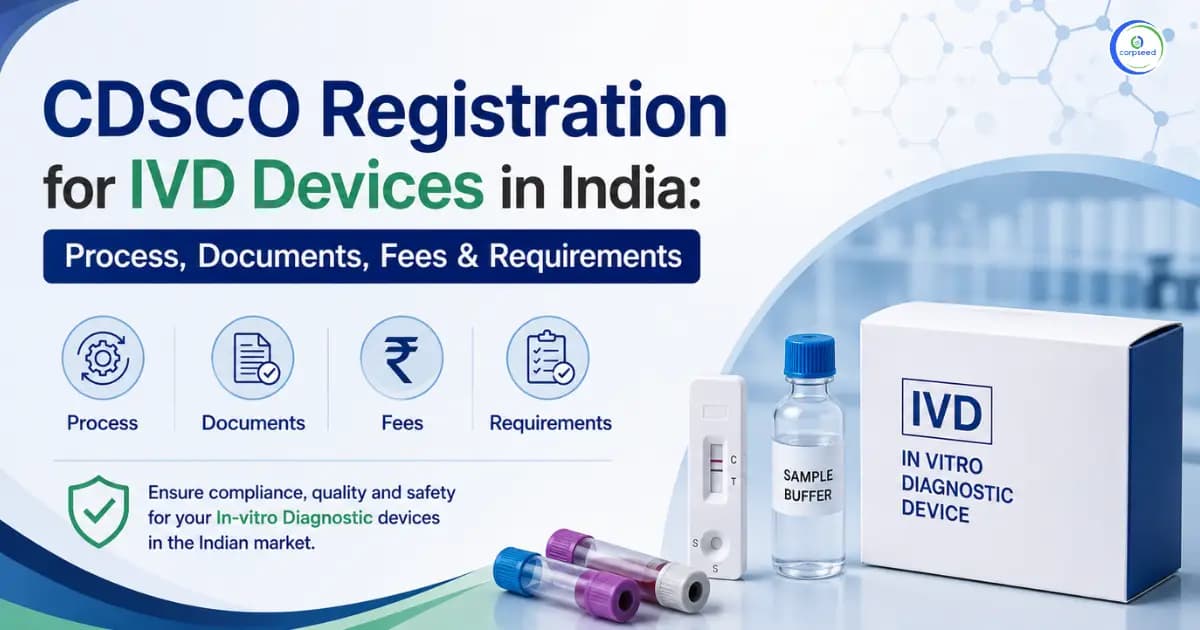
CDSCO Registration for IVD Devices: Process, Documents, Fees & Requirements
Planning to manufacture or import an in-vitro diagnostic (IVD) device in India? Before placing the product on the market, businesses need to understand the CDSCO requirements that apply to their device.
Schedule a Call Back
2,100+ CDSCO medical device assignments since 2018
Clients include Endolite India, Mankind Pharma, Ossur India, ADK Health Care, Credence Prosthetic India, V2U Physio Asia, International Electro Medical Company, Radimage Healthcare India, Istok New Hearing AID, Simpladent Implant Solutions, Starkey Laboratories India, Gentec Medical (12 of 1,100+ served since 2018).
A few more clients we've served in this industryHide the list
- Pharma and healthcare
- Endolite India · Mankind Pharma · Ossur India · ADK Health Care · Credence Prosthetic India · V2U Physio Asia · International Electro Medical Company · Radimage Healthcare India · Istok New Hearing AID · Simpladent Implant Solutions · Starkey Laboratories India · Gentec Medical · Cureesse Pharma · Hygiene Medicus · Nexus Surgical and Medicare
- More clients
- Meditronix Corporation · Nilkamal · Haesi GHL · GHL · Servotech Power Systems · Elektrocraft India · Happy Medicare · Anantaa Gsk Innovations · Cogmac Technologies · Aficionados Tech · Superceuticals · Truevis Technologies · 1008 Digital Health · BDS Services · Evoq Imaging Technologies · Premier Medical Systems and Devices · Riransa · Vitrag Infra Projects · Insta Biotech · Digital Acoustics · Artificial Learning Systems India · Nfilade Security Solutions · Humors Tech · K2O Consulting
Introduction
IVDs are used to examine samples such as blood, urine, tissues and other specimens to help detect diseases, monitor health conditions or support clinical decisions. Because these products are closely linked to diagnosis and patient safety, they are regulated under India's medical device framework.
The regulatory pathway can vary based on the device's intended use, risk classification and whether it is being manufactured in India or imported.
This guide explains CDSCO registration for IVD devices, including classification, the registration process, documents, licensing requirements, fees, timelines and common compliance challenges.
CDSCO IVD Registration at a Glance
| Requirement | Details |
| Regulatory Authority | CDSCO |
| Main Regulatory Framework | Medical Devices Rules, 2017 |
| IVD Classification | Class A, B, C and D |
| Classification Basis | Risk and intended use |
| Import Regulation | Central Licensing Authority |
| Key Compliance Areas | Product, quality, performance, labelling and licensing |
| Professional Support | Classification, documentation, filing and compliance |
IVDs in India are regulated under the Drugs and Cosmetics Act, 1940 and the Medical Devices Rules, 2017. CDSCO's official IVD guidance also confirms the A, B, C and D risk classification system.
What Is CDSCO Registration for IVD Devices?
CDSCO, or the Central Drugs Standard Control Organisation, is India's central regulatory authority for medical devices and IVDs.
Under the Medical Devices Rules, 2017, IVDs are regulated based on their risk and intended purpose. The regulatory requirements can cover areas such as import, manufacturing, performance evaluation, sale and distribution.
IVD products can include:
- Diagnostic test kits
- Reagents
- Calibrators
- Analysers
- Blood screening products
- Pregnancy test kits
- Molecular diagnostic products
- Products used for infectious disease testing
The exact approval, or licence required depends on the product and the applicable regulatory pathway.
Who Needs CDSCO IVD Registration in India?
Businesses involved in manufacturing or importing regulated IVDs need to identify and comply with the requirements applicable to their products.
- Indian Manufacturers
An Indian manufacturer must follow the manufacturing licensing requirements applicable to the IVD's classification and manufacturing activity. The licensing authority and application route can vary according to the class of the device.
- Importers
Importers need to follow the applicable import licensing requirements before bringing regulated IVD products into India. CDSCO states that the Central Licensing Authority is responsible for import of all classes of IVD medical devices.
- Foreign Manufacturers
Foreign companies that want to sell IVD products in India must meet CDSCO requirements. They may also need to appoint an authorised Indian representative for the registration process.
IVD Device Classification under CDSCO
Before applying for CDSCO registration for IVD devices, one of the most important steps is determining the correct risk classification.
CDSCO classifies IVD medical devices into four categories:
- Class A: Low risk
- Class B: Low-moderate risk
- Class C: Moderate-high risk
- Class D: High risk
The classification is based on the risk parameters specified in Part II of the First Schedule to the Medical Devices Rules, 2017. CDSCO also publishes classification information for IVDs, which can be updated from time to time.
Correct classification matters because it can affect the applicable licence, documentation, performance evaluation and regulatory review.
CDSCO Registration Process for IVD Devices
The IVD registration in India process generally involves the following stages.
- Identify the Product and Intended Use
Start by defining the product clearly. This includes its intended purpose, technology, components, specimen type and proposed use.
The intended use is particularly important because it can influence the applicable risk classification.
- Determine the IVD Classification
The product should be assessed against the applicable classification rules and CDSCO classification information.
If the classification is incorrect, the application may face regulatory queries or require changes before it can proceed.
- Identify the Applicable Regulatory Route
The applicant should determine whether the product is being manufactured in India or imported and identify the applicable licence or regulatory pathway.
This is an important stage because the requirements are not identical for every IVD product.
- Prepare the Regulatory Documents
The applicant needs to compile the technical, quality, manufacturing, performance and labelling documents applicable to the product.
- Submit the Application
The relevant application is submitted through the applicable regulatory system along with the required documents and statutory fees.
CDSCO's medical device framework provides online application routes through the SUGAM system for relevant medical device applications.
- Respond to Regulatory Queries
The authority may review the application and raise queries where clarification or additional information is required.
A complete and consistent response can help avoid unnecessary delays.
- Obtain the Applicable Licence or Approval
Once the application satisfies the applicable requirements, the relevant licence or approval can be granted.
The exact route and documentation depend on the product, classification, and whether it is imported, or manufactured.
Documents Required for CDSCO IVD Registration
The document list can vary depending on the product, and regulatory pathway. Common requirements may include:
- Applicant details
- Manufacturer details
- Product description
- Intended use
- Device specifications
- IVD classification
- Manufacturing information
- Quality management system documents
- Performance evaluation information
- Testing reports
- Stability information, where applicable
- Labelling and packaging details
- Instructions for use
- Manufacturing site information
- Details of the authorised Indian agent for imported products
- Regulatory certificates and approvals, where applicable
For some IVD products, performance evaluation and testing requirements can be particularly important. CDSCO maintains updated information on laboratories involved in IVD performance evaluation.
CDSCO Import Licence for IVD Devices
Businesses importing IVD products should confirm the applicable import requirements before shipping the product to India.
The application may require information relating to the foreign manufacturer, product specifications, intended use, classification, labelling, quality documentation and other regulatory information.
The Indian authorised agent can also have an important role in regulatory communication and compliance for imported products.
Import compliance does not end when the licence is granted. Changes to approved product details, manufacturing arrangements, labelling or other regulatory information may require further action under the applicable rules.
CDSCO Manufacturing Licence for IVD Devices
Indian manufacturers must comply with the manufacturing requirements applicable to their IVD products.
Depending on the product and classification, requirements may cover:
- Manufacturing premises
- Quality management systems
- Production processes
- Testing arrangements
- Technical personnel
- Quality control
- Product documentation
- Labelling and packaging
The applicable licensing authority can differ based on the device class and regulatory route. Businesses should determine the correct route before preparing the application rather than assuming that every IVD follows the same process.
CDSCO Registration Fees and Timeline
There is no single fee, or timeline that applies to every IVD application. The overall cost can depend on factors such as:
- IVD classification
- Import or manufacturing route
- Number of products
- Applicable statutory fees
- Documentation requirements
- Performance evaluation requirements
- Testing requirements
- Consultancy or professional support
The processing time can also vary depending on the application, completeness of documents and regulatory queries.
For this reason, businesses should avoid relying on a fixed timeline without first reviewing their specific product and regulatory pathway.
Common Challenges in IVD Registration
A technically strong product can still face regulatory delays if the application is not prepared correctly.
Common issues include:
- Incorrect product classification
- Incomplete technical documentation
- Inconsistent information across documents
- Labelling deficiencies
- Inadequate performance information
- Incorrect application details
- Missing supporting documents
- Delayed responses to regulatory queries
- Differences between manufacturer and importer information
Addressing these issues before filing can make the regulatory process more organised and reduce avoidable back-and-forth.
Also Read: CDSCO Registration for Disposable Medical Devices in India: Process, Documents and Requirements
Why Choose Corpseed for CDSCO IVD Registration?
Managing IVD compliance can be difficult when businesses are unfamiliar with India's medical device regulations.
Corpseed can support businesses with:
- IVD product classification assistance
- Regulatory pathway assessment
- Documentation support
- Application preparation and filing
- Regulatory query assistance
- Import licence support
- Manufacturing licence support
- Post-approval compliance assistance
Our team can help businesses understand the requirements applicable to their specific IVD product and manage the regulatory process in a structured manner.
Planning to register an IVD device in India? Book a free consultation with our experts today and get guidance on the applicable CDSCO requirements.
Conclusion
CDSCO registration for IVD devices is not a one-size-fits-all process. The requirements depend on factors such as the product's intended use, risk classification and whether it is manufactured in India or imported.
Getting the classification and regulatory pathway right at the beginning can make the application process much smoother. Businesses also need to pay attention to technical documents, performance requirements, labelling and continuing compliance.
If you are planning to manufacture or import an IVD device in India, professional guidance can help you identify the applicable requirements and prepare the application correctly.
Need help with CDSCO IVD registration? Book a free consultation with Corpseed experts today.
About the Author

Parul Bohral
Legal Content WriterParul Bohral, a BALLB graduate and experienced legal researcher and content writer with expertise in various legal areas, including corporate law and intellectual property. I have gained valuable experience in esteemed legal environments, where I have strengthened my research skills, allowing me to approach legal writing with precision and depth.
As a legal content writer, I am committed to delivering work that not only informs but also engages readers. By staying informed about the latest trends in content marketing and regulatory developments, I ensure that my writing remains sophisticated and meets industry standards. My dedication to thorough research enables me to craft content that is both insightful and impactful.
Related articles
CDSCO Test License for Import (Form MD-16)
2026-11-18
CDSCO Test License for Manufacturing (Form MD-12)
2026-11-18
Medical Devices PLI Scheme 2026: New Applications, Eligibility, Incentives & Benefits
2026-11-12
CDSCO MD-7 Endorsement for Medical Devices: A Practical Guide for Manufacturers
2026-10-23
CDSCO Export NOC for r-DNA Products: Who Needs It?
2026-10-21
CDSCO Registration: A Simple Guide to Getting Your License in India 2026
2026-10-21