
CDSCO Drug Labelling & Packaging: A Complete Compliance Guide
Drug labelling mistakes cost manufacturers recalls, import bans, and regulatory notices. This guide covers every CDSCO packaging requirement, from Schedule H red line rules to SUGAM portal artwork approvals, so products reach market without friction.
Schedule a Call Back
2,100+ CDSCO medical device assignments since 2018
Clients include Endolite India, Mankind Pharma, Ossur India, ADK Health Care, Credence Prosthetic India, V2U Physio Asia, International Electro Medical Company, Radimage Healthcare India, Istok New Hearing AID, Simpladent Implant Solutions, Starkey Laboratories India, Gentec Medical (12 of 1,100+ served since 2018).
A few more clients we've served in this industryHide the list
- Pharma and healthcare
- Endolite India · Mankind Pharma · Ossur India · ADK Health Care · Credence Prosthetic India · V2U Physio Asia · International Electro Medical Company · Radimage Healthcare India · Istok New Hearing AID · Simpladent Implant Solutions · Starkey Laboratories India · Gentec Medical · Cureesse Pharma · Hygiene Medicus · Nexus Surgical and Medicare
- More clients
- Meditronix Corporation · Nilkamal · Haesi GHL · GHL · Servotech Power Systems · Elektrocraft India · Happy Medicare · Anantaa Gsk Innovations · Cogmac Technologies · Aficionados Tech · Superceuticals · Truevis Technologies · 1008 Digital Health · BDS Services · Evoq Imaging Technologies · Premier Medical Systems and Devices · Riransa · Vitrag Infra Projects · Insta Biotech · Digital Acoustics · Artificial Learning Systems India · Nfilade Security Solutions · Humors Tech · K2O Consulting
Introduction
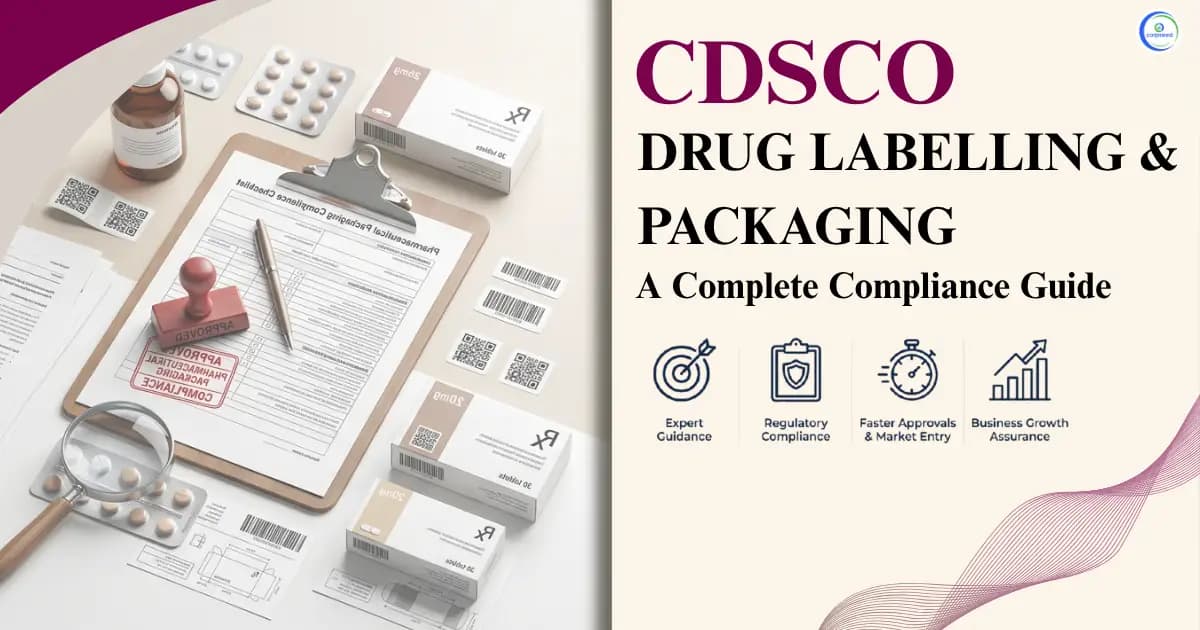
Indian pharmaceuticals' packaging is not about branding at all. It is mandated by law, and it is ensured by the Central Drugs Standard Control Organisation under the jurisdiction of an extensive network of laws.
The label, the font size, the warning message - each has its own legal significance. Compliance failures result in product recalls and import restrictions.
Adoption of digital-first label approvals via the SUGAM portal has added to the stringent enforcement. End-to-end integration in the supply chain ensures that artwork is validated from end to end.
This guide acts as a detailed pathway for both national and international pharma companies. The guide details how regulatory roadblocks can be avoided while ensuring product continuity.
Schedule a Call Back
Key Regulatory Framework: Drugs and Cosmetics Act & Rules
- The Statutory Foundation of Indian Pharma Labelling
India's legislation concerning pharmaceutical labelling is based on two pieces of legislation, which include the Drugs and Cosmetics Act, 1940, and the Drugs and Cosmetics Rules, 1945.
The Act contains both civil and criminal liabilities, while the rules specify requirements for the packages in numbers.
All producers involved in both national and international trade should regard them as living standards of compliance, not archival resources.
- Enforcing Agencies and Legislative Scope
The Central Drugs Standard Control Organisation (CDSCO) acts as the apex body for approving drugs and their regulation. State Drug Controllers ensure that the manufacturing companies adhere to regulations.
Part IX of the Drugs and Cosmetics Rules 1945 governs the precise labelling boundaries for finished formulations, both domestically produced and imported.
Recent industrial compliance reviews confirm that regulatory auditors now cross-verify physical packaging against digitally submitted artwork on the SUGAM portal. Discrepancies between the two result in immediate compliance flags.
Mandatory Labeling Requirements for Finished Formulations
Labelling requirements for pharma packaging in India necessitate accuracy at all stages of labelling. Compliance in pharmaceutical labelling involves the following mandatory label components:
- The Generic Name Prominence and Font Size Rule
The proper name or generic name of the drug must appear more prominently than the brand name on every label. This is non-negotiable.
Practitioners observe that the generic name must appear in font size at least half that of the brand name, or larger. In cases where no brand name is used, the generic name must dominate the visual hierarchy of the label.
This generic name font size rule prevents proprietary name dominance and ensures immediate consumer and dispenser clarity at point of dispensing.
- Mandatory Manufacturing Metadata and License Information
Every immediate container of a finished formulation must carry the manufacturing date, expiry date, and batch number. These elements support traceability across the entire supply chain.
The manufacturing license number issued by the State Licensing Authority must appear on the outer label. The complete physical address of the production facility is equally mandatory.
Omissions in manufacturing metadata represent one of the most frequent compliance failures observed during regulatory audits across Indian pharmaceutical plants.
- Distinctive Warnings and the Red Vertical Line Mandate
Prescription-only medicines classified under Schedule G, H, H1, and X carry specific visual warning mandates under the Drugs and Cosmetics Rules 1945.
Schedule H drugs must carry the statement: "Schedule H Drug, Warning: To be sold by retail on the prescription of a Registered Medical Practitioner only."
The vertical red striping mandate stipulates that there should be a distinct red vertical stripe visible in the left margin of the label. The mandate serves to remind handlers that the formulation is under restriction.
The higher schedules, H1 and X, have enhanced visibility and labelling stipulations, which also include security ink printing requirements in certain states.
Packaging Material Standards and Quality Control
- Adherence to Indian Pharmacopoeia Packaging Standards
Material quality test is very critical prior to regulatory approvals for primary packaging components such as Type I glass vials, HDPE bottles, and bromobutyl rubber closures.
The Indian Pharmacopoeia defines the requirements for chemical resistance, moisture vapor transmission rate, and compatibility with active pharmaceutical ingredients.
The packaging material should be tested to confirm absence of any extractables and leachables within the stated shelf-life period.
- Integrity Controls and Tamper-Evident Engineering
Blister packs, strip packs, and multi-dose containers must incorporate tamper-evident seals that remain visible through distribution and retail handling.
Physical testing protocols must validate shelf-life stability across the diverse climatic zones of the Indian subcontinent, spanning humid coastal regions and dry inland conditions.
Stability testing data must support the packaging claim on the label. Regulatory submissions without stability correlation are routinely rejected under current CDSCO review protocols.
Common Compliance Pitfalls and How to Avoid Them
- Misalignment of Artwork and Font Size Discrepancies
Product rejection during import clearance or market surveillance frequently traces back to incorrect font ratios between the generic name and the proprietary name.
Improper contrast levels and illegible warning texts generate immediate customs hold-ups and trigger regulatory queries from state drug inspectors.
Artwork submitted to the SUGAM portal and printed labels must match exactly, pixel-for-pixel alignment is now verified digitally in several jurisdictions.
- Failure to Update Labels via the SUGAM Portal
An operational failure arises where labelling is not updated in the SUGAM portal according to new guidelines by the government, or from pharmacovigilance alerts on the drug's safety.
During audits, there have been found to be systemic failures where the labels on the products include outdated contraindications and lack black box warnings that may have been included in pharmacovigilance safety updates after approval.
In all cases of pharmacovigilance findings that require the updating of labels worldwide, a similar update must also occur on the SUGAM portal for India.
Conclusion
CDSCO drug labelling and packaging compliance is not a one-time activity. It is a continuous, audit-ready operational discipline.
The Central Drugs Standard Control Organisation and the Drugs and Cosmetics Rules 1945 together comprise the foundation of India's pharmaceutical quality assurance framework. Both the aforementioned measures ensure public health and foster an even-playing field for market players both nationally and internationally.
Validation of artwork, material quality checks, and regular updates on the SUGAM portal prevent potential product recalls, import rejection, and other licensing issues.
India's pharmaceutical manufacturing sector, now among the largest globally by volume and export value, demands that every market participant treat labelling compliance as a strategic operational priority, not a procedural afterthought.
Before bringing any pharmaceutical product to the Indian market, pharmaceutical companies should ensure that competent regulatory authorities have approved their products in terms of packaging and labelling. Non-compliance will not be economical compared to compliance.
About the Author

Mahek Sancheti
Content WriterMahek Sancheti, BAJMC graduate with a deep passion for writing. As a content writer, video content creator, creative content creator, and scriptwriter, I bring stories to life through words and visuals. I honed my skills by working with a prominent news agency, where I excelled in crafting compelling narratives and engaging content. Coming from a journalism and mass communication background I have skills to craft engaging narratives that captivate audiences. With a keen interest in writing and creativity, I aim to deliver impactful and meaningful content that resonates with diverse audiences.
https://www.linkedin.com/in/mahek-sancheti-837196212
Related articles
CDSCO Test License for Import (Form MD-16)
2026-11-18
CDSCO Test License for Manufacturing (Form MD-12)
2026-11-18

Medical Devices PLI Scheme 2026: New Applications, Eligibility, Incentives & Benefits
2026-11-12
CDSCO MD-7 Endorsement for Medical Devices: A Practical Guide for Manufacturers
2026-10-23
CDSCO Export NOC for r-DNA Products: Who Needs It?
2026-10-21
CDSCO Registration: A Simple Guide to Getting Your License in India 2026
2026-10-21