
BIS IS 302-2-80: Household and Similar Electrical Appliances – Safety Part 2-80: Particular Requirements for Fans
IS 302-2-80 is the authoritative Indian Standard titled "Household and Similar Electrical Appliances — Safety, Part 2-80: Particular Requirements for Fans." This standard serves as a special product family standard that provides essential safety requirements for all electric fans, including ceiling fans, duct fans, partition fans, pedestal fans, and table fans, operating at a rated voltage not exceeding 250V (single-phase) or 415V.
Schedule a Call Back
200+ BIS ISI certification assignments since 2018
Clients include Kito India, Hirotec India, N Steels, Agromach Engineering, Annapurna Agronics Machinery, Rajco Metal Industries, Vedas Cement, Sreechem Resins, Appl GOR Plastics India, Global Colours and Chemicals, Deki Electronics, Emerson Process Management (India) (12 of 150+ served since 2018).
A few more clients we've served in this industryHide the list
- Engineering and manufacturing
- Kito India · Hirotec India · N Steels · Agromach Engineering · Annapurna Agronics Machinery · Rajco Metal Industries · Vedas Cement
- Chemicals and materials
- Sreechem Resins · Appl GOR Plastics India · Global Colours and Chemicals
- Electronics and technology
- Deki Electronics · Emerson Process Management (India) · Martelx Electronics
- More clients
- Geepas India · Tegamen Safety Products · TNY Services (India) · Zeal Medical · Trans Health Care India · Agfa Healthcare India · BDS Services · AS Building Solutions · Bhimraj Industries · Indraj Beverages and Distilleries · Knotty Ventures · T Commercialization Global · Bagichi Builder Constructions · Balaji Engineering · Deshi Udyog Corporation · Finnmark India · Nexgen Brands Distributors (I) · Om Construction Company · Provevo Design · SEI Thai Electric Conductor · Amankit Pipes Manufacturing · Essem Srinisons Systems · Ganpat Udyog · IW Software Solutions
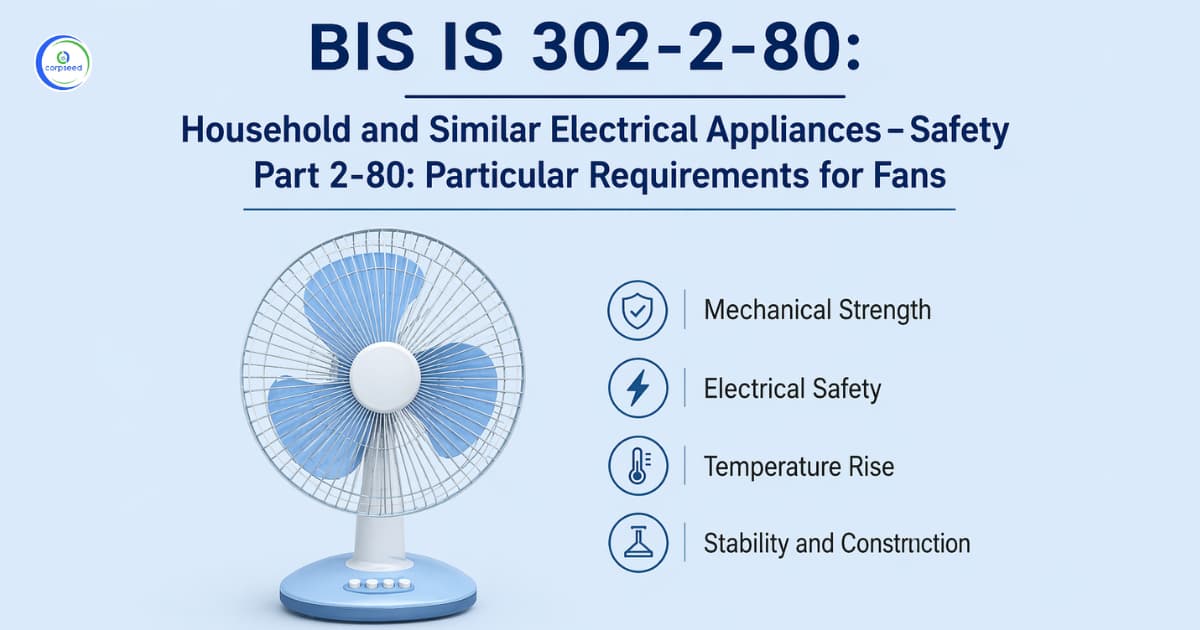
Whenever you enter any shop to purchase your ceiling or pedestal fans, you do not worry about their instability from the ceiling, short-circuiting, or overheating during hot summers. The reason for such reliability is IS 302-2-80, an Indian Standard that precisely prescribes the design criteria for such products.
In the competitive Indian electrical appliance market, consumer safety isn't just a good practice, it's a mandatory benchmark. For manufacturers of everything from ceiling fans to duct ventilation systems, understanding this standard is the single most important step toward legal market access. As the definitive regulation governing fan safety, this standard defines the benchmarks for electrical, mechanical, and thermal protection. If you are a manufacturer navigating this space, this guide breaks down what you need to know to stay compliant.
Schedule a Call Back
What is IS 302-2-80?
IS 302-2-80 is the authoritative Indian Standard titled "Household and Similar Electrical Appliances — Safety, Part 2-80: Particular Requirements for Fans." This standard serves as a special product family standard that provides essential safety requirements for all electric fans, including ceiling fans, duct fans, partition fans, pedestal fans, and table fans, operating at a rated voltage not exceeding 250V (single-phase) or 415V.
It is intended to be used with IS 302-1 and establishes the important safety criteria to be met to ensure protection against electrical, mechanical, fire, and thermal hazards. By ensuring proper testing of the structure, guards, and endurance testing, IS 302-2-80 protects consumers from potential dangers arising from improper fan use.
Scope of IS 302-2-80 Standard
The standard applies to household and similar-use fans. It is relevant to the use of fans whose voltage rating does not exceed 250V for single-phase devices and 480V for all others.
It also applies to separate controls (regulators) supplied with fans. Fans used in shops, the light industry, and farms are included, even if they are not meant for home use, because they can still pose a danger to the public.
The standard does not cover:
- Appliance intended exclusively for industrial use
- Fans installed in premises where there is a risk of corrosion or explosion
- Fans that form part of another appliance, unless it is indicated otherwise in any other standard
- Cooking fans, fan-heated appliances, air conditioners, or mechanical refrigerators
Types of Fans Covered Under IS 302-2-80
IS 302-2-80 explicitly covers the following fan types:
- Ceiling fans: mounted on the ceiling with blades rotating in a horizontal plane
- Duct fans: fitted inside the enclosed airway, with air being ducted from both sides
- Partition fans: fitted in a wall or window partition
- Pedestal fans: mounted on a pedestal
- Table fans: smaller fans placed on a table or bracket-mounted on a wall or ceiling
Key Features of IS 302-2-80
The key features of IS 302-2-80 are:
1. Safety-Focused Design Rules
The standard requires that fan blades, guards, motors, and wiring be designed to prevent injury to users. Fan blades must be guarded unless their edges are rounded, their peripheral speed is below 15 m/s, or they produce less than 2 W of output.
2. Electrical and Mechanical Protection
The standard defines requirements concerning insulation, leakage current, electrical strength, clearances, and creepage distance. Mechanical strength, overload protection, and capability to withstand abnormal operating conditions are also included in the standard.
3. Climate-Based Classification
Fans are classified into two types of climates:
- Fans for temperate climates - standard operating conditions
- Fans for tropical climates - must carry the letter "T" marking and meet stricter thermal limits (temperature rise limits reduced by 15 K)
4. IP Protection Requirements
Duct fans must achieve at least IPX2 protection. Fans marked with an IP numeral must pass the relevant tests of IS/IEC 60529 both at rest and during operation.
Requirements Under IS 302-2-80
To ensure safety, quality, and proper installation of electric fans, manufacturers must strictly follow these established protocols. These are the requirements:
1. Safety Protocols
Fans must prioritize user protection by fully insulating and enclosing all live electrical parts. Internal wiring requires high-grade insulation. Ceiling fans must feature robust load-bearing suspension systems and secondary backup safety cords to prevent accidental detachment.
2. Testing Procedures
Designs undergo rigorous 'Type Tests' evaluating electrical strength, moisture resistance, and thermal performance to verify safety. Regular production batches face 'Acceptance Tests,' including grounding checks and leakage current analysis, to ensure consistent quality and consumer compliance.
3. Marking and Labelling
Every fan must display its blade sweep size and environmental rating, such as 'T' for tropical climates. Manufacturers must clearly label temperature limits and provide precise installation instructions for compatible luminaires to guide safe user operation.
4. Mechanical and Electrical Stability
The pedestal fans should withstand a certain amount of force without toppling. The blade supports are subject to rigorous static loading tests (89N or 156N). Furthermore, the electrical insulation and clearance inside the fan should conform to the pollution degree 3 rating for safety purposes.
5. Construction and Design Requirements
The fans should have balanced blades and motor stampings with good efficiency. The capacitors need to be readily replaceable and acceptable. The guards undergo a finger test using probes to prevent contact with moving parts.
BIS Certification for Fans in India
"Electrical Appliances - Fans," as per IS 302-2-80, is covered under the mandatory BIS certification. This means no fan can be sold in India without a valid BIS license, unless specifically exempted. So, BIS registration is important if anyone needs to sell fans in India.
BIS Certification Process
Manufacturers seeking BIS certification for their fans usually undertake the following procedures:
- Submit an application to BIS for a license based on the applicable IS number
- Have the fan model tested by an authorized BIS laboratory
- Send the test results, factory audit report, and application forms to BIS
- BIS assesses the application and inspects the factory
- After approval, the licensee is issued a license for the ISI mark
Compliance Procedures
In addition, manufacturers need to maintain quality assurance procedures, permit BIS inspection of their factories, and ensure that each batch of fans complies with the standard.
Amendments in IS 302-2-80 (Latest Updates)
Till today, the authority has made 2 amendments, and they are:
Amendment No. 1 (January 2023)
Amendment No. 1 made two key changes to the standard:
- Updated the static load values for ceiling fan blade brackets. The values were changed from kg-force to Newtons: 89 N for fans with blade sweep up to 1.14 m, and 156 N for fans with blade sweep above 1.14 m.
- Updated Clause 21.102 on ceiling fan mechanical strength. The requirement for a safety cord (20x fan weight) was removed from this clause in the amendment, making the suspension system requirements more clearly focused on structural integrity.
Amendment No. 2 (2026 Deadline Extension)
The original implementation date was set for 27th February 2026. However, the BIS released a circular, postponing the implementation date to 18th July 2026.
The BIS Regional and Branch Offices have instructed that all licensees and applicants be informed of the above extension. All other conditions will remain the same as those mentioned in the circular of 22nd October 2025.
Impact on Manufacturers
The standard not only applies to manufacturers in India, but it also serves as the basis for the safety of fans and their entry into the market for fan makers in India. Some of the implications of this standard include:
- The introduction of new models should pass through all types of tests before being introduced into the market in India.
- Licensees are to ensure that their products are in line with the provisions of Amendment No. 2 before 18th July 2026.
- Manufacturers targeting tropical countries should categorize and label their fans according to the tropical rating.
- Ceiling fans' suspension mechanisms should be designed to satisfy the test with a load of 10,000 N.
- Manufacturers should ensure that their capacitors, stampings, and cables adhere to the relevant Indian standards.
- Penalties may be imposed on manufacturers who do not comply with this standard.
Conclusion
IS 302-2-80 is the indian standard for fans in India. It covers everything, from the type of material used for motor stampings to the load a ceiling fan suspension must bear. Whether you make ceiling fans, table fans, duct fans, or pedestal fans, this standard applies to you.
The latest amendments, especially the 2026 deadline extension for Amendment No. 2, show that BIS actively updates its standards to match real-world conditions. Manufacturers who stay compliant not only protect their customers but also protect their own business.
If you need help with IS 302-2-80 compliance, testing requirements, or BIS certification, consult a qualified testing laboratory or a BIS consultant specializing in electrical appliance standards.
About the Author

Mahek Sancheti
Content WriterMahek Sancheti, BAJMC graduate with a deep passion for writing. As a content writer, video content creator, creative content creator, and scriptwriter, I bring stories to life through words and visuals. I honed my skills by working with a prominent news agency, where I excelled in crafting compelling narratives and engaging content. Coming from a journalism and mass communication background I have skills to craft engaging narratives that captivate audiences. With a keen interest in writing and creativity, I aim to deliver impactful and meaningful content that resonates with diverse audiences.
https://www.linkedin.com/in/mahek-sancheti-837196212
Related articles
BIS Hallmarking Centre Setup Scheme 2026-31
2026-11-02
BIS Establishes Three New Indian Standards for Electric Cycles, Therapeutic Footwear and EV Charging Cables
2026-10-19
Importing Toys into India: BIS Toy Certification & Battery EPR Requirements
2026-10-19
BIS Notifies 33 New and Revised Indian Standards in October 2026: Compliance Guide
2026-10-16
BIS Certification for Electrical Appliances: 2026 Guide for Manufacturers & Importers
2026-10-14
BIS Solar PV Module Model Number Update: New MNRE SOP and Registration Requirements
2026-10-09