
Delhi Air Pollution Control Measures 2026: CAQM's New Directions, Air Quality Monitoring and Business Compliance
With the winter season approaching, Delhi has taken several steps to control air pollution. On 12 October 2026, the Commission for Air Quality Management (CAQM) reviewed road dust control measures across all 12 Municipal Corporation of Delhi (MCD) zones. It reiterated a 31 October 2026 deadline for removing accumulated road dust and garbage. On 13 October, the government announced further initiatives, including 13 new air quality monitoring stations, 150 electric buses and new EV charging facilities.
Schedule a Call Back
1,800+ CTE/CTO and plant setup assignments since 2018
Clients include Magnum Aluminium, Enershell Alloys and Steel, Ganesh Foundry & Cast, Inland Speciality Metals, JK Cement, Sskbp India Alloy, Denso India, Neometrix Defence, PMS Waste Management, Daebak India Recycler, Ganix Rubber Recycling, Pashidaa E Waste Copper Battery Recycling PLT Company (12 of 1,100+ served since 2018).
A few more clients we've served in this industryHide the list
- Engineering and manufacturing
- Magnum Aluminium · Enershell Alloys and Steel · Ganesh Foundry & Cast · Inland Speciality Metals · JK Cement · Sskbp India Alloy · Denso India · Neometrix Defence
- Recycling and waste management
- PMS Waste Management · Daebak India Recycler · Ganix Rubber Recycling · Pashidaa E Waste Copper Battery Recycling PLT Company · Upcycle Debris Management · Ficusa Ewaste Recyclers · Shuchaye Recyclers · Quantara Battery Recycling
- Logistics and trade
- 20Cube Logistics Solutions · Airsurge Logistics · Green Space Logistics · Saap Logistics
- Food and consumer goods
- Bake Wish · Kokora Spices · Babi Beverages · Indraj Beverages and Distilleries · Adheshwar Agro Dairy Products · Venco Research and Breeding Farm · Explore Food · IFF India Frozen Foods
- Energy and power
- Servotech Renewable Power System · Saurya Urja Company of Rajasthan · Sun Mobility · Sun Max Solar · Maxvolt Energy Industries · Rays Power Infra
- Chemicals and materials
- Venkateshwara Roto Pack · Lami Tube · M C Bauchemie I · Pro Flexi Packaging · Rustchem Corrosols · SVN Polymers · Kairaa Polypack · Sanctum Chemicals
- More clients
- Intangles Lab · Alten India · Adit Buildwell · Ecowise Trading · GS E-Commerce · Beaucience India
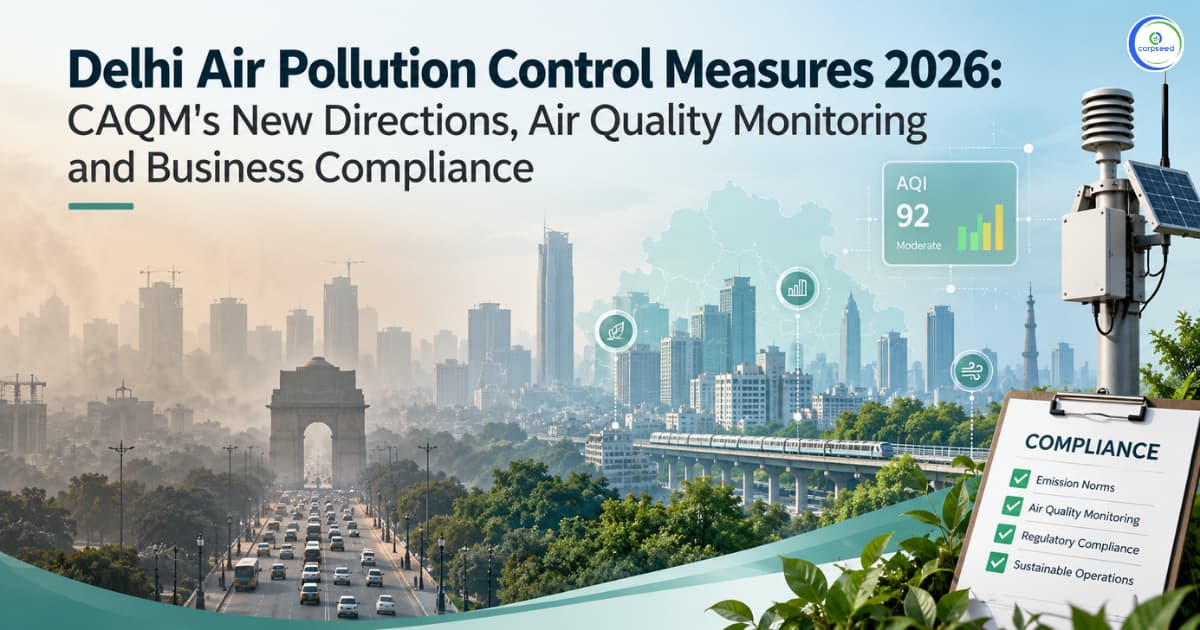
With the winter season approaching, Delhi has taken several steps to control air pollution. On 12 October 2026, the Commission for Air Quality Management (CAQM) reviewed road dust control measures across all 12 Municipal Corporation of Delhi (MCD) zones. It reiterated a 31 October 2026 deadline for removing accumulated road dust and garbage.
On 13 October, the government announced further initiatives, including 13 new air quality monitoring stations, 150 electric buses and new EV charging facilities.
These Delhi air pollution control measures for 2026 focus on cleaner roads, improved monitoring and reduced pollution from transport and other activities. For businesses operating in Delhi-NCR, the developments also highlight the importance of meeting existing environmental compliance requirements.
Schedule a Call Back
Why Is Delhi Strengthening Air Pollution Control Measures in 2026?
Air pollution in Delhi comes from several sources, including vehicle emissions, construction dust, industrial activities, waste burning and dust accumulated on roads.
During winter, weather conditions can limit the dispersion of pollutants, increasing their concentration near the ground.
Road dust remains a significant concern because moving vehicles can repeatedly release settled particles into the air. Construction activities and improper disposal of demolition waste add to the problem.
The October initiatives aim to improve pollution control preparedness, particularly in areas experiencing heavy traffic and dust accumulation.
What Are CAQM's Latest Directions for Road Dust Control in Delhi?
On 12 October 2026, CAQM assessed how effectively all 12 MCD zones were managing road dust pollution. This came after an inspection on 3 October revealed dust buildup and construction and demolition (C&D) waste along several road stretches. Following these findings, CAQM issued a notice on 7 October, raising concerns about the cleaning and waste management practices in these areas.
CAQM reviewed the deployment of cleaning equipment, availability of sanitation workers and coordination between municipal authorities.
Major Road Dust Mitigation Measures
The measures discussed during the review included:
- Mechanised road sweeping: Using specialised equipment to remove deposited dust.
- Water sprinkling: Suppressing loose particles along roads and dust-prone locations.
- Waste removal: Clearing accumulated garbage, silt and C&D waste.
- Road repairs: Addressing potholes, damaged surfaces and unpaved stretches.
- Prevention of waste burning: Strengthening action against open burning and improper waste disposal.
CAQM emphasised effective equipment deployment, regular supervision and coordination between responsible agencies.
CAQM's 31 October 2026 Deadline: What Does It Mean?
CAQM emphasized that the accumulated dust and waste have to be cleared off the roads and open spaces by 31 October 2026.
It is the deadline for the cleaning obligations of the MCD zone and others.
Officials were asked to improve field monitoring and ensure that available cleaning machinery and sanitation resources were used effectively.
CAQM also warned that continued implementation failures could lead to appropriate enforcement action, including possible prosecution of responsible agencies or officials.
Important for businesses: The deadline for October does not include a requirement for registration and environmental clearance of private entities. Companies have to comply with the legal directives separately.
How Is Delhi Addressing Pollution at the Anand Vihar Hotspot?
Anand Vihar is an important pollution hotspot because of heavy traffic, bus movements, road dust and surrounding construction activities.
On 13 October 2026, the Union Environment Minister and Delhi Chief Minister reviewed pollution mitigation work in the area.
The government reported improvements such as road paving, removal of encroachments, clearing illegally dumped C&D waste and implementing dust control measures at construction locations.
Traffic management and greening activities were also discussed.
These initiatives are intended to reduce local pollution sources, although continued monitoring and maintenance remain necessary.
Delhi Expands Air Quality Monitoring From 47 to 60 Stations
Delhi inaugurated 13 new Continuous Ambient Air Quality Monitoring Stations (CAAQMS) on 13 October 2026, increasing the reported network from 47 to 60 stations.
The new locations include Ghummanhera, Chhawla, Karala, Hastsal, Jharoda Kalan, Ghoga, Burari, Tikri Kalan, Narela, Maidan Garhi, Nangloi, Vasundhara Enclave and Badarpur.
How Will the New Monitoring Stations Help?
These stations collect information on ambient air quality and meteorological conditions.
Monitoring pollutants such as PM2.5 and PM10 can help authorities understand pollution patterns, identify affected areas and assess changes over time.
The government stated that the monitoring network would support more location-specific pollution management.
The expansion does not automatically impose new monitoring equipment requirements on every private business.
How Will AI-Based Pollution Monitoring Improve Air Quality Management?
The Delhi Pollution Control Committee (DPCC) has developed an AI-enabled Integrated Command and Control Centre at Shastri Park.
The centre is designed to bring information from different environmental monitoring systems onto one platform.
Its scope includes air quality, industrial emissions, noise, dust-generating activities, waste-burning incidents and citizen complaints.
According to the October announcement, nine of the planned 15 external data systems had been integrated, while six remained under phased integration.
The technology is intended to support faster identification of pollution concerns and better coordination between enforcement authorities.
Delhi Introduces 150 Electric Buses and New EV Charging Facilities
The government also flagged off 150 electric buses at Anand Vihar and inaugurated public EV charging facilities at five locations.
These locations include Anand Vihar, Nand Nagri, Rohini Sector-37, Nangloi and Keshopur.
The use of electric buses may help to cut down direct tailpipe emissions as compared to regular fuel buses. Other facilities such as charging stations may also enhance the use of electric buses.
These measures form part of Delhi's broader efforts to reduce transport-related pollution.
How Do Delhi's Air Pollution Control Measures Affect Businesses?
The October announcements primarily address public pollution control initiatives. However, construction companies, manufacturers and other regulated businesses should review their existing environmental obligations.
| Business category | Main compliance concern |
| Construction companies | Construction dust and C&D waste management |
| Manufacturing units | Industrial emissions and applicable DPCC approvals |
| Waste management businesses | Waste collection, storage, processing and authorisations |
| Transport companies | Vehicle emissions and applicable operating restrictions |
| Infrastructure contractors | Dust suppression and project-specific environmental conditions |
Requirements depend on the activity, location, scale and applicable laws.
Businesses involved in pollution-generating activities may benefit from environmental compliance services to identify relevant approvals and understand their responsibilities.
What Environmental Compliance Requirements Apply in Delhi-NCR?
Businesses must follow the applicable environmental laws, statutory directions and approval conditions.
DPCC Consent to Establish and Consent to Operate
Under the relevant provisions of the Air Act 1981 and the Water Act 1974, the following consents may be needed by covered establishments:
- Consent to Establish (CTE): Consent to establish the establishment.
- Consent to Operate (CTO): Consent to operate the covered activity subject to certain conditions.
Requirements depend on industry classification and other applicable criteria. Not every establishment requires both approvals.
CAQM Directions and Dust Control Requirements
Businesses should check applicable CAQM directions concerning construction activities, dust mitigation and other pollution-generating operations.
These must be distinguished from the October directions addressed to municipal authorities.
Construction and Demolition Waste Management
The Environment (Construction and Demolition) Waste Management Rules, 2025, effective from 1 April 2026, establish requirements for handling and managing C&D waste.
Depending on the project category, requirements may cover segregation, collection, storage, processing, recycling and producer-specific obligations.
How Can Businesses Maintain Environmental Compliance in Delhi-NCR?
Businesses should assess the requirements that apply to their activities rather than assuming that every pollution control announcement creates a new obligation.
Important actions include:
- Check applicable approvals: Determine whether DPCC CTE, CTO or other environmental authorisations are required.
- Control dust emissions: Apply appropriate dust suppression measures during construction and material handling.
- Manage waste properly: Follow applicable collection, storage, transportation and disposal requirements.
- Maintain records: Keep relevant consent documents, waste records and monitoring reports.
- Review regulatory changes: Check new CAQM directions and applicable DPCC requirements.
Non-compliance may lead to regulatory notices, environmental compensation, directions or prosecution, depending on the applicable law and circumstances.
How Can Corpseed Help With Environmental Compliance?
Businesses sometimes struggle to identify which environmental approvals apply to their operations or what documentation is needed.
Corpseed assists with relevant environmental compliance services, including:
- DPCC Consent to Establish and Consent to Operate assistance.
- Pollution control compliance consultancy.
- Construction and demolition waste compliance support.
- Environmental audit and regulatory documentation assistance.
Businesses can explore Corpseed's DPCC CTE/CTO services or environmental consultancy services to understand the support available.
Need environmental compliance assistance in Delhi-NCR?
Contact Corpseed to discuss your applicable approvals and pollution control requirements.
Conclusion
The pollution measures that will be undertaken by Delhi on 31st October 2026 include reducing road dust, improving pollution monitoring, and providing clean public transport.
Whereas the deadline of 31 October is related to specific tasks assigned to civic authorities, all firms operating in Delhi-NCR need to abide by environmental laws.
Checking DPCC approvals, implementing suitable pollution control measures and maintaining proper compliance records can help businesses identify and address regulatory risks. Corpseed can assist businesses seeking support with relevant environmental approvals and compliance processes.
About the Author

Mahek Sancheti
Content WriterMahek Sancheti, BAJMC graduate with a deep passion for writing. As a content writer, video content creator, creative content creator, and scriptwriter, I bring stories to life through words and visuals. I honed my skills by working with a prominent news agency, where I excelled in crafting compelling narratives and engaging content. Coming from a journalism and mass communication background I have skills to craft engaging narratives that captivate audiences. With a keen interest in writing and creativity, I aim to deliver impactful and meaningful content that resonates with diverse audiences.
https://www.linkedin.com/in/mahek-sancheti-837196212
Related articles

Plastic EPR Credits: How Producers, Importers & Brand Owners Buy and Use EPR Certificates
2026-10-23
MoEFCC Draft Notification 2026: Changes Proposed in CRZ and ICRZ Regulations
2026-05-30

How to Obtain a CGWA Compliance Report
2025-10-15

2025 Guidelines for Cage and Pen Culture in Marine Aquaculture
2025-07-29

Deepor Beel Wildlife Sanctuary: A Strategic Conservation Initiative
2025-07-05

Lippa-Asrang Wildlife Sanctuary: A Crucial Haven for Himalayan Wildlife and Conservation Efforts
2025-06-18