
Govt. Unveils New Rules to Boost E-commerce Exports and Manufacturing
India clears EODC backlog and offers SEZ duty relief to boost exports, improve cash flow, and support manufacturing growth amid global uncertainty.
Schedule a Call Back
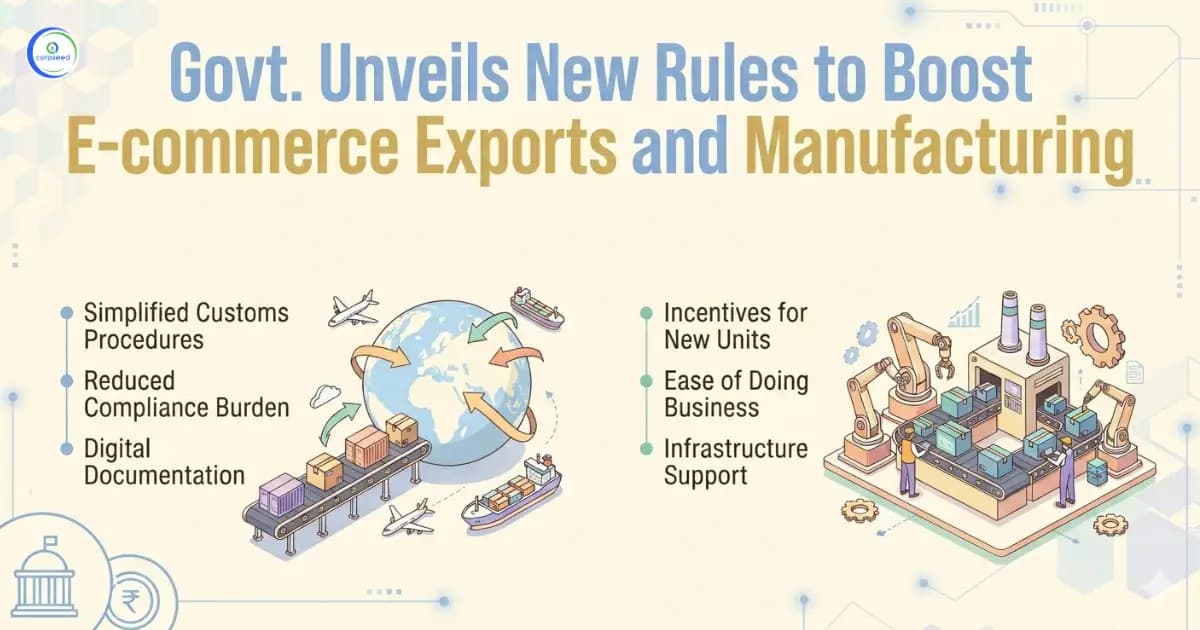
India has introduced two key measures to strengthen its trade ecosystem and support industry. Announced on April 1, 2026, the Ministry of Commerce and Industry is focusing on faster export clearances and improved flexibility for domestic manufacturing. The move comes as businesses continue to deal with global demand uncertainty and rising compliance pressure.
DGFT Fast-Tracks Export Compliance with EODC Drive
In a major push, the Directorate General of Foreign Trade conducted a special drive in March 2026 to clear pending Export Obligation Discharge Certificates (EODCs). These certificates are critical for exporters as they confirm compliance and enable the release of bank guarantees.
The results were notable. A total of 12,690 EODCs were issued in March, compared to 3,747 in February. The sharp jump reflects a focused effort to clear long-pending cases under the Advance Authorisation and Export Promotion Capital Goods schemes. Nearly 97 to 98 percent of available cases were processed, while the backlog dropped by 74 percent despite new applications.
The government has extended the drive until May 31, 2026. This is expected to further reduce delays and improve liquidity for exporters.
SEZ Duty Relief Introduced for Domestic Sales
Alongside export reforms, the government has introduced concessional duty benefits for goods manufactured in Special Economic Zones and sold in the domestic market. Under the Customs Act, 1962, such goods were earlier treated as imports and attracted full customs duties, limiting their competitiveness.
The new framework allows eligible SEZ units to sell up to 30 percent of their peak export value in the Domestic Tariff Area at concessional rates. This is expected to help nearly 1,200 units utilize surplus capacity and manage demand fluctuations.
Safeguards have been built in. Units must ensure at least 20 percent value addition and cannot claim export incentives on these domestic sales. The policy applies to sectors like chemicals, textiles, and machinery, while excluding sensitive industries. It will remain in force until March 31, 2027.
Policy Signals Focus on Faster Clearances and Manufacturing Support
The two measures reflect a clear focus on reducing delays and improving operational flexibility. While the DGFT drive addresses pending export cases, the SEZ framework offers manufacturers an additional route to manage output during weak global demand.
The measures are expected to ease compliance and support exporters and manufacturers ahead.
About the Author

Parul Bohral
Legal Content WriterParul Bohral, a BALLB graduate and experienced legal researcher and content writer with expertise in various legal areas, including corporate law and intellectual property. I have gained valuable experience in esteemed legal environments, where I have strengthened my research skills, allowing me to approach legal writing with precision and depth.
As a legal content writer, I am committed to delivering work that not only informs but also engages readers. By staying informed about the latest trends in content marketing and regulatory developments, I ensure that my writing remains sophisticated and meets industry standards. My dedication to thorough research enables me to craft content that is both insightful and impactful.