
Govt Exemption on Electric, Ethanol, Methanol, and Hydrogen Vehicles from Permit Rules for 7 Years
Govt exempts electric, ethanol, methanol & hydrogen vehicles from permit rules for 7 years. Simple guide to what this means for businesses.
Schedule a Call Back
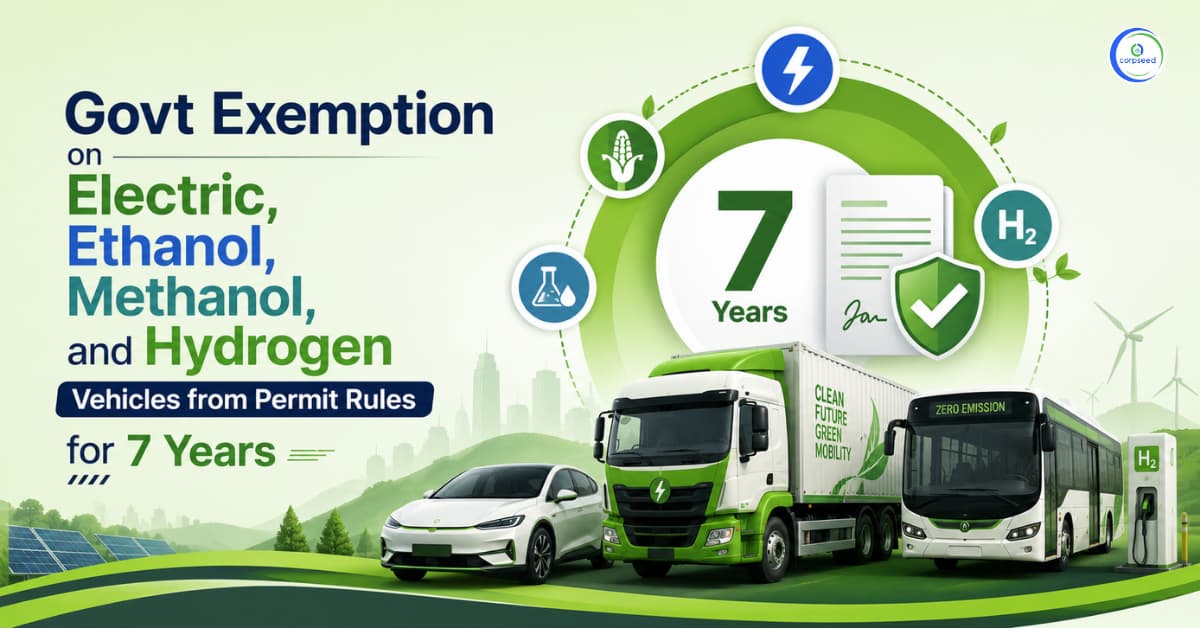
On 6 July 2026, the Ministry of Road Transport and Highways released an official notice that removes the permit requirement - normally required under Section 66(1) of the Motor Vehicles Act, 1988 - for four types of vehicles, for a period of seven years. These vehicle types are: vehicles that run on batteries, vehicles that run on methanol, vehicles that run on ethanol, and vehicles that run on hydrogen. This rule applies only to vehicles used to carry goods or passengers as part of a business.
This new notice replaces an older notice from 18 October 2018. To get this benefit, the vehicle must have a location-tracking device that follows the AIS-140 technical standard.
This is not a case of the government throwing out all transport rules. It is a focused plan to help clean and alternative-fuel vehicles grow in the market. In simple terms, it removes one big obstacle for these vehicles. It makes it easier and cheaper for vehicle makers, fleet owners, delivery companies, and fuel companies connected to clean vehicles to do business.
What the Exemption actually Means
Section 66(1) of the Motor Vehicles Act normally says that any vehicle used for business - to carry goods or people - must have a permit. By removing this requirement for seven years (starting from when the notice was published), the government has taken away one important step that businesses used to have to complete.
This exemption covers:
- Battery-run vehicles, as described under rule 2(u) of the Central Motor Vehicles Rules, 1989.
- Vehicles that run on methanol fuel.
- Vehicles that run on ethanol fuel.
- Vehicles that run on hydrogen fuel.
But there's a catch: this exemption only works if the vehicle has a tracking device that follows the AIS-140 rules. This means businesses don't get to skip all rules. They only get relief from the permit rule. They still have to follow rules about registration, vehicle fitness, safety, insurance, taxes, and the tracking device.
Why did the Government provide this Exemption
This decision seems to support five main goals for the public good.
1. Faster clean mobility adoption
Business vehicles drive a lot of kilometers every day and use a lot of fuel. If the government wants people to start using cleaner vehicles quickly, the best place to start is with buses, taxis, delivery vans, and trucks - since these are used the most. Removing the permit hurdle helps get more of these vehicles on the road faster.
2. Lower non-fuel barriers
Governments usually help clean vehicles by giving discounts, tax breaks, or manufacturing support. But even with these helps, paperwork and waiting time can slow things down. By removing the permit requirement for these vehicles, the government makes it easier for businesses actually to start using them - not just buy them.
3. Energy diversification
India buys a lot of its fuel (petrol and diesel) from other countries. Electric, ethanol, methanol, and hydrogen are all different ways of powering a vehicle without depending only on imported fuel. Electricity connects with India's own power system; ethanol connects with farming; methanol supports a different kind of fuel-making industry; and hydrogen is being looked at as a long-term clean fuel option.
4. Support for manufacturing transition
Car and vehicle-making companies are more willing to invest in new kinds of vehicles when they know there will be demand for them. A seven-year window gives them enough time to plan factories, train workers, and build up their supply chains.
5. Better digital oversight through tracking
Because these vehicles still need a tracking device, the government isn't fully stepping back from watching over them. Instead, it is shifting from paper-based checking (permits) to digital tracking, which can actually give better information about where vehicles are and how they are being used.
Why was this Exemption Needed?
This rule exists because there was a gap between wanting to bring in new clean vehicle technology and actually getting people to use it on India's roads every day.
- Electric and alternative-fuel vehicles often cost more upfront than regular petrol or diesel vehicles.
- New fuel systems (like hydrogen stations) need many users before their costs come down.
- Companies that run vehicle fleets get frustrated by small delays and extra paperwork.
- In the transport business, things like how fast a route gets approved and how well a vehicle is used matter just as much as how good the technology is.
- Many new types of vehicles struggle more because of paperwork delays than because of engineering problems.
Given all this, removing the permit requirement works like a push to speed up the market. It tells businesses that the government doesn't just want these vehicles built in India - it wants them actually driving on Indian roads, doing real work, at a large scale.
Impact on Businesses in India
Vehicle manufacturers
Positive impact
Companies that make electric commercial vehicles, hydrogen vehicles, or vehicles that run on ethanol/methanol now have a stronger reason for businesses to buy from them. They can now advertise not just fuel savings or being eco-friendly, but also less paperwork trouble when a company wants to add these vehicles to its fleet. This matters a lot to businesses, which care about overall cost and how quickly a vehicle can start earning money.
Strategic impact
This notice may encourage vehicle makers to build more types of light commercial vehicles, passenger vehicles, buses, city delivery trucks, and last-mile delivery vehicles. It may also push older, well-established vehicle makers to speed up their own clean-fuel vehicle plans so they don't lose customers.
Fleet operators and logistics businesses
- This group gets some of the biggest, most direct benefits.
- Getting eligible vehicles up and running faster in daily business.
- Less confusion and fewer delays when adding new vehicles or routes.
- Vehicles can start working sooner, so they are used more efficiently.
- Possibly less time and money spent managing permits.
For app-based ride services, city delivery, e-commerce shipping, in-city freight, employee transport, and shuttle services for schools or offices, this can be a real and noticeable business benefit.
Leasing, financing, and fleet-as-a-service businesses
When rules are clearer and simpler, banks and leasing companies feel more confident about lending money for these vehicles, and expect them to hold their value better. This helps vehicle leasing companies, battery subscription businesses, and non-bank lenders design better loan and lease plans built around clean commercial vehicles.
Charging, fuel, and infrastructure businesses
This rule makes future demand look stronger for related businesses, including:
- EV charging companies.
- Battery-swapping station operators.
- Ethanol supply and storage companies.
- Methanol handling businesses.
- Hydrogen production, transport, and refueling stations.
- Companies that make GPS/AIS-140 tracking devices.
These businesses benefit because more vehicles on the road mean their equipment and stations get used more.
Technology and compliance service providers
Companies that make AIS-140 devices, GPS tracking systems, fleet management software, and compliance consulting services all get new business - because the exemption comes with a condition (the tracking device), not a free pass.
How Can Businesses Gain the Benefit of the Exemption?
To actually make use of this rule, businesses need to focus on taking real action, not just knowing about it.
For manufacturers
- Clearly build and label vehicle models under the battery, ethanol, methanol, or hydrogen categories.
- Make sure registration papers and technical documents clearly show what fuel the vehicle uses.
- Build AIS-140 tracking compatibility into the vehicle, or work with approved partners who can fit it.
- Create marketing material that explains the permit exemption correctly and legally.
For fleet operators
- Buy vehicles that clearly belong to the exempted categories.
- Install and maintain AIS-140-compliant tracking devices.
- Keep proper records for registration, insurance, fitness checks, taxes, and the tracking device.
- Train staff to understand that only the permit rule is removed - other rules still apply.
- Plan fleet growth to prioritize these exempted vehicles where it makes financial sense.
For distributors and dealers
- Offer ready-to-use delivery packages that already include the tracking device.
- Help business customers understand what paperwork they actually need to get this benefit.
- Build after-sales support to maintain tracking devices.
For related infrastructure businesses
Look for high-opportunity areas such as city delivery zones, municipal bus routes, industrial freight routes, and airport or tourism transport.
Build partnerships with vehicle makers and fleet operators early, before demand grows too large.
Compliance Requirements under this Exemption
The most important thing to remember is that this rule removes only one layer of regulation. Businesses must still follow every other applicable rule.
Mandatory condition
Fit an AIS-140-compliant vehicle location tracking device.
Other requirements that still apply
- Vehicle registration under motor vehicle rules.
- Fitness certification for transport vehicles.
- Insurance coverage.
- Road tax and other local charges, where applicable.
- Safety, emissions, and technical standards for that type of vehicle.
- Any state or local rules that this notice does not specifically remove.
In short, businesses should not assume they are completely free from regulation. This exemption is valuable, but it does not replace proper transport compliance management.
Is this a Right Decision or an Unfair Burden on Petrol and Diesel Manufacturers?
Why is it a justified decision
From a public-policy point of view, this looks like a reasonable choice.
- Clean and alternative-fuel vehicles need some temporary help to compete, since they are newer to the market.
- Petrol and diesel vehicles already have well-established factories, suppliers, service centers, and customer trust.
- The rule lasts only seven years, which shows this is meant to support a transition, not to favor one side permanently.
- The exemption connects to public goals like reducing pollution, using different energy sources, and modernizing industry.
Is it Unfair to Petrol and Diesel Vehicle Companies?
It is more accurate to call this competitive pressure, not unfairness. Petrol and diesel vehicle makers are not banned from doing business or selling vehicles. They don't get this one particular benefit. In fact, most large traditional vehicle makers are also investing heavily in electric, flex-fuel, and hydrogen vehicles themselves. This rule encourages them to move faster, but it does not take away their existing business right away.
Burden on conventional manufacturers
- There is still a real, practical challenge for these companies.
- Their vehicles may look less attractive to fleet buyers than before.
- They may need to spend more money on research and development.
- Dealers may need to change what kinds of vehicles they focus on selling.
- Suppliers who only make parts for petrol/diesel engines may see less demand over time.
So yes, there is a burden - but it is part of a wider industry shift, not an unfair punishment.
Impact on Consumers and Service Quality
This exemption can improve people's everyday experience in a few indirect ways.
Better service availability
If fleet businesses can start using vehicles faster and with less paperwork trouble, customers may see more transport options available - in city travel, workplace transport, deliveries, and logistics.
Newer and smarter fleets
Vehicles that qualify for this exemption are likely to be newer models that are digitally tracked. This can make services more reliable, improve safety monitoring, and give customers more confidence.
Possible cost benefits over time
If it becomes cheaper for fleet businesses to run their vehicles, some of that saving might be passed on to customers - through better prices, more frequent service, or more dependable transport. How much this happens will depend on fuel costs, how much the vehicles are used, financing terms, and how much infrastructure (like charging stations) is available.
Environmental impact
This policy has a stronger and clearer connection to environmental goals than most simple paperwork changes.
Positive effects
- Battery-run vehicles can reduce exhaust pollution in cities.
- Hydrogen vehicles can support low-pollution business transport, especially if cleaner ways of making hydrogen are common.
- Ethanol and methanol vehicles can reduce dependence on regular petroleum fuel, though how much they truly help the environment depends on how the fuel itself is produced.
- Tracking devices can help improve how well routes and operations are monitored.
Limitations
- The real environmental benefit depends on how many businesses actually adopt these vehicles.
- Electric vehicles are only as clean as the electricity used to charge them.
- Ethanol and methanol benefits depend on how sustainably the fuel is produced.
- Hydrogen benefits depend on where the hydrogen comes from and how developed the infrastructure is.
- Even so, as a signal of direction, this notice clearly supports cleaner transport over sticking with regular fossil-fuel vehicles.
Impact on the Indian Economy
Positive effects on the economy
- Encourages Indian companies to invest in building clean vehicles domestically.
- Supports new jobs in batteries, electronics, tracking devices, charging stations, fuel systems, hydrogen, and fleet services.
- Boosts business activity in logistics and passenger transport companies that adopt these vehicles.
- Helps reduce reliance on imported petroleum fuel over time.
- Encourages new and innovative ways of running transport businesses.
Risks during the transition
- Suppliers who focus only on petrol/diesel parts may face reduced demand.
- Gaps in infrastructure (like not enough charging stations or hydrogen stations) could limit the full benefit in the early years.
- Smaller vehicle makers may find it hard to afford the shift to new technology.
- The market could grow unevenly toward technologies that get government support but don't yet have full infrastructure ready.
Overall, the likely effect on the economy is positive - especially if this exemption is paired with better infrastructure, financing support, and stronger supply chains.
Impact on Other Countries
This notice is an Indian law, but it can affect business around the world.
Likely outside effects
- Global companies that make electric, hydrogen, or alternative-fuel vehicle technology may see India as a bigger, more attractive market to grow in.
- Foreign vehicle makers may build more factories or form partnerships within India.
- Countries that supply battery materials, fuel-cell parts, electronics, and clean transport equipment may benefit from higher demand from India.
- Countries that export crude oil to India may see, over the long run, a gradual decrease in demand if India's shift to clean transport grows large enough.
- For other countries doing business with India, this rule signals that India wants to be a major future market for next-generation commercial transport.
Implementation Date and Duration
The notice is dated 6 July 2026, and it says the exemption lasts for seven years from the date the notice was published. The document shows it was published in the Gazette on 7 July 2026. So, in practical terms, the exemption period begins on 7 July 2026 and continues for seven years from that date.
Businesses should treat these seven years as a serious, long-term planning window - not a short-lived, temporary offer.
Opportunities in Related Businesses
This rule creates opportunities that go beyond just vehicle manufacturing.
High-opportunity sectors
- Making and installing AIS-140 tracking devices.
- GPS and telematics (tracking technology) platforms.
- EV charging hardware and software.
- Battery leasing and battery-swapping services.
- Fleet financing and green leasing products.
- Hydrogen storage, transportation, and fueling systems.
- Delivery and storage of ethanol and methanol.
- Vehicle conversion and fleet transition consulting, as permitted by law.
- Data tools for planning routes and monitoring fleets.
- Insurance products designed specifically for clean commercial fleets.
Opportunity by business type
Risks and Practical Cautions
- Businesses should still think carefully about the risks involved in acting on this rule.
- How the rule is applied may vary from state to state until enforcement becomes consistent.
- Methanol and hydrogen fuel are still not widely available compared to petrol and diesel.
- Some business uses may only make sense in certain city areas or specific transport routes.
- Relying too heavily on this exemption, without also planning for infrastructure, could leave businesses with vehicles they can't fully use.
- Traditional petrol/diesel businesses should not ignore this shift - instead, they should prepare a plan for the transition ahead.
Conclusion
This exemption is a very powerful one, as it shows that India intends to accelerate the practical implementation of battery-powered and alternative-fuel commercial vehicles and not just talk about it. It solves a very real operational challenge while encouraging the production and acquisition of forward-thinking vehicles and fleets. This presents many possibilities for other industries such as tracking, charging, hydrogen, and fleet finance.
For businesses focused on clean mobility, this seven-year exemption is a real and meaningful business opportunity. For companies focused only on petrol and diesel, it's a clear signal that change is no longer optional. The smartest move for these traditional companies isn't to resist the change - it's to diversify into electric, flex-fuel, hydrogen, and digitally-tracked fleet solutions.
About the Author

Mahek Sancheti
Content WriterMahek Sancheti, BAJMC graduate with a deep passion for writing. As a content writer, video content creator, creative content creator, and scriptwriter, I bring stories to life through words and visuals. I honed my skills by working with a prominent news agency, where I excelled in crafting compelling narratives and engaging content. Coming from a journalism and mass communication background I have skills to craft engaging narratives that captivate audiences. With a keen interest in writing and creativity, I aim to deliver impactful and meaningful content that resonates with diverse audiences.
https://www.linkedin.com/in/mahek-sancheti-837196212