
Why India’s New Textile Compliance Rules are a Survival Test for 2026?
The Government of India has taken strong steps to make the textile sector cleaner, greener, and more sustainable. From new carbon rules to eco-labelling to powerful budget schemes, India is building a textile industry that can grow without destroying the planet.
Schedule a Call Back
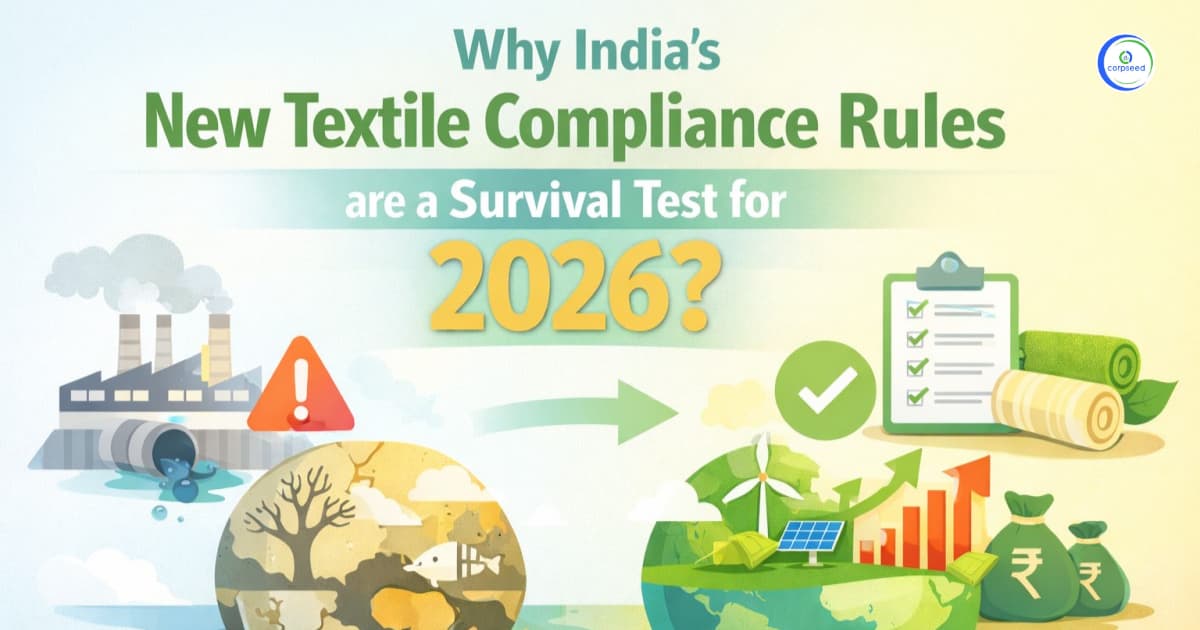
India’s textile industry is one of the largest in the world. It provides jobs to millions of people and sends products to countries across the globe. But this big industry also creates a big challenge, as it uses a lot of water, energy, and chemicals. This harms the environment if the industry does not follow the right rules.
The good news is that the Government of India has taken strong steps to make the textile sector cleaner, greener, and more sustainable. From new carbon rules to eco-labelling to powerful budget schemes, India is building a textile industry that can grow without destroying the planet.
Schedule a Call Back
What is the Carbon Credit Trading Scheme (CCTS)?
The Government of India has notified Greenhouse Gas Emission Intensity (GEI) targets for carbon-heavy industries, and the textile sector is on that list. This happens under the Carbon Credit Trading Scheme (CCTS).
Under CCTS, every big textile company must track and report two types of emissions:
- Scope-1 emissions, pollution that comes directly from a factory (like burning fuel)
- Scope-2 emissions, pollution that comes from the electricity a factory uses
Once companies report their emissions, they work to reduce them. If they go below the target, they earn carbon credits, like reward points for being eco-friendly. This gives businesses a strong reason to cut pollution.
The government also runs a pilot project to help small and medium businesses (SMEs), brands, and manufacturers. This project teaches them about lifecycle approaches and Product Environmental Footprint (PEF), a way to measure how much harm a product causes to the environment from start to finish.
Banning Harmful Dyes: Protecting Workers and Nature
The textile industry uses thousands of dyes and chemicals to colour fabrics. Some of these chemicals are very dangerous for workers, for rivers, and for people who wear the clothes.
The Government of India banned benzidine-based dyes and their salts back in 1990. These dyes cause cancer and other serious diseases.
In 1997, the government also prohibited the handling of 70 types of Azodyes, which break down into harmful substances when they touch human skin or water.
India also joined the Stockholm Convention on 13 January 2006, a global treaty that protects human health and the environment from Persistent Organic Pollutants (POPs). POPs are chemicals that stay in the environment for a very long time and travel long distances through air and water.
These actions show that India takes chemical safety very seriously.
Textile Factories Must Treat Their Wastewater
One of the biggest problems in textile manufacturing is wastewater. When factories dye and process fabrics, the leftover water is full of chemicals, colours, and toxins. If this water flows directly into rivers or soil, it kills fish, harms crops, and makes people sick.
To stop this, the Government of India has set Standards for Emission or Discharge of Environmental Pollutants under Schedule I of the Environment (Protection) Rules, 1986. Every textile unit and cluster must either:
- Install its own Effluent Treatment Plant (ETP), or
- Use a shared Common Effluent Treatment Plant (CETP)
In addition to wastewater treatment requirements, many textile businesses must also comply with waste management rules through EPR Registration and obtain an EPR Certificate from the appropriate authority.
These measures ensure that producers take responsibility for the environmental impact of their products throughout the product lifecycle. These plants clean the dirty water before releasing it. This rule makes sure that rivers and groundwater stay safe from textile pollution.
The Eco-Mark Scheme 2024: Green Labels for Green Products
Consumers today want to know if the products they buy are safe for the environment. The Eco-Mark Scheme 2024 helps them make that choice.
The government has notified this scheme, and textiles are one of the key product categories included. Products that earn the Eco-Mark label must meet strict standards related to:
- Reducing the consumption of toxic substances.
- Improved utilisation of resources such as water and energy.
- Wastewater and air emissions should be managed properly.
- Complete adherence to environmental laws.
Having the Eco-Mark on a textile product, buyers can be aware that the product was produced responsibly. This presents manufacturers with the challenge of bettering their operations and competing based on sustainability and not price.
Manufacturers that follow responsible production practices, including obtaining EPR Certification and maintaining proper environmental compliance systems, gain a stronger chance of qualifying for eco-labels and meeting global sustainability standards.
Budget 2026-27: The Integrated Programme for Textiles
The Hon’ble Finance Minister made a landmark announcement in the Budget Speech 2026-27, an Integrated Programme for Textiles that will apply across India. This programme has five powerful parts:
- National Fibre Scheme: This scheme focuses on self-reliance in natural fibres, man-made fibres, and new-age fibres. India will grow its own raw materials instead of depending on imports.
- Textile Expansion and Employment Scheme: Traditional textile clusters will get capital support for new machinery, technology upgrades, and common testing and certification centres. This brings modern tools to age-old crafts.
- National Handloom and Handicraft Programme: Weavers and artisans who work with handlooms and handicrafts will receive targeted support. This protects India’s cultural textile heritage while giving craftspeople a better income.
- Tex-Eco Initiative: This is the sustainability heart of the programme. The Tex-Eco Initiative promotes globally competitive and sustainable textiles and apparel, helping Indian brands meet international green standards.
- Samarth 2.0: This scheme modernises the skill ecosystem. It works with industry and academic institutions to train workers with the skills needed in a modern, tech-driven textile world.
Support for Himachal Pradesh’s Handloom Weavers
Through the Small Cluster Development Programme (SCDP), a part of the National Handloom Development Programme (NHDP), the government has provided financial assistance of ₹548.09 lakh during FY 2021-22 to 2025-26. This covered 6 clusters and helped 979 beneficiaries in Himachal Pradesh.
The SCDP gives weavers what they need to grow, upgraded looms, worksheds, solar lighting, and new product and design ideas. This kind of targeted support transforms local weaving communities into thriving, self-reliant units.
National Technical Textiles Mission: R&D for a Bio-Fibre Future
The National Technical Textiles Mission (NTTM) is funding 17 research and development (R&D) projects focused on natural and bio-fibres, especially for agro-textiles (used in farming) and geo-textiles (used in construction and land management).
The objective is evident, to stop relying on synthetic fibre-based materials in the long run. Natural products such as jute, coir and bamboo can be used in place of plastic-based products in most applications. This reduces pollution, helps farmers who cultivate these fibres and creates a healthier supply chain of textiles.
Conclusion
India’s textile industry stands at a turning point. The government has built a strong system of rules, schemes, and missions that guide the sector toward a cleaner and more competitive future.
From the Carbon Credit Trading Scheme that monitors carbon emissions, to the Eco-Mark Scheme that rewards products for being ‘green’, to the Integrated Program for Textiles in Budget 2026-27 that invests in fibres, skills, artisans, and sustainability, all of it is interconnected.
Small weavers of Himachal Pradesh, big manufacturing units of industrial clusters, and researchers who work on alternatives to bio-fibres, all of them are part of this national vision. EPR Authorization, wastewater treatment practices, and other practices such as eco-labelling only add to India’s commitment to sustainable textile production.
The message is simple - a greener textile industry is not just good for the planet, it is good for business, good for workers, and good for India’s future on the global stage.
About the Author

Mahek Sancheti
Content WriterMahek Sancheti, BAJMC graduate with a deep passion for writing. As a content writer, video content creator, creative content creator, and scriptwriter, I bring stories to life through words and visuals. I honed my skills by working with a prominent news agency, where I excelled in crafting compelling narratives and engaging content. Coming from a journalism and mass communication background I have skills to craft engaging narratives that captivate audiences. With a keen interest in writing and creativity, I aim to deliver impactful and meaningful content that resonates with diverse audiences.
https://www.linkedin.com/in/mahek-sancheti-837196212
Related articles

What Are Carbon Credits and How They Work With Carbon Offsets
2025-11-28

India’s Emerging Carbon Credit Market Opportunities
2025-11-13

Revised List of Activities under Article 6.2 Mechanism of the Paris Agreement
2025-09-30
What Is CDP Reporting? A Beginner’s Guide to Climate Disclosure
2025-08-25
What is Carbon Footprint? Causes, Impact & How to Reduce It
2025-08-18

Carbon Credit Trading Platform Market
2024-08-14