
How to Apply for IEC Code Online | Fees, Documents & Steps
Planning to expand your business globally? Get expert assistance with IEC Code Registration in India. We help simplify the DGFT application process so you can start your import-export journey with confidence.
Schedule a Call Back
300+ import-export and DGFT assignments since 2018
Clients include Advantech Industrial Computing India, Smiths Detection Systems, Areca Embedded Systems, Motorola Solutions India, Trinity Mobile APP Lab, Motorica India, Glocal Healthcare Systems, Tablets (India)Limited, Auroras TEA Company, Surabhi Aqua Minerals, Solankili Logistics Management, ATG Freight India (12 of 250+ served since 2018).
A few more clients we've served in this industryHide the list
- Electronics and technology
- Advantech Industrial Computing India · Smiths Detection Systems · Areca Embedded Systems · Motorola Solutions India · Trinity Mobile APP Lab
- Pharma and healthcare
- Motorica India · Glocal Healthcare Systems · Tablets (India)Limited
- Food and consumer goods
- Auroras TEA Company · Surabhi Aqua Minerals
- Logistics and trade
- Solankili Logistics Management · ATG Freight India
- Jewellery
- Janki Jewellers · Viindhya Bullion
- More clients
- Esskay Compuservices · Welgrow Technologies · Ample Technologies · Aprodite Infotech · Floroma Infinity · Moonlight Technology · NJ Power · Ample Digital · Augustdevices India · Automap Software and Technologies · SNS Metpro Industries · Webmeditech Healthcare · Anagh Traders · Meritech India · Zipped Solutions · Metanovo Health · Kapemai Lifestyle · Zexcorp Services · Agricapita Innotech · Meticulous Networks · Nexavarge · Arng · D13 Business Ventures · Datalux Systems India
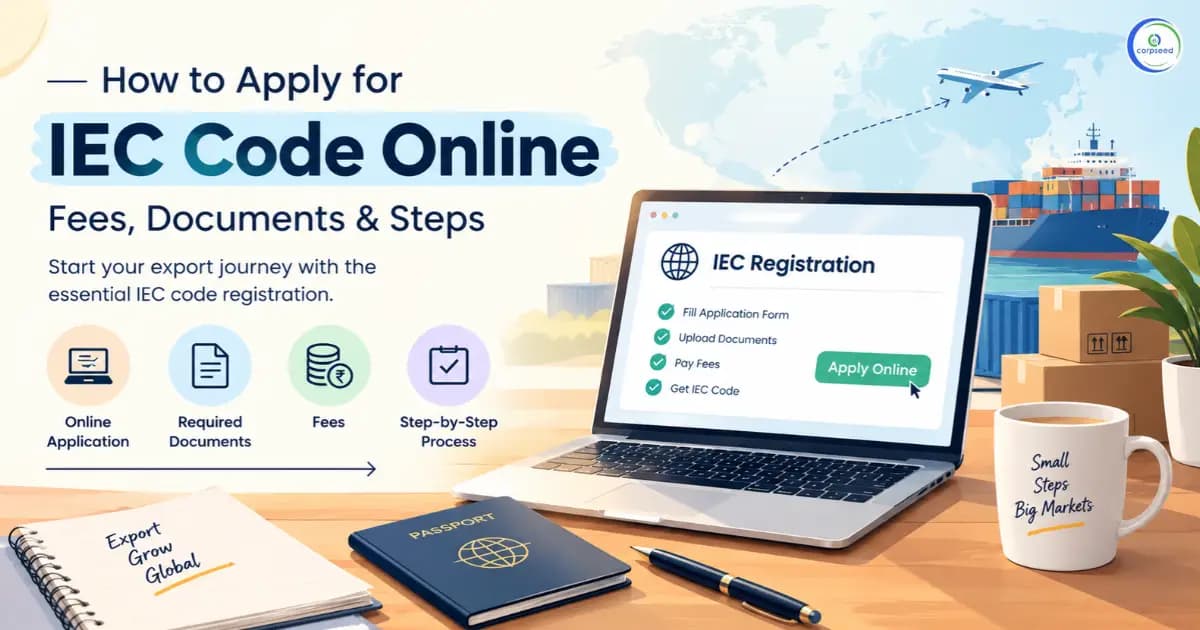
Introduction
An Import Export Code (IEC) is generally required to import or export goods from India, unless an exemption applies. You can apply through the official DGFT portal by submitting your business and bank details, completing electronic authentication and paying the government fee. Once issued, your IEC remains valid for a lifetime, subject to annual updating or confirmation between April and June.
This guide covers the IEC registration process, required documents, fees and common mistakes to help you apply without unnecessary delays.
The process is online, but errors in PAN details, bank information, address proof or electronic signing can delay an application. Here is how to apply for an IEC code, which documents to prepare and what to do after registration.
What Is an IEC Code?
An Importer Exporter Code (IEC) is a 10-character alphanumeric code issued by the Directorate General of Foreign Trade (DGFT), under the Ministry of Commerce and Industry. It is generally required for businesses and individuals importing or exporting goods from India, subject to applicable exemptions.
The IEC is linked to the applicant's PAN. However, having a PAN does not automatically mean that an IEC application has been completed. The code must be separately obtained through the DGFT portal.
Who Issues IEC in India?
The Directorate General of Foreign Trade (DGFT) issues IECs. Applicants submit their applications through the official DGFT website.
Is IEC Number the Same as PAN?
The IEC is based on the entity's PAN and generally carries the same PAN-based number. However, IEC registration is a separate process handled by DGFT. Businesses must complete the application and receive their IEC before undertaking activities for which it is required.
Who Needs an IEC Code?
Businesses and individuals importing or exporting goods generally need an IEC unless they fall under a specified exemption. The requirement depends on the nature of the activity, the applicant's status and the applicable provisions of the Foreign Trade Policy.
Eligible Entities: Proprietorship, Partnership, LLP, Company, Trust, HUF, Society
The following types of entities can apply for IEC registration:
- Sole proprietorships
- Partnership firms
- Limited Liability Partnerships (LLPs)
- Private and public limited companies
- One Person Companies (OPCs)
- Trusts and Hindu Undivided Families (HUFs)
- Registered societies
- Other eligible entities recognised under the DGFT application process
The applicant must provide the relevant PAN, bank account details, address information and supporting documents for the entity.
Do Service Exporters Need IEC?
Service exporters generally need an IEC when they intend to claim benefits under the Foreign Trade Policy. Exporting services does not automatically mean that every service provider must obtain an IEC for every transaction. The applicable requirement depends on the activity and the benefits being claimed.
Depending on the product, export activity and benefits being claimed, an exporter may also need a Registration-cum-Membership Certificate (RCMC) from the relevant Export Promotion Council or authorised body.
Who Is Exempt from IEC?
Certain categories are exempt under the Foreign Trade Policy and the Handbook of Procedures. These include:
Central and State Government ministries and departments.
Individuals importing or exporting goods for personal use unrelated to trade, manufacture or agriculture.
Certain importers and exporters covered by the Foreign Trade (Exemption from Application of Rules in Certain Cases) Order, 1993.
Specified cross-border transactions involving Nepal, Bhutan, Myanmar and certain notified routes through China, subject to prescribed conditions and consignment-value limits.
These exemptions are subject to the relevant rules and conditions. Businesses should check the applicable provisions of Paragraph 2.07 of the DGFT Handbook of Procedures before deciding that they do not need an IEC.
Documents Required for IEC Code Registration
Before filling out the IEC code registration form, keep your PAN details, bank proof and address proof handy. You may also need other documents depending on whether you are applying as an individual, proprietor, partnership firm, LLP or company.
| Document | Purpose |
| PAN card or PAN details | Identifies the applicant or business entity |
| Bank Proof | Verifies the bank account, generally through a cancelled cheque or bank certificate |
| Address Proof | Establishes the registered or business address |
| Incorporation or establishment proof, where applicable | Supports the legal existence and constitution of the entity |
| Aadhaar details or valid DSC | Used for electronic authentication and signing, as applicable |
| Active email address and mobile number | Used for portal registration, communication and verification |
| GSTIN, if available or applicable | Business tax identification details; applicants should follow the current portal fields and applicable requirements |
Documents should be legible and consistent with the details entered in the application. DGFT may request additional information or supporting documents where necessary.
Documents for Individuals and Proprietors
An individual proprietor should generally prepare the proprietor's PAN details, bank proof and address proof. Depending on the portal requirements, Aadhaar or another accepted identity document may also be needed for authentication.
If the address proof is not in the name of the firm or applicant, additional supporting documents, such as a No Objection Certificate (NOC) and proof of address, may be required. The current DGFT instructions should be checked before uploading the documents.
Documents for Companies, LLPs and Partnerships
Companies, LLPs and partnership firms should prepare their PAN and bank details, proof of the registered or business address and the relevant establishment documents. These may include a certificate of incorporation, LLP details or partnership deed, depending on the entity type and what the application requires.
A company or LLP may also need to provide details of its authorised signatory for electronic signing. Do not assume that a board resolution or Memorandum of Association is a mandatory document for every IEC application. Submit additional documents when the current DGFT portal or the circumstances of the application require them.
Not sure your documents are complete? Get a free check. Consult Corpseed's experts to review your IEC application documents before submission.
How to Apply for IEC Code Online on the DGFT Portal
The IEC application is submitted electronically through the DGFT portal. Keep the required documents and bank information ready before starting.
Step 1: Register on the DGFT Portal
Visit the official DGFT website and create an account if you don't already have one. Enter your contact details and complete the verification to access the portal.
Log in to your account and open the IEC application service. Choose the option to apply for a new IEC and follow the instructions displayed on the portal.
Step 2: Fill the IEC Application Details
Enter the applicant's details, including the firm name, PAN, type of entity, address, contact information and bank details. Make sure the name and PAN match the official records.
Fill in the remaining fields shown on the DGFT portal, including GSTIN where applicable. If your business also needs GST Registration, check the applicable requirements before proceeding. Review the information entered in the IEC application before moving to the next step.
Step 3: Upload Documents
Upload your bank proof, address proof and the other documents asked for in the IEC application. Before uploading, check that the files are readable and meet the DGFT portal's size, and format requirements.
Check the name and address on these documents against the details in your application. If something does not match you may need to provide additional proof, such as an NOC, or another supporting document, depending on the discrepancy.
Step 4: Sign with DSC or Aadhaar e-Sign
Complete the electronic signing process using an accepted Digital Signature Certificate (DSC) or Aadhaar-based e-Sign option available for the application.
The available signing method may depend on the applicant and portal requirements. Check that the person signing is authorised to submit the application on behalf of the entity.
Step 5: Pay the Fee
Pay the prescribed IEC application fee of Rs 500 through the payment method available on the DGFT portal. Save the payment confirmation, or transaction reference for your records.
Before making the payment, review the application summary and check the entered details and uploaded documents.
Step 6: Download Your IEC Certificate
After submission, monitor the application for confirmation, approval or any request for additional information. If DGFT raises a deficiency, log in and address the issue as instructed.
Once the IEC is issued, log in to the DGFT portal to view or download the certificate. Check the IEC details and retain a copy for business records and future import-export transactions.
Can You Still Apply for IEC Offline?
No. The IEC application process is online and paperless. Applicants should use the DGFT portal to apply for a new IEC or update an existing one.
Older instructions referring to printed forms, demand drafts, cash payments, envelopes or submitting the application at a DGFT office should not be followed as the standard application procedure. The current DGFT portal and instructions should be used for filing.
How to Check IEC Application Status
To check your IEC application status:
- Visit the DGFT website and log in to your account.
- Open the relevant IEC application, or dashboard section.
- Look for the application's current status and any pending action, or deficiency notice.
- If DGFT asks for additional information, submit the required details through the portal as instructed.
- Once the application is approved, log in to the portal to access your IEC certificate.
Keep your application reference number handy so you can check the status when needed. If there is a delay or you cannot resolve an issue on the portal, contact the DGFT helpdesk for assistance.
IEC Registration Fees and Timeline
The prescribed application fee for a new IEC is Rs 500. The fee is paid online through the DGFT portal during the application process.
The processing time can vary depending on the completeness of the application, validation of the details and any additional checks or deficiencies raised by DGFT. Applicants should not treat a fixed number of working days as a guaranteed issuance timeline.
| Particular | Details |
| Issuing authority | Directorate General of Foreign Trade (DGFT) |
| Application mode | Online |
| New IEC application fee | Rs 500 |
| Payment method | Available online payment options on the DGFT portal |
| Processing time | Depends on validation and whether additional information is required |
| Certificate access | Through the DGFT portal after issuance |
The Rs 500 amount applies to a new IEC application. Charges for other IEC-related services, such as late annual updation or certain modifications, may differ.
IEC Validity and Mandatory Annual Update
An IEC does not need to be renewed annually in the traditional sense, but its details must be updated electronically every year during April to June, even if no information has changed. This requirement is set out in Paragraph 2.05 of the Foreign Trade Policy.
The annual update allows the IEC holder to confirm that the details recorded with DGFT remain current. Businesses should check their profile and complete the process within the prescribed period.
What Happens If You Miss the Annual Update?
If an IEC is not updated within the prescribed period, DGFT may deactivate it. A deactivated IEC can generally be reactivated after successful updation, subject to applicable requirements and any other action that may apply.
DGFT's published fee schedule provides for a nil fee for annual updation during April to June, and a Rs 200 fee for updation after the stipulated period. Check the current portal instructions, and fee schedule when completing a late update.
How to Update or Modify Your IEC
To update, or modify an IEC:
- Log in to the DGFT portal.
- Open the IEC profile management or update/modify service.
- Review the existing details, and select the information that needs updating.
- Enter the revised details, and upload supporting documents where required.
- Complete the required electronic signing and payment steps, if applicable.
- Submit the request and check the updated IEC profile or application status.
Annual updation and modification are not always the same action. Annual updation confirms the IEC details for the relevant year, while modification is used when information such as the address or bank details changes.
Common Reasons for IEC Application Rejection
Errors in the application can lead to deficiencies, delays or rejection. Check the following points before submitting your IEC application.
- Incorrect PAN or Firm Name: Enter the details exactly as they appear in the relevant records.
- Mismatched Bank Details: Check the account holder's name, and account information against the submitted bank proof.
- Unclear or Incomplete Documents: Upload readable files and include all required pages.
- Address Discrepancies: Provide the correct address proof, and any additional supporting documents required.
- Incorrect Entity Details: Select the right constitution, such as proprietorship, partnership, LLP or company.
- Signing by an Unauthorised Person: Confirm that the person completing the electronic signing is permitted to act for the applicant.
- Ignoring Deficiency Notices: Check the application dashboard and registered email for requests from DGFT, then respond within the prescribed period.
- Assuming PAN alone is Enough: Complete the separate IEC application through the DGFT portal.
An incomplete or unauthorised application may be rejected with reasons. DGFT's Handbook of Procedures also provides for incomplete applications to be reopened for rectification, subject to the prescribed conditions and timelines.
Get Your IEC Code Registration with Corpseed
Applying for an IEC involves checking documents, entering the correct details and completing the required steps on the DGFT portal. Corpseed can help you review your documents, prepare the application and follow up if DGFT asks for additional information. This gives you support throughout the process, from the initial document check to accessing your IEC certificate.
How We Get Your IEC Done
- Free consultation (same day): We confirm your eligibility, entity type, and the exact documents you need. No guesswork.
- Expert document review: Our team checks your PAN, bank proof, and address proof for mismatches before filing. This is the most common reason applications get delayed.
- Application filing on DGFT: We fill and file your IEC application, guide you through DSC or Aadhaar e-sign and complete the payment.
- Follow-up until issued: If DGFT raises a deficiency, we respond on your behalf and keep you updated at every stage.
- IEC certificate delivered: You receive your e-IEC certificate along with a reminder setup for your annual April–June update.
Typical turnaround: Most IEC applications with complete documents are issued within 1-3 working days of filing.
The actual processing time depends on the completeness of the application and DGFT's verification. Any expected timeline should be confirmed for the individual case rather than treated as a guaranteed issuance date.
Need help with your IEC application? Consult Corpseed's experts for guidance on documents, filing and the next steps.
Why Businesses Trust Corpseed?
Businesses seeking help with regulatory applications can benefit from clear documentation guidance, assistance with application requirements and support in understanding post-registration obligations.
Corpseed provides compliance-related services for businesses across different regulatory areas. The support required will depend on the applicant's entity type, documents and specific import-export activity.
Contact the team to discuss your IEC registration requirements and the assistance available for your case.
Conclusion
Getting an IEC code is a straightforward process when your documents and application details are in order. Before submitting the form, check your PAN, bank and address details to avoid unnecessary delays. Once your IEC is issued, keep your business information up to date and complete the annual IEC update between April and June. If you need help with IEC code registration or the DGFT application process, Corpseed's experts can guide you through the requirements and documentation.
About the Author

Surbhit Sharma
Content WriterI have worked for many internet blog pages and news portals. currently, I am working as a content writer for Corpseed Pvt. Ltd. I like to write blogs and articles in the field of different services.
Related articles
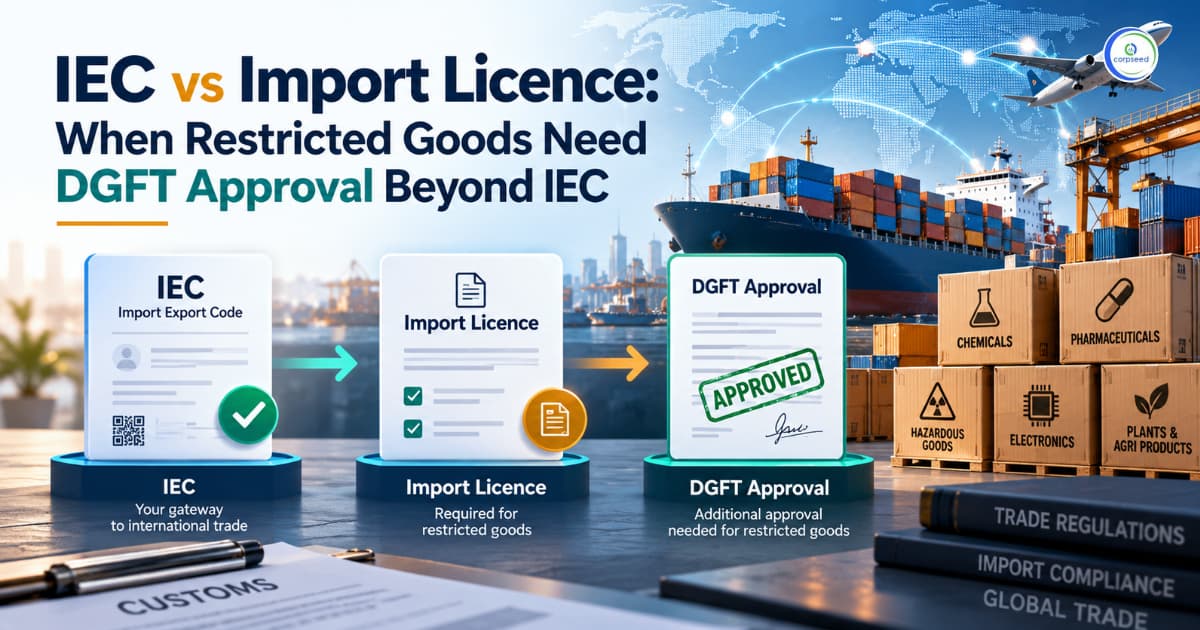
IEC vs Import Licence: When Restricted Goods Need DGFT Approval Beyond IEC
2026-10-26
Can You Import Products Before BIS Certification? What Importers Must Know
2026-10-15

Selling Imported Goods on Amazon & Flipkart? 7 Compliance Checks Before Listing
2026-10-15
Rules of Origin Explained: A Complete Guide for Exporters and Importers
2026-08-06
DGFT Extends India-UAE CEPA Gold Import TRQ Deadline
2026-07-08

Impact of China’s Lithium Policy Changes on India’s EV Sector
2026-03-18