
AOC-4 Filing: Due Date, Documents and Penalty for FY 2025-26
MCA has given FY 2025-26 filers until 31 December 2026 to file AOC-4 without additional fees. This guide covers who files AOC-4, the due dates, the documents to attach and what a late filing costs.
Schedule a Call Back
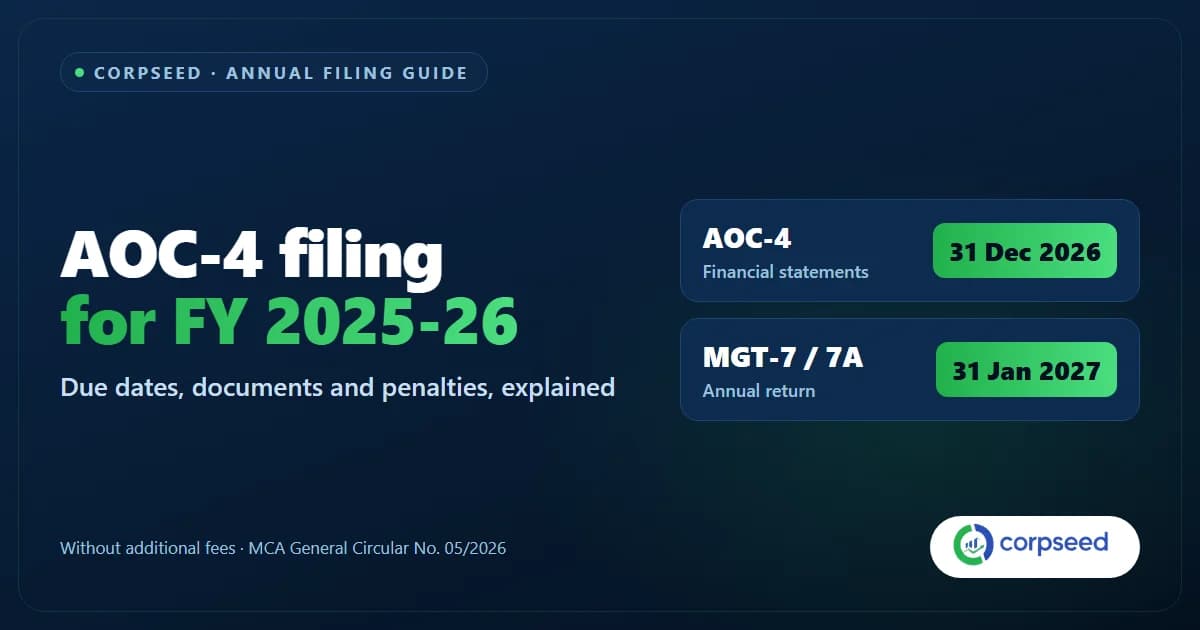
If your company's accounts for the year ended 31 March 2026 are adopted but not yet filed, AOC-4 is the form that puts them on the Registrar of Companies (ROC) record. The Ministry of Corporate Affairs (MCA) has now given FY 2025-26 filers until 31 December 2026 to file it without additional fees. This guide covers who files AOC-4, the dates, the documents that go with it, and what a late filing costs. It also explains what the relief leaves untouched, starting with the AGM date.
Contents
- What is Form AOC-4?
- What is the AOC-4 due date for FY 2025-26?
- Who has to file AOC-4?
- Documents to attach
- How do you file AOC-4?
- Late filing: fee and penalty
- What the circular does not change
- Mistakes to avoid
- How Corpseed can help
- Frequently asked questions
What is Form AOC-4?
AOC-4 is the e-form in which a company files its financial statements with the Registrar. Section 137 of the Companies Act, 2013 requires a copy of the financial statements, adopted at the annual general meeting (AGM), to be filed along with the documents that must be attached to them.
There are several versions of the form. The MCA circular of 24 October 2026 names AOC-4, AOC-4 (CFS), AOC-4 (XBRL), AOC-4 NBFC (Ind AS) and AOC-4 CFS NBFC (Ind AS). Which one applies depends on whether you file consolidated statements, whether your company is required to file in XBRL (eXtensible Business Reporting Language), and whether you are a non-banking financial company (NBFC) reporting under Indian Accounting Standards (Ind AS).
Under section 2(40), "financial statement" means the balance sheet, the profit and loss account (or income and expenditure account for a not-for-profit company), the cash flow statement, a statement of changes in equity where applicable, and the explanatory notes. A One Person Company, small company or dormant company may leave out the cash flow statement.
What is the AOC-4 due date for FY 2025-26?
The normal due date is 30 days from the date of the AGM. For FY 2025-26, General Circular No. 05/2026 (our Law Update) lets companies file AOC-4 up to 31 December 2026 without additional fees.
| Item | Normal rule | FY 2025-26 position |
| AOC-4 and its variants | Within 30 days of the AGM (section 137(1)) | Without additional fees till 31 December 2026 |
| MGT-7 and MGT-7A (annual return) | Within 60 days of the AGM (section 92(4)) | Without additional fees till 31 January 2027 |
| AGM | Within six months of the end of the financial year (section 96(1)) | Not extended |
Take a company that held its AGM on 30 September 2026, the usual last day for a 31 March year-end (a company's first AGM can be held within nine months). Its normal AOC-4 date was 30 October 2026. Under the circular, it now has until 31 December 2026 to file without additional fees. A company whose AGM falls late in the year, or has not been held yet, should ask its company secretary how the relaxed date applies to its case before relying on either date.
Other cases have their own clocks. A One Person Company does not hold an AGM and must file within 180 days from the close of the financial year. If the accounts were not adopted at the AGM, the unadopted statements are still filed within 30 days of that meeting and are taken as provisional until the adjourned AGM adopts them. If no AGM was held at all, section 137(2) requires the statements, signed and with a statement of facts and reasons, within 30 days of the last date on which the AGM should have been held.
Who has to file AOC-4?
Section 137 applies to every company, private or public, large or small. Each one has to file its financial statements with the Registrar each year. A company with subsidiaries or associates also prepares consolidated financial statements under section 129(3), and section 137(1) requires these to be filed with the Registrar as well.
The circular's relief applies to FY 2025-26 filings only. A company filing for an earlier year does not get the benefit.
Documents to attach
The form carries the adopted financial statements and the documents the Act requires to be attached to them.
| Document | Why it is needed | Source in the Act |
| Balance sheet, profit and loss account, cash flow statement (where applicable), statement of changes in equity (where applicable), notes | These make up the financial statements | Section 2(40) |
| Board approval and signatures | The Board approves the statements before they go to the auditor, and authorised signatories sign them | Section 134(1) |
| Auditor's report | Must be attached to every financial statement | Section 134(2) |
| Board's report | Attached to the statements laid before the AGM | Section 134(3) |
| Consolidated financial statements | Where the company has subsidiaries or associates | Section 129(3) |
| Accounts of foreign subsidiaries | Where a foreign subsidiary has no place of business in India | Fourth proviso to section 137(1) |
Keep the AGM notice, the minutes and the signed statements in the same folder, in case a figure is ever questioned.
How do you file AOC-4?
Most delays come from doing these steps out of order, not from the portal itself.
- The Board approves the financial statements, and the signatories sign them (section 134(1)).
- The statutory auditor examines them and issues the report.
- The statements and the Board's report go to the members at the AGM, where the statements are adopted.
- Your team or your company secretary prepares the correct version of AOC-4 and attaches the documents.
- The form is filed on the MCA portal along with the prescribed fee.
- Save the filing acknowledgement with the AGM minutes.
Check before you start that each signatory's digital signature certificate is valid and linked to their MCA login. An expired certificate can hold up a filing that is otherwise ready.
Late filing: fee and penalty
A late filing costs more than the fee you would have paid on time, and it can also lead to a penalty on the company and its officers.
Section 403 allows a delayed filing under section 137 or 92 on payment of an additional fee, which "shall not be less than one hundred rupees per day". The Companies (Registration Offices and Fees) Rules, 2014 set the amounts, and they can differ between classes of company.
Separately, section 137(3) provides a penalty on the company of Rs.10,000, with a further Rs.100 for each day the failure continues, up to Rs.2 lakh. The managing director and the Chief Financial Officer, or in their absence any director the Board has made responsible for compliance, or failing that all the directors, face Rs.10,000 with a further Rs.100 for each day after the first, up to Rs.50,000. Under section 403(2), this penalty is payable on top of the fee and additional fee, so paying the additional fee does not remove it.
Once the window closes, the relief goes with it. Any filing after the circular's dates "would attract payment of all fees, including additional fees" counted from the date the filing was actually due under the Act, not from 31 December.
What the circular does not change
The circular says it does not extend the statutory time for holding AGMs. A company that missed the six-month AGM deadline under section 96 remains liable under the Act, even though its AOC-4 now has more time.
It also names only the AOC-4 and MGT-7 families. Forms it does not mention, such as ADT-1, keep their own time limits. Cost audit reports have a separate circular: General Circular No. 06/2026 of 27 October 2026 allows CRA-4 for FY 2025-26 up to 31 December 2026 without additional fees. See our guide to filing e-form CRA-4.
Finally, the relief covers additional fees. You still pay the normal filing fee.
Mistakes to avoid
Don't wait for 31 December: a slow portal on the last day leaves no time to fix anything. If the AGM is still pending, the circular won't help; hold it first, within section 96 and any extension the Registrar has allowed.
Before uploading, check that the balance sheet, the auditor's report and the Board's report carry the same figures. And check whether an MGT-7 or MGT-7A is also pending. The annual return has its own date, 31 January 2027, and is easy to overlook once the AOC-4 is done. Our guide to Form MGT-7 filing covers it.
How Corpseed can help
If you would like a second pair of eyes on your AGM date, your attachments and the filing sequence, our company law team handles AOC-4, MGT-7 and related ROC filings. You can see the details on our annual compliance for private limited company page and schedule a call back there.
Frequently asked questions
What is the last date to file AOC-4 for FY 2025-26?
31 December 2026 if you want to avoid additional fees. This comes from MCA General Circular No. 05/2026 dated 24 October 2026. After that date, additional fees apply from the original due date.
Does the extension cover MGT-7 as well?
Yes. The same circular allows MGT-7 and MGT-7A for FY 2025-26 up to 31 January 2027 without additional fees. The two forms are separate filings with separate dates.
Has the MCA extended the AGM date?
No. The circular says it does not extend the statutory time for holding AGMs, and companies that have not met the relevant timelines remain liable under the Act.
How much is the penalty for late AOC-4 filing?
Besides the additional fee (not less than Rs.100 per day under section 403), section 137(3) provides a Rs.10,000 penalty on the company plus Rs.100 a day up to Rs.2 lakh, and a penalty on specified officers, or failing them all the directors, of up to Rs.50,000.
When does a One Person Company file AOC-4?
A One Person Company files within 180 days from the close of the financial year, because it does not hold an AGM. For the year ended 31 March 2026, 180 days ends on 27 September 2026, and the circular's relief to 31 December 2026 applies to FY 2025-26 filings.
What is the difference between AOC-4, AOC-4 CFS and AOC-4 XBRL?
They are versions of the same filing. The circular lists AOC-4, AOC-4 (CFS), AOC-4 (XBRL), AOC-4 NBFC (Ind AS) and AOC-4 CFS NBFC (Ind AS). The version you use depends on whether you file consolidated statements, whether your company is required to file in XBRL and whether you are an NBFC under Ind AS.
This article is for general information and does not constitute legal advice. Requirements can vary by state, product and facts of your case. Please verify with the official notification or speak to a Corpseed expert before acting.
Sources
- Ministry of Corporate Affairs, General Circular No. 05/2026, "Relaxation of additional fees and extension of time for filing of Financial Statements and Annual Returns under the Companies Act, 2013" (File No. Policy-17/111/2022-CL-V-MCA), 24 October 2026: https://www.mca.gov.in/bin/dms/getdocument?mds=5vSiNq59rdjIZwZqMbEIgQ%3D%3D&type=open
- Ministry of Corporate Affairs, General Circular No. 06/2026, "Relaxation of Additional Fees and Extension of Time for Filing CRA-4 (Cost Audit Report in XBRL Format)", 27 October 2026. mca.gov.in home page, Circulars tab.
- The Companies Act, 2013 (India Code): https://www.indiacode.nic.in/bitstream/123456789/2114/5/A2013-18.pdf
About the Author

Related articles

Pvt Ltd vs LLP vs OPC: Which Is the Best Business Structure in India?
2026-10-08

MCA Introduces New CSR Funding Route Through Zero-Coupon Zero-Principal Instruments
2026-05-30

How to Register a Startup in India (2026): A Step-by-Step Legal & Compliance Guide
2026-05-07
How to Secure 12A Registration in 2026?
2026-04-18

MCA Invites Stakeholders' Feedback to Simplify SPICe+ Part B Resubmission and Linked Forms
2026-01-03

Annual Compliance Checklist For Private Limited Companies And LLPs In India
2026-12-31