9311255283
×

Welcome to Corpseed. Please type your query, and we shall provide immediate assistance.

×

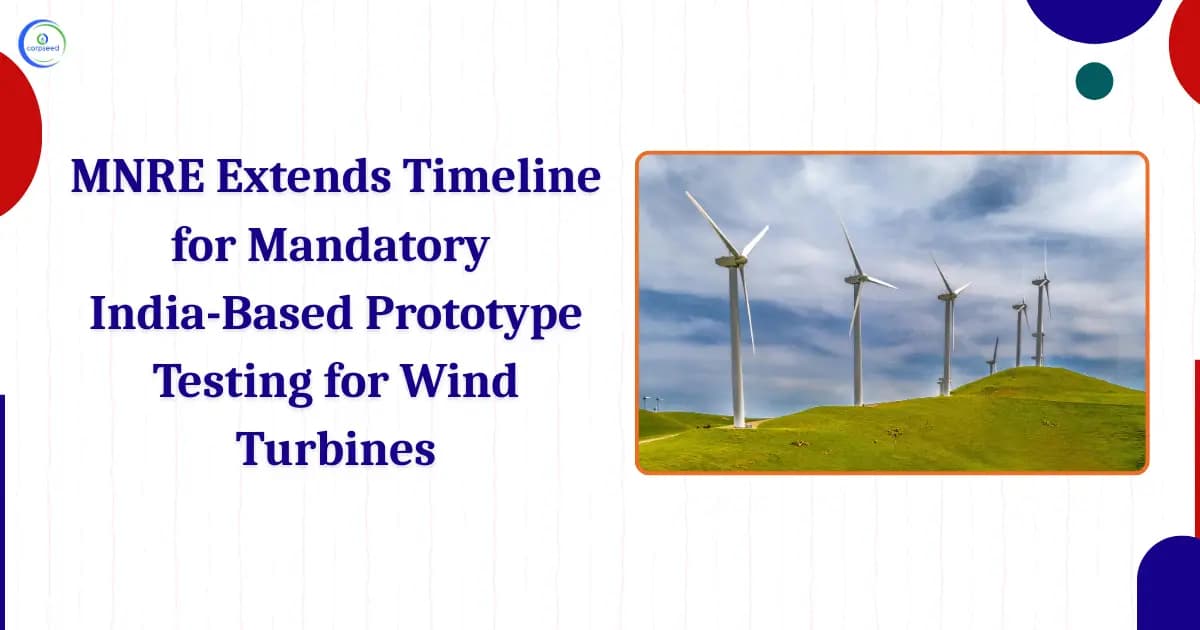
MNRE Extends Timeline for Mandatory India-Based Prototype Testing for Wind Turbines

MNRE_Extends_Timeline_for_Mandatory__India-Based_Prototype_Testing_for_Wind_Turbines_Corpseed.webp

The Ministry of New and Renewable Energy (MNRE) has announced a significant update to the Standard Operating Procedure (SOP) for wind turbine equipment. The amendment, delivered on December 1, 2025, brings a major shift in the regulations that guide the assessment of wind turbines under the Approved List of Models and Manufacturers (ALMM).

The amendment aims at Clause 801, which deals with performance proficiency and safety compliance. The original SOP, released on October 29, 2025, needed manufacturers to conduct prototype testing of wind turbines within India. This rule was meant to confirm that turbines perform well under local wind, terrain, and climate variations.

Mandatory Local Testing Deferred for Two Years

The ministry has now relaxed the immediate implementation of that requirement. Instead of making India-based prototype testing obligatory right away, MNRE has delayed the mandate for two years. This means manufacturers will only need to conduct compulsory prototype testing in India after December 1, 2027.

During this two-year window, the government will review industry readiness and may revise the requirement again, depending on progress. Manufacturers are still stimulated to perform testing in India as early as possible, but they are no longer pressured by an immediate order.

All other provisions of the original SOP remain unchanged.

Certification Still Required Under Global Standards

Even with the relaxed timeline, MNRE has kept some technical conditions firm. Wind turbine makers must still submit proof that the power curve of their models has been tested and certified by a qualified laboratory. These tests must comply with the international standard IEC 61400-12-1.

The review committee will continue assessing whether turbines fulfill the expected performance benchmarks. It will also check if the equipment is suitable for India’s varied geographical conditions.

Operational Ease for Manufacturers

The amendment is expected to ease pressure on both domestic and global manufacturers. By offering a two-year transition period, MNRE focuses on helping the industry align its testing capabilities without reducing wind energy development. The move also signals the government’s intent to balance quality control with practical timelines.

Industry stakeholders believe this step will help new investments and support companies in boosting their operations before the compulsory local testing rule comes into effect.

The revised SOP offers manufacturers a smoother transition while maintaining quality expectations. The extended timeline is likely to support steady industry growth without compromising on essential performance and safety standards.

This portion of the site is for informational purposes only. The content is not legal advice. The statements and opinions are the expression of author, not corpseed, and have not been evaluated by corpseed for accuracy, completeness, or changes in the law.

5431804048Parul_Bohral_Corpseed.jpg

Parul Bohral, a BALLB graduate and experienced legal researcher and content writer with expertise in various legal areas, including corporate law and intellectual property. I have gained valuable experience in esteemed legal environments, where...

Learn More >>