
US Imposes 10% Tariff on Indian Imports Over Forced Labour Concerns: A Complete Compliance Guide for Exporters
US imposes a 10% tariff on Indian imports over forced labour concerns. Know the impact on exporters, MSMEs & compliance steps to take now
Schedule a Call Back
Introduction
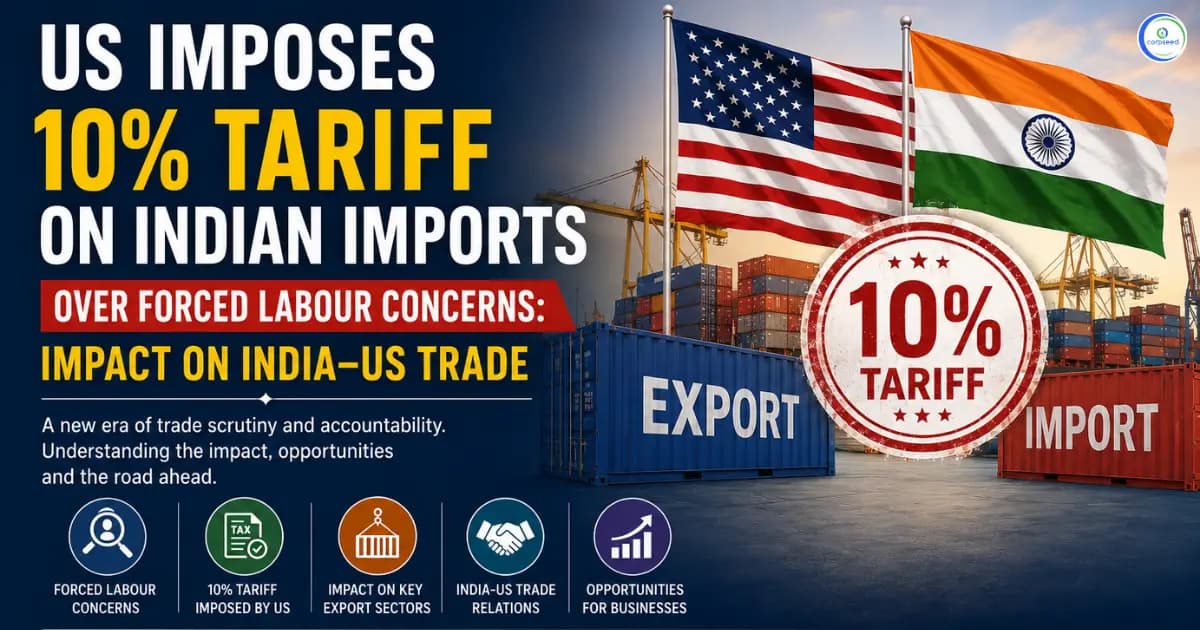
The United States has placed a new 10 per cent tariff on imports from India. This tariff took effect at 12:01 am EDT on Friday, July 24, 2026. It replaces an earlier, temporary baseline tariff that applied broadly to US trading partners.
This is not a random trade move. The US Trade Representative (USTR) built this decision on the outcome of a formal investigation conducted under Section 301 of the Trade Act of 1974. The investigation focused on forced labour practices connected to goods entering the United States. India was one of many countries reviewed. It ended up in a comparatively favourable position, but the change still carries real weight for Indian businesses.
Why is this important for Indian exporters, manufacturers and MSMEs? Because a tariff is more than just a figure written on a customs form. It affects price, contract, logistics, documentation, and competitiveness in the United States market in the long run. Such a change can work silently against their profitability if they are not ready for it, or they can accommodate it without any problem if they are prepared.
This guide breaks down what changed, why it changed, who it affects, and what steps Indian businesses should be taking right now. It also looks at the practical compliance and documentation questions that tend to trip up exporters when a new tariff regime lands. Businesses that treat this as a compliance exercise, not just a pricing problem, will be in a stronger position in the future.
Executive Summary
- The US has imposed a flat 10 per cent tariff on goods imported from India, effective July 24, 2026.
- The tariff stems from a Section 301 investigation into forced labour in global supply chains.
- The USTR had originally proposed a steeper 12.5 per cent tariff on Indian goods, but reduced it after India revised its Foreign Trade Policy to restrict the import of forced-labour-linked goods.
- India is one of 18 economies placed in the lower 10 per cent bracket, out of 60 economies reviewed in this action. Others face a 12.5 per cent duty.
- Goods in transit at the time of announcement will be exempt from the new tariff rate up until July 28, 2026.
- Indian exporting companies, importing organizations, manufacturing firms, and American buyers now have a fresh task of reviewing their deals, costs, paperwork, and labour practices.
What Happened?
On July 24, 2026, the US authorities announced the new tariff structure to apply to a number of its trading nations after conducting a lengthy Section 301 study. India was selected among many countries and received a relatively low tariff structure of 10 percent, unlike the 12.5 percent given to others.
The USTR's reasoning rested on a few connected factors:
- Findings from its own forced labour investigation.
- Recent changes India made to its Foreign Trade Policy to restrict imports linked to forced labour.
- Input gathered from public hearings.
- Recommendations from advisory bodies involved in the review.
- According to the USTR, the process included two rounds of public hearings and drew more than 2,100 public comments, alongside direct engagement with the governments of the countries under review. This was a methodical, multi-month process rather than a sudden announcement.
- Goods that were already in transit toward the US before the new tariff came into force will not be charged the new rate immediately. The USTR has allowed an exemption window for such shipments until July 28, 2026.
Background: Why Did the US Take This Step?
To understand this tariff, it helps to understand the tool behind it. Section 301 of the Trade Act of 1974 gives the US government authority to investigate foreign trade practices that are considered unfair to US commerce, and to respond with tariffs or other trade measures if the investigation supports it.
The US has maintained a ban on the import of goods made with forced labour for close to a century, and officials have signalled they intend to enforce it more rigorously going forward. US Trade Representative Jamieson Greer framed the decision as a response to labour practices that, in his words, have not been eliminated from global supply chains through moral persuasion alone. He said it was time for trading partners to adopt the same kind of import restrictions the US itself enforces.
This context places the new tariff system in the nexus between trade and labour rights policies. This tariff system is not merely about raising revenues and protecting interests, but about the behaviour the US expects from its trading partners in restricting goods linked to forced labour through their import policies.
Regulatory Framework
Indian businesses trading with the US should be aware of the following regulatory layers now in play:
| Layer | Relevance |
| Section 301, Trade Act of 1974 (US) | Legal basis for the tariff action |
| USTR tariff notification | Sets the applicable rate and effective date |
| India's revised Foreign Trade Policy | India's own restriction on forced-labour-linked imports, which influenced the lower US rate |
| US Customs and Border Protection (CBP) | Enforces tariff collection at the port of entry |
| India's DGFT (Directorate General of Foreign Trade) | Governs Indian exporters' compliance with India's own trade policy changes |
This is a case where both US and Indian regulatory frameworks now interact directly. A shipment leaving India is affected by India's own forced-labour import restrictions, and again by the tariff regime at the US border.
Key Changes at a Glance
| Aspect | Before | Now |
| Tariff rate on Indian goods | Temporary baseline tariff (varied by product/prior orders) | Flat 10% |
| Basis for tariff | General trade measures | Section 301 forced labour investigation |
| Original proposed rate for India | N/A | 12.5% (reduced to 10%) |
| Countries reviewed | - | 60 economies |
| Countries in lower 10% bracket | - | 18 economies, including India |
| Effective date | - | July 24, 2026, 12:01 am EDT |
| Transit exemption | - | Until July 28, 2026 |
Why Was This Tariff Introduced?
A few overlapping objectives appear to be behind this move:
- Labour rights enforcement: The US wants trading partners to actively restrict imports connected to forced labour, not merely discourage it in principle.
- Consistency across trading partners: By reviewing 60 economies together, the US appears to be applying a uniform standard rather than singling out one country.
- Incentivising policy reform: India's reduced rate, compared to the originally proposed 12.5 per cent, shows the US is willing to reward countries that amend their own trade policy in line with US expectations. This creates a direct incentive structure: policy alignment lowers tariff exposure.
- Trade practice scrutiny: 301 investigations are conducted precisely to assess if foreign trade practices cause an undue burden on US businesses. The use of forced labour in supply chains is an issue in that context.
Who Will Be Affected?
Below are the key stakeholders who will be affected by the new US tariff on Indian imports and how the notification may impact their businesses.
- Exporters: Any Indian exporter selling goods into the US market will see a 10 per cent tariff applied at the border, unless the goods qualify for exemption due to transit timing.
- Importers (on the American side): American importers of products from India will bear the cost of tariffs unless the tariff costs get transferred through the prices.
- Manufacturing: Manufacturing entities producing products for exports to the US, especially those involved in manufacturing in labour-intensive sectors like textiles, leather, and handicrafts, may find themselves under increased scrutiny regarding their labour practices and documentation.
- MSMEs: Small exporters tend to work with smaller margins than large corporations, so they will be affected by the tariffs more than larger companies with a diverse market portfolio.
- Large companies: Big exporters will also need to reconsider their pricing policies for goods heading to America.
- Startups: Export-focused startups building a US customer base will need to factor this tariff into cost models from the outset.
- Foreign companies with Indian supply chains: Global brands sourcing from Indian manufacturers will likely revisit supplier audits and labour compliance documentation.
- Supply chain partners: Logistics providers, customs brokers, and freight forwarders handling India-US trade routes will need to adjust documentation processes.
- Compliance professionals: Trade compliance teams and consultants will see increased demand for guidance on tariff classification, labour compliance certification, and customs documentation.
Business Impact
Below are the key business impacts of the new US tariff measures on companies involved in India-US trade.
- Operational Impact: Planning for exports, shipping, and inventory management could get impacted, particularly considering the cut-off date on July 28 for the tariff exemption.
- Financial Impact: The fixed 10 percent tariff directly impacts the landed cost in the US market. It is up to individual businesses whether to absorb the cost, pay it forward to customers, or otherwise negotiate.
- Legal Impact: US buyers’ contracts without proper allocation of tariff risk may be contentious. Force Majeure and Price Adjustment Clauses will receive more attention.
- Compliance Impact: Exporters may have to provide evidence of non-use of forced labour in the supply chain as per the updated Foreign Trade Policy.
- Documentation: Additional certifications, supplier’s declarations, and audit reports may be required to support customs clearance and buyer due diligence.
- Licensing: Exporters must verify whether their IEC and other relevant registrations are consistent with the new DGFT policy.
- Audits: Businesses with complex, multi-tier supply chains may face labour practice audits from buyers, certification bodies, or Indian regulatory authorities.
- Imports and exports: Both inbound raw material sourcing and outbound finished goods may be affected if any part of the supply chain involves flagged labour practices.
- Customs: Customs brokers on both sides will need updated tariff codes and documentation checklists.
- Supply chain: Businesses may need to map their supply chains more thoroughly to identify and eliminate any forced-labour-linked inputs.
- Contracts: Existing and future contracts with US buyers should be reviewed for tariff and compliance clauses.
- Vendor management: Exporters may need to request updated compliance declarations from their own vendors and sub-contractors.
- Risk management: A broader risk assessment covering pricing, compliance, and reputational exposure is advisable for businesses with significant US trade volume.
Compliance Requirements
Businesses exporting to the US should be prepared to address the following:
- Supply chain documentation showing the source of raw materials and labour practices used in production.
- Compliance with India's revised Foreign Trade Policy, which now restricts imports linked to forced labour.
- Updated customs declarations reflecting the correct tariff classification and applicable 10 per cent duty.
- Buyer-side due diligence responses, since many US importers will now request supplier certifications related to forced labour compliance.
- Coordination with DGFT for any registration or policy-related clarifications.
- Monitoring of USTR notifications for any future adjustments to the tariff rate or exemption terms.
Step-by-Step Compliance Process
The following steps will help exporters prepare for the new tariff, strengthen supply chain compliance, and minimise trade disruptions.
- Check the status of existing US-bound consignments to see if they are eligible for transit exemption until July 28, 2026.
- Conduct an audit of the supply chain to determine any components or labor practices that may fall foul of forced labor regulations.
- Amend the declarations of the suppliers/vendors regarding compliance with the Foreign Trade Policy of India.
- Compute the landed cost based on 10% duty for US-bound consignments.
- Analyze existing contracts with US customers for any provision regarding tariff allocation and price adjustment.
- Collaborate with your customs broker to ensure proper tariff classification and documents for consignments.
- Generate compliance documentation that could be provided to the US customers on demand.
- Monitor for additional developments from the USTR/DGFT, as the tariff structure based on the investigation may change.
- Seek guidance from a trade compliance expert if your organization does not have such internal capacity.
Challenges Businesses May Face
- Operational challenges: Coordinating shipment timing around the exemption cut-off, especially for businesses with limited logistics visibility.
- Financial challenges: absorbing a 10 per cent cost increase without losing competitiveness in the US market.
- Legal challenges: interpreting how existing contracts apply under the new tariff, particularly where pricing was fixed in advance.
- Documentation challenges: building out forced-labour compliance documentation where none previously existed.
- Technology challenges: Smaller exporters may lack systems to track and document multi-tier supply chains.
- Cross-border challenges: Aligning Indian export documentation with US customs expectations, which may not always be identical.
Penalties for Non-Compliance
While the tariff itself is a cost rather than a penalty, non-compliance with related documentation and labour practice requirements can lead to more serious consequences, including:
- Shipment delays or holds at US customs.
- Rejection of goods found linked to forced labour, under the long-standing US import ban on such goods.
- Loss of buyer trust and potential contract termination if compliance documentation cannot be produced.
- Reputational damage in a market that is increasingly sensitive to labour practice scrutiny.
- Possible action under India's own Foreign Trade Policy if a business is found non-compliant domestically.
Industry Opportunities
This shift is not only a cost. It also opens space for:
- Trade compliance consulting, as businesses look for help navigating dual regulatory requirements.
- Compliance software and documentation tools to manage supply chain audits.
- Third-party labour practice audits and certifications, which can become a competitive differentiator for exporters.
- Training programs for compliance teams handling forced-labour and customs documentation.
- Supply chain optimisation services to help exporters identify and remove non-compliant inputs proactively.
Exporters who move early on compliance may find themselves better positioned with US buyers who are themselves under pressure to prove clean supply chains.
Best Practices for Indian Exporters
- Map your full supply chain, not just direct suppliers, to catch forced-labour risks at every tier.
- Keep documentation updated and easily accessible for buyer or customs requests.
- Build tariff-related price adjustment clauses into new contracts.
- Track USTR and DGFT notifications regularly, since this framework may evolve.
- Communicate proactively with US buyers about compliance steps being taken.
- Treat compliance as an ongoing process, not a one-time response to this announcement.
Why Professional Compliance Support Matters?
Such regulatory changes seldom occur in isolation. They connect with customs law, labour regulation, contract law, and international trade laws. For a company that is interested in manufacturing and selling products, keeping track of all the regulatory aspects may not always be easy.
- Professional compliance guidance can benefit businesses by helping them:
- Avoid shipment delays because of inadequate or incorrect documentation.
- Minimize the risks associated with labour compliance problems.
- Gain quicker approval and certification processes.
- Maintain documentation that holds up to buyer or customs scrutiny.
- Get clear interpretation of how new rules apply to a specific business and product category.
- Manage communication with relevant government bodies more efficiently.
Businesses should evaluate their compliance obligations at the earliest, since delays in adapting to new tariff and labour compliance requirements can directly affect shipment timelines and buyer relationships.
How Can Corpseed Help?
A regulatory compliance consultancy like Corpseed can support Indian exporters across several stages:
- Compliance assessment to understand current exposure under the new tariff and forced labour rules.
- Analysis of the gap between current supply chain documentation and what US customs and buyers need.
- Documentation for supplier declarations, audit trail, and customs documents.
- Assistance on licensing and registrations, including meeting DGFT guidelines.
- Regulatory advice on the impact of Section 301 regulations and FTPI on each other.
- Audit assistance to companies undergoing buyer’s and third-party labour practice audits.
- Training of internal compliance and export teams.
- Ongoing compliance monitoring, so businesses are not caught off guard by future tariff or policy revisions.
- Government coordination, helping businesses navigate queries or clarifications with DGFT or other authorities.
- Seeking professional regulatory guidance can help avoid costly mistakes, particularly for MSMEs and smaller exporters without dedicated compliance teams.
Conclusion
The newly imposed 10 per cent duty on imports from India is a sign of a change in the way compliance with forced labour standards is becoming part of trade regulations. While the reduced import duty as opposed to the other 12.5 per cent shows that the Foreign Trade Policy of India has been taken into consideration, this is not sufficient in overcoming the compliance issue. Exporters, manufacturing organizations, and MSMEs should consider transparency and compliance documentation as central activities when dealing with trade with the US.
A proactive approach to compliance avoids operational disruptions and helps in sustaining buyer relations in the long term. Businesses that deal with the US must consider their current shipping, supply chain, contractual arrangements, and documentation before it becomes necessary due to any customs delays or buyer audits. If the regulatory landscape seems complicated, using a trade and regulatory compliance consultant may become essential.
About the Author

Anshika Jindal
Content WriterAnshika Jindal, a Legal Content Writer with strong expertise in legal research and a solid academic background in BA LLB and LLM (Criminal Law). I specialize in researching statutes, case laws, and legal developments and presenting them in clear, accurate, and engaging written content. With strong analytical skills and attention to detail, I create reliable, well-structured legal content while maintaining professional and ethical standards.
I specialize in conducting in-depth legal research using credible sources and presenting legal information in a structured, reader-friendly manner while maintaining precision and authenticity. My work focuses on simplifying legal language without compromising its meaning, making legal content accessible to a wider audience.