
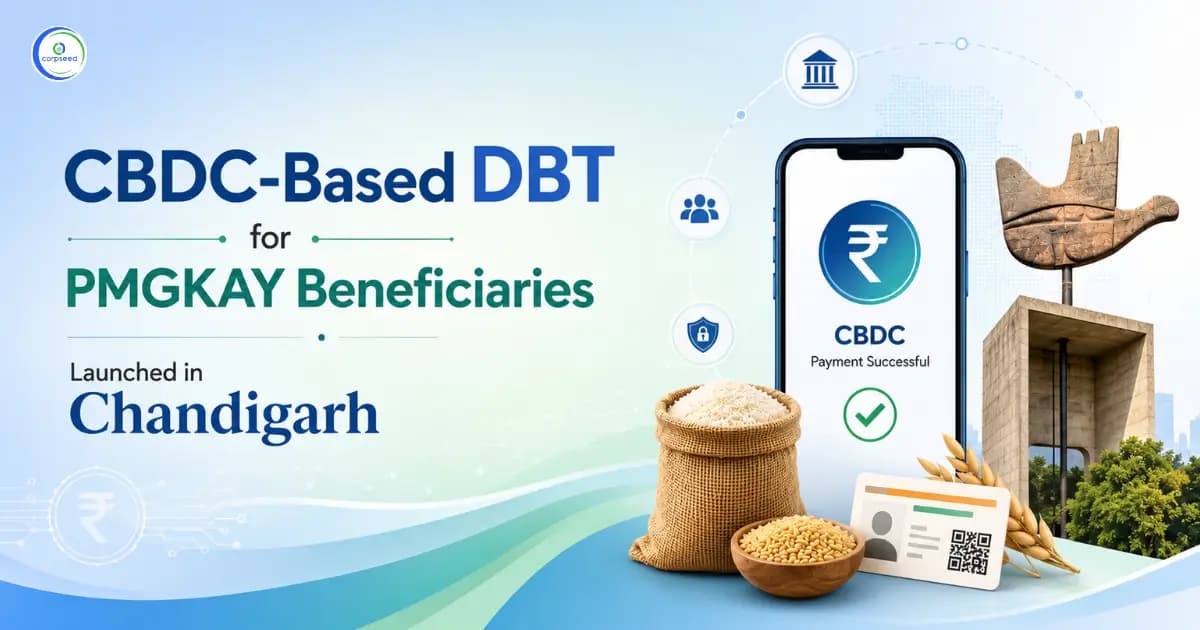
CBDC-Based DBT for PMGKAY Beneficiaries Launched in Chandigarh
India launches CBDC-based DBT for PMGKAY beneficiaries in Chandigarh using the Digital Rupee. Learn how it works, its benefits, and open questions.
Schedule a Call Back
Introduction
The Government of India launched Central Bank Digital Currency-based Direct Benefit Transfer for beneficiaries of the Pradhan Mantri Garib Kalyan Anna Yojana in Chandigarh on 14 August 2026. The benefit will use the Digital Rupee instead of relying solely on the earlier bank-account transfer route. Akashvani News described Chandigarh as the first Union Territory to undertake a full-fledged CBDC-based DBT roll-out for food subsidy.
This is mainly a change in the way the subsidy value is delivered. It does not, by itself, change who qualifies for food support under the existing framework. Chandigarh has used cash transfers for food subsidies instead of physical foodgrain distribution since September 2015. The new development brings the Digital Rupee into the established DBT system.
The statement goes on to say that the purpose of the system is to do away with intermediaries and make the transfer process clear and straightforward. In addition, the statement highlights that beneficiaries who own a smartphone or even an ordinary phone can access the benefit. The statement, however, fails to provide any information regarding the other aspects of the process.
Announcement at a Glance
| Particular | Verified detail |
| Announcing authority | Government of India |
| Nature of development | Policy and implementation announcement, not a new law or RBI regulation |
| Launch date | 14 August 2026 |
| Place of launch | Union Territory of Chandigarh |
| Scheme concerned | Pradhan Mantri Garib Kalyan Anna Yojana (PMGKAY) |
| Payment instrument | Central Bank Digital Currency - Digital Rupee (digital rupee) |
| Target group | PMGKAY beneficiaries covered by the Chandigarh roll-out |
| Stated objective | Direct and transparent transfer with fewer intermediaries |
| Reported status | Chandigarh is the first Union Territory with a full-fledged CBDC-based DBT roll-out for food subsidy |
| Other territories mentioned | The same scheme was launched virtually for Dadra and Nagar Haveli |
| Detailed beneficiary process | Not expressly specified in the announcement |
| Participating bank or wallet provider | Not expressly specified in the announcement |
What Is the Digital Rupee?
The Digital Rupee, written as digital rupee, is India's Central Bank Digital Currency. According to the Reserve Bank of India, it is the digital form of the physical rupee and is issued by the RBI. It is at par with physical currency and carries the RBI's guarantee and finality of settlement.
The retail digital rupee is stored in a digital wallet. It can be sent to another person or used to pay a merchant. The retail pilot has been running since 1 December 2022.
This distinction matters. Money in an ordinary bank account is a claim on the bank. The Digital Rupee is a direct liability of the Reserve Bank of India, economically similar to cash but held digitally. RBI also states that the digital rupee is legal tender under Section 26 of the Reserve Bank of India Act, 1934.
Is the Digital Rupee the Same as UPI?
No. The Digital Rupee is the money itself in digital form, while the Unified Payments Interface is a method used to move money, usually between bank accounts.
A digital rupee payment made between two CBDC wallets can settle without the value passing through the users' bank accounts at the time of payment. RBI has also enabled digital rupee applications to scan UPI QR codes. In that situation, the user experience may look familiar, but the underlying instrument and settlement route are not identical.
UPI is therefore a payment channel. The Digital Rupee is a store of value and a payment instrument issued by the central bank. The launch in Chandigarh does not mean that the digital rupee is replacing UPI, cash, or every form of conventional DBT.
PMGKAY and Chandigarh's Existing Food-Subsidy System
Pradhan Mantri Garib Kalyan Anna Yojana is the Union government's free-foodgrain programme for eligible households covered under the National Food Security Act, 2013. The present integrated scheme provides free foodgrains to Antyodaya Anna Yojana and Priority Household beneficiaries in accordance with their NFSA entitlements.
In November 2023, the Cabinet decided to provide free food grains to around 81.35 crore people for five years from 1 January 2024, estimated to cost 11.80 lakh crore rupees in terms of food subsidy. This is the PMGKAY scheme at the national level. It must not be mistaken for the CBDC implementation in Chandigarh.
Chandigarh has a different delivery arrangement from most states and Union Territories. An official 2022 government reply stated that the cash transfer of the food subsidy had been implemented there since September 2015. Eligible households receive a subsidy in place of foodgrains and can purchase foodgrains from the open market. Urban areas of Dadra and Nagar Haveli have used a similar cash-transfer model since March 2016.
This cash transfer mechanism operates in accordance with the Cash Transfer of Food Subsidy Rules, 2015, which were notified under the National Food Security Act. The regulations provide for cash transfers in regions identified as ready for such transfers, having regard to factors such as digitisation and de-duplication of beneficiaries, seeding of bank details, and availability of foodgrains in the open market.
In this light, the 2026 launch date does not mark the start of the food subsidy DBT in Chandigarh. What marks the difference is the use of the Digital Rupee in place of cash.
What Has the Government Announced?
The Akashvani announcement confirms four main points:
- CBDC-based DBT has been launched for PMGKAY beneficiaries in Chandigarh.
- The payment instrument is the Digital Rupee issued by the Reserve Bank of India.
- Chandigarh has been described as the first Union Territory with a full-fledged CBDC-based DBT roll-out for food subsidy.
- The same scheme was launched virtually for Dadra and Nagar Haveli.
The government said the initiative is intended to remove middlemen from welfare delivery. It described the transfer as transparent and easy and said people with smartphones or simple phones could receive the benefit.
The report also records that the Central Government spends more than 2.10 lakh crore rupees on distributing free rations. This statement provides the scale of the broader subsidy program, but it is not a stated budget for the Chandigarh CBDC roll-out.
How CBDC-Based DBT May Work
The announcement does not provide a complete transaction flow. It does not name the participating bank, non-bank, wallet application, or technology provider. It also does not explain whether every beneficiary must open a standard retail digital rupee wallet or whether a separate assisted or feature-phone model is being used.
RBI's general framework helps explain the technology, but it cannot be treated as the confirmed Chandigarh procedure. In the general retail CBDC pilot, the RBI issues digital rupee electronically to participating banks and non-banks. These institutions facilitate customer onboarding and provide wallets. A user can hold Digital Rupees in the wallet, send them to another user, pay a merchant, or redeem the value to a linked bank account.
RBI also explains a programmability feature. A government or corporate sponsor can configure funds for a specific purpose using conditions such as merchant category, geography, or expiry. RBI says DBT schemes are among the use cases being explored. The Chandigarh announcement, however, does not say which programming conditions, if any, apply to the food-subsidy transfer.
This is why the proven process involves only three points: the beneficiary is associated with PMGKAY, the subsidy is paid in the form of the Digital Rupee, and the government intends for the payment to be made to the beneficiary. The next step, if any, would be validated by the Chandigarh Administration, the concerned department, or the wallet partner.
Who Is Covered by the Chandigarh Roll-Out?
The public report refers broadly to PMGKAY beneficiaries in Chandigarh. It does not give the number of beneficiaries covered or state whether the roll-out began for the entire eligible population on the launch date.
It also does not say:
- Whether the implementation is immediate or phased,
- Whether separate beneficiary consent or registration is required,
- Whether a bank account must remain linked,
- Whether the registered mobile number must match bank or ration-card records,
- Whether a new digital rupee wallet must be opened,
- How a person without a personal mobile device will receive the subsidy, or
What happens when onboarding or authentication fails?
National PMGKAY coverage should not be read as national CBDC coverage. The announcement confirms the roll-out in Chandigarh and refers separately to Dadra and Nagar Haveli. It does not extend CBDC-based food-subsidy payments to every state or Union Territory.
Why Chandigarh Matters
Chandigarh makes sense as the testing site for this model due to the existing cash transfer system for food subsidies. This is because the administrative framework required, along with all the necessary systems for beneficiaries and the process linking payments, has been in place in Chandigarh for many years now.
Roll-out can be a valuable source of information regarding issues with broader implications: Can recipients access and operate the wallet? Are the payments made via this mechanism easy to process at regular merchants? Is it applicable for people with low digital literacy? What is the speed of processing failed transactions?
This is in terms of implications rather than findings from the launch, since a thorough evaluation would need official statistics regarding coverage, success rates, complaints, merchant acceptance, and costs.
What Was Announced for Dadra and Nagar Haveli?
Akashvani News states that the same scheme was launched virtually for Dadra and Nagar Haveli from Chandigarh. This is relevant because urban Dadra and Nagar Haveli have been using cash transfers for food subsidies since March 2016.
The report does not say whether the virtual launch represents a roll-out of the same scale as Chandigarh. It gives no beneficiary number, implementation date, wallet provider, or operating instructions for Dadra and Nagar Haveli. Chandigarh's description as the first Union Territory with a full-fledged roll-out should therefore not automatically be applied to the second territory.
CBDC-Based DBT vs Conventional DBT
| Comparison point | Conventional food-subsidy DBT | CBDC-based food-subsidy DBT |
| Value transferred | Bank account money | Digital Rupee issued by RBI |
| Usual destination | Beneficiary's bank account | digital rupee wallet or other officially approved CBDC arrangement |
| Nature of payment | Bank deposit transferred through banking rails | Central bank digital money transferred through CBDC infrastructure |
| Use after receipt | Withdrawal, bank transfer, or payment through available bank-linked channels | Wallet transfer, merchant payment or redemption, subject to the applicable model |
| Purpose controls | Normally, based on the scheme and banking rules | May support programmability, but Chandigarh conditions are not published |
| Chandigarh position | Cash food-subsidy DBT has existed since 2015 | Full-fledged CBDC-based roll-out announced on 14 August 2026 |
DBT describes how a government benefit reaches an identified beneficiary. CBDC describes the form of money used. The two ideas are connected in this program, but they are not interchangeable.
Why the Initiative Was Introduced
Reasons stated by the government
The government linked the launch with direct welfare delivery and reducing the role of intermediaries. It also presented CBDC transfers as transparent and easy to operate. These are the official reasons reported at the launch.
Broader policy implications
A CBDC might allow the sponsoring authority to exercise greater control over how the payment is made and for what purpose it is intended. In addition, there could be more transactional transparency and faster settlement through the CBDC system. For the food subsidy scheme, this would allow for more direct payment transfers and ensure its successful completion.
These are not to be viewed as guaranteed results; technology will eliminate certain sources of friction but introduce new ones, particularly during onboarding, authentication, device recovery, and complaint handling.
Benefits for the Beneficiaries
The model could provide the following advantages if executed with simple instructions and reliable support:
- Direct delivery would help minimize dependence on intermediaries for the subsidy.
- A digital record can make it easier to confirm when a transfer was received and used.
- The digital rupee can be used digitally without first withdrawing cash, where suitable acceptance facilities exist.
- RBI states that general retail digital rupee wallet balances can be loaded, redeemed, and transferred to or from a bank account around the clock.
- RBI does not levy charges for the use of the digital rupee or digital rupee wallets under the general retail framework.
- A carefully designed basic phone or assisted channel may help people who do not use smartphones.
These are potential benefits. The Chandigarh announcement does not yet clarify which standard retail wallet features apply to beneficiaries or whether the subsidy can be freely redeemed. The experience will depend on the operating rules issued for the programme.
Impact on Major Stakeholders
| Stakeholder | Likely effect | Main concern |
| PMGKAY beneficiaries | A new way to receive food-subsidy value | Onboarding, phone access, understanding and complaint support |
| Chandigarh Administration | Coordination of beneficiary records and public communication | Failed transfers, inclusion, and clear operating instructions |
| Central government departments | Oversight of a new welfare-payment use case | Measuring effectiveness without disrupting entitlement delivery |
| RBI and participating institutions | Expansion of retail CBDC use into DBT | Security, scale, wallet recovery, and user protection |
| Merchants | Possible receipt of digital rupee from beneficiaries | Acceptance readiness and settlement clarity |
| Fintech and payment businesses | A policy signal for programmable public payments | No automatic right to participate, RBI permissions still apply |
The issue for beneficiaries is not the terminology but the availability of money when needed. Public officials will have to succeed in maintaining good beneficiary data, clear communication, and prompt error correction. If banks and wallets are to be included in this scheme, there needs to be provision for first-time users.
Accessibility and Digital Inclusion
The statement that a simple phone can be used is important, but the report does not explain the technology behind that access. RBI says current digital rupee wallets support Android and iOS devices. RBI is also exploring offline solutions, including options that work without an internet connection but may still require telecom connectivity. These general features do not prove which method Chandigarh beneficiaries will use.
When considering the welfare payment system, one needs to take into account the following features of the user base: elderly people, people with disabilities, people with low digital literacy, single phone use within families, changes in phone numbers, poor internet connectivity, and language barriers (non-English speakers). Onboarding services might be needed for some families. The user manual should address balance-check issues, identification of legitimate messages, recovery from device loss, and reporting unauthorized transactions.
Digital inclusion also requires a fallback. A genuine access problem should not cause an eligible household to lose or indefinitely delay its subsidy. The launch report does not describe the fallback arrangement, so further official guidance is needed.
Privacy, Security and Consumer Protection
According to the RBI, digital rupee wallets function in a cybersecure environment, and a wallet can be restored to a new device using the same phone number or SIM card. Disputes can be raised using the wallet app or the customer care service provided by the wallet provider within the general retail system.
As far as the Chandigarh scheme is concerned, it would be better to know the process for seeking help if there is a problem with no transfer, a wrong transfer, a change of mobile number, a locked wallet, or any kind of fraud. Moreover, it is very important for beneficiaries to be aware that they must never give away their OTPs, PINs, and wallet details to imposters.
It is unclear what personal data will be exchanged between the food department, the administration, banks, and wallet providers. Also, nothing is mentioned regarding retention policy, consent policy, and transaction monitoring. Therefore, it would be incorrect to consider the program fully anonymous, fully traceable, or fraud-resistant.
Operational Challenges to Monitor
The rollout can have general implementation issues rather than issues specific to CBDCs. These include incorrect mobile phone numbers, incomplete information, authentication failures, unfamiliar user interfaces, and a lack of merchant awareness.
Other questions are specific to the payment design:
- Is the subsidy programmable for food purchases only?
- Can the beneficiary redeem the full amount into a bank account or cash?
- Can every local merchant accept payment through an existing UPI QR code?
- Does a feature-phone user receive the same functionality as a smartphone user?
- What happens to unused value, and can any expiry condition apply?
- How are duplicate, delayed, or failed transfers corrected?
These are risks to monitor, not confirmed defects. Clear answers will help beneficiaries trust the new process and help administrators evaluate whether it is better than the earlier bank-transfer route.
Information Not Expressly Specified
The Akashvani announcement does not expressly provide:
- The number of beneficiaries included at launch,
- The participating bank, non-bank, or wallet provider,
- The enrolment and wallet-activation procedure,
- The process for simple-phone access,
- Bank-account and mobile-linking requirements,
- Transaction or wallet limits applicable to the scheme,
- Any programmability, merchant-category, geographic, or expiry restrictions,
- The redemption or cash-conversion process,
- The treatment of unused subsidy value,
- The dedicated grievance-redressal channel,
- The privacy and data-sharing framework,
- A phased implementation calendar,
- Performance-monitoring indicators, or
- A confirmed plan for expansion to other states and Union Territories.
Beneficiaries should rely on instructions issued by the competent government authority or the officially identified service provider. General information about the retail digital rupee should not be treated as a scheme-specific process unless the program expressly adopts it.
Is CBDC-Based Welfare Delivery Helpful or an Added Burden?
The model has a sensible policy purpose. It can make government payments more direct, provide a digital record, and test whether sovereign digital money can improve welfare delivery. Chandigarh's long-running cash-subsidy arrangement also gives the government a suitable base for comparing the new rail with ordinary bank transfers.
The burden will arise if beneficiaries are expected to solve technical problems independently. A new wallet, PIN, mobile-linking step, or usage restriction can be difficult for people who are not comfortable with digital services. A system designed to reduce intermediaries should not remove helpful human support.
A balanced view would suggest that while the technology holds promise, its ultimately impact will be determined by how it is implemented. Ease of onboarding, usage rights, acceptance, support in case of grievances, and an effective backup plan mean more than merely paying.
Relevance for Banks, Fintechs and Payment Businesses
The announcement is a useful policy signal for businesses working in digital payments, wallet infrastructure, identity, cybersecurity, and public-sector technology. It shows that programmable CBDC is moving beyond a general retail pilot into a welfare-payment use case.
Nevertheless, it does not grant any organization the right to issue the digital rupee, be part of the program, or handle government benefits. It does not launch a procurement process, change the authorizations required by the RBI, or issue a license for fintechs. If any business wants to take part, they need to make another arrangement.
The concerned organizations can track the developments by the RBI regarding its CBDC, government procurements, terms of participation, technology standards, and consumer protection. Claims about the product should never imply government approval or program membership without official authorization.
What Relevant Businesses Should Do Next
Review the RBI's latest Digital Rupee FAQs and CBDC pilot material before designing a digital rupee-related product.
- Confirm whether the proposed activity requires RBI authorization or partnership with an authorized institution.
- Monitor the Department of Food and Public Distribution and the Chandigarh Administration for scheme-specific instructions or procurement notices.
- Assess cybersecurity, customer support, accessibility, and data governance controls before offering beneficiary-facing technology.
- Keep marketing claims accurate and avoid implying government empanelment or approval.
- Build clear dispute, wallet-recovery, and incident-response processes where the business has a regulated customer-facing role.
These are practical preparation steps. The launch announcement itself does not create a new compliance deadline for private businesses.
Future Outlook
The Chandigarh implementation might offer insights into whether the CBDC can facilitate more direct, purpose-based welfare transfers without making them harder to use. The Dadra and Nagar Haveli district will provide another location with prior experience of cash food subsidy transfer.
Further implementation must wait for some published findings and sufficient protections for the beneficiaries. Helpful indicators for the government will be the transfer rate, onboarding rate, number of complaints, resolution period, merchant acceptance, and user feedback on the use of feature phones.
No nationwide expansion date has been announced in the source. It would be premature to state that all PMGKAY payments or other government benefits will move to the Digital Rupee.
How Corpseed Can Help
Corpseed does not decide PMGKAY eligibility, issue Digital Rupee wallets, or distribute welfare benefits. The government, RBI-authorised institutions, banks, and other responsible authorities handle these functions.
Corpseed’s role is to support startups, fintech companies, technology providers, and other businesses that want to explore CBDC or regulated digital-payment services.
1. Regulatory Applicability Assessment
Before launching a CBDC-related product, businesses must understand which regulations apply to their activities. Corpseed can help:
- Identify relevant RBI directions and government guidelines.
- Determine whether the proposed activity is regulated.
- Understand whether any registration, licence, approval, or authorised partnership may be required.
- Clarify what the business may and may not do under the existing framework.
2. Fintech Regulatory Research
Digital-payment regulations can be technical and may change as the sector develops. Corpseed can conduct focused research to:
- Examine the rules applicable to the proposed product or service.
- Explain important regulatory requirements in simple language.
- Study recent developments concerning CBDC and digital payments.
- Help businesses make informed decisions before investing in technology.
3. Business Model Review
A promising fintech idea may still create regulatory risks if the roles of the business, bank, vendor, and customer are not clearly defined. Corpseed can:
- Review how the proposed service will operate.
- Examine how payments and customer data will be handled.
- Identify legal, regulatory, and operational risks.
- Suggest areas that may require restructuring or professional clarification.
4. RBI Framework Interpretation
Businesses entering the digital-payment sector may find it difficult to interpret RBI guidelines. Corpseed can help them understand:
- The general framework governing the Digital Rupee.
- The role of banks and authorised service providers.
- Relevant customer-verification and compliance requirements.
- Restrictions that may apply to private companies and technology vendors.
5. Compliance and Policy Support
A regulated fintech business needs proper internal policies and compliance systems. Corpseed can assist with:
- Conducting a compliance-gap assessment.
- Reviewing privacy and data-protection practices.
- Developing internal compliance and information-security policies.
- Strengthening record-keeping, customer grievance, and risk-management procedures.
6. Vendor and Contract Review
CBDC and digital-payment products may involve banks, software developers, cloud providers, payment partners, and cybersecurity vendors. Corpseed can support businesses by:
- Reviewing vendor and service agreements.
- Clarifying the responsibilities of each party.
- Examining clauses related to data use, security, confidentiality, and liability.
- Identifying contractual risks before agreements are signed.
7. Monitoring Regulatory Updates
CBDC and fintech regulations are continuously evolving. Corpseed can help businesses monitor:
- RBI circulars, notifications, and policy updates.
- Relevant government announcements.
- Changes in digital-payment and data-protection requirements.
- New opportunities relating to pilots, procurement, or empanelment.
Businesses considering a CBDC-related product can consult Corpseed to understand their proposed role, identify compliance obligations, and prepare a practical regulatory roadmap before developing the technology or approaching public authorities.
About the Author

Mahek Sancheti
Content WriterMahek Sancheti, BAJMC graduate with a deep passion for writing. As a content writer, video content creator, creative content creator, and scriptwriter, I bring stories to life through words and visuals. I honed my skills by working with a prominent news agency, where I excelled in crafting compelling narratives and engaging content. Coming from a journalism and mass communication background I have skills to craft engaging narratives that captivate audiences. With a keen interest in writing and creativity, I aim to deliver impactful and meaningful content that resonates with diverse audiences.
https://www.linkedin.com/in/mahek-sancheti-837196212