
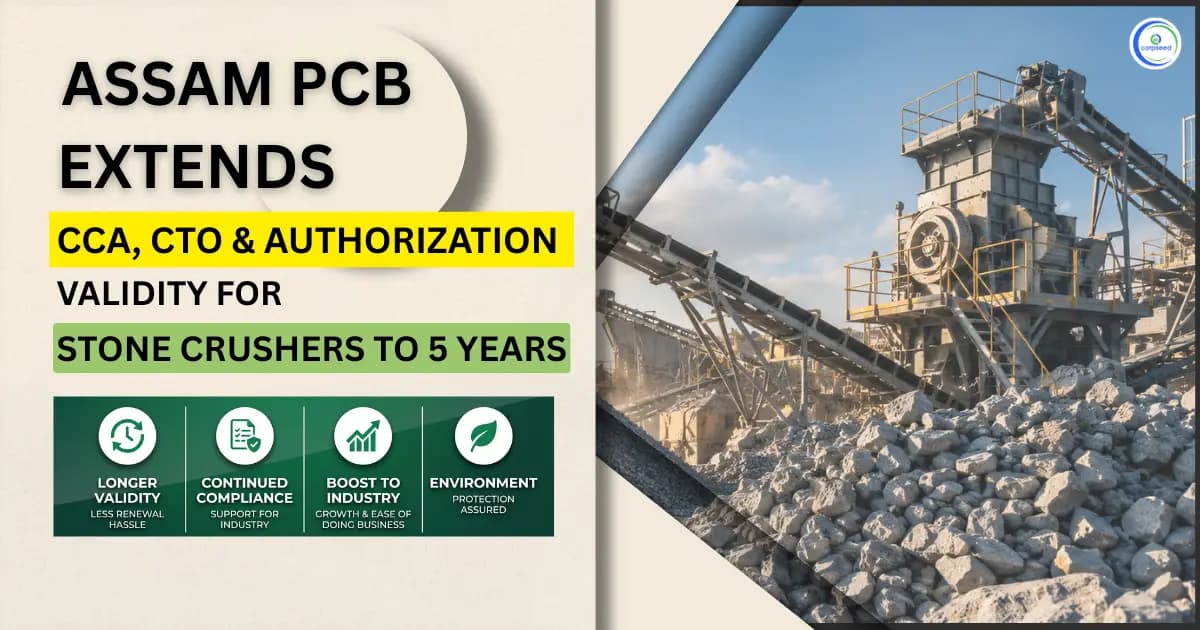
Assam PCB Extends CCA, CTO & Authorization Validity for Stone Crushers to 5 Years
Assam Pollution Control Board allows 1- or 5-year CTE/CTO renewal for stone crushers, now linked to a yearly GST No Dues Certificate.
Schedule a Call Back
1,800+ CTE/CTO and plant setup assignments since 2018
Clients include Magnum Aluminium, Enershell Alloys and Steel, Ganesh Foundry & Cast, Inland Speciality Metals, JK Cement, Sskbp India Alloy, Denso India, Neometrix Defence, PMS Waste Management, Daebak India Recycler, Ganix Rubber Recycling, Pashidaa E Waste Copper Battery Recycling PLT Company (12 of 1,100+ served since 2018).
A few more clients we've served in this industryHide the list
- Engineering and manufacturing
- Magnum Aluminium · Enershell Alloys and Steel · Ganesh Foundry & Cast · Inland Speciality Metals · JK Cement · Sskbp India Alloy · Denso India · Neometrix Defence
- Recycling and waste management
- PMS Waste Management · Daebak India Recycler · Ganix Rubber Recycling · Pashidaa E Waste Copper Battery Recycling PLT Company · Upcycle Debris Management · Ficusa Ewaste Recyclers · Shuchaye Recyclers · Quantara Battery Recycling
- Logistics and trade
- 20Cube Logistics Solutions · Airsurge Logistics · Green Space Logistics · Saap Logistics
- Food and consumer goods
- Bake Wish · Kokora Spices · Babi Beverages · Indraj Beverages and Distilleries · Adheshwar Agro Dairy Products · Venco Research and Breeding Farm · Explore Food · IFF India Frozen Foods
- Energy and power
- Servotech Renewable Power System · Saurya Urja Company of Rajasthan · Sun Mobility · Sun Max Solar · Maxvolt Energy Industries · Rays Power Infra
- Chemicals and materials
- Venkateshwara Roto Pack · Lami Tube · M C Bauchemie I · Pro Flexi Packaging · Rustchem Corrosols · SVN Polymers · Kairaa Polypack · Sanctum Chemicals
- More clients
- Intangles Lab · Alten India · Adit Buildwell · Ecowise Trading · GS E-Commerce · Beaucience India
Introduction
The Assam Pollution Control Board, also called APCB, released a new order on 17 June 2026. This new order slightly changes two older orders from December 2022 and May 2024. It brings a big and helpful change for Stone Crushing Units and for LAMC Bee Hive Coke Oven/Crushing Units across Assam.
What the Order Actually Says
Stone Crushing Units and LAMC (Limestone and Aggregate Mining Crushing), Bee Hive Coke Oven/Crushing Units can now get their CCA (Consent to Continue Activity), CTO (Consent to Operate), or Authorization renewed for either one year or five years. This depends on how well the unit follows APCB's rules.
Every Stone Crushing Unit must also submit a GST No Dues Certificate each June, covering the previous financial year. This certificate is a required part of getting environmental consent under the Air Act 1981, the Water Act 1974, and the Environment Protection Act 1986.
APCB has made clear that it does not check or approve GST records itself. The certificate is only asked for so that the two systems, pollution rules and tax rules, stay connected. The order started working right away on 17 June 2026, though it still needs formal Board approval afterward.
Why APCB Came Up With This Policy
Background and need
Older APCB orders from December 2022 and May 2024 had shorter or stricter renewal periods. This meant stone crusher businesses had to renew paperwork again and again, which cost time and money. APCB made this new rule for a few clear reasons:
- Making business easier: Fewer renewal applications for units that follow the rules well mean less paperwork trouble for both the business owner and the Board.
- Rewarding good behavior: The 5-year option is like a reward for units that always follow environmental rules properly.
- Connecting pollution rules with tax rules: Asking for a GST No Dues Certificate closes a gap where a unit could follow pollution rules but still owe unpaid taxes. This checking system helps make sure only responsible, legally working units get the longer 5-year benefit.
- Reducing extra work: APCB offices across Assam, in places like Dibrugarh, Guwahati, Silchar, and Tezpur, handle many stone crusher renewal requests every year. The 5-year choice cuts down this workload a lot.
- Matching national goals: This change follows a bigger national trend, seen in the Jan Vishwas 2026 reforms, where businesses that follow rules well are given fewer unnecessary yearly checks.
Implementation Date
The order was signed on 17 June 2026 and started working immediately from that same day. The GST No Dues Certificate must be submitted every June, and it should cover the financial year right before that June.
How Businesses Will Comply
Immediate actions required
Check current status: Look at the existing CCA/CTO/Authorization and find out when it needs to be renewed.
1. Pick a renewal length: Choose between 1 year or 5 years, based on:
- How steady and long-term the business plans are (5 years suits businesses planning to stay long).
- Whether the unit can keep following the rules strictly for the full 5 years.
2. Get the GST No Dues Certificate: Every stone crushing unit must collect this certificate from GST authorities each year before the end of June, covering the year before (for example, by June 2027, it must cover the 2026–27 financial year).
3. Submit the certificate to APCB: This should be handed in through the correct APCB regional office, along with other required documents.
4. Keep following environmental rules: Conditions under the Air Act, Water Act, and Environment Protection Act must be followed at all times to keep the 5-year benefit. Breaking rules can shorten the period back to 1 year or even stop operations.
Ongoing compliance calendar
| Month | Action Required |
| June every year | Submit GST No Dues Certificate to APCB for the previous financial year. |
| At least 3-6 months before the renewal expiry | Apply for CCA/CTO renewal (1-year or 5-year) |
| Throughout year | Maintain stack emission records, effluent reports, ambient air quality monitoring, and other consent conditions. |
Who Gets Maximum Benefits
Stone Crushing Units - biggest winners
Well-established stone crushers that already follow the rules gain the most from the 5-year option. Instead of renewing paperwork every year, their approval now lasts much longer.
- This lowers the risk of stoppage: earlier, delays in renewal could have paused operations. A 5-year approval gives a much longer period of smooth, uninterrupted work.
- Planning money becomes easier too: fewer yearly renewal fees, fewer surprises, and a clear five-year outlook.
Large and mid-sized stone crushing units working in Assam's fast-growing construction areas - highways, bridges, dams, and Smart Cities - benefit the most.
LAMC Bee Hive Coke Oven/Crushing Units
These units help produce coal-based fuel used across Assam and the Northeast. They also gain from fewer renewals, helping their work continue without breaks.
Construction and infrastructure sector (indirect beneficiary)
Assam's big construction projects - roads, railway bridges, and flood barriers built by NHIDCL, railways, and other agencies - depend heavily on stone supply from crushers. Longer, steadier approvals mean a steadier supply of building materials.
State and local contractors
Small and mid-sized contractors who depend on stone crushers for roads and buildings have often faced delays when crusher approvals expired. The 5-year choice removes much of this risk from their supply chain.
Who Is Impacted Negatively or Faces Losses
Non-GST-compliant units
Stone Crushing Units that are not registered under GST, or that still owe GST dues, will now face a direct block when trying to renew CCA/CTO.
Units that followed pollution rules but ignored tax rules will now have to fix their GST status, or they will lose their pollution approval, meaning they cannot legally operate.
This creates a brand-new compliance step for the informal part of Assam's stone crushing industry.
Very small or informal operators
Small, less-organized stone crushers that handled renewals one at a time may now find it harder to manage both environmental rules and the yearly GST certificate together.
These operators now need to deal with two separate systems at once: APCB for pollution rules and GST offices for tax matters.
Units that have already paid for multi-year consents under older orders
Some operators who already received 1-year approvals under the May 2024 order may face small adjustment issues while shifting to the new 5-year system.
Habitual violators facing stricter scrutiny
Stricter conditions apply to the 5-year benefit, so any unit wanting the longer period must show a clean compliance record. Units with a history of breaking rules will likely stay limited to 1-year renewals and more frequent checks.
Impact on Assam's Economy
Positive economic effects
Steady infrastructure growth: Assam is one of India's most active states for road, bridge, and flood-control building, funded through NEC, NHIDCL, PMGSY, and ADB projects. Stable stone crusher work is important for these projects to continue without material shortages.
Lower costs for industry: Fewer renewal cycles mean lower costs for stone-crushing businesses, making Assam a bit more attractive compared to nearby states for setting up such units.
Better tax collection: By connecting pollution approval to GST certificates, APCB is pushing more businesses to pay their taxes properly. This can raise Assam's tax income.
More formal businesses: The combined requirement of following both pollution and tax rules will push many informal stone-crushing units to become properly registered, improving overall data, wages, and business health.
Better investment environment: Longer approval periods make Assam more appealing to investors interested in stone quarrying, material supply, or construction logistics businesses.
Possible economic downsides
Some short-term trouble is likely for units that must quickly fix their GST status before the June deadline.
A few small operators may choose to shut down instead of meeting both requirements together, which could create local shortages of stone material in remote districts like Dima Hasao, Karbi Anglong, and Cachar.
Is This the Right Decision?
Why is this broadly the right decision
This is not only a relief step, it is a balanced move: it makes life easier for businesses (longer approval time) while also raising accountability (mandatory GST link).
Connecting pollution rules with tax rules is a new idea for an Indian State Pollution Control Board, and it fixes a known gap where businesses could follow one rule while ignoring another.
APCB still stays fully in control: the 5-year approval is conditional, not automatic. Any rule-breaking can still lead to shorter renewal periods or cancelled approval.
It respects both business needs and environmental safety: rules under the Air Act, Water Act, and Environment Protection Act stay fully active; only how often renewal happens has changed.
Where caution is needed
The new GST rule must be applied fairly and consistently everywhere; if APCB officers apply it unevenly, it could open doors to unfair practices.
APCB must make sure the 5-year approval is not treated as a break from environmental checking; field visits, emission testing, and air quality checks must continue throughout the full five years.
Environmental risks from stone crushers, such as dust, noise, ground shaking, and effects on water, remain serious. APCB should invest in strong, real-time monitoring so the longer approval period does not weaken environmental oversight.
How This Improves Business Conditions, Transparency, and Environmental Safety
Business conditions
- Removes the constant worry of yearly renewal stress for units that follow the rules.
- Gives a simple two-choice system (1 year or 5 years), which is more predictable than case-by-case extensions.
- Encourages operators to stay compliant all year round instead of rushing to fix things only before renewal time.
Transparency
- Linking pollution approval with GST No Dues Certificates connects two government records, which lowers the chance of fake applications.
- APCB clearly states it does not certify GST compliance itself, keeping its role clear and avoiding confusion between departments.
- The order has been shared with all Zonal and Regional Heads of APCB and posted on the APCB website so that anyone can access it.
Environmental safety
- Units choosing the 5-year option must still follow strict conditions the entire time, meaning environmental standards are not relaxed, only the paperwork frequency changes.
- The yearly June GST certificate creates a required yearly check-in with regulators, even for units holding a 5-year approval, keeping some regular oversight in place.
- Fewer units stuck between an expired and a renewed approval mean fewer cases of technically illegal operations continuing during renewal delays, something that used to cause enforcement problems.
Opportunities for Corpseed
This order creates a set of clear business opportunities:
CCA/CTO Renewal Services for Stone Crushers in Assam
Offer dedicated renewal service packages for stone crushing units across all APCB regional zones, including Dibrugarh, Golaghat, Sibsagar, Tezpur, Guwahati, Kamrup, Bongaigaon, Nagaon, Silchar, Tinsukia, and South Bank.
Provide 5-year renewal paperwork help, application preparation, fee calculation, and coordination with APCB.
GST No Dues Certificate Procurement and Annual Compliance Package
Many stone crusher owners are small businesses without strong tax support.
A bundled "Annual APCB Compliance + GST No Dues Certificate" package can help handle both the yearly GST certificate submission to APCB and the underlying tax filings needed to stay dues-free.
Compliance Audit for 5-Year Eligibility
Before applying for the 5-year renewal, units need a full compliance check across the Air Act, the Water Act, and the Environment Protection Act rules.
A "5-Year Consent Readiness Audit" can cover emission reports, effluent testing, hazardous waste rules, record-keeping, and complaint history.
New Crusher Setup Authorisation in Assam
With longer approvals now available, new investors setting up stone crushers in Assam for construction supply chains will need first-time CCA/CTO/Authorization.
This can target contractors, quarry developers, and material suppliers entering the Northeast India market.
LAMC Bee Hive Coke Oven / Crushing Unit Services
This is a specialized area; coal-based industries in Assam's Makum, Margherita, and Tinsukia belt need focused compliance help.
Building expertise in LAMC unit CTO renewal can be a strong, unique offering in Northeast India.
Pan-Northeast "SPCB Renewal" Packages
This reform shows APCB's willingness to make renewal simpler for well-behaved businesses.
Similar changes may follow in Meghalaya, Nagaland, and Arunachal Pradesh, which have similar stone-crushing industries.
Assam can serve as the starting point for building a full Northeast India Stone Crusher Compliance service line.
About the Author

Mahek Sancheti
Content WriterMahek Sancheti, BAJMC graduate with a deep passion for writing. As a content writer, video content creator, creative content creator, and scriptwriter, I bring stories to life through words and visuals. I honed my skills by working with a prominent news agency, where I excelled in crafting compelling narratives and engaging content. Coming from a journalism and mass communication background I have skills to craft engaging narratives that captivate audiences. With a keen interest in writing and creativity, I aim to deliver impactful and meaningful content that resonates with diverse audiences.
https://www.linkedin.com/in/mahek-sancheti-837196212