
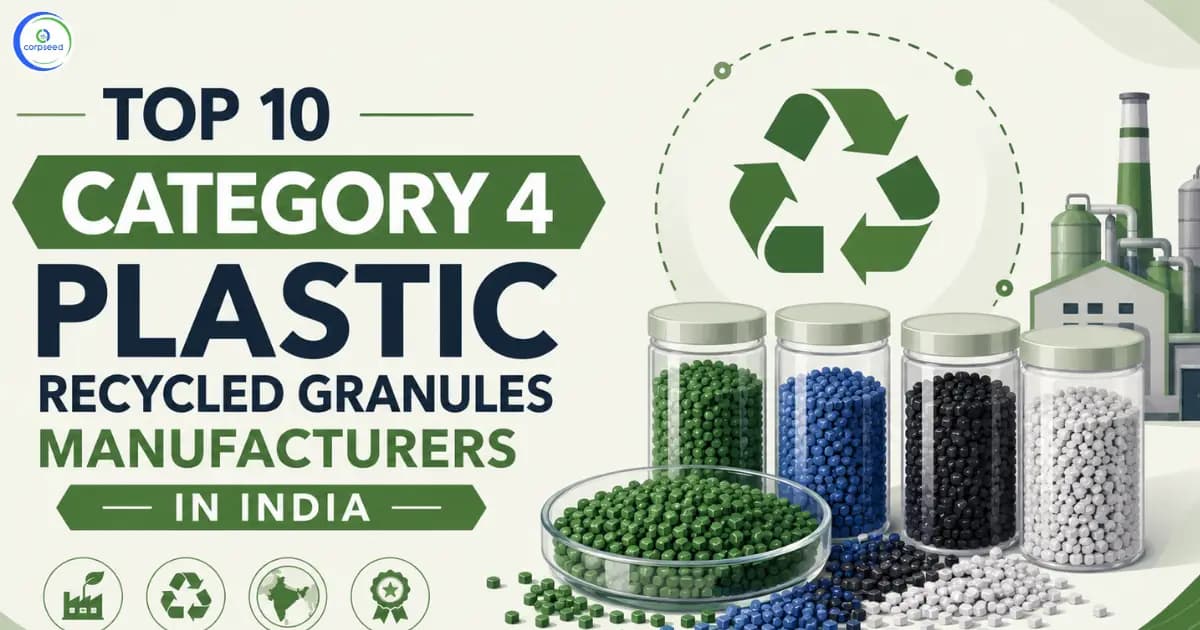
Top 10 Category 4 Plastic Recycled Granules Manufacturers in India
With India's increasing focus on Extended Producer Responsibility (EPR) and sustainable plastic waste management, the demand for Category 4 plastic recycled granules continues to grow. Under the Plastic Waste Management framework, Category IV covers plastic sheets or similar packaging and carry bags made from compostable plastics, making compliance and sourcing from reliable manufacturers increasingly important.
Schedule a Call Back
4,500+ plastic EPR assignments since 2018
Clients include Brenntag Ingredients India, Reliant Packaging Films, Taurus Packaging, Axel Polymers, Lintec India, Kumar Organic Products, HP Adhesives, DDP Speciality Products India, Colt Technology Services India, Emerson Automation Solutions Intelligent Platforms, Intangles Lab, Shindengen India (12 of 1,700+ served since 2018).
A few more clients we've served in this industryHide the list
- Chemicals and materials
- Brenntag Ingredients India · Reliant Packaging Films · Taurus Packaging · Axel Polymers · Lintec India · Kumar Organic Products · HP Adhesives · DDP Speciality Products India
- Electronics and technology
- Colt Technology Services India · Emerson Automation Solutions Intelligent Platforms · Intangles Lab · Shindengen India · Emerson Process Management (India) · Lianchuang Electronic India · Emerson Process Management Chennai · Hayakawa Electronics India
- Pharma and healthcare
- Beryl Drugs · Ascent Meditech · Eli Lilly and Company (India) · Q-Line Biotech · Rajasthan Antibiotics · G D Pharmaceuticals · Micro Labs · ADK Health Care
- Engineering and manufacturing
- Essel Mining & Industries · Juki India · Hilti India · Bundy India · Hilti Manufacturing India · KJS Cement (I) · Mangalam Cement · Birla Precision Technologies
- Food and consumer goods
- Onest · AVT McCormick Ingredients · Akay Natural Ingredients · Ugraya Foods and Feeds · AVT Natural Products · Jalpaiguri Food Industries · Param Dairy · Esther Parfumerie
- Logistics and trade
- Siddhartha Logistics · Siddhartha Logistics Ftwz · Honda Trading Corporation India · Dksh India · MOL Logistics (India) · Fibs Logistics India · Zenexpress Logistics
- More clients
- Nilkamal
Introduction
Finding trusted Category 4 recycled plastic granules manufacturers in India has emerged as an important aspect for brands due to increasingly stringent laws regarding compostable packaging in India. According to the PWM Rules, 2016 and EPR Guidelines, the PIBOs need to account for their plastic packaging in all of the four categories, and they have to fulfill their respective EPR obligations. What makes Category 4 special is that it lies at the confluence of thin plastic films, carry bags, and compostable plastic granules in India.
This guide explains what Category 4 plastic really covers, why "recycled granules" is a special case for compostable materials, which manufacturers and suppliers are active in this space, and how to build a fully compliant Category 4 plastic EPR compliance strategy.
What Is Category 4 Plastic Under India's EPR Rules?
Regulatory guidance from CPCB defines Category IV as:
- Plastic sheet or similar material used for packaging, and
- Carry bags and commodities made of compostable plastics
If your business uses compostable carry bags, liners, or similar compostable plastic products, they must be declared under Category 4 for EPR purposes. These products must:
- Conform to IS/ISO 17088 or updated Indian standards
- Carry proper labelling and approval as per PWM Rules
Be declared as Category 4 tonnage on the CPCB Common EPR Portal, with compliance against applicable targets.
Under CPCB's Standard Operating Procedure for compostable carry bags, manufacturers must first secure a provisional registration from their State Pollution Control Board before applying to CPCB. They must submit a complete test report including seed germination and heavy metal analysis conducted after 180 days from CIPET or another CPCB-recognised laboratory before a final certificate is issued. Once certified, manufacturers are also required to file six-monthly compliance reports through CPCB's dedicated online certification system for compostable plastics. Any company that cannot produce this registration-to-certification paper trail should be treated as a compliance risk, regardless of how its marketing describes the product.
In practice, this means PIBOs must work with dependable manufacturers of compostable and speciality Category 4 granules who can support both technical performance and this level of documentation.
Schedule a Call Back
Why "Category 4 Recycled Granules" is a Special Case?
From an exacting perspective, the majority of Category 4 compostable materials are typically either bio-based or fossil-based compostable polymers, which do not "recycle" conventionally in a mechanical recycling process. Rather, they are specifically designed to be composted or biologically treated.
However, from an EPR and circular-economy standpoint, brands often group together two distinct material streams:
- Recyclable plastic sheets and thin films that can be mechanically recycled into granules
- Compostable plastic granules in India used to replace certain banned single-use plastics
The directory mainly features the companies producing compostable and specialty granules, which will help in fulfilling the requirements of Category 4 EPR declarations. In addition, the directory also includes companies involved in recovery and reprocessing of thin films and sheets wherever applicable.
Disclaimers: This listing is indicative only and based on publicly available data. Corpseed neither endorses nor ranks any particular company. The activities, products, and certification status of the companies are subject to change, and one should cross-check the certifications and registrations with the supplier and the CPCB before onboarding.
Category 4 and Related Plastic Granule Manufacturers in India
The companies below are compiled from public business listings and industry directories. This is not a certified or ranked list, and inclusion here is not an endorsement or a substitute for direct verification.
Before engaging any supplier for Category 4 or compostable packaging, confirm their current CPCB certification number directly against CPCB's own published list of certified compostable plastic manufacturers, and cross-check it against the specific product and grade they intend to supply you.
1. PMS Poly Plast Industries Pvt Ltd
A recognised manufacturer, exporter, and supplier of a wide range of plastic granules, including ABS, acrylic, nylon, polypropylene, and impact copolymer granules, with a portfolio relevant to flexible packaging and value-added film applications.
2. Ruchi Plastic
Participating in the recycled granules market segment, providing secondary plastic granules to processors downstream, appropriate as an alternative for film recycling grade upon confirmation of its suitability and production capability.
3. ARS Recycling Pvt Ltd
Operating in the field of recycling, dealing with plastic as well as other secondary material inputs for producing reusable outputs, capable of providing granules obtained from flexible plastic waste streams after verification.
4. Baroda Plastic Scrap
Involved in the collection and trading of plastic scrap typically reprocessed into granules for packaging and moulding, useful as a feedstock and recycle partner in western India.
5. DADA Polymers
Functions in the plastic granule and scrap trade, connecting recycling operations with converters, and can serve as a regional aggregator bringing multiple small recyclers under one commercial counterparty.
6. Padmavati Polymers
Engaged in polymers and reprocessed plastic trade, often sourcing recycled PP/PE granules for packaging and moulded products, relevant where consistent, blended film-grade recycle is needed.
7. Hindustan Polymers
Works in the plastic polymers business, including recycled grades used by downstream converters, and can be positioned as a supplier to small and mid-sized film manufacturers.
8. J Choudhary & Company Unit II
A plastic scrap and polymers player supporting collection and supply of material for reprocessing into granules, useful for building a scrap-to-granule supply chain in a specific cluster.
9. World Plastic Care
Focused on plastic waste handling, recycling, and reuse, capable of supplying flexible packaging granules and supporting EPR-linked recycling for brand owners with clear specifications and audits.
10. Evergreen Industries
Operates in plastics and recycling, supplying reprocessed material to local converters, and serves as a practical partner for regional requirements in non-critical film and bag applications.
Which of these suppliers currently holds CPCB certification for your product? Corpseed can independently verify a supplier's documentation before you sign a contract. Talk to our EPR compliance team.
Compostable Plastic Granule Manufacturers and Suppliers in India
Beyond the conventional recyclers listed above, a distinct ecosystem supports compostable plastic granules in India and Category 4 compliance specifically. These fall into three practical groups:
- Resin producers and compounders: These include manufacturers of biodegradable granules using corn-starch as raw material and those who blend PLA, PBAT, and starch to form compostable compounds for extrusion and molding. Their production goes towards making plastic grocery bags, ecommerce mailers, organic waste bins, garment bags, and agricultural mulch films. Some of the importers and compounders also import certified compostable resin and tailor it according to Indian conditions for supply to converters. No matter which path you choose, the certification needs to be applicable to that specific finished product and grade and not just the base resin. This is because even when the compostable resin meets the test requirements, a bag made from it may not qualify due to additives or ink prints.
- Vertically integrated bag manufacturers: Some manufacturers will blend and granulate their own resins within their premises before extrusion, thereby providing a better chain of custody for PIBOs from granules to the final category 4 material. The state government or municipality may also empanel other manufacturers for supplying compostable carrier bags for use in waste management programs, which could be used as a good initial list.
- Adjacent and emerging players: LDPE/LLDPE sheet recyclers and bubble wrap recyclers are also Category 4 materials, despite their non-compostable nature and use of a different mechanical recycling process route, as opposed to IS/ISO 17088 certification. At the same time, a second generation of start-up and research-and-development-oriented biopolymer companies are creating compostable films and advanced new formulations (biopolymer starch and cellulose-based and biodegradable polyesters), which can help in positioning the brand, but which have to meet the same set of certifications and disposal infrastructure requirements as any other established supplier does.
Difference Between Compostable and Recyclable Plastic Under EPR
Understanding the difference between compostable and recyclable plastic under EPR is essential before choosing a Category 4 supplier:
| Aspect | Recyclable Plastic | Compostable Plastic |
| End-of-life process | Mechanically reprocessed into granules for reuse | Broken down through industrial or controlled composting |
| Applicable standard | Polymer-specific recycling guidelines | IS/ISO 17088 or updated Indian standards |
| EPR category | Typically, Category 1, 2, or 3 | Category 4 |
| Labelling requirement | Recyclability symbols and polymer codes | Composability certification and approved labelling |
| Disposal infrastructure needed | Recycling collection and processing units | Industrial composting facilities |
Brands using both material types must maintain separate EPR and recycled-content strategies for each, since different compliance pathways govern them.
How to Verify Compostable Plastic Certificates in India?
Before finalising any Category 4 supplier, PIBOs should confirm the following:
- A valid CPCB certificate, issued only after the manufacturer secured provisional SPCB registration and later submitted it to CPCB; ask to see both documents, not just the final certificate.
- A complete IS/ISO 17088 test report, including seed germination and heavy metal analysis conducted after 180 days of composting, carried out by CIPET or another CPCB-recognised laboratory.
- Evidence of ongoing six-monthly reporting through CPCB's online compostable plastics certification system, confirming the certificate hasn't lapsed since issuance.
- Consistency between documents, manufacturer name, and final packaging, since certificates are issued for a specific product and grade, not a company as a whole.
- Realistic disposal infrastructure, confirming that industrial composting facilities are genuinely accessible where the product will be used.
- Skipping this verification step is one of the most common causes of compliance failure and enforcement risk for Category 4 packaging.
Are Compostable Bags Legal in India in 2026?
Carry bags made from compostable material and complying with the IS/ISO 17088 standards and having a valid certificate from CPCB or SPCB are still allowed in India, despite many types of single-use plastics being banned. However, the claims of products being “biodegradable” or “oxo-degradable” without any proof will be actionable by authorities, as they do not necessarily mean composability according to Indian laws. It is advised that brands verify their certifications before using these terms.
How Can Corpseed Support Category 4 Plastics and Compostable Granules?
Because compostable plastics sit at the intersection of material science, regulation, and EPR accounting, PIBOs often face mixed and conflicting information from vendors. Corpseed supports brands in three key ways:
- Regulatory mapping and EPR calculation: identifying where current and planned compostable and plastic-sheet packaging sits within Category 4, and calculating exact EPR obligations.
- Supplier and granule due diligence: Reviewing CPCB-related documentation, IS/ISO 17088 compliance, lab reports, artwork, and real-world load tests for compostable bags and films.
- Documentation and CPCB portal support: Designing robust processes for category-wise declarations, certificate management, and annual EPR returns via the Common EPR Portal.
- The goal is to ensure that every rupee spent on compostable or Category 4 packaging results in genuine regulatory compliance, credible sustainability claims, and reduced enforcement risk.
Looking for verified Category 4 plastic recycled granules manufacturers in India or compostable packaging suppliers for your EPR strategy? Connect with Corpseed's EPR compliance experts for a tailored assessment.
Final Thoughts
The use of Category 4 plastic packaging materials presents an important place within the EPR program in India because it includes regular plastic sheets as well as the rapidly developing category of compostable materials. In view of the increasing restrictions associated with the use of biodegradable and oxo-degradable materials, it is necessary to cooperate with reliable manufacturers of Category 4 plastic recycled granules in India.
About the Author

Anshika Jindal
Content WriterAnshika Jindal, a Legal Content Writer with strong expertise in legal research and a solid academic background in BA LLB and LLM (Criminal Law). I specialize in researching statutes, case laws, and legal developments and presenting them in clear, accurate, and engaging written content. With strong analytical skills and attention to detail, I create reliable, well-structured legal content while maintaining professional and ethical standards.
I specialize in conducting in-depth legal research using credible sources and presenting legal information in a structured, reader-friendly manner while maintaining precision and authenticity. My work focuses on simplifying legal language without compromising its meaning, making legal content accessible to a wider audience.
Related articles
CPCB SOP 2026 for CTE and CTO Approvals - Timelines, Inspections and Key Directions
2026-10-30
E-Waste EPR for Electronics Brands: Registration, Targets & Annual Compliance
2026-10-26
Battery EPR Registration: Who Needs It Under the Battery Waste Management Rules?
2026-10-26
Detailed Project Report for CTE and CTO: Requirements, Format, Documents and Approval Process
2026-10-22
EPR Registration in India: Who Needs It and Which EPR Category Applies to Your Business?
2026-10-21
CPCB Guidelines on Levy of Fees Under the Solid Waste Management Rules, 2026
2026-10-07