
How to Start an Ayurveda Business in India: AYUSH License, Market Growth & Opportunities
Ayurveda has always had a place in Indian households. What has changed is the scale at which it is now being discussed, researched, manufactured, and taken to new markets.
Schedule a Call Back
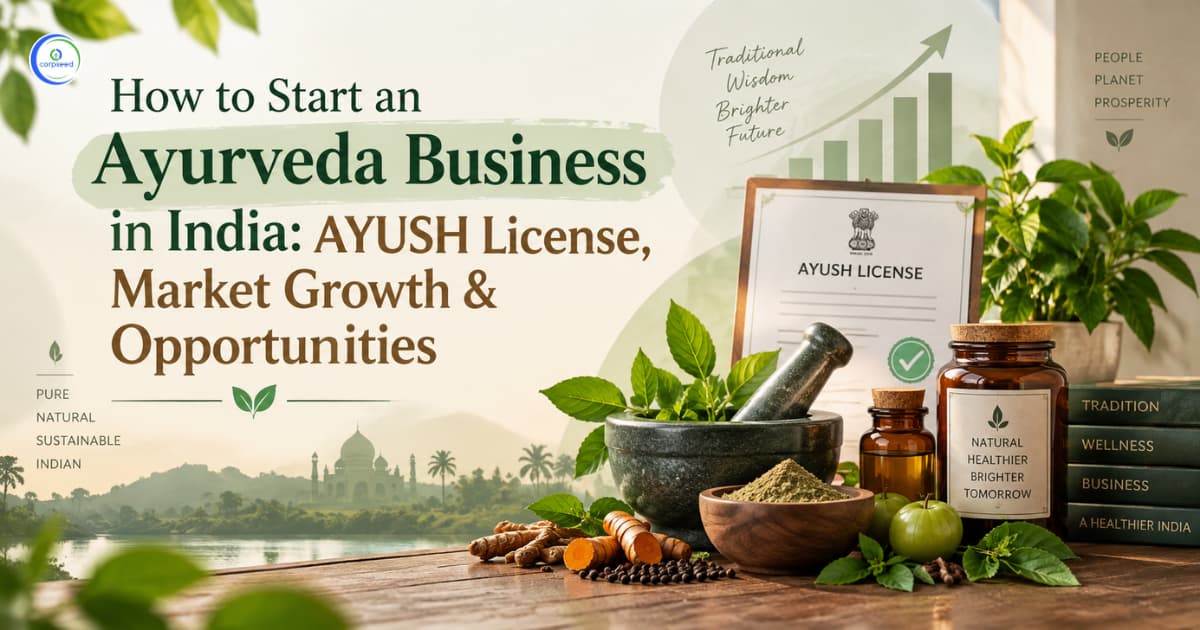
Ayurveda has always had a place in Indian households. What has changed is the scale at which it is now being discussed, researched, manufactured, and taken to new markets.
Today, Ayurveda is connected not only with traditional treatment but also with wellness, preventive healthcare, product manufacturing, exports, medical value travel, and research. For entrepreneurs, this opens several possibilities, from launching an Ayurvedic medicine brand to setting up a manufacturing unit or working with an existing manufacturer.
Timing also matters, as India will celebrate its 11th Ayurveda Day on 23 September 2026 with the theme "Ayurveda for a Healthier Tomorrow." The theme is part of the bigger trend of sustaining the traditional knowledge base of Ayurveda while improving its research and credibility.
But entering the Ayurveda market is not simply about selecting a product and creating a brand. Businesses planning to manufacture Ayurvedic medicines also need to understand the appropriate AYUSH license, manufacturing model, and regulatory route.
Schedule a Call Back
Why Is the Ayurveda Industry Growing in India?
India already has a strong cultural connection with Ayurveda, but recent numbers show that the sector has also developed into a sizeable economic market.
The Ayush market increased from USD 2.85 billion in 2014 to USD 43.4 billion in 2023. Ayush exports also increased from USD 1.09 billion to USD 2.16 billion over the period referred to in the release.
Domestic familiarity is another major advantage.
The first exclusive All-India Survey on Ayush, cited in the government release, recorded Ayush awareness of 94.8% among rural residents and 96% among urban residents. It further found that 46.3% of rural residents and 52.9% of urban residents had used Ayush for treatment or prevention during the preceding 365 days.
For an entrepreneur, these numbers point to something practical: the market already understands Ayurveda. A new brand does not necessarily have to introduce the basic concept from scratch.
The real competition is around product quality, trust, positioning, manufacturing standards, claims, and customer experience.
At the same time, the Ayurveda industry in India is moving beyond the traditional medicine shop. Opportunities are developing around branded products, manufacturing, third-party production, exports, wellness services, research, and medical value travel.
What Business Opportunities Are Emerging in the Ayurveda Sector?
There is no single way to build an Ayurveda business in India.
One entrepreneur may want to establish an Ayurvedic medicine manufacturing unit. Another may want to launch a brand without building a factory. Some businesses may be interested in exports, while others may work in wellness, distribution, tourism, or research-led products.
The government's international focus on Ayurveda also makes this space worth watching.
In July 2026, NITI Aayog introduced the “Strategic Roadmap for Making Ayurveda Global,” released in July 2026. The roadmap looks towards 2047 and covers areas including research, standards, education, international cooperation, exports, branding, and medical value travel.
For businesses, possible areas include:
- Ayurvedic medicine manufacturing,
- Ayurveda brand development,
- third-party manufacturing,
- contract or loan-license manufacturing arrangements,
- domestic distribution,
- Ayurveda exports,
- wellness businesses,
- medical value travel, and
- research and product development.
That does not mean every Ayurveda product will automatically find a market. A good business still needs the right product, pricing, distribution, manufacturing partner, and regulatory foundation.
For businesses dealing with Ayurvedic medicines, that foundation often begins with understanding AYUSH license registration in India.
What Is an AYUSH License and Why Does an Ayurveda Business Need It?
“AYUSH license” is commonly used as a broad term, but a business should not assume that one standard license applies to every product carrying an Ayurveda, herbal, or natural positioning.
The first question should be:
What exactly is the product, and how will it be manufactured?
For the manufacture for sale of Ayurvedic, Siddha or Unani drugs, the Drugs and Cosmetics Rules provide for a manufacturing license in Form 25-D. The framework also provides for a Form 25-E loan license where an applicant uses the manufacturing facilities of another eligible manufacturer.
This distinction is particularly important for startups.
A company planning to establish its own manufacturing facility will have different infrastructure and operational requirements from a brand that wants another licensed manufacturer to produce medicines on its behalf.
An early licensing assessment can therefore prevent costly mistakes.
Before spending heavily on packaging, machinery, premises or marketing, a business should understand:
- its exact product category,
- proposed formulations,
- manufacturing model,
- applicable licensing route,
- technical and manufacturing requirements, and
- The authority responsible for the application.
Using terms such as “natural” or “Ayurvedic” in marketing does not by itself determine the legal category of a product. Classification should be checked based on the actual product and the proposed claims.
This is one reason businesses often seek support from an AYUSH license consultant before beginning the application process.
AYUSH Manufacturing License or Third-Party Manufacturing: Which Is Better?
The answer depends mainly on how much control, infrastructure, and investment the business wants to take on.
Setting Up Your Own Manufacturing Unit
Businesses that want direct control over production may choose their own manufacturing facility.
For applicable Ayurvedic, Siddha and Unani medicines, Form 25-D is the manufacturing license form. Official drug-control guidance also connects Ayurvedic drug manufacturing with requirements relating to suitable premises, machinery, technical personnel, quality controls, and Good Manufacturing Practices under the applicable framework.
Own manufacturing may suit an established company or entrepreneur planning a larger operation, but the initial commitment is naturally higher.
The business has to consider much more than an AYUSH manufacturing license. The manufacturing site, equipment, manpower, quality systems, and day-to-day operations also have to be planned.
Using a Loan License or Third-Party Manufacturer
Not every founder wants to build a factory.
A new Ayurveda brand may prefer to work with an existing manufacturer so that more attention can be given to branding, sales, distribution, and customer acquisition.
Under the drug rules, a Form 25-E loan license is used where an applicant does not have its own manufacturing arrangements and intends to use facilities belonging to another qualifying manufacturer.
This makes AYUSH third-party manufacturing an attractive area for many startups, but the arrangement should not be treated as a way to bypass regulatory requirements.
The manufacturer's license, proposed products, documentation, and exact business arrangement should all be checked before production begins.
How to Start an Ayurveda Business in India?
Starting in the right sequence can save a founder considerable time later.
- First, decide exactly what you want to sell. “Ayurveda products” is too broad as a starting point. Identify the formulation, intended use, claims, and proposed product category.
- Second, choose the manufacturing model. Decide whether you want your own manufacturing facility or intend to work with an existing manufacturer.
- Third, determine which type of AYUSH license applies. For example, if the activity involves manufacturing Ayurvedic medicine, determine whether the AYUSH manufacturing license, loan-license, or other relevant scheme applies.
- Fourth, set up the necessary infrastructure and paperwork. The necessary infrastructure and paperwork may vary based on the state or UT, the manufacturing scheme used, and the product and application involved. It is thus important to determine the applicable process instead of using a generic online checklist.
- Fifth, get the license in advance of manufacturing if required by law.
- Lastly, it must be noted that getting the license does not end the compliance requirement. Manufacturing, record-keeping, and the relevant operating conditions still apply post-production.
For anyone planning an Ayurveda startup in India, it is much safer to make these decisions before investing heavily in a product launch.
Ayurveda Day 2026: Why Research and Quality Matter for Businesses
Ayurveda Day is not only an occasion to talk about India's traditional knowledge. In 2026, it also brings attention to where Ayurveda is heading next.
The theme “Ayurveda for a Healthier Tomorrow” comes at a time when India is trying to connect traditional knowledge with modern research, quality standards and wider international recognition.
Research will have an important role in that journey.
The Ministry of Ayush's Ayush Research Portal contains more than 43,000 research entries. The release also notes that Ayurveda's future global development will increasingly depend on areas such as evidence, innovation, quality, professional capacity and responsible globalisation.
For an Ayurveda brand, this has a simple business meaning.
Consumers now have more choices. A brand cannot depend only on words such as “traditional”, “herbal” or “natural”. Product quality, reliable manufacturing, and responsible communication are becoming more important.
That is also why an Ayurvedic medicine manufacturing license should not be treated as just another certificate needed before launch. A properly planned regulatory and manufacturing setup forms part of the foundation on which a serious Ayurveda business is built.
How Can Corpseed Help with AYUSH License Registration?
For many entrepreneurs, the confusing part is not choosing Ayurveda as a business opportunity. It is about deciding how the product should be manufactured and which licensing route actually fits the business.
Corpseed can assist businesses looking for AYUSH license registration services by first reviewing the proposed product and manufacturing structure.
Depending on the requirement, support may include:
- understanding the applicable licensing route,
- assistance with an AYUSH manufacturing license,
- support for relevant loan-license or third-party manufacturing requirements,
- review of application documentation,
- guidance on manufacturing-related requirements, and
- Post-licensing regulatory support, where applicable.
A business looking for an AYUSH manufacturing license consultant should ideally seek help before finalising its plant, manufacturer, or product portfolio. Correcting a basic business-structure issue early is usually easier than fixing it after money has already been invested.
Conclusion
Ayurveda industry in India has been expanding outside its traditional limits. Domestic acceptance continues to be strong, whereas production, research, exports, wellness, and global interest have opened up new avenues for entrepreneurs.
Ayurveda Day 2026 captures that change well. The future of the sector is increasingly being discussed in terms of both traditional knowledge and stronger evidence, quality, and global credibility.
For businesses, however, opportunity has to be matched with preparation. Choosing the right product, deciding between own manufacturing and third-party manufacturing, and understanding the correct AYUSH license registration in India are important early decisions.
A good Ayurveda brand starts long before the product reaches the shelf. It starts with getting the business model, manufacturing arrangement, and licensing foundation right.
About the Author

Mahek Sancheti
Content WriterMahek Sancheti, BAJMC graduate with a deep passion for writing. As a content writer, video content creator, creative content creator, and scriptwriter, I bring stories to life through words and visuals. I honed my skills by working with a prominent news agency, where I excelled in crafting compelling narratives and engaging content. Coming from a journalism and mass communication background I have skills to craft engaging narratives that captivate audiences. With a keen interest in writing and creativity, I aim to deliver impactful and meaningful content that resonates with diverse audiences.
https://www.linkedin.com/in/mahek-sancheti-837196212
Related articles

IS 18750 (Part 6): 2024 Unani Medicine – Glossary of Terms Part 6: Standardized Terminology Used for Respiratory System Diseases
2025-03-04

IS 18750 (Part 5): 2024 Unani Medicine - Glossary of Terms Part 5 Standardized Terminology Used for Cardiovascular Diseases
2025-03-03

IS 18750 (Part 4): 2024 Unani Medicine - Glossary of Terms Part 4 Standardized Terminology Used for Ear, Nose and Throat Diseases
2025-03-01
AYUSH License for Sale of Herbal Products
2025-02-27

How to Apply for an AYUSH License Online in India
2025-02-19
How to Get an AYUSH Manufacturing License?
2025-01-24