
CDSCO Documents Checklist: Complete Guide for 2026
The Central Drugs Standard Control Organization (CDSCO) maintains separate application checklists depending on the regulatory activity and product category. Its official portal provides specific checklists for medical device applications, including Forms MD-7, MD-8, MD-12, MD-14, MD-16, MD-22 and MD-26, as well as checklists for Free Sale, Market Standing and Non-Conviction Certificates.
Schedule a Call Back
2,100+ CDSCO medical device assignments since 2018
Clients include Endolite India, Mankind Pharma, Ossur India, ADK Health Care, Credence Prosthetic India, V2U Physio Asia, International Electro Medical Company, Radimage Healthcare India, Istok New Hearing AID, Simpladent Implant Solutions, Starkey Laboratories India, Gentec Medical (12 of 1,100+ served since 2018).
A few more clients we've served in this industryHide the list
- Pharma and healthcare
- Endolite India · Mankind Pharma · Ossur India · ADK Health Care · Credence Prosthetic India · V2U Physio Asia · International Electro Medical Company · Radimage Healthcare India · Istok New Hearing AID · Simpladent Implant Solutions · Starkey Laboratories India · Gentec Medical · Cureesse Pharma · Hygiene Medicus · Nexus Surgical and Medicare
- More clients
- Meditronix Corporation · Nilkamal · Haesi GHL · GHL · Servotech Power Systems · Elektrocraft India · Happy Medicare · Anantaa Gsk Innovations · Cogmac Technologies · Aficionados Tech · Superceuticals · Truevis Technologies · 1008 Digital Health · BDS Services · Evoq Imaging Technologies · Premier Medical Systems and Devices · Riransa · Vitrag Infra Projects · Insta Biotech · Digital Acoustics · Artificial Learning Systems India · Nfilade Security Solutions · Humors Tech · K2O Consulting
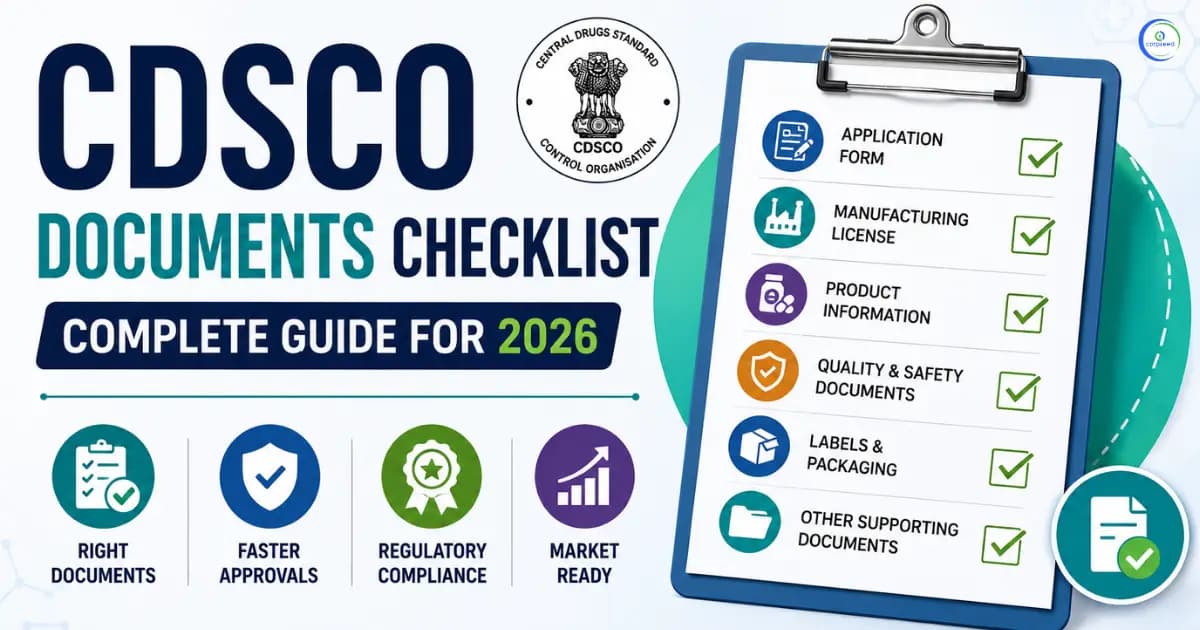
Introduction
Approval by the Central Drugs Standard Control Organisation (CDSCO) for any drug is usually delayed not due to policy differences but because of paperwork. The lack of an apostille, an incorrect product name, or the expiration of the Free Sale Certificate may cause a delay of several months. This guide provides information on all documents required by CDSCO, depending on the type of application.
What is the CDSCO Documents Checklist?
CDSCO is the national regulator for drugs, medical devices, IVDs, and cosmetics in India, functioning under the Ministry of Health and Family Welfare. These four categories of regulated products are regulated by CDSCO using the Drugs and Cosmetics Act, 1940, Drugs and Cosmetics Rules, 1945, Medical Devices Rules, 2017, and Cosmetics Rules, 2020.
"CDSCO documents checklist" refers to a list of forms, certificates, licenses, and technical documents that should be submitted together with an application filed through the SUGAM portal, CDSCO's online system for filing applications, making payments, and tracking their status. An application first undergoes pre-screening by CDSCO to ensure that all required documentation is present and coherent before the product itself is assessed. In many cases, rejections or delays are caused not by problems with the product but by problems with the documents themselves – they may be incomplete, inconsistent, or have authentication issues.
It is useful to distinguish between the common list of documents required for any submission to CDSCO and the list of documents specific to each product category and application type.
Schedule a Call Back
Common Documents Required for All CDSCO Applications
Regardless of whether you're registering a drug, a medical device, or a cosmetic, most CDSCO applications share this baseline set of documents:
- Covering Letter: States the purpose of the application (fresh application, endorsement, renewal, or re-registration), signed and stamped by the authorised signatory, listing all enclosed documents.
- Duly Filled Application Form:The correct SUGAM form for your product and licence type (e.g., Form 40, Form MD-14, Form COS-1), signed and stamped by the manufacturer, importer, or Indian agent.
- Fee Payment Proof (TR-6 Challan): Evidence of the prescribed fee deposited under the relevant schedule of the applicable rules.
- Power of Attorney (POA) / Authorisation Letter: Naming the Indian Authorised Agent, jointly signed and dated by both the foreign manufacturer and the agent, with a clearly defined validity period.
- Manufacturing or Wholesale Licence of the Indian Agent: A valid licence copy showing the agent is legally permitted to import, stock, and distribute the product category in India.
- Free Sale Certificate (FSC) or Certificate of Pharmaceutical Product (CPP): Issued by the regulatory authority in the country of origin, confirming the product is legally sold there.
- GMP Certificate: From the source country's regulatory body, confirming the manufacturing site meets Good Manufacturing Practice standards.
- Product Labels and Packaging Details: Compliant with Indian labelling rules, including manufacturer, importer, and licence details.
- Company Registration Documents: Certificate of incorporation, PAN, GST registration, and IEC (Import Export Code) for the Indian entity.
- Plant Master File (PMF): Overview of the manufacturing site, equipment, and quality systems.
Foreign-issued documents generally need to be authenticated by the Indian Embassy before submission, a step that trips up many first-time applicants.
CDSCO Documents Checklist for Different Application Types
Beyond the common baseline, requirements diverge sharply depending on what you're applying for:
| Application Type | Relevant Form | |
| Drug Registration (foreign manufacturer) | Form 40 → Registration Certificate (Form 41) | |
| Drug Import Licence | Form 8/9 → Import Licence (Form 10/10A) | |
| Medical Device Import (Class A/B) | Form MD-13 → Form MD-15 | |
| Medical Device Import (Class C/D) | Form MD-14 → Form MD-15 | |
| Cosmetic Import Registration | Form COS-1 → Form COS-2 |
Each of these routes has its own dossier requirements, detailed below.
Documents Required for CDSCO Medical Device Registration
The level of risk posed by medical devices is determined by class, from Class A (Low) to Class D (High), and the required documentation varies by class. For Class C & D medical devices seeking authorization using Form MD-14 for Import Permit (Form MD-15), the following is usually required:
- Covering Letter on the Indian Authorised Agent's letterhead, explaining the application's purpose and confirming compliance with the Medical Devices Rules, 2017.
- Device Master File (DMF)- Design, manufacturing process, and quality control documentation, equivalent to a technical file.
- Plant Master File (PMF)- Manufacturing site details and quality systems.
- Free Sale Certificate matching the exact device models listed in the application.
- ISO 13485 Certification- Proof of a certified quality management system (mandatory for most Class B, C, and D devices).
- Essential Principles Checklist / Risk Analysis - As per ISO 14971.
- Device Classification and GMDN Codes- Correctly grouped to avoid fee errors and delays.
- Clinical Evaluation or Performance Data- Required for certain higher-risk devices.
- Labelling and Instructions for Use (IFU)- In English, compliant with Indian labelling rules.
- Predicate Table- Demonstrating substantial equivalence to devices already approved in India, where applicable.
- Stability/Sterility Data- For sterilised devices.
- Power of Attorney- Correlating the Indian agent's authority with the application, apostilled where foreign-issued.
Class A and B devices generally follow a lighter Form MD-13 route, with a similar but reduced set of documents. Note that certain non-sterile, non-measuring Class A devices qualify for a simplified online registration rather than full import licensing.
Documents Required for CDSCO Drug Import Licence
Drug imports typically move through two stages: first, registration of the product and manufacturing site (Form 40 → Form 41), then the import licence itself (Form 8/9 → Form 10 or 10A). Core documents include:
- Form 40: Application for Registration Certificate, signed by the Local Authorised Agent or manufacturer, who must hold a valid sale or manufacturing licence in India.
- Form 8/Form 9: Application and undertaking by the manufacturer for the import licence, notarised and authenticated by the Indian Embassy in the country of origin.
- Certificate of Pharmaceutical Product (CPP) or Free Sale Certificate: Apostilled or embassy-authenticated.
- GMP Certificate from the country's regulatory authority.
- Product Dossier: Specifications, analytical methods, stability data, and packaging details.
- Certificate of Analysis: Issued by the foreign manufacturer for each drug category being imported.
- Power of Attorney correlating with Form 40, valid for the registration period.
- Import history and sampling details: For endorsement or re-registration applications, details of drugs imported in the last three years and any sampling results.
- Facility and Infrastructure Details: Storage layout, quality-control lab specifications, and qualified personnel, since CDSCO scrutinises the importer's storage and testing infrastructure before granting Form 10.
Import licences are generally valid on a long-term basis subject to retention fees, while the underlying Registration Certificate (Form 41) is typically valid for three years and needs renewal.
Documents Required for CDSCO Cosmetic Registration
Cosmetic imports are registered under the Cosmetics Rules, 2020, via Form COS-1, resulting in a registration certificate in Form COS-2 (valid for 5 years). The checklist includes:
- Covering Letter- Stating whether the application is fresh, an endorsement, or a re-registration.
- Form COS-1- Duly filled, signed, and stamped, submitted on the SUGAM portal.
- Authorisation from Manufacturer- As prescribed under the First Schedule, executed before a magistrate or apostilled/embassy-authenticated in the country of origin.
- Free Sale Certificate- Original, from the National Regulatory Authority of the country of origin, confirming the product is legally marketed there.
- List of Ingredients / Composition- Full ingredient list with percentages, signed by the manufacturer, checked against BIS 4707 safety standards.
- Product Labels- Compliant with Chapter 6 labelling rules, free of misleading or non-cosmetic claims.
- Manufacturing Licence or Authorisation- Authenticated copy from the country of origin.
- GMP Certificate and Product Testing Report.
- Non-Animal Testing Declaration.
- Declaration on Heavy Metal and Hexachlorophene Content.
- Importer's IEC and GST Registration.
- Treasury Challan- Fee payment proof as per the Third Schedule of the Cosmetics Rules, 2020.
As of 2026, all cosmetic filings go through SUGAM only paper-based submissions are no longer accepted.
Common Reasons for CDSCO Document Rejection
Most rejections and delays trace back to a handful of recurring, avoidable errors:
- Missing apostille or notarisation on foreign-issued documents such as the POA, FSC, or GMP certificate.
- Mismatched product details where the Free Sale Certificate, labels, or application form list different product names, variants, or manufacturing addresses.
- Expired or misaligned Power of Attorney that doesn't correlate with the validity period of the registration being sought.
- Incomplete technical files missing ISO 13485 proof, an incomplete Device Master File, or gaps in stability/sterility data.
- Labelling non-compliance instructions or labels not in English, or missing mandatory Indian-specific details like importer name and licence number.
- Incorrect or outdated forms applying on an older version of a SUGAM form, or filing under the wrong classification (e.g., wrong device risk class or wrong cosmetic category).
- Fee payment discrepancies: challans that don't match the correct fee head or amount under the applicable schedule.
Because CDSCO can raise queries on even minor inconsistencies, cross-checking every document against every other document name, addresses, dates, and product variants before submission is one of the highest-leverage steps in the process.
Why Choose Corpseed for CDSCO Documentation and Registration?
Preparing a CDSCO-ready dossier means coordinating legal, technical, and regulatory documentation among manufacturers, Indian agents, and multiple government touchpoints while ensuring consistency across dozens of files.
- Corpseed's regulatory team works through this end-to-end.
- Identifying the correct licence category and SUGAM form for your product.
- Assembling and cross-verifying the full document set.
- Coordinating notarisation and apostille for foreign paperwork, and
- Managing the application through pre-screening, query responses, and final approval.
That structured, document-first approach turns a multi-month regulatory process into a predictable one, helping you avoid delays and rejections caused by paperwork gaps rather than product issues.
Conclusion
However, CDSCO's processing timeframes for applications vary widely depending on the quality of the documents presented, rather than on the complexity of the product itself. No matter whether the company is registering a pharmaceutical, importing a medical equipment item, or bringing a cosmetics line into India, the principle is the same – a perfectly filled in SUGAM form, a complete and uniform set of certificates and licences, and all documents from abroad being properly certified are the key factors to ensuring that an application will pass through the preliminary stage without any questions asked.
About the Author

Anshika Jindal
Content WriterAnshika Jindal, a Legal Content Writer with strong expertise in legal research and a solid academic background in BA LLB and LLM (Criminal Law). I specialize in researching statutes, case laws, and legal developments and presenting them in clear, accurate, and engaging written content. With strong analytical skills and attention to detail, I create reliable, well-structured legal content while maintaining professional and ethical standards.
I specialize in conducting in-depth legal research using credible sources and presenting legal information in a structured, reader-friendly manner while maintaining precision and authenticity. My work focuses on simplifying legal language without compromising its meaning, making legal content accessible to a wider audience.
Related articles
CDSCO Test License for Import (Form MD-16)
2026-11-18
CDSCO Test License for Manufacturing (Form MD-12)
2026-11-18
Medical Devices PLI Scheme 2026: New Applications, Eligibility, Incentives & Benefits
2026-11-12
CDSCO MD-7 Endorsement for Medical Devices: A Practical Guide for Manufacturers
2026-10-23
CDSCO Export NOC for r-DNA Products: Who Needs It?
2026-10-21
CDSCO Registration: A Simple Guide to Getting Your License in India 2026
2026-10-21