
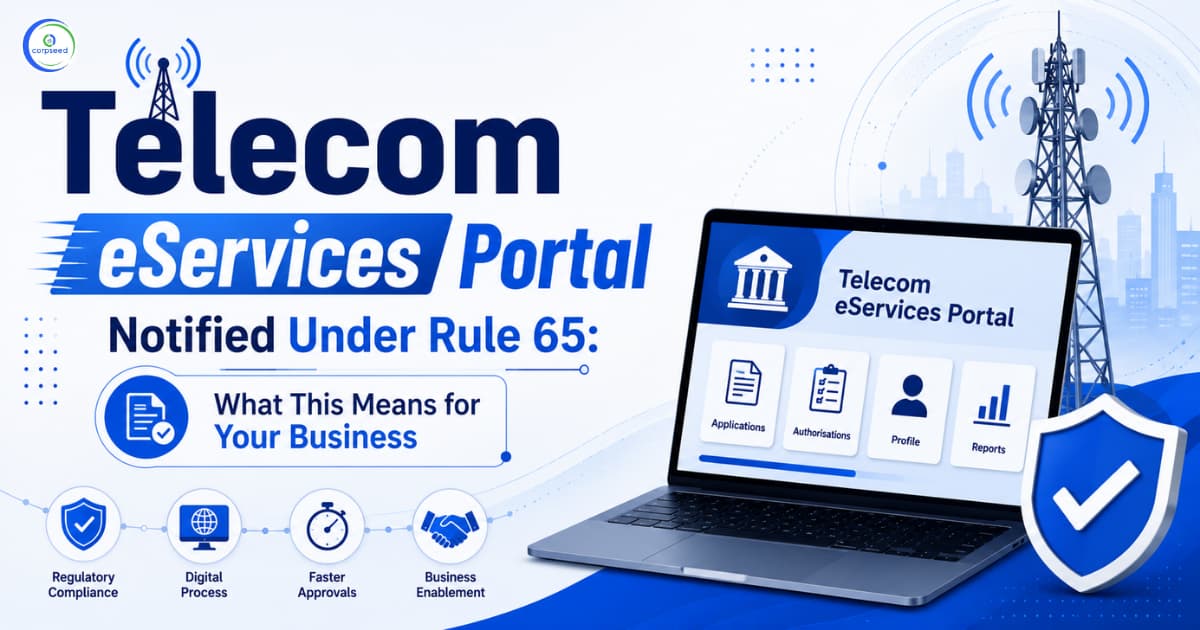
Telecom eServices Portal Notified Under Rule 65: What This Means for Your Business
DoT notifies the Telecom eServices Portal under Rule 65 of the 2026 Authorization Rules. Know what changed, who is affected, and how to comply.
Schedule a Call Back
Introduction
In the Gazette of India dated July 20, 2026, DoT, under the Ministry of Communications, published a short but significant notification. This notification identifies the Telecom eServices Portal as the government's recognized online portal for implementing the Telecommunications (Authorization for Telecommunication Network) Rules, 2026.
Why does this notification matter?
- It tells every telecom company exactly where to go for authorization-related work.
- It replaces confusion and scattered processes with one clear digital address.
- It gives legal recognition to a website that businesses will use for years to come.
Why businesses should care about this update:
- The Indian telecommunications industry has moved beyond the traditional paper-based licensing regime.
- Instead, it has adopted an "authorization" regime under the Telecommunications Act, 2023.
- The Telecom eServices Portal is the platform where the new authorization regime is available.
- If your business deals with telecom in any way, whether as an operator, Internet service provider, infrastructure provider, or a corporate network user, then the portal becomes part of your normal routine.
Who should read this article?
- Telecom company owners and compliance officers
- Legal and regulatory team members
- Internet service providers
- Infrastructural and tower companies
- Corporate networks using telecom systems
- Consultants and advisors supporting telecom clients
Background of the Regulatory Framework
Evolution of India's Telecom Rules
- India's telecom ran for 100+ years under two old laws: the Indian Telegraph Act, 1885, and the Wireless Telegraphy Act, 1933.
- These laws couldn't handle modern telecom (mobile, broadband, 5G, satellite), causing heavy paperwork, long delays, and inconsistent rules across regions.
- The government pushed for digital governance to cut delays, reduce paperwork, and support faster rollout of new technologies.
Telecommunications Act, 2023 (Parent Law)
- Introduced "authorization" instead of the previous "licensing".
- Enabled the Central Government to make regulations in detail.
- Laid the groundwork for doing away with the two old Acts (of 1885 & 1933).
- Legal hierarchy: Act followed by Regulations followed by Rule 65 followed by Portal Notification.
Telecommunications (Authorization for Telecommunication Network) Rules, 2026
- Provide the process of authorizing telecommunications networks/services under the principal Act of 2023.
- Introduce a unified procedure to replace different types of licenses.
- Applicable to network operators, service providers, infrastructure companies, and private networks in some cases.
Understanding Rule 65
- Gives the government the power to officially "notify" a digital portal to implement the Rules.
- Needed so businesses know exactly which platform is legally valid.
- The government chose the existing Telecom eServices Portal instead of building a new one.
Effect: the portal becomes the officially recognized compliance channel, not just a helpful website.
| Topic | Explanation |
| Rule Number | Rule 65 of the Telecommunications (Authorisation for Telecommunication Network) Rules, 2026 |
| Purpose | Gives the Central Government power to notify an official digital portal for implementing the Rules |
| Authority | Ministry of Communications, Department of Telecommunications, Government of India |
| Applicability | Telecom network operators, service providers, infrastructure companies, and related businesses across India |
| Legal Effect | Makes the notified portal the officially recognised digital compliance channel |
What Does This Notification Announce?
What exactly has been notified:
- The Telecom eServices Portal of the DoT is now the official portal for digital implementation of the 2026 Authorization Rules.
Which portal has been notified:
- The Telecom eServices Portal, managed and controlled by the Department of Telecommunications.
Legal authority behind the announcement:
- Rule 65 of the Telecommunications (Authorization for Telecommunication Network) Rules, 2026.
Scope of the notification:
- Applies across the entire country; there are no state-specific or regional limitations.
- Covers any business or entity that needs authorization under these Rules.
Effective date:
- July 20, 2026, the date the notification was published in the Gazette of India.
What changes in practice after this notification:
- Companies now have a single verified online place for authorization-related issues.
- There is no longer any ambiguity about which digital system to use.
- Future communication regarding authorization is expected to route through this portal.
Understanding the Telecom eServices Portal
What the portal is:
- The Department of Telecommunications' digital platform for handling telecom authorization and compliance processes.
- Applications, approvals, renewals, and reporting all move through a single connected online system rather than scattered paper files.
Why it was created:
- To support India's broader shift from a license-based telecom system to an authorization-based one.
- To give businesses a matching digital system as the underlying rules themselves became simpler and more unified.
Main objectives of the portal:
- Reduce paperwork for both businesses and government staff.
- Speed up processing timelines for applications and approvals.
- Give businesses and regulators a shared, transparent view of every filing.
- Build a centralized historical record that supports easier audits later.
Expected services available through the portal:
- Submitting new authorization applications
- Uploading required supporting documents
- Tracking real-time application status
- Managing renewals and periodic compliance filings
- Requesting modifications to an existing authorization
- Receiving official notices and communication from DoT
- Making relevant fee payments connected to the authorization
How businesses will use the portal in daily operations:
- Applying for a fresh authorization when entering the telecom sector.
- Updating company details such as ownership, address, or contact information.
- Submitting periodic or annual reports required under the Rules.
- Requesting changes when business operations or service categories expand.
- Migrating from an older license to the new authorization category, where applicable.
Why this improves overall compliance quality:
- Creates a clear digital trail for every submission, review, and approval.
- Significantly reduces the risk of lost paperwork or missed deadlines.
- Makes it far easier for a business to demonstrate compliance during inspections or audits.
- Reduces dependency on individual government officials or offices for basic status updates.
| Portal Feature | Benefit |
| Online application filing | Saves time; removes the need for physical office visits |
| Centralised document upload | Keeps all compliance records in one searchable place |
| Application status tracking | Gives real-time visibility into where an application stands |
| Digital communication | Reduces delays caused by postal or in-person correspondence |
| Unified authorisation records | Makes audits, renewals, and inspections simpler |
| Online fee payment (where applicable) | Removes manual payment processing delays |
Key Highlights of the Notification
- Official portal: The Telecom eServices Portal is now legally recognized as the digital implementation platform for the 2026 Authorization Rules.
- Digital implementation: All authorization-related processes under these Rules are expected to run through this online system.
- Rule 65 authority: The notification was issued under the specific legal authority granted by Rule 65.
- Central Government notification: This is a formal, legally binding government order, not an internal circular or informal advisory.
- Nationwide applicability: The notification applies to all telecom businesses across India, with no regional exceptions.
- Better regulatory monitoring: A single digital portal provides the government with a more consistent, centralized way to track compliance across the entire telecom industry.
- Part of a larger reform: This notification sits within India's broader shift from telecom licensing to telecom authorization under the 2023 Act.
What Has Changed Under the New Notification?
Earlier system, before this specific notification:
- No single gazette-confirmed digital portal had been formally specified for this exact Rules framework.
- Processes could feel scattered across departments or informal channels.
- Businesses sometimes lacked full clarity on the officially recognized digital channel for certain filings.
New system, after this notification:
- One clearly identified, officially notified online destination for authorization matters.
- A formal legal basis (Rule 65) backing the portal's recognized status.
Manual processes versus digital processes:
- Fewer physical documents need to be printed, signed, and couriered.
- Fewer in-person visits to government offices are required.
- Processing times are expected to improve as digital workflows replace manual routing.
Impact of having a single, unified portal:
- One consistent point of contact instead of multiple, sometimes conflicting channels.
- Easier onboarding for new businesses, since there is only one system to learn.
Improvements in transparency:
- Businesses and regulators can view the same application status and history.
- Reduces disputes over whether a document was submitted or received.
Faster approvals become more achievable:
- Applications no longer depend entirely on manual routing between different departments.
- Digital systems can flag missing information immediately, rather than businesses discovering errors weeks later.
- Automated status updates reduce the need for businesses to repeatedly follow up manually.
Earlier Process vs New Process
| Earlier Process | New Process |
| Manual, paper-based applications and approvals | Digital applications through the Telecom eServices Portal |
| Unclear or scattered points of contact | One officially notified digital portal |
| Slower processing due to physical document movement | Faster processing through online workflows |
| Limited visibility into application status | Real-time tracking through the portal |
| Higher chance of delays and lost paperwork | Centralised digital records reduce errors |
| Manual follow-ups required for updates | Automated status notifications through the portal |
Why Has the Government Introduced This Notification?
Digital governance:
- Supports India's larger goal of running government services digitally across sectors.
- Telecom, as a technology-driven industry, is a natural fit for this transformation.
Faster approvals:
- Digital systems can process, sort, and review applications more quickly than manual paper-based review.
- Automated checks can catch incomplete applications early, saving time for both sides.
Transparency:
- Businesses have full visibility into where their application is at all times.
- Decreases the need for informal follow-ups and contact within the government offices.
Reduced paperwork:
- Cuts down on physical documents, storage space, and manual data entry work.
- Lowers administrative costs for businesses, especially smaller ones.
Ease of Doing Business:
- A faster, clearer compliance process makes India more attractive for telecom investment.
- Simplified processes can encourage both domestic and international players to expand operations.
Better monitoring for the government:
- A centralized system gives regulators a clearer, more complete view of authorization activity across the sector.
- Supports more informed policy decisions based on real compliance data.
Supporting next-generation technology rollout:
- Faster authorization processes help newer technologies, such as 5G expansion and satellite communication, reach the market more quickly.
Who Will Be Affected by This Notification?
Telecom companies:
- Providers of mobile, broadband, or long-distance services must use the portal for authorization-related filings.
- This includes both new applicants and companies renewing or updating existing authorizations.
Infrastructure providers:
- Service providers that construct and maintain tower facilities, cabling, and other network hardware will need to access the portal, depending on their specific authorization needs.
- Service providers with shared infrastructures will also need to manage compliance status via the portal.
Internet Service Providers (ISPs):
- Fall directly under the scope of telecom authorization.
- Will rely on the portal for applications, renewals, and periodic reporting.
Enterprises with private or captive networks:
- Businesses operating private telecom networks for internal industrial or operational use may need to engage with the portal, depending on their specific network category.
- This can include manufacturing units, ports, and large industrial campuses using dedicated network setups.
Existing authorization or license holders:
- Will certainly utilize the portal for renewals, amendments, and other updates of corporate or network information.
- Will also utilize the portal during the transition period from existing licenses to new authorization.
New applicants entering the telecom sector:
- Will use the portal as their starting point for seeking authorization, from initial application through to approval.
Indirectly affected stakeholders:
- Legal and compliance consultants supporting telecom clients.
- Technology vendors offering compliance and document management tools to telecom businesses.
Business Type and Impact
| Business Type | Impact |
| Telecom service providers | Must use the portal for authorization applications and renewals |
| Infrastructure companies | May need portal access for authorisation and compliance filings |
| Internet Service Providers | Directly affected; portal becomes the main filing channel |
| Enterprises with private networks | May need to engage with the portal based on their network type |
| Existing license or authorization holders | Will use the portal for updates, migration, and renewals |
| New market entrants | Will apply for authorization through this portal from the start |
| Consultants and advisors | Will need portal familiarity to support client filings |
Impact on Businesses
Operational Impact
- Businesses will need to adjust internal workflows to work with an online system instead of manual, paper-based filing.
- Compliance and legal staff will need dedicated time to become familiar with the portal's features, forms, and requirements.
- Companies may need to assign a specific internal team or point person to manage portal-related tasks.
Compliance Impact
- Since the portal is now the officially recognized digital channel, filings made through it become the primary compliance record.
- Missing a required step, upload, or update on the portal could directly translate into a failure to meet a regulatory requirement.
- Businesses should treat portal accuracy with the same seriousness previously given to signed physical documents.
Documentation Requirements
- Companies must prepare their documents in formats suitable for digital upload, such as scanned copies or digitally issued certificates.
- Businesses relying heavily on older paper records may need a dedicated internal effort to organize and digitize them.
- Document version control becomes important, since outdated files uploaded by mistake could cause processing delays.
Digital Filing Practices
- Application forms, supporting documents, and official communication will now largely move through the portal rather than physical letters or in-person visits.
- Businesses should maintain internal backups of all submissions made through the portal for their own records.
Approval Process Changes
- With a centralized digital system, businesses may experience more predictable and trackable timelines.
- Applications are less likely to get lost or delayed between different departments, since everything routes through one platform.
- Businesses can proactively track pending items instead of waiting passively for updates.
Long-Term Impact on Business Operations
- Businesses that adapt early to digital compliance are likely to spend less time on repetitive administrative work over time.
- More internal resources can shift toward core business operations, such as network expansion or service improvement.
- Companies that build strong internal digital compliance habits now will likely find future regulatory updates easier to adopt.
Compliance Checklist for Businesses
- Check whether your business requires authorization under the 2026 Rules.
- Determine the appropriate authorization category for your services.
- Register your company on the Telecom eServices Portal.
- Appoint a team member responsible for managing your portal activities.
- Collect all necessary documents in electronic format.
- Submit your application and necessary documentation through the portal.
- Keep checking the status of your application regularly via the portal.
- Address any questions raised about your application immediately.
- Keep your records up to date for renewal purposes.
- Maintain backup copies of all your documents communicated via the portal.
Key Benefits of the Telecom eServices Portal
- Saves time by removing the need for physical office visits.
- Reduces paperwork through fully digital document handling.
- Gives businesses real-time updates on their application status.
- Creates a clear, traceable record of every compliance step taken.
- Supports faster processing compared to older manual systems.
- Makes renewals and updates easier to manage over the long term.
- Provides a single consistent channel instead of multiple confusing contact points.
- It helps small businesses compete more effectively by lowering administrative hurdles.
- Lowers the dependence on hard copy documentation that can be misplaced, damaged, or held up in transit.
- A long digital record of compliance that will facilitate future dealings with regulators.
Benefits for the Government and Regulators
- Better supervision: It becomes easier for regulators to monitor authorization activities nationwide through a single platform.
- Centralized documentation: All applications and their approvals are recorded in a single location, simplifying the auditing process.
- Clarity: Both businesses and regulators use the same information base, avoiding confusion.
- Quick processing: It enables officials to handle applications digitally without delay due to manual intervention.
- Digital governance: Supports India's broader goal of delivering government services online consistently and at scale.
- Data-driven policymaking: Centralized digital records can help the government better understand industry trends and adjust policy accordingly.
Is This a Progressive Reform or an Additional Compliance Burden?
Benefits
- This notification simplifies exactly where businesses go for telecom authorization.
- It supports faster processing, better transparency, and easier long-term record-keeping.
- For many businesses, especially larger ones with dedicated digital teams, this is a clear step forward.
- It reduces the unpredictability that often came with older, manual processes.
Challenges
- For smaller businesses or those with limited digital resources, adapting to a new online system takes time, training, and sometimes new tools.
- This can feel like an added burden in the short term, even if it brings long-term benefits.
- Businesses in remote areas with limited internet access may face practical difficulties during the transition period.
Industry Perspective
- Much of the telecom industry has been moving toward digital compliance for several years already.
- Many larger operators already use online systems for various regulatory and operational tasks.
- For these businesses, this notification may feel like a natural next step rather than a major disruption.
- Smaller players may view it more cautiously until they see the system working smoothly in practice.
Overall Assessment
- This notification is best understood as part of a longer digital transformation journey within India's telecom sector.
- It brings short-term adjustment challenges but is clearly designed to create long-term efficiency.
- Businesses that prepare early, train their teams, and organize their documentation are likely to find the transition considerably smoother than those who wait until the last moment.
Business Opportunities Created by This Notification
Compliance consulting:
- Businesses may need expert help understanding and correctly navigating the new authorization process.
- Growing demand for advisors who understand both the legal Rules and the practical portal workflow.
Digital services:
- Services that provide for document digitization and structured data management will assist with the transition.
Technology providers:
- Those developing compliance tracking dashboards and workflow automation solutions can see their opportunities increase here.
Telecom sector expansion:
- A streamlined approval process may lead to more companies entering the Indian telecommunications industry.
- Less friction may facilitate more rapid adoption of technology and services.
Documentation services:
- Businesses that help organize, format, and prepare compliance documents in digital form can find steady, ongoing demand.
Training and capacity building:
- Opportunities exist for firms offering staff training programs focused on digital compliance and portal usage.
Key Takeaways
- The Telecom eServices Portal is now the official digital portal for the Telecommunications (Authorization for Telecommunication Network) Rules, 2026.
- This notification was issued on July 20, 2026, under Rule 65 of these Rules.
- It was published by the Department of Telecommunications, Ministry of Communications.
- Rule 65 gives the government the specific legal power to notify an official implementation portal.
- The notification applies nationwide, with immediate effect from its date of publication.
- Telecom companies, ISPs, infrastructure providers, and enterprises with private networks are all affected.
- Businesses should register on the portal and prepare their digital documentation early.
- The shift supports faster approvals, better transparency, and easier compliance tracking over time.
- Smaller businesses may need additional support and training to adapt smoothly to the new digital process.
- This notification is part of India's broader, ongoing move toward digital telecom governance under the 2023 Act.
How Can Corpseed Help?
- Regulatory guidance: Aids organizations in comprehending what this notification means in relation to their specific authorization classification.
- Document preparation: Aids organizations in completing documentation that will meet the requirements expected from the Telecom eServices Portal.
- Telecom authorization support: Aids organizations throughout the authorization process from eligibility assessment to completion.
- Portal assistance: Aids internal teams with respect to the various functions of the portal.
- Compliance monitoring: Offering ongoing support to help businesses stay updated as rules and procedures continue to evolve.
- End-to-end consulting: Providing support at every stage, from understanding a new notification like this one to maintaining long-term, ongoing compliance.
If your business needs clarity on this notification or support with the telecom authorization process, Corpseed is ready to help you move forward with confidence.
About the Author

Mahek Sancheti
Content WriterMahek Sancheti, BAJMC graduate with a deep passion for writing. As a content writer, video content creator, creative content creator, and scriptwriter, I bring stories to life through words and visuals. I honed my skills by working with a prominent news agency, where I excelled in crafting compelling narratives and engaging content. Coming from a journalism and mass communication background I have skills to craft engaging narratives that captivate audiences. With a keen interest in writing and creativity, I aim to deliver impactful and meaningful content that resonates with diverse audiences.
https://www.linkedin.com/in/mahek-sancheti-837196212