
CPCB Mandates GST E-Invoicing for Used Oil EPR Certificate Generation from July 2026
CPCB has made GST e-invoicing mandatory for the generation of Used Oil EPR certificates from July 1, 2026. Learn the impact on recyclers, PIBOs, and collection agents, and how to stay compliant.
Schedule a Call Back
Businesses we've worked with on used-oil EPR
Clients include Brenntag Ingredients India, VAS Petrochemicals, Genpact India, Headstrong Services India, Jakson, Aisin ASK India, Escorts Kubota, Sealand Trading Exim, Sun Oil Company (9 of 10+ served since 2018).
See our used-oil EPR service →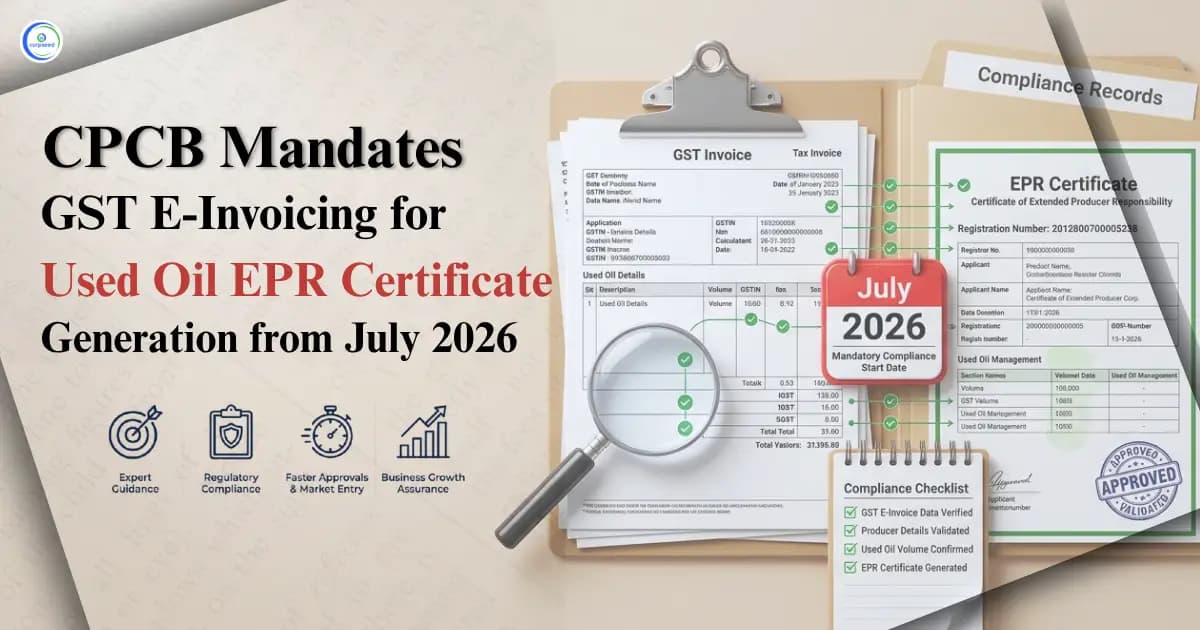
Introduction
Central Pollution Control Board of India has issued a strong enforcement order that, from July 1, 2026, all GST e-invoices with an IRN and QR code are acceptable at the Used Oil EPR Portal for EPR certificate issuance. Otherwise, the certificate generated through any other invoice not having GST will automatically become illegal as per the guidelines, and producers, importers, and recyclers will have to face serious consequences due to this violation.
What CPCB Has Mandated and From When?
The Central Pollution Control Board manages the Used Oil EPR Portal, which is part of the rules governing Hazardous and Other Wastes (Management and Transboundary Movement) Amendment Rules under Chapter VII that came into effect on April 1, 2024. These rules outline the EPR requirements of three groups of stakeholders in the market, including producers of base oil and lubrication oil, importers of used oil, and recyclers/collection agents.
It was in June 2026 that CPCB made some stringent guidelines that have drastically changed the whole system of creating and validating the EPR certificate through the portal. It is quite evident that GST e-invoices, which imply those invoices that are generated through the portal provided by the government and which come with IRN and QR Code, are the ones that will be considered as documents of proof for generating the Used Oil EPR Certificate.
It is quite clear when exactly the cutoffs would apply. June 30, 2026, is the last day by which any invoice without GST can be considered, and these will include manual tax invoices and even simpler invoicing systems on paper. Any invoices submitted from July 1, 2026, onwards to the CPCB portal will have to be based on a GST e-invoice. Otherwise, any EPR certificates issued after this deadline will automatically become invalid and will expose the issuer to penalties as well as liability under EPR.
| Key Date | Regulatory Event | Consequence of Non-Action |
| April 1, 2024 | Used Oil EPR Rules enter force under Chapter VII of HW Rules | EPR obligations legally bind all producers, importers, and recyclers |
| June 2026 | CPCB issues enforcement directions mandating GST e-invoicing on the EPR portal | Industry receives formal compliance notice; immediate action required. |
| June 30, 2026 | Last date non-GST invoices accepted for EPR certificate generation | All pending non-GST invoice-linked transactions must be closed before this date |
| July 1, 2026 | Only GST e-invoices (IRN + QR code) are accepted on the Used Oil EPR Portal | Certificates from non-compliant invoices are treated as invalid, and registration is at risk |
Why CPCB Implemented GST E-Invoicing for Used Oil EPR?
- Used Oil EPR becomes the third waste stream after plastic packaging and e-waste to receive GST e-invoice integration.
- CPCB applied the same model to plastic packaging and e-waste EPR, both saw reduced fraud and stronger mass-balance traceability, making used oil the logical next step.
- The primary driver is fraud prevention, without GST-validated invoices, recyclers could over-declare processed volumes and generate EPR certificates against oil that was never actually recycled.
- PIBOs could purchase these inflated certificates to fulfil EPR obligations on paper while the physical oil remained unrecovered.
- GST e-invoicing addresses this loophole by ensuring that each certificate is issued in respect of a bona fide transaction, with the payment of tax being registered with the government.
- This will facilitate the automatic cross-checking system since the information provided on sales for recyclers is available through the GST return system and compared with certificate information from the portal.
- Informal, cash-based collection networks have historically dominated used oil, GST integration forces every transaction into the formal digital economy.
- Without invoice-level tracking, used oil quietly disappears into illegal burning or dumping, GST e-invoicing makes every litre traceable and illegal disposal commercially unattractive.
Impact on Businesses in India in 2026
The impact is different for everyone:
Used Oil Recyclers
- Should be GST registered and make upgrades to GST invoicing using IRN + QR by July 1, 2026.
- All sales of re-refined base oils with claims against EPR certificates should have a valid GST invoice.
- Smaller recyclers face the steepest challenge, ERP onboarding costs are high within a tight transition window.
- Failure to comply means losing certificate generation rights and becoming commercially irrelevant to PIBOs.
Producers / Importers (PIBOs for Used Oil)
- PIBOs comply with EPR responsibility by buying certificates from registered recyclers, thereby putting the compliance issue on recyclers.
- The failure of the generation of GST invoices after June 30, 2026, makes this certificate invalid.
- An invalid certificate brings about responsibility for environmental compensation and EPR deficit.
- Recycling companies' responsibility for GST e-invoicing capability verification is no longer negotiable.
Collection Agents and Used Oil Aggregators
- Most collectors tend to be informal, unregistered, and run on a cash basis without invoices.
- Formalization becomes a matter of having to comply with GST requirements or else leave the chain altogether.
- Market consolidation is likely; organised logistics firms will absorb informal volumes.
- Rural collection coverage may temporarily shrink where informal operators were the only option.
GST and ERP Service Providers
- Significant new market emerging for GST e-invoicing software built for environmental compliance use cases.
- API integration services connecting ERP outputs with the CPCB Used Oil EPR Portal are in high demand.
- Training of staff for IRN creation, troubleshooting, and portal synchronization can be charged separately as a service line.
- The recurrent GST-EPR reconciliation service provides another opportunity to generate recurring revenue for compliance software companies.
How Businesses Will Be Compliant
For Used Oil Recyclers
- Step 1: Confirm GST Registration and E-Invoicing Eligibility
Verify that the entity's GST registration is active and in good standing. Even recyclers below the mandatory e-invoicing turnover threshold must voluntarily adopt GST e-invoicing to meet CPCB's requirements for EPR certificate generation. This is not optional, the CPCB portal will reject non-GST invoices regardless of the recycler's turnover classification.
- Step 2: Set Up E-Invoicing Infrastructure
Adopt an e-invoicing infrastructure that includes either the use of an ERP system with built-in IRN generation capabilities, an Application Service Provider/GST Suvidha Provider system, or even direct interaction with government portals when dealing with lower-volume invoices. An invoice will not be considered valid unless it has a proper IRN, QR code, and GST fields filled out accordingly.
- Step 3: Integrate with the CPCB Used Oil EPR Portal
Ensure GSTIN and other relevant information about the entity are up-to-date. Refer to the guidelines provided by CPCB for uploading GST e-invoices using either a manual JSON file upload process or an API integration process for large recyclers. Testing transactions before the cutoff date of July 1, 2026, would ensure that e-invoicing is working fine and EPR certificates are generated based on invoiced quantities.
- Step 4: Manage the June 30 Cutoff Cleanly
Make sure that non-GST invoices do not get raised on EPR transactions from July 1, 2026, onwards. In case there are any eligible invoices that have been raised before the deadline, make sure these are raised in the portal immediately to ensure that certificates are obtained in time.
- Step 5: Establish Ongoing Internal Controls
Standardize the process internally such that all sales related to EPR certificate claims will automatically go via the e-invoicing process. Establish a reconciling process to reconcile data relating to GST outward supplies and the certificates produced on the portal. Any difference should be immediately identified and addressed to prevent CPCB audits.
For PIBOs / Producers / Importers
- Perform an audit of all recyclers in the supply chain regarding their current status of GST registration and ability to perform GST e-invoicing prior to June 25, 2026. Isolate those who fail to prove compliance.
- Amend the terms and conditions of all recycler contracts to ensure that all EPR certificate sales have proof in the form of GST e-invoicing and have the ability to deny/repay funds when the EPR certificate is found to be invalid via CPCB.
- Have the process of reconciliation between CPCB EPR certificates and GST invoices (from recyclers) every month.
- Appoint a compliance manager who can oversee the submission process of returns via the CPCB portal and document the details.
Why This Move Was Needed?
- Plastic packaging and e-waste EPR proved that GST e-invoice integration reduces fraud and improves certificate tracking; used oil was the last major hazardous waste stream without this safeguard.
- Without invoice-level validation, EPR risked becoming pure paper compliance, certificates trading on a portal, while used oil continued to be illegally burned or dumped.
- Used oil is a serious environmental contaminant; illegally disposed of oil degrades air quality, pollutes groundwater, and persists in soil for decades.
- The system of GST electronic invoicing ensures that there is a one-to-one correspondence between each portal certificate claim and an actual transaction.
- Formalisation efforts in India involve using the framework of GST as a foundation because compliance with tax law and environmental law go hand-in-hand.
Is This the Right Decision or an Additional Burden?
Why It Is the Right Decision
Considering the size of the challenge it seeks to overcome, the GST e-invoicing rule is a proportionate requirement for the CPCB. Without GST e-invoicing, it would not be possible for the Used Oil EPR program to achieve meaningful results because its core mechanism would have been susceptible to fraud through inaccurate or even fictitious invoicing.
| Aspect | How GST E-Invoicing Strengthens the System |
| Environmental Integrity | Every EPR certificate corresponds to a real, tax-paid recycling transaction, eliminating paper compliance and greenwashing from the Used Oil EPR market. |
| Traceability & Transparency | GST-linked invoices allow CPCB to track the full used oil supply chain from producer to recycler using data that cannot be altered after generation. |
| Fair Competition | Honest recyclers already issuing compliant GST invoices are no longer commercially undercut by operators who fake volumes or underinvoice to avoid tax. |
| Regulatory Consistency | Aligns Used Oil EPR with Plastic Packaging and E-Waste EPR, creating a uniform, technology-consistent compliance architecture across hazardous waste streams. |
| PIBO Protection | Producers and importers acting in good faith gain certificates with strong evidential value that can withstand regulatory audit and enforcement scrutiny. |
Where It Is a Burden
The criticism of this particular directive is valid and needs to be considered. Small-scale recyclers and collection agencies, especially those who work in tier 2 and tier 3 towns or rural collecting hubs, do have an actual disadvantage when it comes to following this rule. GST registration, e-invoicing software purchase, ERP linkage, along with all other follow-ups, do require actual investment.
| Stakeholder | Specific Compliance Burden |
| Small recyclers and collectors | Must invest in GST registration, e-invoicing systems, ERP integration, and staff training, costs that are substantial relative to the margins of micro-scale operators. |
| Transition period (July 2026) | System glitches, portal errors, and learning curves will cause disruption to certificate generation volumes in the short term, potentially creating supply gaps. |
| Informal cash-based operators | The business model built on unrecorded, cash transactions becomes entirely unviable under the new regime. Exit or formalisation are the only options. |
The balanced verdict: This particular directive certainly does create some real challenges for smaller, more informal firms, as it requires considerable effort on their part. However, from the point of view of being credible, of being a tax-compliant firm, and, most importantly, of sustaining a healthy EPR market, this directive is justified and necessary.
How It Improves Quality, Consumer Satisfaction, Environment, and Ethical Practices
GST e-invoicing makes the Used Oil EPR regime from an exercise on paper to a regime that is verifiable.
- Disposal of the oil illegally, such as burning it as fuel and pouring it down drains, becomes uneconomical since each litre of the oil is required to go through a GST-registered recycler.
- Environmentally sound recycling volumes increase as formal collection infrastructure replaces informal, untracked channels.
- CPCB gains high-quality, independently verifiable data on actual collection and recycling volumes, sector by sector, geography by geography.
- There is a clear and precise way to determine targets, based on solid evidence rather than assumptions.
- PIBOs with GST invoices become more compliant because there is greater evidence for the regulators, ESG audits, and environmentally conscious consumers.
- With the transition from voluntary to mandatory ESG reporting, having reliable proof of compliance has turned into a commercial advantage.
- Properly recycling companies, which are paying their GST and maintaining proper bookkeeping, are no longer undermined by non-compliant recyclers inflating quantities.
- The playing field is levelled, rewarding genuine recycling capacity and penalising corner-cutting.
Corpseed EPR Used Oil Advisory Services
The complexity of aligning GST e-invoicing infrastructure with CPCB's Used Oil EPR Portal requirements has created significant demand for specialist advisory support. Corpseed offers end-to-end advisory services designed to help all categories of Used Oil EPR stakeholders- recyclers, producers, importers, and collection agents- navigate this transition efficiently and avoid the commercial and regulatory risks of non-compliance.
| Service | What It Covers | Who Benefits |
| EPR + GST Integration Advisory | End-to-end support for e-invoicing setup, CPCB portal integration, and ongoing GST-EPR reconciliation for recyclers and PIBOs | Recyclers, producers, importers |
| Digital Tools and SaaS Platforms | GST e-invoice generation, EPR portal integration, real-time dashboards tracking EPR targets versus certificates and GST-EPR reconciliation status | All stakeholders need automated compliance tracking |
| Formal Collection Network Development | Building GST-compliant, documented used oil collection and aggregation networks for large-scale operations, door-to-door collection with full EPR documentation | Large waste management firms, automotive OEM networks |
| EPR Assurance and Independent Audit | Independent verification of EPR data, GST-EPR reconciliation, and mass-balance records for ESG reporting, investor disclosure, and CPCB audit readiness | Large PIBOs with ESG obligations, lender-scrutinised businesses |
The landscape for compliance with Used Oil EPR is different forever. Organizations that take action by auditing the recyclers' network, introducing GST E-invoice and completing all the outstanding portal returns before July 1, 2026, will secure their access to the market and availability of EPR certificates. If they postpone taking any action, they are likely to encounter not only an issue with enforcement but also with their ability to comply with market registration requirements due to a lack of certificates.
About the Author

Mahek Sancheti
Content WriterMahek Sancheti, BAJMC graduate with a deep passion for writing. As a content writer, video content creator, creative content creator, and scriptwriter, I bring stories to life through words and visuals. I honed my skills by working with a prominent news agency, where I excelled in crafting compelling narratives and engaging content. Coming from a journalism and mass communication background I have skills to craft engaging narratives that captivate audiences. With a keen interest in writing and creativity, I aim to deliver impactful and meaningful content that resonates with diverse audiences.
https://www.linkedin.com/in/mahek-sancheti-837196212