
Is India's Textile Industry Finally Going Green for Real?
The textile industry employs crores of people and generates billions of rupees in export earnings annually. But behind the colourful fabrics and fast-moving supply chains, there has always been a darker reality, rivers choked with chemical waste, groundwater poisoned by toxic dyes, and factories running on energy-hungry machines with little accountability.
Schedule a Call Back
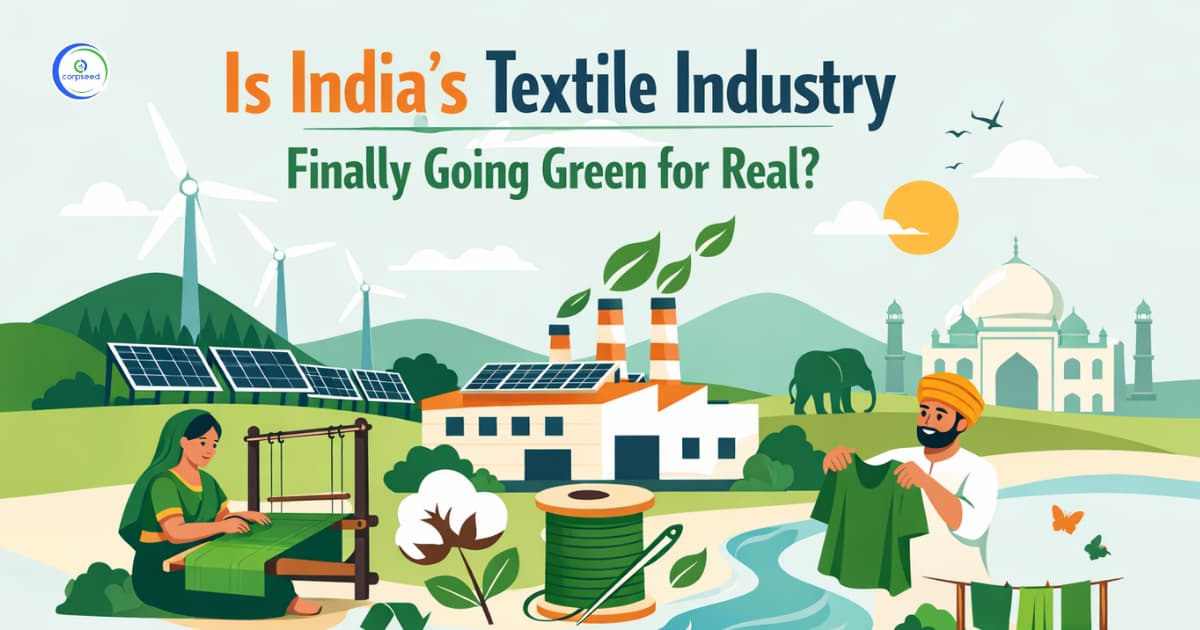
India is the clothing hub of the world, with the textile industry affecting every corner of the country, from the cotton fields of Gujarat to the dyeing units of Tirupur. The textile industry employs crores of people and generates billions of rupees in export earnings annually. But behind the colourful fabrics and fast-moving supply chains, there has always been a darker reality, rivers choked with chemical waste, groundwater poisoned by toxic dyes, and factories running on energy-hungry machines with little accountability.
This reality is being challenged, and it is being challenged from the top. On 17 March 2026, Textile Minister Shri Giriraj Singh said that the Government of India's efforts to promote green textiles include green manufacturing, green certification, green credits, ESG, Common Effluent Treatment Plants, and Zero Liquid Discharge. The details are important for anyone in this industry or anyone purchasing from it.
Schedule a Call Back
Eliminating Hazardous Chemicals from India's Textile Supply Chain
The government is already running a pilot project titled "Eliminating Hazardous Chemicals from Apparel Fashion Supply Chain in India." This project covers eight textile clusters and four fashion houses. The goal of the project is very direct, and that is to help textile units adopt clean, safe, and eco-friendly production processes. The project does not just involve the production units, it also includes consumer awareness, so that end consumers can opt for eco-friendly clothing. When the supply and demand sides are aligned in the same direction, the whole industry follows.
What is ESG Compliance and Why Can Textile Exporters No Longer Ignore It?
The government has set up an Environment, Sustainability, and Governance (ESG) Task Force specifically for the textile sector. ESG is no longer just a buzzword for stock market investors. For textile exporters, ESG compliance is fast becoming the difference between landing international orders and losing them. Major buyers in Europe, the United Kingdom, and the United States now demand documented proof that the products they purchase meet environmental and social standards.
The ESG Task Force provides India's textile industry with a structured platform to address these requirements, covering sustainable production, green certification, export compliance, and more. Through programmes such as Circular Samvaad and the Cluster Exchange Mechanism, the task force helps smaller units learn from larger, more advanced units without reinventing the wheel.
Green Certification for Textiles
Green certification sits at the heart of all this. A green certificate tells a buyer, a regulator, or a customer that a textile product was made without banned chemicals, without wasteful water use, and without environmental damage. The government is actively helping clusters earn these certifications through its BREF/COINDS document, a comprehensive reference guide mapping out the best available techniques for water and energy efficiency, chemical management, and sustainable production. This document provides factories with a clear, practical roadmap that shows exactly which steps to take and in what order.
How Effluent Treatment Plants are Protecting India's Water?
Textile processing is one of the most water-intensive industries on earth. The wastewater it generates carries dyes, heavy metals, and finishing chemicals that destroy rivers and groundwater if left untreated. The government's Integrated Processing Development Scheme, or IPDS, has been running since the Twelfth Five-Year Plan to build new Common Effluent Treatment Plants (CETPs) and upgrade existing ones. A CETP is a shared facility where multiple textile units send their wastewater for treatment before it is discharged into the environment. For any textile cluster not yet connected to a CETP, this is now a compliance priority, not a choice.
Zero Liquid Discharge: The Gold Standard of Textile Water Management
Six projects approved under IPDS have gone even further by adopting Zero Liquid Discharge technology. ZLD means exactly what the name says, not a single drop of industrial wastewater leaves the factory premises. Every litre of water is treated, recycled, and re-entered into the production cycle. Global buyers are specifically looking for ZLD implementation as a measure of genuine environmental commitment. It reduces the need for fresh water, eliminates the risk of pollution, and helps establish credibility with the global supply chain in the long term. The future of ZLD is not just a future aspiration, it is happening now.
PM MITRA Parks and Sustainable Textile Manufacturing
The government's PM MITRA Parks takes this vision further. These are large, integrated textile manufacturing hubs being developed across the country. Every PM MITRA Park includes CETPs, wastewater recycling systems, and scientific waste management facilities as mandatory infrastructure. Shared utilities like water, power, and logistics are structured to maximise resource efficiency and reduce environmental impact. For any textile entrepreneur planning to set up or expand, a PM MITRA Park offers the rare advantage of green compliance built into the infrastructure itself, rather than an expensive afterthought.
Can Textile Waste Really Be Turned Into Carbon Fibres and Green Materials?
Under the National Textile Technology Mission, various R&D projects are underway that use textile waste, agricultural biomass, and bio-residues to produce advanced materials such as carbon fibers and functional textiles. The concept here is to adopt a fully closed-loop system in which waste is used as a resource. This innovation not only minimizes the textile industry's environmental impact but also generates new streams of revenue. India is not only cleaning up old processes but also creating new ones.
MSE-GIFT and MSE-SPICE Schemes and Green Credits for Small Textile Businesses
For micro and small enterprises, the government has introduced the MSE-GIFT and MSE-SPICE Schemes under the RAMP Programme. These schemes offer interest subvention and capital subsidy to help small textile businesses adopt sustainable practices. The cost of going green has always been the biggest barrier for smaller units. These schemes remove that barrier directly. A small dyeing unit that could never afford a ZLD system or a green certification audit now has a clear financial pathway. Under the earlier ATUFS scheme, over 1,117 energy-saving machines were already supported across textile units to improve water and energy efficiency. The foundation is firmly in place.
Conclusion
The message is clear, and the government is conveying it as well. Green textiles are not a goal for the future, but rather a necessity for the present. ESG, green, CETP, Zero Liquid Discharge, green credits via MSE-GIFT and MSE-SPICE, etc., are tools available to every textile business worldwide, required by the international market, incentivized by Indian policy, and dictated by environmental necessity. The opportunity for the Indian textile industry is immense, and it has the potential to lead the world in both quality and quantity. The road has been made available, the support has been put in place, and it is time for action.
About the Author

Mahek Sancheti
Content WriterMahek Sancheti, BAJMC graduate with a deep passion for writing. As a content writer, video content creator, creative content creator, and scriptwriter, I bring stories to life through words and visuals. I honed my skills by working with a prominent news agency, where I excelled in crafting compelling narratives and engaging content. Coming from a journalism and mass communication background I have skills to craft engaging narratives that captivate audiences. With a keen interest in writing and creativity, I aim to deliver impactful and meaningful content that resonates with diverse audiences.
https://www.linkedin.com/in/mahek-sancheti-837196212
Related articles

Green Credit Rules 2025: New Methodology for Tree Plantation and Environmental Compliance
2025-08-30
Eco-Sensitive Zone Proposal for Kumbhalgarh Wildlife Sanctuary: Safeguarding Biodiversity and Ecosystems
2025-06-16
Green Standards to Address issues of Sustainability by BIS
2023-04-21

What is LEED Certificate? Its Benefits For Indian Builders
2023-04-11

How to Obtain Green Building Certification in India
2022-10-17