
Rubber Board Compliance
Rubber Board Compliance includes mandatory licensing for all natural rubber businesses. It is managed by the Rubber Board of India, which is an official permission granted to traders, farmers, and processors. Having a valid rubber board license not only provides legal recognition but also offers several benefits, such as business protection, credibility, quality control, and also ensures market transparency.
Schedule a Call Back
Why wait? Start now!
Get Support AnytimeBusinesses we've worked with on Rubber Board licence
Showing 37 of 50+ clients served since 2018- Clients include
- Tegamen Safety Products · P P Bafna Ventures · Cartel Healthcare · Hindustan Tapes · Munish Forge · Niva Rubber · Polychemora · +4 more
Last updated:
What is Rubber Board Compliance?
Rubber Board Compliance is the compulsory requirement for all natural rubber businesses (dealers, processors, manufacturers) under the Rubber Act, 1947. This obligation is set by the Rubber Board of India, and it applies to all the dealers, processors, manufacturers, and exporters engaged in any form of rubber production or trade. This compliance aims to build a structured, transparent, and accountable industry which will not affect the livelihoods and industrial supply chains.
The Rubber Board Compliance begins with obtaining the rubber board registrations or having a valid rubber board license, as per the nature of the business activity. The registration enables the authority to maintain proper records of rubber farming areas, production volumes, dealer networks, and pricing movements. It also helps avoid under-reporting, unregulated trading, and any market influence.
With the introduction of rubber board online registration and digital services, compliance has become easier and simpler, but it still needs correctness and legal transparency. Any errors, delay, incomplete or wrong documents may result in delay or application rejection. Therefore, appropriate compliance is not just a legal requirement, but it is crucial for businesses to operate legally and confidently in India.
Why Rubber Board Registration Is Mandatory for Rubber Businesses
In India, natural rubber is a regulated agricultural commodity; therefore, it’s crucial to get Rubber Board registration. Having to comply with the set norms ensures fair pricing, quality assurance, and lawful trade. Some of the key reasons are listed below:
- Legal Recognition of Rubber Businesses: Having a Rubber Board license provides several benefits to businesses involved in the rubber business or trade. It provides them legal recognition, transparency, and build the credibility among consumers. Additionally, having an appropriate license also helps avoid the changes of business closures or penalties.
- Regulation of Rubber Board Price Mechanisms: The Rubber Board monitors and publishes rubber board price trends to alleviate the market. Having the registration enables the board to track manufacturing and trade capacity, which also ensures no fake price inflation or suppression that may affect producers and buyers.
- Access to Rubber Board Subsidy Schemes: To get access to subsidy schemes, rubber board compliance is essential. Only registered/ licensed businesses are eligible to apply for the Rubber Board subsidy schemes. These schemes help in replantation, production enhancement, and infrastructure development. Mainly for small and medium rubber producers.
- Control over Dealer and Trader Networks: Compulsory registration helps the Board maintain an updated rubber dealer license list, confirming that only licensed dealers contribute to rubber trading. This not only avoids unlawful procurement but also reduces the chances of untraceable supply chains.
Who Needs a Rubber Board License Under Current Compliance Rules?
Any person or entity engaged in buying, selling, processing, manufacturing, or trading of natural rubber from India is required to obtain a valid Rubber Board license from the respective authority.
- Natural Rubber Growers: The owners of plantations and small growers who grow natural rubber above the limit of notification should be registered under the Rubber Board to give information about the cultivation area, output, and eligibility for technical or financial aid.
- Rubber Dealers and Traders: Entities involved in the buying and selling of rubber must have a valid rubber board license to be listed in the official rubber dealer license list. This provides transparency in transactions and controlled market entry.
- Rubber Processors and Sheet Manufacturers: The units under which raw rubber is processed into sheets, blocks and other forms are also required to be licensed so that they can adhere to the set quality standards and reporting requirements as imposed by the Rubber Board of India.
- Rubber-Based Manufacturing Units: The manufacturers that utilise natural rubber as a raw material have to be registered to guarantee the legal sourcing, proper consumption reporting, trade compliance and price regulations.
- Exporters and Bulk Buyers: Businesses that are involved in the export or purchase of natural rubber from India are required to have a valid registration to comply with quality certifications, export standards, and price monitoring requirements.
Legal Framework Governing Rubber Board Compliance
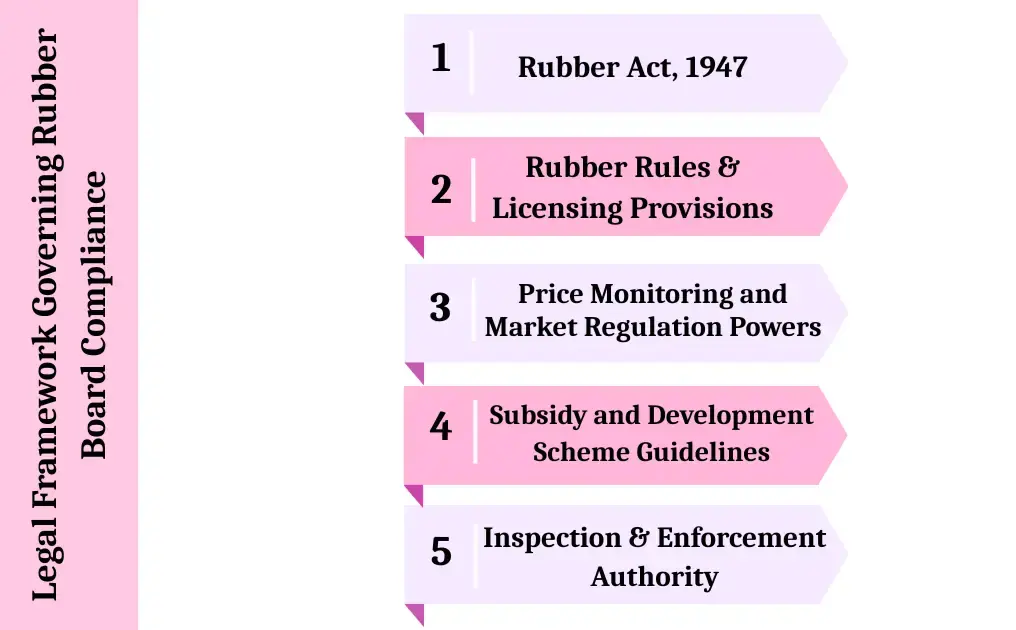
The Rubber Board compliance is regulated by a well-structured legal framework designed to regulate cultivation, trade, and pricing of natural rubber across India, ensuring industry stability and farmer protection. Some of its legal frameworks include:
- Rubber Act, 1947: The Rubber Act was enacted by the Rubber Board of India, which exercises its powers to control the production, processing, marketing, and pricing of natural rubber in the country.
- Rubber Rules and Licensing Provisions: The Act has certain provisions stating the rules of licensing, registration and reporting duties of growers, dealers and manufacturers in the rubber industry.
- Price Monitoring and Market Regulation Powers: The Board has the authority to gather information, give guidelines and conduct price surveillance to avert unfair trading action and maintain the interests of the stakeholders.
- Subsidy and Development Scheme Guidelines: The legal guidelines permit the Board to design and execute rubber board subsidy schemes aiming at the advancement and improvement of plantations as well as sustainability.
- Inspection and Enforcement Authority: The structure permits inspections, audits and enforcement actions against unregistered or non-compliant organizations such as penalties and suspended licenses.
Eligibility Criteria for Obtaining Rubber Board License
Rubber Board license is issued depending on the nature of the activity, the structure of the business and readiness to comply. Before approval, the applicant should have basic operational, legal and documentation requirements. The key eligibility criteria include:
- The applicants should be actively engaged in the cultivation, processing, trading, or manufacturing of rubber as defined in the regulations of the Rubber Board.
- The applicant must be a person, partnership, company or cooperative that is registered legally in India.
- The verifiable land of declared cultivation, processing unit, or trading premises should be in accordance with local regulations.
- The applicants are not supposed to have a history of serious violations related to the rubber trade or commodity laws.
- All information provided in the rubber board online registration has to be comprehensive, honest, and backed up with documents.
Documents Required for Rubber Board Registration
Proper documents are very significant for the smooth registration of rubber boards. Incomplete/wrongful documentation is one of the common reasons for delay or rejection of an application. The key documents include:
- Identity proof of the applicant
- Address proof of business or plantation
- Proof of land ownership or lease (for growers)
- Business registration certificate
- Details of the processing unit or trading activity
- Bank account details
- Passport-size photographs
- Any additional declarations required by the Rubber Board
Step-by-Step Rubber Board Compliance Process
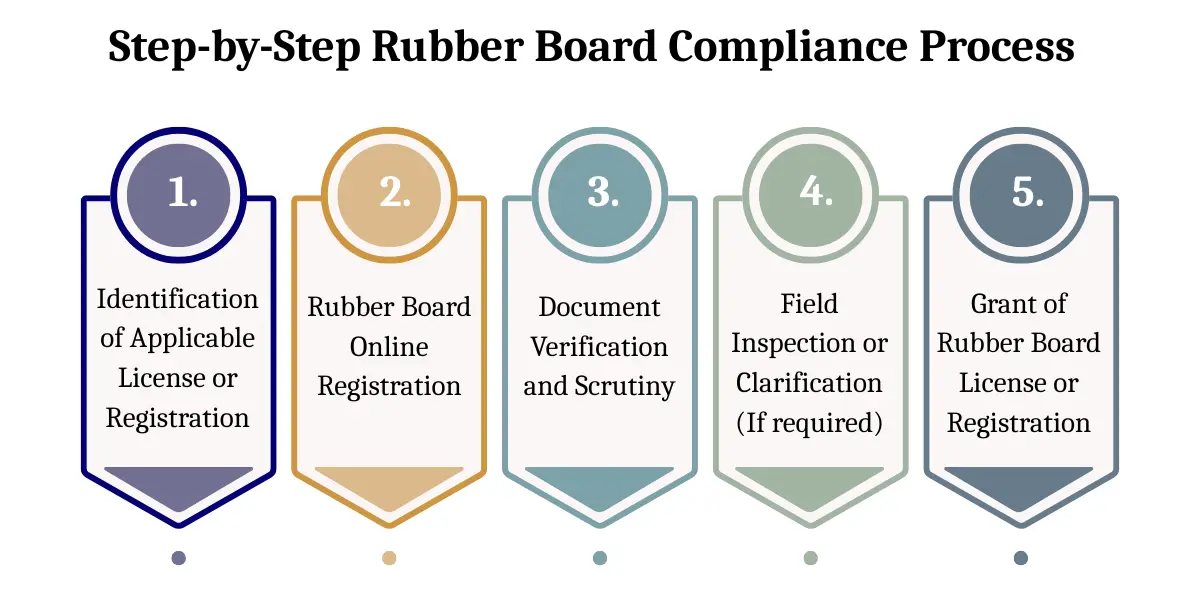
The Rubber board compliance is a systematic process that is aimed at verifying eligibility, transparency and proper records in the industry. The following is the step-by-step process:
- Identification of Applicable License or Registration: Applicant should first identify whether they require grower registration, dealer licensing or manufacturer registration, depending on their position in the rubber value chain.
- Rubber Board Online Registration: The registration can be done through the official rubber board login portal, where the applicant information, activity and supporting documents are uploaded in a digital format.
- Document Verification and Scrutiny: The Rubber Board validates the submitted documents to verify the eligibility, operation information and legal requirements.
- Field Inspection or Clarification (If required): In some cases, the board may request a physical inspection or may ask for further clarifications to justify the cultivating area or processing facilities.
- Grant of Rubber Board License or Registration: Approval is given by the Rubber Board after a successful check, enabling legal operation and access to price updates and subsidies scheme.
Penalties for Non-Compliance with Rubber Board Rules
Failure to comply with the rules of the Rubber Board can lead to serious consequences. The penalties can be imposed in monetary terms, suspension or cancellation of the rubber board license, removal from the rubber dealer license list, and limitation on trade activities. The frequent violations can be subject to litigation under the Rubber Act and other acts related to commodities. Functioning without valid registration also excludes businesses from receiving subsidies and exposes them to enforcement inspections and market exclusion.
Renewal and Validity under Rubber Board Compliance
Rubber Board licenses are not lifetime approvals. It needs timely renewal; entities which want to continue the operation must apply for timely renewal. The rubber board license is usually valid for a period of three years only and can be renewed for five years. The exact validity time will be mentioned on the license. Businesses are required to submit or update the details in case of any changes in operations, location, and business ownership through the Rubber Board online registration. Ensure all renewals must be done in time and before the expiration to avoid loss, business interruption or suspension.
Why Corpseed?
Corpseed is a leading consulting firm providing complete, end-to-end support for Rubber Board compliance to growers, dealers, processors, and manufacturers. The process involves multiple rules, portals, and checks, and we ensure nothing is missed at any stage.
- Clear guidance on Rubber Board regulations: We explain Rubber Board rules in simple language, covering eligibility, Rubber Board license requirements, pricing obligations, and compliance responsibilities relevant to your business activity.
- Error-free registration and licensing support: From rubber board registration to rubber board online registration and updates, every document is reviewed carefully to avoid rejections, objections, or unnecessary delays.
- End-to-End Support: We manage application drafting, submission through the rubber board login portal, department coordination, follow-ups, and approval tracking, so you can focus on running your business.
- Tailored Compliance for all Business Types: Whether you are a grower, dealer needing inclusion in the rubber dealer license list, processor, or manufacturer, our compliance approach is tailored to your exact role.
- Assistance with subsidies and ongoing compliance: We guide you on rubber board subsidy eligibility, price-related compliance, renewals, and future updates to keep your registration active and risk-free.
Connect With Corpseed
Connect with the Corpseed team to discuss your requirements at IVR: 7558640644 or hello@corpseed.com. It takes 20–25 minutes to discuss the requirement.
Dedicated Manager
Once you discuss the requirement, we will align a dedicated Account Manager to understand your business needs and assist throughout the process.
Real Time Update
Track the progress of your application and always know what’s in progress and what’s done.
Job Completed
Once the job is completed, you will receive registrations & certifications directly to your email ID and at your doorstep.
Frequently Asked Questions
Quick answers to common questions about this service.
What is Rubber Board registration used for?
Rubber Board registration officially records your rubber-related activity with the Rubber Board of India, allowing lawful trade, price compliance, and access to approved subsidy schemes.
Who needs a rubber board license?
Growers, rubber dealers, processors, manufacturers, and exporters involved in natural rubber must obtain a rubber board license or registration based on their role.
Is rubber board online registration mandatory now?
Rubber Board applications are primarily processed online to ensure faster verification, transparency, and easier tracking through the Rubber Board login portal.
How long does Rubber Board registration take?
Timelines depend on document accuracy and activity type. Correct filings usually move faster, while errors often cause delays or additional verification.
What documents are required for rubber board registration?
Basic documents include identity proof, business registration, land or premises proof, activity details, and supporting declarations as required by the Rubber Board.
What is the rubber dealer license list?
The rubber dealer license list is an official record of authorised rubber traders permitted to buy and sell natural rubber legally in India.
How does the Rubber Board decide the rubber board price?
Rubber board price indicators are based on market data, production trends, and demand patterns to guide fair and transparent rubber trade.
Can I apply for the rubber board subsidy without registration?
Rubber board subsidy schemes are available only to registered growers or eligible entities that meet compliance and reporting requirements.
What happens if Rubber Board compliance is ignored?
Non-compliance can lead to penalties, license cancellation, loss of subsidy eligibility, and restrictions on rubber trade activities.
Is renewal required for the rubber board license?
Rubber board license and registration details must be renewed or updated periodically to keep records accurate and in compliance.
Rubber Board Compliance by State/City
Need help?
Talk to an Expert
Get free guidance on the right service, improved documents & timeline.






















