
Petrol Pump Setup in India
Petrol pump setup in India starts with choosing an oil company, arranging suitable land and securing the required approvals. Corpseed offers petrol pump setup services, including land verification, dealership documentation and PESO licence assistance, helping applicants complete the regulatory formalities required to establish a fuel retail outlet.
Schedule a Call Back
Why wait? Start now!
Get Support AnytimeLast updated:
Overview of Petrol Pump Setup in India
Starting a petrol pump in India requires a dealership from an oil marketing company, land that meets the company's requirements and enough funds to develop and operate the outlet. Applicants must also obtain the necessary government approvals, including petroleum storage licensing and other permissions applicable to the location. The petrol pump setup process covers dealership selection, site development, fuel equipment installation and final inspections.
Corpseed assists applicants with land documentation, dealership-related paperwork, PESO licensing and regulatory approvals. Our petrol pump setup consultancy services can support individual stages or several parts of the project, depending on the work required. Applicants can seek assistance with documentation and compliance before making a major investment in land or construction.
Petrol Pump Setup Requirements at a Glance
| Requirement | Details |
| Business activity | Retail sale of petrol, diesel and other authorised products |
| Dealership providers | IOCL, BPCL, HPCL and private oil marketing companies |
| Eligibility | Depends on the applicant category and oil company |
| Land | Owned, leased or qualifying land offer, as permitted |
| Main petroleum licence | PESO Form XIV |
| Application procedure | Official dealership portal or relevant company process |
| Investment | Dealership charges, land, construction and working capital |
| Processing time | Depends on selection, approvals and construction |
What Is Petrol Pump Setup in India?
Petrol pump setup is the process of establishing a licensed outlet where petrol, diesel and other permitted fuels can be sold to customers. It involves obtaining a dealership, arranging land, developing the site and installing equipment that meets petroleum safety standards.
A petrol pump cannot begin selling fuel simply because a dealership has been allotted. The outlet must also meet the requirements of the oil marketing company and obtain the applicable statutory permissions.
What Does Petrol Pump Setup Involve?
The main activities involved in petrol pump setup are:
- Dealership selection: Applying to a public-sector or private oil marketing company.
- Land assessment: Checking plot dimensions, ownership, road access and location suitability.
- Investment planning: Arranging funds for dealership charges, construction and working capital.
- Government approvals: Obtaining the applicable PESO licence, District Authority NOC and other permissions.
- Infrastructure development: Installing fuel storage tanks, dispensers, pipelines and safety equipment.
- Commissioning: Completing inspections, verification and the oil company's operational requirements.
The work involved varies according to the dealership model and location.
Difference Between Petrol Pump Dealership and Petrol Pump Installation
Petrol pump dealership and petrol pump installation are connected, but they serve different purposes.
| Basis | Petrol Pump Dealership | Petrol Pump Installation |
| Meaning | Appointment by an oil marketing company to operate a retail outlet | Development of the site and fuel dispensing infrastructure |
| Main purpose | Obtain the right to operate under a dealership agreement | Prepare the outlet for safe fuel storage and sales |
| Requirements | Eligibility, application, land offer and selection | Approved layout, construction, equipment and safety systems |
| Responsible parties | Applicant and oil marketing company | Dealer, oil company and qualified contractors |
| Main documents | Application, declarations, land documents and dealership agreement | Technical drawings, approvals and testing records |
| Outcome | Dealership appointment subject to agreed conditions | Outlet ready for required inspections and commissioning |
A dealership appointment does not replace the licences needed to operate the petrol pump.
Who Can Start a Petrol Pump in India?
Individuals, partnerships and eligible organisations can apply for petrol pump dealerships, subject to the conditions prescribed by the oil marketing company.
IOCL, BPCL and HPCL use a common dealership selection framework for their advertised regular and rural retail outlets. Private companies follow their own eligibility requirements.
Eligibility Criteria for Individual Applicants
The PSU dealer selection brochure issued in June 2023 provides the following general eligibility conditions.
| Eligibility criteria | General PSU requirement |
| Citizenship | Indian citizen |
| Residential status | Resident of India under applicable rules |
| Age | 21-60 years, subject to specified exemptions |
| Educational qualification | Minimum Class 10 pass, subject to exemptions |
| PAN | Valid PAN |
| Land | Eligible owned/leased land or qualifying land offer |
| Other conditions | Family-unit, employment and disqualification rules |
Applicants should check the latest conditions in the advertisement before applying.
Eligibility for Companies and Partnership Firms
Partnership applicants must comply with the applicable partnership provisions of the PSU selection rules.
Companies, registered societies, trusts and other eligible non-individual entities may apply for permitted dealership categories.
Under the June 2023 PSU brochure, non-individual applicants generally must satisfy the following conditions:
- The entity must be registered in India.
- It must ordinarily have completed three years since registration or incorporation.
- The land must meet the prescribed conditions and be offered in the entity's name.
- Registered companies and societies generally need to show net profit for the previous three consecutive financial years, certified by a Chartered Accountant.
- The application must be submitted through an authorised representative.
- The three-year profitability condition has a specified exception for eligible Primary Agricultural Credit Societies (PACS).
Reserved Categories and Special Eligibility Conditions
Public-sector petrol pump dealerships include reservations for eligible SC/ST, OBC and other notified applicant categories.
Special provisions may apply to defence personnel, persons with disabilities, eligible sportspersons, freedom fighters and PACS.
Applicants claiming a reserved category must have the required certificates and supporting documents.
Family Unit Rules and Other Dealership Restrictions
Applicants must check the family-unit and multiple-dealership restrictions before applying.
Existing dealership interests held by the applicant or relevant family members may affect eligibility. Incorrect declarations, certain employment relationships or failure to meet the specified conditions can also lead to disqualification.
Types of Petrol Pump Dealerships in India
The type of dealership determines how applicants are selected, who develops the land and how the investment is divided between the dealer and the oil company.
Regular Petrol Pump Dealerships
Regular retail outlets generally operate within municipal areas or along national and state highways.
Their development requirements depend on the advertised location, expected sales and facilities proposed by the oil company.
Rural Petrol Pump Dealerships
Rural retail outlets are generally located outside municipal limits and away from highways covered under the regular outlet category.
The application fee and certain dealership charges are lower for rural PSU outlets. However, civil works, land development and operating expenses must still be considered.
IOCL, BPCL and HPCL Petrol Pump Dealerships
Indian Oil Corporation Limited, Bharat Petroleum Corporation Limited and Hindustan Petroleum Corporation Limited advertise dealership opportunities through the official selection system.
Applicants must apply for a specified location. Selection is carried out through the prescribed draw-of-lots or bidding procedure, depending on the site model.
Private Petrol Pump Dealerships: Jio-bp, Nayara and Shell
Private oil marketing companies assess applications through their own procedures.
- Jio-bp: Considers applicants based on land suitability, investment capacity and its dealership requirements.
- Nayara Energy: Evaluates land availability, financial capability and the applicant's business proposal.
- Shell: Offers dealership opportunities under its specified investment and operating arrangements.
Dealer-Owned, Corporation-Owned and Corpus Fund Scheme Sites
| Dealership model | Land and infrastructure arrangement | Selection method |
| Dealer-owned (B/DC) | Dealer develops land and superstructure, OMC supplies specified equipment | Draw of lots |
| Corporation-owned (A/CC) | OMC develops the site under the applicable land arrangement | Bidding |
| Corpus Fund Scheme (CFS) | OMC provides prescribed development assistance for eligible reserved-category locations | Draw of lots |
| Private dealership | Land and infrastructure responsibilities depend on the agreement | Company-specific selection |
A corporation-owned dealership site should not be confused with a company-owned, company-operated outlet.
What Is the Difference Between a Petrol Pump Franchise and a Dealership?
People often use the terms petrol pump franchise and petrol pump dealership interchangeably. However, public-sector oil companies such as IOCL, BPCL and HPCL generally appoint retail outlet dealers under their prescribed dealership selection rules.
There can be many ways for private fuel retailers to form partnerships and franchises, each having its own terms of investment and operation.
Those interested in getting information about petrol pump franchise costs in India have to know the real business model, the terms of dealership, as well as the land conditions and costs.
This cannot be known from the word "franchise" alone.
| Model | General description | What to check |
| Typical PSU retail outlet dealership | Dealer appointed under advertised selection rules | Follow the applicable public-sector advertisement |
| Private branded station or partnership | Company-specific contractual operating model | Review investment, land and control clauses |
Land Requirements and Site Feasibility for Petrol Pump Setup
Land is one of the biggest factors in determining whether a petrol pump project can proceed.
A plot may face a busy road but still fail the company's assessment because of insufficient frontage, poor access, unsuitable land use or restrictions on the proposed location.
Minimum Land Required for Petrol Pump Setup
There is no single minimum land area applicable to every petrol pump in India.
For PSU dealerships, the advertisement specifies the minimum plot area, frontage and depth. Private oil companies assess land under their own site requirements.
Land Requirements for Urban, Rural and Highway Petrol Pumps
| Petrol pump location | Land requirements |
| PSU rural outlet | Dimensions specified in the location advertisement |
| PSU urban outlet | Dimensions specified in the location advertisement |
| PSU highway outlet | Advertised dimensions and applicable road access requirements |
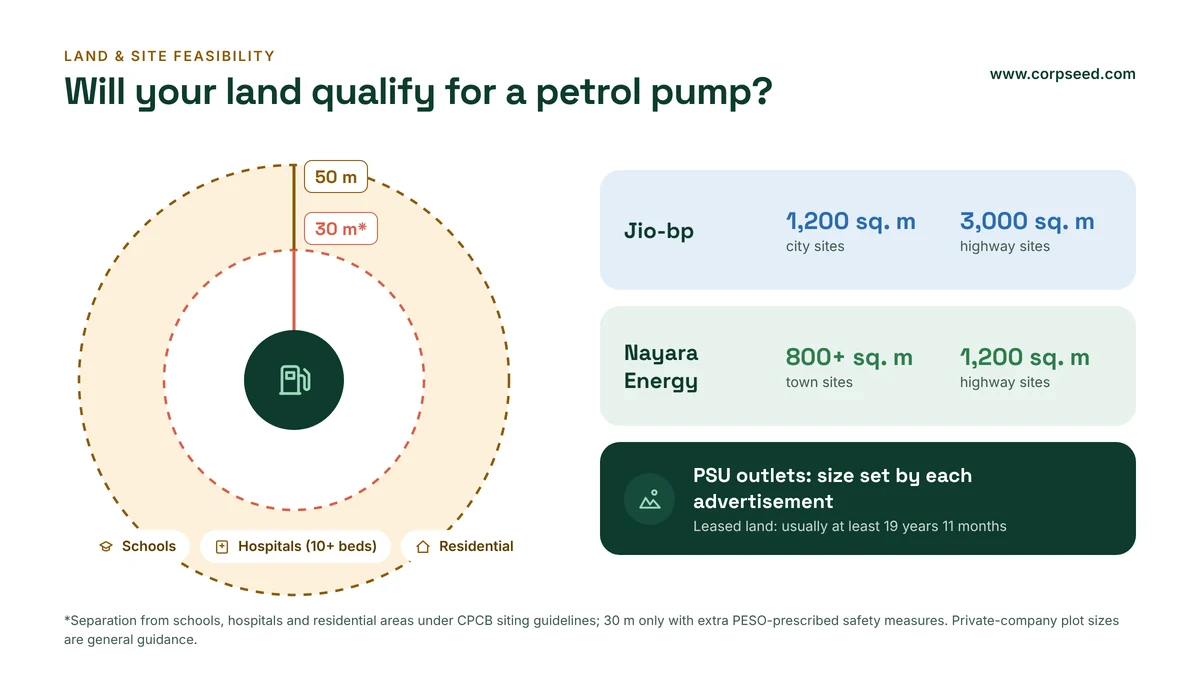
| Jio-bp outlet | Location-specific, its current partner guidance generally refers to 1,200 sq. m for city sites and 3,000 sq. m for highway sites |
| Nayara Energy outlet | Company guidance generally refers to more than 800 sq. m in towns and 1,200 sq. m on highways |
| Shell outlet | Based on the company's evaluation and dealership model |
Company brochures may contain different plot sizes for different outlet formats. Applicants should rely on the requirements applicable to the specific site being considered.
Can You Open a Petrol Pump on Leased Land?
Yes. Leased land is accepted under dealership models that permit it.
For PSU dealerships, the June 2023 brochure generally requires a lease of at least 19 years and 11 months, subject to the advertised conditions.
Private companies may require different lease arrangements. For example, Nayara Energy's dealership guidance refers to a 30-year land lease arrangement.
Land Ownership, Conversion and Road Access Requirements
Before applying for a petrol pump dealership, applicants should check:
- Land ownership and registered title documents
- Existing mortgages, disputes or encumbrances
- Lease period and permitted land use
- Agricultural land conversion requirements
- Plot frontage and depth
- Road access and entry/exit arrangements
- Highway access permission, where applicable
- Environmental and petroleum safety restrictions
A land title or registered lease does not guarantee that the site will qualify for a petrol pump.
How to Check Whether Land Is Suitable for a Petrol Pump?
A petrol pump site feasibility assessment should examine the land records, plot dimensions, traffic movement, nearby establishments, road access and construction requirements.
Applicants must also consider CPCB siting guidelines. The guidelines generally prescribe a 50-metre separation from schools, hospitals with 10 or more beds and residential areas designated under local law.
Where the prescribed conditions permit, the distance may be reduced to 30 metres with additional PESO-prescribed safety measures. The distance is assessed from the nearest relevant emission source, such as the fill point, dispensing unit or vent pipe.
A proposal should not assume that the relaxation will be granted automatically.
Applicants can seek land verification services to review relevant ownership and documentation issues before making major commitments.
Can You Apply for a Petrol Pump Dealership Without Land?
Certain PSU selection provisions allow eligible SC/ST applicants to participate in specified Group 3 circumstances without offering land initially.
Other applicants generally need to satisfy the land requirements prescribed for their selection group.
Private companies may consider proposed purchase or lease arrangements, depending on their policies.
Have land for a petrol pump? Contact Corpseed to discuss a preliminary land documentation review.
Profit & Commission
The profitability of a petrol pump depends on fuel sales, applicable dealer commission and operating expenses. A petrol pump with high daily sales may generate more revenue, but the amount remaining as profit depends on salaries, electricity, maintenance and other business costs.
How Much Commission Does a Petrol Pump Dealer Earn Per Litre?
Petrol pump dealers receive commission on petrol and diesel sales under the applicable oil marketing company arrangements. The commission structure may change over time, depending on prevailing rates and applicable adjustments.
For example, if a dealer receives an assumed commission of 3 rupees per litre of petrol sold, selling 1 litre would generate 3 rupees in gross commission. Selling 1,000 litres at the same assumed rate would generate 3,000 rupees before deducting operating expenses and other applicable recoveries.
| Petrol sold | Assumed commission | Gross commission earned |
| 1 litre | 3 rupees per litre | 3 rupees |
| 100 litres | 3 rupees per litre | 300 rupees |
| 1,000 litres | 3 rupees per litre | 3,000 rupees |
| 10,000 litres | 3 rupees per litre | 30,000 rupees |
This is only an example to explain how dealer commission works. The actual commission is calculated under the prevailing arrangement and should be confirmed with the oil marketing company or the Petroleum Planning & Analysis Cell (PPAC).
How Much Does a Petrol Pump Owner Earn Per Month?
There is no fixed monthly income for a petrol pump owner in India. Earnings depend on daily fuel sales, the applicable commission and the expenses required to operate the outlet.
The main factors affecting monthly income include:
- Daily petrol and diesel sales
- Applicable dealer commission
- Location and customer traffic
- Staff salaries and electricity bills
- Rent, maintenance and financing expenses
- Income from other permitted business activities
Gross commission is not the dealer's net profit. Operating expenses and applicable adjustments must be considered when calculating actual earnings.
Indian Oil Petrol Pump Profit Margin and Dealer Commission
IndianOil petrol pump dealers earn commission according to the prevailing dealership arrangements. The total commission depends on fuel sales and the applicable commission calculation.
There is no fixed profit-margin percentage for every IndianOil dealership. Two outlets operating under the same company may earn different profits because of differences in sales volume and operating expenses.
How to Calculate Monthly Petrol Pump Earnings
Petrol pump owners can estimate their earnings by calculating the gross commission from fuel sales and deducting their operating expenses.
| Component | Calculation method |
| Petrol commission | Petrol sold × applicable commission |
| Diesel commission | Diesel sold × applicable commission |
| Gross dealer commission | Petrol commission + diesel commission |
| Operating expenses | Salaries + electricity + rent + maintenance + other costs |
| Estimated operating surplus | Gross commission − operating expenses |
| Other permitted income | Earnings from additional business activities, where applicable |
The calculation provides an estimate, not a guaranteed monthly profit. Actual earnings can also be affected by commission adjustments, financing costs, depreciation and taxes.
Is Opening a Petrol Pump Profitable in India?
A petrol pump can be profitable when fuel sales and other permitted earnings are sufficient to cover operating expenses and provide a return on investment.
Before applying for a dealership, applicants should consider traffic movement, expected fuel demand, nearby competitors, investment requirements and monthly expenses.
A project-specific financial estimate provides a more realistic picture of petrol pump profitability than relying on a fixed commission or monthly income figure.
Documents Required for Petrol Pump Setup
The documents needed for a petrol pump dealership depend on the applicant category and the stage of the project.
Initial dealership applications, field verification and PESO licensing have different documentation requirements.
Documents Required for Dealership Application
Applicants must provide the prescribed application information, declarations and supporting details.
For PSU dealerships, the portal specifies the documents and information required at the application stage.
Additional records are requested during the subsequent selection and verification stages.
Personal and Eligibility Documents
Depending on the applicant category, the following may be required:
- PAN and identity proof
- Age and educational qualification certificates
- Residence information
- Reserved-category certificate, where applicable
- Prescribed affidavits and declarations
- Financial documents, where required
- Company or partnership records, where applicable
Land Ownership and Lease Documents
Relevant land documents may include:
- Registered sale deed, gift deed or lease deed
- Revenue records such as Khasra and Khatauni
- Site plan showing dimensions and boundaries
- Supporting ownership or lease documents
- Applicable land conversion records
- Other declarations requested during land evaluation
Technical Documents for PESO Licensing and Other Approvals
The technical and regulatory stage may require:
- Prescribed application forms
- Site layout and technical drawings
- Land possession documents
- Oil company Letter of Intent
- District Authority NOC
- Relevant safety and installation records
- Inspection and testing certificates
- Applicable fees and declarations
Stage-Wise Document Checklist
| Stage | Main documents |
| Dealership application | Application details, declarations and prescribed identification records |
| Field verification | Eligibility, category and land supporting documents |
| Land approvals | Title/lease documents, site drawings and land-use records |
| PESO licensing | Form IX, drawings, NOC and prescribed technical documents |
| Commissioning | Installation, inspection and equipment verification records |
Applicants should follow the specific checklist issued by the oil marketing company or licensing authority.
How to Start a Petrol Pump in India: Step-by-Step Process
Opening a petrol pump involves dealership selection, documentation, government approvals, construction and final commissioning.
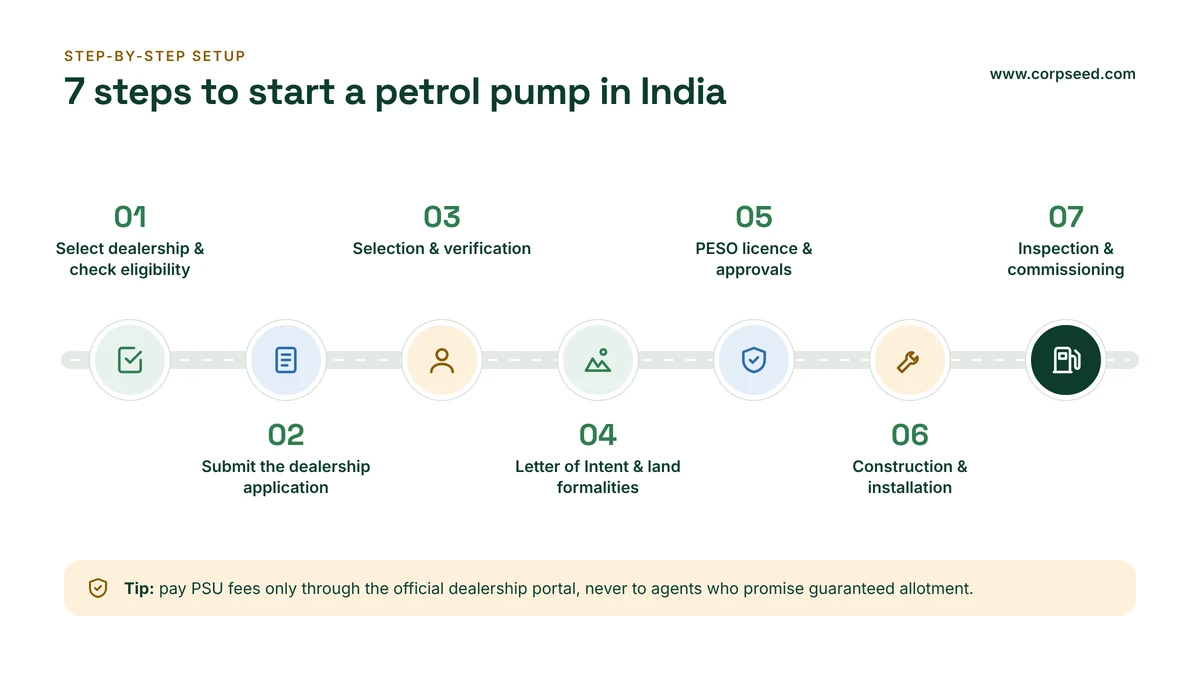
Step 1: Select a Petrol Pump Dealership and Check Eligibility
Choose between PSU and private dealership opportunities. Review the oil company's eligibility conditions, available locations, land requirements and investment obligations.
Step 2: Submit the Dealership Application
For IOCL, BPCL and HPCL, applicants must apply for advertised locations through the official Petrol Pump Dealer Chayan portal. Private oil companies follow separate application procedures. Applicants can also read Corpseed's guide on how to start a petrol pump in India.
Step 3: Complete the Selection and Verification Process
PSU dealerships are selected through the applicable draw-of-lots or bidding process. Provisionally selected applicants must provide the prescribed documents and initial security deposit within the required deadlines.
Step 4: Obtain the Letter of Intent and Complete Land Formalities
After successful verification, the oil marketing company may issue a Letter of Intent (LOI). Applicants must then fulfil the specified land and development conditions.
Step 5: Obtain Licences and Government Approvals
Prepare the prescribed drawings and apply for PESO and other relevant statutory permissions. Pre-construction approvals must be obtained before the work to which they relate begins. Final licences and verification may follow completion of the installation.
Step 6: Complete Petrol Pump Construction and Installation
Develop the outlet according to the approved layout and company specifications. The relevant contractors must install the required infrastructure and safety equipment.
Step 7: Complete Inspections and Commissioning
After construction, complete the necessary testing, documentation, licensing and equipment verification. The oil company must also complete its appointment and operational requirements before commercial fuel sales begin.
Licences and Approvals Required for Petrol Pump Setup
Petrol pump licensing in India is governed primarily by the Petroleum Act, 1934, the Petroleum Rules, 2002, and other applicable laws.
The required approvals depend on the location, land use, outlet design and additional business activities.
PESO Licence for Petrol Pump (Form XIV)
A petrol pump generally requires a petroleum retail storage and dispensing licence in Form XIV under the Petroleum Rules, 2002.
The licence is issued through the Petroleum and Explosives Safety Organisation (PESO), subject to the applicable requirements.
Corpseed offers PESO licence assistance for documentation and regulatory application requirements.
PESO Prior Approval and Licence Application Procedure
The PESO licensing process includes separate stages for prior approval and grant of licence.
The application for the relevant petroleum licence uses Form IX, while Form XIV is the licence issued for the applicable retail outlet.
The principal stages include:
- Preparing the proposed site layout and technical drawings.
- Applying for the necessary prior approval.
- Obtaining the applicable District Authority NOC.
- Completing the approved installation.
- Preparing the final Form IX application and supporting documents.
- Completing the required licensing checks and obtaining Form XIV.
The exact order of documentary submissions and inspections must follow PESO's applicable procedure.
District Authority No Objection Certificate
The District Authority NOC is required under Rule 144 of the Petroleum Rules, 2002 for the relevant licensing process.
The competent authority examines the proposed site and relevant local considerations before deciding whether to issue the NOC.
Land Use Conversion and Building Plan Approval
Agricultural land may require conversion to an approved non-agricultural use before petrol pump construction.
Building plans may also need approval from the applicable municipal, development or planning authority.
Pollution Control Board Permissions and Environmental Requirements
Petrol pumps must meet the applicable environmental requirements for fuel handling, vapour emissions, leakage prevention and drainage.
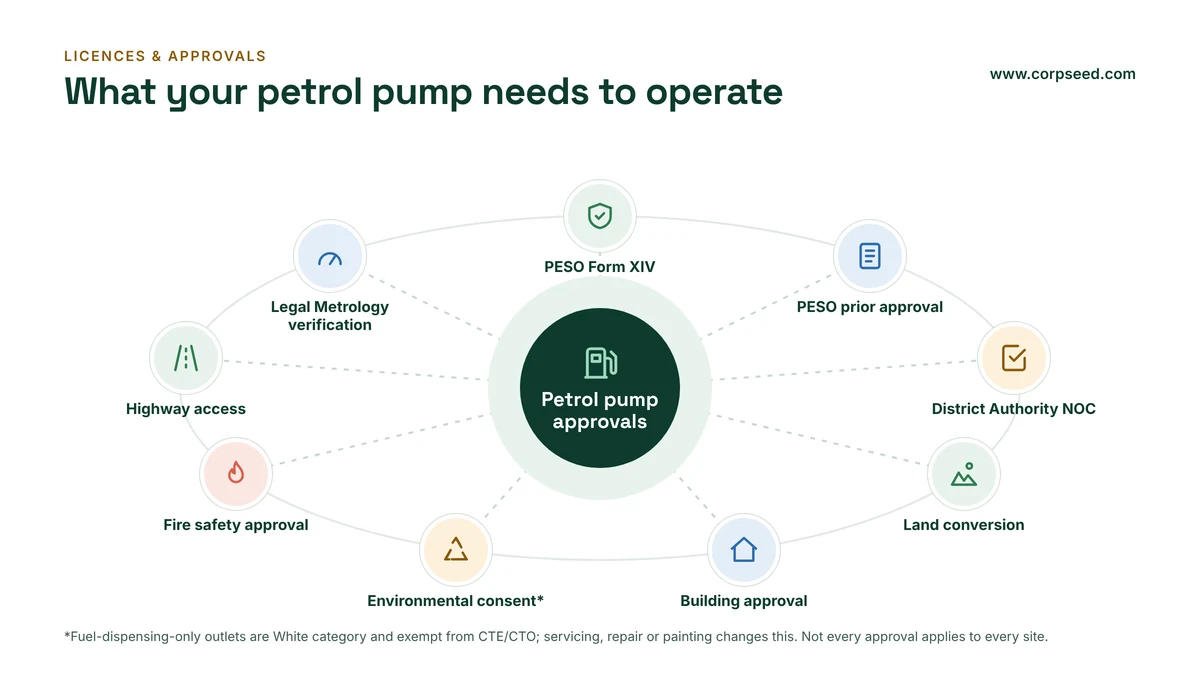
Important 2026 clarification: Fuel-dispensing units without automobile servicing, repairing or painting are classified under the White category and are exempt from Consent to Establish (CTE) and Consent to Operate (CTO) under the relevant environmental consent framework.
Outlets proposing additional activities must have their classification and other environmental obligations assessed separately.
Where pollution board permissions are required for the proposed activities, Corpseed provides assistance with applicable State Pollution Control Board consent.
Fire Safety NOC and Other Safety Requirements
Petrol pump installations must comply with the relevant petroleum and fire protection standards.
A separate fire department approval may be required under applicable state or local conditions. Corpseed provides Fire Safety NOC assistance where such approval is necessary.
NHAI or State Road Access Permission
Petrol pumps proposed along national or state highways may require access approval from NHAI or the relevant road authority.
The access design may involve service roads, entry and exit points and other traffic safety requirements.
Legal Metrology Verification of Fuel Dispensers
Petrol and diesel dispensers must undergo the applicable verification and stamping before use.
The verification process is handled by the competent Legal Metrology authority or authorised verification body, as permitted under the applicable rules.
Other Applicable Business Registrations
Other registrations may be required depending on the outlet's business activities.
Petrol and diesel are outside the present GST levy, but the sale of lubricants, convenience-store products or other taxable services can create GST registration obligations, subject to applicable law.
Petrol Pump Licensing and Approval Checklist
| Licence or approval | Responsible authority | Purpose |
| PESO Form XIV | PESO | Petroleum storage and retail dispensing |
| PESO prior approval | PESO | Approval of prescribed plans and arrangements |
| District Authority NOC | Competent District Authority | NOC for proposed petroleum premises |
| Land conversion | State authority | Land-use permission, where required |
| Building approval | Local planning authority | Construction-related permissions |
| Environmental consent | SPCB/PCC | Where applicable to the activity |
| Fire safety approval | Competent fire authority | Where separately required |
| Highway access | NHAI/PWD/road authority | Applicable road access permission |
| Legal Metrology verification | Competent authority or authorised body | Verification of dispensing equipment |
Petrol Pump Installation and Infrastructure Requirements
Petrol pump installation includes preparing the site and installing the infrastructure required for fuel storage, dispensing and safe operation.
The equipment and design must meet the oil company's specifications and applicable petroleum safety rules.
What Is Included in Petrol Pump Installation Cost?
Petrol pump installation cost depends on the size of the outlet, storage capacity, number of fuel dispensers and the construction work required. The cost also changes according to the responsibilities assigned to the dealer and the oil marketing company.
The major installation expenses may include:
- Civil construction: Forecourt paving, office space, canopy, boundary walls, utilities and drainage.
- Underground fuel storage: Tanks and related infrastructure, where dealer-funded.
- Fuel dispensing equipment: Petrol and diesel dispensers, pipelines and associated systems.
- Electrical and automation systems: Wiring, monitoring equipment, backup power and operating systems.
- Safety arrangements: Fire protection equipment, emergency controls and environmental safeguards.
- Testing and inspections: Applicable technical documentation and equipment verification.
For PSU dealer-owned sites, the dealer generally develops the land and superstructure, while the oil marketing company supplies specified core fuel equipment.
The private dealerships have to adhere to the responsibilities outlined in their contracts. The applicants need to find out about the installation charges before making a budget for the project.
The estimate for the installation of the petrol pumps should not cover the equipment charges that are covered by the total installation charges.
| Installation element | Who may pay | Applicant check |
| Forecourt and civil works | Dealer or OMC, depending on site model | Confirm extent in approved development plan |
| Underground tanks and dispensers | OMC may supply specified core equipment at PSU B/DC sites | Check equipment schedule and ownership |
| Electrical and automation | Depends on the dealer agreement | Confirm supply, commissioning and maintenance |
| Fire protection and drainage | As allocated in the site scope | Check approved safety and environmental design |
Petrol Pump Site Development and Civil Construction
Site development may include land levelling, boundary walls, entry and exit roads, forecourt paving, sales office, toilets, utilities and drainage.
Additional access arrangements may be required for highway locations.
Underground Fuel Storage Tank Installation
Underground tanks are used to store authorised petroleum products.
Tank capacity, placement, construction and protective arrangements must comply with the approved design and applicable safety requirements.
Petrol and Diesel Dispensing Equipment
Dispensers deliver measured quantities of fuel to vehicles.
The number of dispensers and dispensing positions depends on the outlet layout and proposed sales requirements.
Fuel Pipelines, Automation and Electrical Systems
Pipelines connect storage tanks and dispensing equipment.
Electrical systems, monitoring equipment and automation help manage fuel stock, transactions and operating conditions.
Fire Protection and Environmental Safety Systems
A petrol pump must have the fire protection and emergency arrangements required under the applicable standards.
Suitable drainage, spill prevention and fuel containment systems must also be provided.
Testing, Inspection and Commissioning Readiness
Before the outlet begins operating, the applicable equipment testing, safety checks and Legal Metrology verification must be completed.
Main Petrol Pump Infrastructure
| Infrastructure | Function |
| Underground storage tanks | Store authorised petroleum products |
| Fuel dispensers | Measure and deliver petrol or diesel |
| Pipelines and valves | Transfer fuel within the outlet |
| Electrical and automation systems | Support power, monitoring and transactions |
| Fire protection systems | Support emergency response |
| Drainage and containment systems | Reduce spill and contamination risks |
| Customer facilities | Provide the amenities required by the outlet design |
Equipment responsibility and petrol pump installation cost depend on the dealership agreement.
Petrol Pump Licence Cost in India
The cost of a petrol pump licence in India will depend on the fees according to PESO, the necessary permissions, and the necessary documentation for the planned petrol pump.
Applicants should distinguish the statutory licensing expenses from dealership fees and construction costs.
The PESO application for a petroleum retail outlet is made through the prescribed Form IX procedure, while the relevant storage and dispensing licence is issued in Form XIV.
It is advisable for the applicants to go through the fee structure at the time of payment from the official PESO portal.
Corpseed helps with petrol pump licensing, which includes the PESO application, among others, based on the scope of the service provided.
| Cost item | Type | What to verify |
| PESO licence fee | Prescribed statutory charge | Verify the current PESO fee for the proposed licence |
| District Authority NOC | Local procedural charge, if applicable | Check requirements with the competent authority |
| Technical drawings | Preparation and professional work | Confirm the scope and quotation |
| Land, building and road permissions | Site-dependent statutory charges | Check which approvals are applicable |
| Consultancy charges | Professional services, if engaged | Confirm separately from government fees |
Applicants comparing petrol pump licence cost in India should distinguish PESO statutory fees, other applicable government charges and any professional fees for petrol pump licensing services.
Petrol Pump Setup Timeline and Processing Time
The time required to establish a petrol pump depends on dealership availability, verification, land approvals, construction and commissioning.
There is no single nationwide timeline that applies to every petrol pump project.
Dealership Application and Selection Timeline
Public-sector applications depend on the advertisement and selection schedule.
Private brands assess applications according to their own procedures.
Land Verification and Regulatory Approval Timeline
Land title verification, layout preparation, road access permissions and statutory applications can take different amounts of time depending on the project and the authority involved.
Construction, Installation and Commissioning Timeline
Construction and installation begin after the relevant prior permissions are obtained.
Final licensing, equipment verification and commissioning follow the completion of the necessary work.
Factors That Can Delay Petrol Pump Setup
| Stage | Common cause of delay |
| Dealership application | No suitable advertised location |
| Applicant verification | Missing or incorrect documents |
| Land assessment | Title, dimensions or road access problems |
| Government approvals | Incomplete drawings or authority queries |
| Construction | Contractor, equipment or utility delays |
| Commissioning | Outstanding inspections or licensing requirements |
Applicants should prepare a project-specific schedule and track all official submission deadlines.
Ongoing Compliance
Compliance responsibilities continue after the petrol pump starts selling fuel.
Operators must follow their licence conditions, applicable petroleum safety standards, measurement requirements and environmental obligations.
PESO Licence Renewal and Amendments
The licence holder must monitor the validity of the PESO licence and apply for renewal when required.
Changes to the approved storage arrangements, layout or other licensed particulars may require prior approval or amendment.
Environmental Compliance and Operational Safety
Fuel handling, drainage, spill prevention and environmental safeguards must be maintained according to the applicable requirements.
The White-category consent exemption does not remove the obligation to follow relevant environmental and safety standards.
Fuel Dispenser Verification and Maintenance
Dispensing equipment must remain accurate and undergo the prescribed verification or re-verification.
Fire Safety Inspections and Staff Training
Fire protection equipment must be maintained in working condition. Staff should understand fuel handling, emergency response and the outlet's safety procedures.
Recordkeeping and Other Applicable Business Compliance
Operators should maintain applicable licence records, equipment documentation, inspection reports and other records required by the oil company or competent authorities.
Corpseed may assist with applicable renewal, amendment and regulatory documentation requirements.
Common Reasons for Petrol Pump Application Rejection or Delays
Applications may face rejection or delay because of eligibility problems, unsuitable land, incorrect declarations or incomplete licensing documentation.
Incorrect Eligibility or Application Details
Incorrect information relating to age, qualifications, category or dealership interests can result in disqualification.
Land Ownership, Size and Access Issues
A plot may fail evaluation because it does not meet the advertised dimensions, lacks suitable access or has unresolved ownership issues.
Incomplete Documents or Missed Deadlines
Failure to submit the prescribed records or deposit within the required time can lead to cancellation of provisional selection.
Delays in Government Licences and NOCs
Incomplete drawings, land document problems and regulatory objections may delay the relevant applications.
Construction and Safety Non-Compliance
Construction that does not follow the approved layout may require correction before licensing or commissioning.
Fraudulent Dealership Offers and Unauthorised Agents
Applicants should not pay unauthorised intermediaries who promise guaranteed dealership allotment.
For PSU applications, official fees and initial security deposit payments must be made through the authorised dealership portal.
Common Problems and Preventive Actions
| Common problem | Possible consequence | Preventive action |
| Incorrect eligibility declaration | Disqualification | Check applicant conditions before applying |
| Unsuitable land dimensions | Land rejection | Compare the plot with the advertisement |
| Ownership or lease dispute | Application delay | Review land records |
| Missing documents | Verification delay | Prepare a stage-wise checklist |
| Incomplete licence application | Regulatory queries | Check forms and technical documents |
| Unapproved construction | Corrective work | Follow the approved design |
| Payment to unauthorised agents | Financial loss | Use official application and payment channels |
How Can Corpseed Help with Petrol Pump Setup in India?
Setting up a petrol pump involves applications, land records, technical documents and approvals from different authorities.
Corpseed provides regulatory assistance for applicants who need help with documentation, petroleum licensing and other applicable compliance requirements.
An applicant looking for a petrol pump setup consultant can compare services such as land documentation review, PESO licence assistance and licensing coordination. The work covered by petrol pump setup consultancy in India should be agreed before starting the engagement.
Land Verification and Petrol Pump Feasibility Assessment
Corpseed can assist with reviewing land-related records and identifying documentation issues relevant to a proposed petrol pump site.
The scope of any detailed technical or commercial feasibility assessment should be confirmed for the particular project.
Dealership Application and Documentation Assistance
Support may include checking the documentation requirements, preparing relevant records and helping applicants understand the application conditions.
Dealership allotment remains the responsibility of the oil marketing company.
PESO Licensing and Government Approval Coordination
Corpseed provides petroleum licensing assistance, including relevant documentation and regulatory application support.
Other applicable approvals may also be included in the engagement, depending on the project requirements.
Petrol Pump Installation and Inspection Support
Where agreed, support may include regulatory documentation and coordination concerning installation approvals and inspection readiness.
Construction and technical installation work must be undertaken by appropriately qualified or authorised contractors.
Commissioning and Post-Setup Compliance Assistance
After installation, applicants may need support with outstanding licensing requirements, amendments and continuing compliance documentation.
Why Choose Corpseed for Petrol Pump Setup Services?
Corpseed's petrol pump setup consultancy focuses on the regulatory and documentation requirements involved in establishing a fuel retail outlet.
Our services may include:
- Reviewing the applicant's project requirements
- Identifying applicable government approvals
- Preparing required regulatory documents
- Supporting application submission and follow-up
- Coordinating documentation queries
- Assisting with applicable licensing amendments and renewals
The scope of assistance and professional fees depend on the services agreed for the project.
Corpseed does not control dealership allotment or government approval decisions.
Planning to Open a Petrol Pump? Get Expert Assistance from Corpseed.
Share your proposed location, land details and dealership requirements with our team to discuss the licensing and compliance support needed for your project.
Connect With Corpseed
Connect with the Corpseed team to discuss your requirements at IVR: 7558640644 or hello@corpseed.com. It takes 20–25 minutes to discuss the requirement.
Dedicated Manager
Once you discuss the requirement, we will align a dedicated Account Manager to understand your business needs and assist throughout the process.
Real Time Update
Track the progress of your application and always know what’s in progress and what’s done.
Job Completed
Once the job is completed, you will receive registrations & certifications directly to your email ID and at your doorstep.
Frequently Asked Questions
Quick answers to common questions about this service.
Is opening a petrol pump profitable in India?
A petrol pump can make profits if the sale of petrol and diesel is sufficient to pay salaries, electricity bills and other expenses. The actual profit will be based on the volume of sales, dealer commission and operating costs and not on a uniform profit margin across the country.
What is the average monthly income of a petrol pump owner?
There is no fixed monthly income for petrol pump owners in India. The income will be based on the volume of sales of petrol and diesel, the dealer commission, location and operating costs.
How much profit does a petrol pump owner make per litre?
The dealers are paid commission on the sale of petrol and diesel, but the commission earned is not equal to the net profit. The petrol and diesel commission rates will be as per the dealer commission rate structure.
What is the difference between a petrol pump franchise and dealership?
A petrol pump dealership is a contract made with an oil marketing company for running a fuel retail shop. Franchise is another name often used for such business deals, however, the real deal and investments depend on the contract of the oil company.
What is the minimum investment to open a petrol pump?
There is no specific minimum investment requirement for all petrol pumps. Petrol pump dealers have to consider dealership fees, security deposit, land, construction, and working capital. It depends on the location, dealership level, and obligations mentioned in the contract.
Is the petrol pump setup cost inclusive of land and construction?
No. Petrol pump dealership fees and investment requirements that have been published may not include land purchase or lease, construction, or working capital.
How much does a petrol pump licence cost in India?
The cost of obtaining the licence will depend on the applicable PESO fee and other permissions required for the outlet. Fees charged by the government, technical documentation costs and professional consultation fees need to be evaluated separately from the dealership fees and cost of construction.
What is the petrol pump setup cost in rural areas?
PSU Dealerships in rural areas tend to have lower fees both in terms of application and fixed fees as compared to normal outlets. As per the June 2023 Brochure, the open category rural dealer-owned outlet has an application fee of 8,000 rupees, a fixed fee of 5 lakh rupees and a prescribed refundable security deposit of 4 lakh rupees. Cost of construction and operations is additional.
Can I start a petrol pump without owning land?
Possibly, provided the leased land fulfills the requirements of the oil company. There are some provisions of PSU selection under which one can apply without offering any land initially.
How can I apply for an IOCL, BPCL or HPCL petrol pump dealership?
They can apply via the official Petrol Pump Dealer Chayan website if suitable sites are advertised. They should verify their eligibility, choose the site advertised, fill the application form and pay the fees prescribed via the authorized channel.
What documents are needed to open a petrol pump?
The documents required to be submitted include ID proof, PAN card, educational qualifications, declaration and proof of land ownership/lease. Documents like technical drawings and an NOC from the District Authority may be needed in case of petroleum licensing and installation.
How can Corpseed help with petrol pump licensing and setup?
Corpseed helps with land documentation, the application for a PESO license and other regulatory requirements. They can provide support for licensing activities or compliance coordination according to the services agreed upon for the project.
Need help?
Talk to an Expert
Get free guidance on the right service, improved documents & timeline.






















