
Form NDH-4 Compliance
NDH-4 compliance is not just a formality for Nidhi companies. It decides whether a company can legally continue operations, accept deposits from members, and function without regulatory interruptions under the Companies Act framework.
Schedule a Call Back
Why wait? Start now!
Get Support AnytimeLast updated:
What is NDH-4 Compliance under the Companies Act?
NDH-4 compliance refers to the mandatory filing required by certain Nidhi companies to obtain approval from the Central Government for continuation as a Nidhi. It is governed by Rule 3A of the Nidhi Rules, 2014, read with the Companies Act, 2013. This requirement applies when a company registered as a Nidhi is unable to meet the mandatory conditions within the given time. In such cases, the company must apply for permission to continue as a Nidhi.
By filing NDH-4, the company requests approval to operate even though requirements like minimum members, net owned funds, or deposit limits are not yet fulfilled. It is a continuation request, not a routine filing. The application allows the authorities to check the company’s financial position, how it is managed, and its member records. Until approval is received, the company must stop accepting deposits and cannot expand its activities.
NDH-4 compliance ensures that only genuine Nidhi companies continue operating. It protects members’ money and prevents misuse of the Nidhi structure.
Failure to file or rejection of NDH-4 may result in loss of Nidhi status, penalties, and restrictions on operations. Therefore, timely and accurate compliance plays a critical role in the legal survival of a Nidhi company.
Applicability of NDH-4 to Nidhi Companies
NDH-4 is required when a Nidhi company does not meet the required conditions within the given time after registration. In such cases, the company must seek approval to continue operating as a Nidhi. The following are the applicability:
- Newly Incorporated Nidhi Companies: Companies incorporated as Nidhi that fail to meet membership, capital, or deposit conditions within one year must apply for approval through NDH-4 to continue operations legally.
- Declared Nidhi Companies: Companies declared as Nidhi under earlier provisions but not complying with revised Nidhi Rules are required to file NDH-4 for continuation approval.
- Non-Compliant Membership Structure: Nidhi companies unable to achieve the minimum required number of members within the stipulated timeline fall under NDH-4 applicability.
- Capital and Fund Deficiency: Entities failing to maintain minimum net owned funds or required deposit ratios must seek approval through NDH-4.
- Operational Continuation Requests: Any Nidhi company seeking permission to continue despite temporary non-compliance must file NDH-4 before the deadline.
Purpose of Filing NDH-4 with MCA
The main purpose of getting NDH-4 compliance is to regulate continuation of Nidhi companies while safeguarding members and ensuring financial discipline. It enables authorities to review genuine cases of non-compliance.
- Regulatory Approval for Continuation: NDH-4 enables companies to seek official approval to continue Nidhi operations despite not meeting mandatory thresholds within the prescribed timeframe.
- Protection of Member Interests: The filing makes sure that companies without enough funds or proper controls are not allowed to keep members’ money.
- Compliance Assessment: Before giving approval, the authorities check the company’s capital, deposits, internal control, and member records.
- Prevention of Misuse: NDH-4 helps prevent misuse of the Nidhi structure by filtering out entities operating without adequate financial or operational capacity.
Requirements before Filing for NDH-4 Compliance
Before applying for NDH-4 compliance, a Nidhi company must meet certain basic conditions or clearly fall within the permitted compliance framework. The following are the key requirements distilled from the applicable rules:
- A Nidhi company should have at least 200 members and a Net Owned Fund of INR 20 lakh, or fall within the allowed time to meet this requirement.
- The promoters and directors must qualify as fit and proper persons under the Nidhi Rules, with no disqualifications.
- A Nidhi company cannot start business activities until Form NDH-4 is approved and Form 20A is filed after approval.
- The government must respond to an NDH-4 application within 45 days, if there is no response, the approval is treated as granted.
- New Nidhi companies must meet the NOF requirement within 120 days of incorporation, while existing companies were given up to 18 months.
- A Nidhi cannot borrow from banks or financial institutions for lending, and members cannot transfer more than fifty percent shareholding during active loans or deposits.
Capital and Membership Requirements under Form NDH-4
Capital and membership requirements form the core evaluation parameters during Form NDH-4 scrutiny. Authorities closely examine whether deficiencies are temporary and rectifiable.
- Minimum Net Owned Funds: The Company must show that it is working toward the minimum required net owned funds. This should be backed by financial statements and clear plans for adding capital if required.
- Membership Threshold: The Company should be actively working to get the minimum number of members, and all new members must be properly recorded in the registers.
- Deposit to Fund Ratio: Deposits taken by the company should match its available funds, so that members’ money is always safe and not higher than what the company can manage.
- Controlled Deposit Acceptance: The Company should not accept any new deposits from members until it receives approval for NDH-4.
Documents Required for Form NDH-4 Filing
To get NDH-4 approval, having appropriate and valid documents is crucial, as authorities depend on documentary evidence to examine the compliance intent and financial credibility. Some of the necessary documents include:
- Certified copy of Board Resolution approving Form NDH-4 filing
- Audited financial statements
- List of members with complete details
- Net owned funds calculation statement
- Declaration of non-acceptance of deposits
- Affidavit by directors confirming compliance efforts
- Supporting documents for capital infusion, if any
Step-by-Step NDH-4 Filing Process
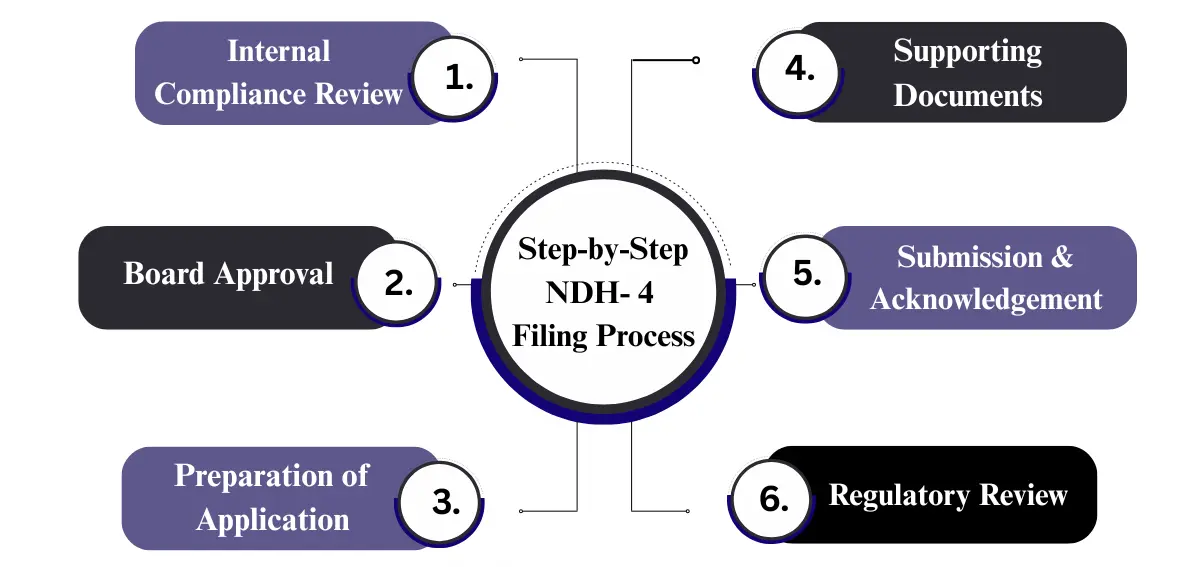
Filing NDH-4 is a step-by-step process. The company needs to be accurate, get internal approvals, and provide correct financial details to avoid delays or rejection.
- Internal Compliance Review: The Company first checks where it hasn’t met the rules and notes what needs fixing. They plan corrective actions to meet Nidhi requirements.
- Board Approval: A formal board meeting is conducted to approve NDH-4 filing and authorize a director to submit the application on behalf of the company.
- Preparation of Application: The Form NDH-4 application is prepared with accurate financial data, membership details, and declarations supported by audited records.
- Attachment of Supporting Documents: All required documents, like financial statements, declarations, and affidavits, are gathered and attached to show the company is serious about compliance.
- Submission and Acknowledgement: The application is submitted online, and the company gets an acknowledgement. This helps track the application and know that it’s officially received.
- Regulatory Review: Authorities go through the application carefully. They may ask for extra documents or clarifications before approving or rejecting the request.
NDH-4 Approval Status and Post-Approval Obligations
Once NDH-4 is approved, the company can operate as a Nidhi but must follow all rules and complete any pending compliance within the specified timeline. Failure to do so can lead to penalties or cancellation of Nidhi status. The company should keep track of its capital, membership, and deposit ratios, maintain proper books, conduct audits, and file returns on time.
Approval for NDH-4 is temporary and conditional. The company must keep all transactions limited to members and maintain clear communication with both members and regulators to build trust and stay compliant.
Timeline and Due Date for Form NDH-4 Submission
NDH-4 should be filed as soon as the company misses the required Nidhi rules. For new companies, this usually happens one year after incorporation. Filing late can cause restrictions on operations. Submitting on time keeps the process smooth and avoids penalties, and authorities see timely filing as a sign that the company is serious about compliance.
What is the Government Fees for NDH-4 Filing?
The government fee for NDH-4 filing is prescribed under the Companies (Registration Offices and Fees) Rules. The fee varies based on the company’s authorised share capital. No additional stamp duty applies to NDH-4. The applicable fee must be paid at the time of submission, and incorrect payment may result in rejection or resubmission.
Common Reasons for NDH-4 Rejection or Resubmission
NDH-4 applications are often rejected or sent back due to avoidable compliance errors. Most issues arise from incorrect disclosures, missing documents, or non-adherence to Nidhi Rules at the time of filing. The following are the key reasons:
- Incorrect calculation of net owned funds as per the prescribed Nidhi Rules
- Membership details not matching statutory registers and supporting records
- Submission of incomplete, outdated, or unaudited financial statements
- Evidence of deposit acceptance during the non-compliance period
- Missing affidavits, declarations, or board authorisations
Consequences of Non-Compliance with NDH-4
Failure to comply with NDH-4 requirements can seriously impact a Nidhi company’s legal standing. Non-compliance restricts operations, attracts penalties, and may ultimately lead to loss of Nidhi status. The following are the key consequences:
- Restriction on accepting deposits from existing or new members
- Loss of permission to operate as a recognised Nidhi company
- Monetary penalties imposed on the company and the defaulting directors
- Increased regulatory scrutiny and compliance inspections
- Risk of cancellation of registration or compulsory winding up
Why Corpseed?
Corpseed is a leading consulting firm that supports Nidhi companies with regulatory approvals, filings, and ongoing compliance under the Companies Act. We focus on clarity, accuracy, and practical execution so your business continues without disruption.
- Deep Understanding of Nidhi Regulations: Our team works extensively with Nidhi Rules and NDH filings. We assess your exact non-compliance position and guide you on realistic, approval-focused solutions.
- Accurate Preparation and Filing: From financial disclosures to declarations, we prepare NDH-4 applications with complete accuracy, reducing the risk of rejection or repeated resubmissions.
- End-to-End Compliance Support: We manage the entire process, internal review, document preparation, application submission, and follow-ups, while keeping you informed at every stage.
- Focused on Approval, Not Just Filing: We do not believe in form-only compliance. Our approach is built around meeting regulatory expectations and securing continuation approval.
- Post-Approval Compliance Guidance: After NDH-4 approval, we help you meet pending requirements, track timelines, and maintain ongoing Nidhi compliance without future setbacks.
Connect With Corpseed
Connect with the Corpseed team to discuss your requirements at IVR: 7558640644 or hello@corpseed.com. It takes 20–25 minutes to discuss the requirement.
Dedicated Manager
Once you discuss the requirement, we will align a dedicated Account Manager to understand your business needs and assist throughout the process.
Real Time Update
Track the progress of your application and always know what’s in progress and what’s done.
Job Completed
Once the job is completed, you will receive registrations & certifications directly to your email ID and at your doorstep.
Frequently Asked Questions
Quick answers to common questions about this service.
What is NDH-4 filing?
NDH-4 is an application seeking government approval for a Nidhi company to continue operations despite temporary non-compliance.
Who needs to file NDH-4?
Nidhi companies that fail to meet membership or capital requirements within the prescribed timeline must file NDH-4.
Is NDH-4 mandatory for all Nidhi companies?
No, only non-compliant Nidhi companies are required to file NDH-4 for continuation approval.
Can a Nidhi accept deposits before NDH-4 approval?
No, accepting fresh deposits is prohibited until NDH-4 approval is granted.
What happens if NDH-4 is not filed on time?
The company may be stopped from operating normally and could also face penalties or loss of Nidhi status.
How long does NDH-4 approval take?
There is no fixed timeline. It depends on how accurate the documents are and whether clarifications are required.
Can NDH-4 be filed again if it is rejected?
Yes. After fixing the issues, the application can be filed again with correct details.
Are audited financial statements required for NDH-4?
Audited financial statements are required to reflect the company’s actual capital position and overall financial health.
Does NDH-4 approval allow permanent relaxation?
NDH-4 approval is not permanent and the company must complete all pending compliance within the allowed timeline.
Can directors be penalised for NDH-4 non-compliance?
Directors can be penalised if the company continues to default or submits incorrect or misleading information.
Need help?
Talk to an Expert
Get free guidance on the right service, improved documents & timeline.






















