
DGFT Restricted Import License for Gas, Industrial Gas & LPG
A DGFT Restricted Import License for Gas, Industrial Gas & LPG Import is required when the specific gas product falls under the restricted import category as per its applicable ITC(HS) classification and Foreign Trade Policy conditions. Importers must obtain the necessary authorization from the Directorate General of Foreign Trade (DGFT) before importing such products into India.
Schedule a Call Back
Why wait? Start now!
Get Support AnytimeBusinesses we've worked with on import-export and DGFT
Showing 1538 of 250+ clients served since 2018- Electronics and technology
- Advantech Industrial Computing India · Smiths Detection Systems · Areca Embedded Systems · Motorola Solutions India · Trinity Mobile APP Lab · +2 more
- Pharma and healthcare
- Motorica India · Glocal Healthcare Systems · Tablets (India)Limited
- Food and consumer goods
- Auroras TEA Company · Surabhi Aqua Minerals
- Logistics and trade
- Solankili Logistics Management · ATG Freight India
- Jewellery
- Janki Jewellers · Viindhya Bullion
- More clients
- Esskay Compuservices · Welgrow Technologies · Ample Technologies · Aprodite Infotech · Floroma Infinity · Moonlight Technology · NJ Power · Ample Digital · Augustdevices India · Automap Software and Technologies · SNS Metpro Industries · Webmeditech Healthcare · Anagh Traders · Meritech India · Zipped Solutions · Metanovo Health · Kapemai Lifestyle · Zexcorp Services · Agricapita Innotech · Meticulous Networks · Nexavarge · Arng · D13 Business Ventures · Datalux Systems India · +21 more
Overview of DGFT Restricted Import License for Gas Import
If your business wants to bring gas, industrial gas, or LPG into India, you cannot simply place an order and wait for it to arrive at the port. Before your shipment even leaves its country of origin, you need a DGFT Restricted Import License. Without this license, customs officers will not release your goods, no matter how much you paid for them or how urgently you need them.
Many business owners find this process confusing. There are several government departments involved, a long list of documents to gather, and rules that can feel like they are written in a different language. A single missing paper or a wrong product code can mean your shipment sits at the port for weeks, quietly costing you money every single day.
It is the type of issue that we solve daily. Corpseed assists businesses in obtaining DGFT licenses for gas imports, LPG imports, gas cylinder imports, industrial gas equipment imports, and medical gas equipment imports.
We have spent years working directly with DGFT applications, and in that time, we have built a dedicated team that understands exactly what the department expects. When you work with us, you get a consultant who is personally responsible for your file, documentation that is checked and rechecked before submission, and a process built to avoid common mistakes that cause delays.
- Many Licenses Approved across gas, chemical, and industrial import categories
- PAN India Service covering every state
- Expert DGFT Consultants who work on restricted goods import cases every day
- Fast Documentation with error checks built into every step
- End-to-End Compliance Support, from IEC registration to post-approval assistance
If paperwork is standing between your business and your next shipment, let's talk. Reach out through our contact form, message us on WhatsApp, give us a call, or book a free consultation, and we will walk you through exactly what your business needs.
What Is a DGFT Restricted Import License for Gas Import?
Gas, by its very nature, is a sensitive product to move across borders. Some gases are flammable or dangerous if handled incorrectly. Others are used in industries that governments like to keep a close eye on, such as chemicals, defence-adjacent manufacturing, or medical supply chains. Because of this, the Government of India has placed gas, industrial gas, and LPG under the "Restricted" category in its import policy. The license applies to several restricted gas products, gas cylinders, industrial gas equipment, LPG cylinders, cryogenic tanks, and speciality gas products covered under the DGFT import policy.
First of all, it needs to be noted that "restricted" products in this case do not mean that you are prohibited from importing such goods. In other words, you have the opportunity to deliver such products, but to do so you need certain permissions from the Indian Government. Permission is granted through the issuance of a Restricted Import License by the Directorate General of Foreign Trade (DGFT). In the absence of such a license, your consignment will be stored at customs.
The problem is that the consequences can be significant, as importing gas without a license can lead to serious trouble and losses. First of all, it means the goods will be stored at the port, and you will have to pay daily fees that will accumulate if your shipment stays there. In serious cases, you may incur fines and face legal proceedings under the provisions of the Foreign Trade Act. However, the last issue related to such problems is less obvious, which is why it needs to be considered as well. It is your company's reputation. If suppliers and clients know that you have problems with your goods, they will avoid working with you.
Supported Gas Products, Containers, Equipment & Services
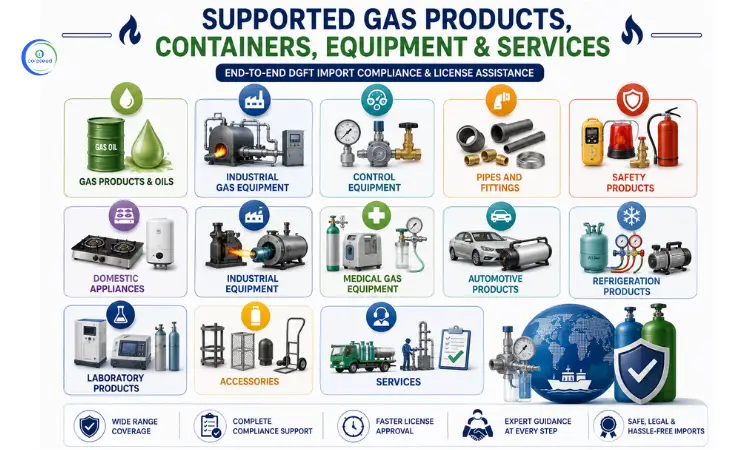
We provide end-to-end DGFT import compliance and license assistance across a wide spectrum of gas categories, equipment, and related oil classifications:
- Gas Products & Oils: Gas oil and oils obtained from gas under HS Code 27101941 / 27101941, compliant with Gasoil - IS 17789:2022 standards.
- Industrial Gas Equipment: Import compliance support for industrial gas burners, gas furnaces, industrial boilers, gas cutting torches, welding machines, and heat-treatment equipment.
- Control Equipment: Regulators, pressure gauges, valves, manifolds, flow meters, and control panels.
- Pipes and Fittings: Gas hoses, copper or steel pipes, connectors, adaptors, clamps, and quick couplings.
- Safety Products: Gas-leak detectors, alarms, flame arrestors, emergency shut-off valves, ventilation systems, and fire extinguishers.
- Domestic Appliances: Gas stoves, cooktops, ovens, geysers, room heaters, barbecue grills, and gas lighters.
- Industrial Equipment: Gas burners, furnaces, boilers, cutting torches, welding machines, and heat-treatment systems.
- Medical Gas Equipment: DGFT import assistance for oxygen concentrators, oxygen cylinders, medical gas regulators, ventilator accessories, masks, cannulas, and medical gas equipment.
- Automotive Products: CNG/LPG conversion kits, injectors, reducers, filling valves, storage tanks, and fuel filters.
- Refrigeration Products: Refrigerant cylinders, charging kits, vacuum pumps, recovery machines, and leak detectors.
- Laboratory Products: Gas generators, purity analysers, calibration kits, gas cabinets, and chromatography supplies.
- Accessories: Cylinder stands, cages, caps, trolleys, cabinets, and identification labels.
- Services: Cylinder refilling, delivery, installation, pipeline maintenance, pressure testing, and safety inspection.
Why This License Matters for Your Business?
Besides ensuring compliance with the law, there are many benefits to a valid DGFT license for gas imports for the growth of your business. You will have the legal right to import and sell your gas products nationwide. There is no chance of any of your consignments being held up due to faulty documentation. Customs officers will easily notice that your documents are in order and will have no difficulty clearing your shipment at the port. Over time, your clients and business associates will gain confidence in you because you complied with regulations.
On the legal side, importing gas without this license constitutes a violation of the Foreign Trade (Development & Regulation) Act, 1992. This is not a minor technicality. Depending on the circumstances, it can lead to financial penalties or even the seizure of your goods. Many gases also fall under additional safety and environmental regulations, so holding the correct DGFT license is one way to show that your business takes compliance seriously across the board, not just with trade rules.
Understanding the Import Policy for Gas, Industrial Gas & LPG
India's Foreign Trade Policy classifies every product entering the country into one of three categories: Free, Restricted, and Prohibited. As per the DGFT ITC (HS) Classification Schedule, specific gases, including several categories of industrial gases and LPG, are listed as "Restricted," meaning prior import authorization from DGFT is required before the goods can legally enter India.
| Import Category | What It Means | License Required |
| Free | The product can be imported without any special permission | No License |
| Restricted | The product can only be imported with prior government authorization | DGFT License Required |
| Prohibited | The product cannot be imported under any circumstances | Cannot Import |
Most industrial gases, LPG, and speciality gases fall into the Restricted category under this schedule, and this classification is tied closely to the specific Gas HS Code, or Harmonized System Code, assigned to your particular product. Different gas products, gas cylinders, gas regulators, industrial gas equipment, and LPG products are classified under specific Gas HS Codes, which determine the applicable import policy. The exact import policy for industrial gas that applies to your shipment depends on a few things:
- the type of gas you are importing,
- the HS Code that matches it, the end use you plan for it, and
- the quantity you intend to bring in.
For LPG specifically, the applicable HSN codes generally fall under the 2711 series, though the exact sub-heading depends on the form and composition of the gas being imported.
Gas & LPG Import in India: The Bigger Picture
Knowing how significant gas imports into India are will make it clear why such a compliance process exists and why it is being supervised so carefully. India needs imports to cover 60% of its overall LPG demand, which totals millions of tonnes per year, and these imports mostly come from Qatar, Saudi Arabia, and the UAE. The need for industrial gas has increased due to the development of the manufacturing, healthcare, food processing, and chemical industries, which require a reliable, steady supply.
This is exactly why DGFT, PESO, BIS, and Customs collaborate on gas imports. One ship can deliver tens of thousands of tonnes of compressed gas, making compliance essential to ensure a smooth, trouble-free flow of goods. Applying for gas imports to your company is not an attempt to engage in a minor and rare compliance process. Gas import licensing is a well-established, high-volume compliance process, and DGFT, PESO, and Customs have the processes in place to handle it.
Government Authorities Involved in Gas Import
Getting a gas import license is rarely a matter of dealing with just one office. Depending on the type of gas and how it will be used, several different government bodies may need to be involved. DGFT is the primary authority and issues the Restricted Import License itself, which is filed via Form ANF 2M. BIS approval may apply to gas cylinders, pressure vessels, gas regulators, valves, and related gas equipment notified under Quality Control Orders. Alongside DGFT, the Petroleum & Explosives Safety Organisation, known as PESO, often needs to issue safety approvals, especially for LPG and other pressurized gases, since these pose a higher risk if mishandled. The Bureau of Indian Standards, or BIS, may also be involved if your gas cylinders fall under a notified Quality Control Order. Where the gas being imported qualifies as a hazardous chemical, the Ministry of Environment, Forest and Climate Change and CPCB also step in under the Manufacture, Storage and Import of Hazardous Chemicals (MSIHC) Rules, 1989. Finally, the Customs Department is the authority that physically clears your shipment at the port once all other approvals are in place, and, depending on your state, the State Pollution Control Board may also need to sign off.
| Authority | Role | Approval Required |
| DGFT | Issues the Restricted Import License (Form ANF 2M) | Yes, mandatory |
| PESO | Safety approval for gas cylinders and pressure vessels | Often, for LPG and pressurized gas |
| BIS | Certification of gas cylinders under notified Quality Control Orders (e.g., IS 3196, IS 7285) | Yes, for certain cylinder types |
| MoEF&CC / CPCB | Notification and safety documentation under MSIHC Rules, 1989, for hazardous chemical gases | Where the gas qualifies as a hazardous chemical |
| Customs Department | Clears the shipment at the port | Yes, mandatory |
| State Pollution Control Board | State-level environmental checks | Sometimes, case by case |
Who Is Eligible to Apply in Gas Import?
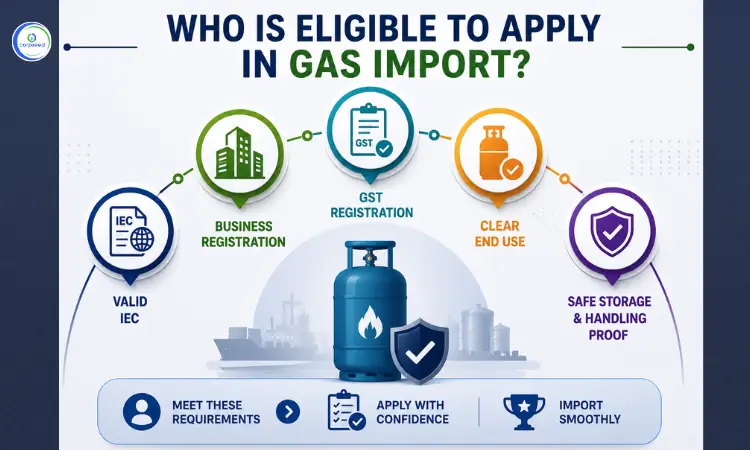
Any manufacturer, trader, distributor, or gas equipment importer, gas cylinder importer, laboratory, healthcare provider, or industrial user:
- A valid Import Export Code (IEC)- This is the foundational registration every importer in India must hold. Without an active IEC, DGFT will not process a license application at all, since it is the number your entire import activity gets tracked against. IEC registration is typically the very first step in any gas import authorization case, so it's worth sorting out before you start gathering the rest of your documents.
- Proper business registration- Your company needs to be legally registered, whether as a proprietorship, a partnership, an LLP, or a private limited company. DGFT uses this to confirm that a real, accountable legal entity is behind the application, not just an individual placing an order.
- A valid GST registration- This ties your import activity to your tax records and is checked alongside your IEC during the application process.
- A clear, stated end use for the gas. DGFT wants to know exactly what you intend to do with the gas once it lands, whether that is manufacturing, resale, medical use, or something else. A vague or missing end use is one of the most common reasons applications get delayed with follow-up queries.
- Proof that you can safely store and handle gas. Since gas poses real safety risks, you need to demonstrate that your storage setup meets the basic safety requirements for the product you are importing.
If you don't already have an IEC, that is not a deal breaker. We can help you obtain one as a first step before moving into the license application itself, so it doesn't delay your timeline later.
Manufacturer Importers
If the usage of gas by your company is involved in the manufacturing process of your company, whether it be welding gas, chemical gas, or any other type of manufacturing, then you belong to the category of Manufacturer Importer. The usual requirements of DGFT from a Manufacturer Importer are a valid IEC, GST registration, Factory License/Manufacturing Registration, and a safety certificate for storing the gas within your factory.
Merchant Importers
If instead your business imports gas with the intention of selling it on to other companies, you fall into the merchant importer category. This applies to trading businesses that treat gas as a product for resale rather than for internal consumption. For this category, you will generally need your IEC and GST registration, a trade license, approval for your storage and distribution setup, and in some cases, proof of buyer demand or an existing market for the product.
Documents You Will Need for Gas, Industrial Gas & LPG Import
Submitting an online application for a DGFT license depends heavily on having the right customs documentation ready before you file. If you haven't yet completed your IEC registration, that should be sorted first, since several of the documents below reference your IEC number directly. The table below outlines what is typically required for the DGFT online portal submission.
| Document | Purpose | Mandatory / Optional |
| Import Export Code (IEC) | Proves you are a registered importer | Mandatory |
| GST Registration Certificate | Tax compliance proof | Mandatory |
| PAN Card of Company/Proprietor | Identity and tax proof | Mandatory |
| Certificate of Incorporation | Proves business is legally registered | Mandatory |
| Product Technical Specification | Describes the type of gas being imported | Mandatory |
| End-Use Certificate | States how the gas will be used | Mandatory |
| Purchase Order / Proforma Invoice | Shows the import transaction details | Mandatory |
| Storage Facility Details | Proves safe storage arrangement | Mandatory |
| PESO License (if applicable) | Safety approval for pressurized gas | Conditional |
| BIS Certificate (if applicable) | Quality standard proof | Conditional |
| Factory License (for manufacturers) | Proves manufacturing use | Conditional |
| Board Resolution / Authorization Letter | Authorizes the applicant to apply | Mandatory |
It might not look like much on paper, but even one missing or slightly incorrect document can delay your application by weeks, because DGFT will pause your file until you resubmit the missing piece. This is one of the areas where we add the most value, since we go through every document on this list before anything is submitted, catching gaps or errors while there is still time to fix them quietly rather than after DGFT has already flagged them.
Why DGFT Applications Get Rejected?
Knowing where applications typically go wrong is one of the most useful things a business can learn before filing. Incorrect classification of gas cylinders, gas regulators, cryogenic tanks, or industrial gas equipment under the wrong HS Code. In our experience, rejections and delays almost always come back to one of the same handful of causes:
- Wrong HS Code. Selecting an HS Code that doesn't precisely match the gas being imported is one of the most common triggers for a query or outright rejection, since the entire application is built around this classification.
- Missing end-use certificate. If DGFT cannot clearly see what you plan to do with the gas once it arrives, your application will be paused until this is provided.
- Incorrect IEC details. Even small mismatches, such as a company name that doesn't exactly match your IEC record, can hold up processing.
- Product mismatch. If the submitted technical specification doesn't align with what's stated on your invoice or purchase order, DGFT will flag the inconsistency before proceeding.
- Missing PESO approval. For pressurized gases like LPG, applying without the required PESO safety clearance is a frequent cause of delay.
- Incomplete application. As simple as it sounds, applying even with one missing field or attachment sends the whole file back to the queue.
Each of these is avoidable with a careful review before submission, which is exactly the step most rejected applications skip.
How the Process Works for Gas, Industrial Gas & LPG Import?
Getting your DGFT e-license involves a series of steps. Here is what happens at each stage, and why it matters:
Step 1: Identify whether you are importing industrial gases, LPG products, gas cylinders, gas equipment, or medical gas equipment
Step 2: Document Checklist & Collection. We give you a clear list of exactly what is needed and help you gather it, rather than leaving you to guess what DGFT wants. This step alone prevents most of the delays businesses run into later.
Step 3: HS Code Validation. We have validated the correct HS Code for the given product. The HS Code has the sole responsibility for specifying the set of rules, duties, and approvals that would apply to your goods.
Step 4: Preparation of Application. We help you prepare your DGFT application. We ensure consistency in all technical data details for your product across your documents. Inconsistency in documents is the most common reason for application rejection.
Step 5: Simultaneous Processing of Other Approvals. If any PESO/BIS/CPCB approvals are needed for your gas, we handle them simultaneously while filing the DGFT application, rather than sequentially. It would save your precious time.
Step 6: Filing of DGFT Application. When everything is done, we submit Form ANF 2M via the DGFT portal (Services -> Import Management System -> Import Authorization for Restricted Imports -> Apply for New Authorization).
Step 7: Handling Queries. It is common for DGFT to come back with a question or request more information. How quickly and accurately you respond directly affects your timeline, so we handle these queries on your behalf, drawing on our experience with what DGFT typically asks for.
Step 8: License Approval. Upon satisfaction from DGFT, your Restricted Import License will be granted.
Step 9: Customs Compliance Assistance. We ensure that the license is used appropriately by the time your shipment reaches customs to avoid any holdup due to a documentation error.
Step 10: After Approval Assistance. Just because you have received the approval does not mean we will stop assisting. We are always there to help with any renewals or amendments.
Additional Approvals You May Need for Gas Import
Depending on the specific gas you are importing, one or more additional approvals may sit alongside your import authorization. This is a core part of industrial gas compliance, and skipping any applicable step here is one of the fastest ways to end up stuck at customs later.
- BIS Applicability. The requirement for BIS approval applies when the gas you have, or the cylinder/vessel used for its storage and transportation, is covered by the notified Quality Control Order. It applies more often to gas cylinders than the gas itself. In the case of LPG and industrial gas cylinders, they are usually manufactured and approved as per certain Indian standards, such as IS 3196 (Parts 1 to 4) for welded low-carbon steel gas cylinders, IS 7285 (Parts 1 to 2) for refillable seamless steel cylinders, and IS 7312 for dissolved acetylene gas cylinders.
- DGFT Applicability. This one is always required, as it is the core license that allows the import of restricted-category gases at all. The application is submitted through the DGFT e-Import license module and is supported by all the mandatory documents outlined earlier on this page.
- MOEF&CC Applicability. This becomes relevant when the gas being imported qualifies as a hazardous chemical under the Manufacture, Storage and Import of Hazardous Chemicals (MSIHC) Rules, 1989, which operate under the Environment (Protection) Act, 1986, and are jointly overseen by the Ministry of Environment, Forest and Climate Change and CPCB. Several industrial gases fall within this framework, particularly those classified as toxic, flammable, or reactive. If your product qualifies, you are required to notify the relevant authority before import and to maintain proper safety documentation, including a Material Safety Data Sheet, for the chemical being imported.
- CPCB Applicability. CPCB is one of the designated authorities under the MSIHC Rules, meaning that importers of hazardous chemical gases are generally required to inform CPCB, along with other identified authorities, at the time of import, as set out in Schedule 5 of the Rules.
What Happens at Customs Clearance?
Once your DGFT license is in hand, the shipment still needs to clear customs before it legally enters India. This process starts with your customs broker filing a Bill of Entry, which outlines all the details of your shipment. Alongside this, you submit your DGFT license, invoice, packing list, and any other relevant paperwork. Customs officials may physically examine the gas cylinders or containers to confirm they match the declaration, and once that is complete, the applicable customs duty is calculated and paid based on your product's HS Code. For pressurised gas in particular, safety officials may also inspect how it is stored and handled before giving the final go-ahead. Once all checks are completed, customs release your shipment.
A surprising number of delays at this stage come down to avoidable mistakes: an incorrect HS Code listed on shipping documents, a mismatch between the details on your license and the details on your invoice, missing safety certificates for pressurized gas, or worst of all, applying for the license only after the shipment has already arrived at the port. We work to prevent every one of these issues by carefully reviewing your documents before your shipment even leaves its country of origin, so there are no surprises at customs.
What Affects the Cost of This License?
There is no single flat fee for every gas import license because the total cost depends on several factors specific to your situation the type of gas you are importing and the quantity involved are among them. If additional approvals, such as PESO, BIS, or CPCB clearance, are needed, they add to the overall scope of work. The complexity of your business structure matters, and whether this is a first-time application or a renewal of an existing license also affects the price.
DGFT itself fixes one part of the cost and doesn't vary by consultant: the government application fee for a Restricted Import Authorisation is set at Rs. 1 per thousand (roughly 0.1%) of the CIF value of the shipment, subject to a minimum of ₹500 and a maximum of ₹1,00,000. On top of this, amending an issued authorization incurs a basic fee of around ₹200, and revalidating an authorization (allowed for up to 6 months at a time) typically incurs a fee of around ₹500. Beyond these fixed government charges, the remaining cost reflects the consulting, documentation, and coordination work involved in getting your application right. Rather than quoting a generic number that may not reflect your actual situation, we take the time to understand your specific case first, then give you a clear, upfront estimate with no hidden charges later.
How Long Approval Typically Takes for Gas, Industrial Gas & LPG Import?
On average, businesses can expect the approval process for a DGFT Restricted Import License to take a few weeks. However, the exact timeline depends heavily on how complete your documents are from the start and whether additional approvals, such as PESO or BIS, are required. The speed at which you respond to any DGFT queries also plays a significant role in how quickly the whole process wraps up. Once issued, a Restricted Imports Authorisation is generally valid for 18 months from its date of issuance and can be revalidated for a further period on merit if needed. It's worth planning your import schedule around that window rather than applying separately for every shipment.
Most delays that businesses run into can be traced back to a small number of avoidable causes:
- incomplete or incorrect documents,
- an incorrectly selected HS Code,
- slow responses to government queries, or
- simply not applying for related approvals early enough.
The best way to avoid these delays is to start the process well before your shipment needs to move, rather than waiting until it is already on its way. Working with an experienced consultant who thoroughly reviews your documents before submission also helps enormously, as does applying for all related approvals together rather than tackling them one at a time.
Common Challenges Businesses Face for Gas Import
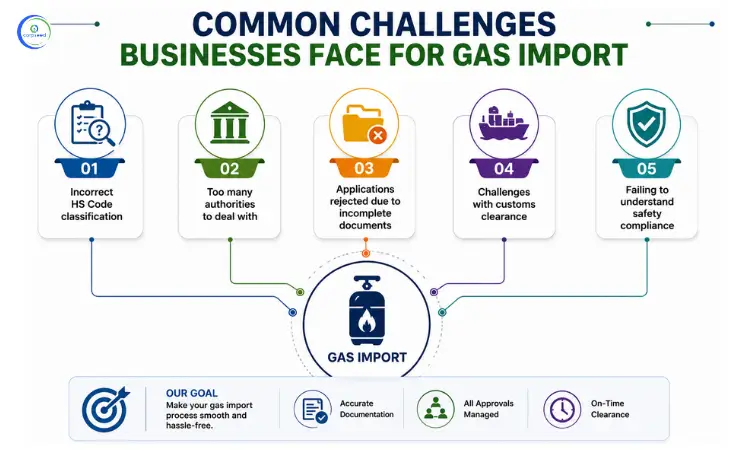
Several recurring challenges tend to come up during this process, and it helps to know about them in advance:
- Incorrect HS Code classification. Many businesses struggle to classify their product under the right HS Code, and getting it wrong changes, which rules and duties apply. We resolve this by carefully verifying the code before any application goes in.
- Too many authorities to deal with. Between DGFT, PESO, BIS, and sometimes CPCB, coordinating with multiple government offices at once can feel overwhelming for a business trying to run its day-to-day operations. We handle this by coordinating all the necessary approvals together rather than leaving you to manage each one separately.
- Applications turned down due to incomplete documents. One missing document is all that DGFT needs to freeze an application process. We avoid that by performing a thorough document verification before the submission, not after DGFT identifies a gap.
- Challenges with customs clearance. Even with a license, discrepancies in your documents could delay your shipment at the port. We solve that problem by preparing our documentation in advance, so no issues arise.
- Failing to understand safety compliance. Not everyone is aware of the safety compliance requirements set by PESO and others regarding storage and handling. We provide detailed information to ensure you understand what your establishment needs.
Why Businesses Turn to Professional Consultants?
Handling this entire process alone is technically possible, but it comes with real risk. Businesses that work with experienced consultants tend to see faster approvals, simply because their consultant already knows what DGFT expects and can avoid the back-and-forth that comes from an incomplete or poorly prepared application. They also see fewer rejections overall, since a thorough document check before submission catches errors that would otherwise come back as a query weeks later. Beyond that, a good consultant brings genuine technical knowledge to how the application itself is written and structured, and stays on top of policy changes that might otherwise catch a business off guard. Trying to manage all of this without support often leads to exactly the kind of delays, rejections, and unexpected costs that a good consultant is meant to prevent in the first place.
Why Choose Corpseed?
We see ourselves as more than just a consultant you hire once and forget about. We aim to be a genuine compliance partner for your business, someone you can call whenever an import question comes up, not just when you need a new license. Here's what that looks like in practice:
- Real, hands-on industry experience. We have handled DGFT licenses specifically for gas and industrial products for years, so we already understand the nuances that trip up businesses working with a general consultant for the first time.
- A dedicated expert on your file. You get one consultant who knows your case from start to finish, rather than being passed from person to person every time you call.
- End-to-end support. We support your entire journey, from gathering documents to customs clearance, so you are never left figuring out the next step on your own.
- PAN India service. We work with businesses across every state in India, not just one region, so wherever you are based, you get the same level of support.
- Affordable, transparent pricing. Our pricing is explained clearly upfront, with no surprise charges added later once the work is already underway.
- A transparent process. You always know exactly what stage your application is at, instead of waiting in the dark for updates.
- Quick turnaround. We move fast without cutting corners on accuracy, since a rushed application that gets rejected costs you more time than a careful one.
- Post-approval support. We don't disappear once your license is approved. We will continue to support you with renewals, amendments, and any compliance questions that come up down the line.
Your gas import shouldn't be held hostage by paperwork. Let Corpseed take on the compliance work so you can focus on running your business.
Connect With Corpseed
Connect with the Corpseed team to discuss your requirements at IVR: 7558640644 or hello@corpseed.com. It takes 20–25 minutes to discuss the requirement.
Dedicated Manager
Once you discuss the requirement, we will align a dedicated Account Manager to understand your business needs and assist throughout the process.
Real Time Update
Track the progress of your application and always know what’s in progress and what’s done.
Job Completed
Once the job is completed, you will receive registrations & certifications directly to your email ID and at your doorstep.
Need help?
Talk to an Expert
Get free guidance on the right service, improved documents & timeline.






















