
DGFT Restricted Import License for Copper Scrap Import
Importing copper scrap into India does not begin with a licence application. It begins with identifying what exactly is being imported. A consignment described commercially as “copper scrap” may be copper wire scrap, heavy copper scrap, insulated copper wire, mixed copper waste, residue, dross, ash or another copper-bearing material. That difference can change the eight-digit ITC HS code and, with it, the import route.
Schedule a Call Back
Why wait? Start now!
Get Support AnytimeBusinesses we've worked with on import-export and DGFT
Showing 1538 of 250+ clients served since 2018- Electronics and technology
- Advantech Industrial Computing India · Smiths Detection Systems · Areca Embedded Systems · Motorola Solutions India · Trinity Mobile APP Lab · +2 more
- Pharma and healthcare
- Motorica India · Glocal Healthcare Systems · Tablets (India)Limited
- Food and consumer goods
- Auroras TEA Company · Surabhi Aqua Minerals
- Logistics and trade
- Solankili Logistics Management · ATG Freight India
- Jewellery
- Janki Jewellers · Viindhya Bullion
- More clients
- Esskay Compuservices · Welgrow Technologies · Ample Technologies · Aprodite Infotech · Floroma Infinity · Moonlight Technology · NJ Power · Ample Digital · Augustdevices India · Automap Software and Technologies · SNS Metpro Industries · Webmeditech Healthcare · Anagh Traders · Meritech India · Zipped Solutions · Metanovo Health · Kapemai Lifestyle · Zexcorp Services · Agricapita Innotech · Meticulous Networks · Nexavarge · Arng · D13 Business Ventures · Datalux Systems India · +21 more
Last updated:
What Is a DGFT Restricted Import License for Copper Scrap?
A DGFT Restricted Import License, formally dealt with as a Restricted Import Authorisation, is required where the relevant ITC HS tariff item is classified as Restricted and the applicable policy does not provide another permitted route.
Under the Foreign Trade Policy, goods marked Restricted may be imported only in accordance with the required authorisation, permission or procedure prescribed by DGFT. Freely importable goods follow a different route, although the word “Free” does not mean that other registrations or regulatory conditions disappear.
This creates three very different positions for an importer:
| Import-policy position | What it means in practice |
| Free | No Restricted Import Authorisation merely because of the tariff policy, but other laws and conditions can still apply. |
| Free subject to conditions/registration | DGFT restricted licensing may not be needed, but registration, PSIC, environmental or other requirements have to be completed. |
| Restricted | Import normally requires the prescribed DGFT authorisation/permission before clearance, subject to the conditions applicable to that tariff item. |
The DGFT Restricted Import License for Copper Scrap therefore has to be approached product by product. An importer should not file an application merely because the overseas supplier calls the goods “copper scrap.”
Before deciding the route, check:
- the eight-digit ITC HS code,
- precise description of the material,
- physical form,
- composition,
- scrap or waste grade,
- quantity,
- CIF value,
- country of origin,
- supplier,
- proposed use in India,
- whether the importer is an actual user, recycler or trader,
- NFMIMS applicability,
- PSIC requirement,
- environmental classification, and
- any SPCB/PCC or MoEFCC condition.
Where there is uncertainty, the useful work of a DGFT Import License Consultant is not simply filling an online form. It is identifying whether that form is actually required.
Why Is a DGFT License Required for Importing Certain Copper Scrap into India?
India's import controls operate through the Foreign Trade Policy and the eight-digit ITC HS classification. Restricted goods cannot ordinarily be imported in the same way as freely importable goods. DGFT's FTP expressly requires Restricted goods to follow the relevant authorisation or permission route.
Copper scrap also forms part of this overlap between foreign-trade control laws and material safety laws. As per the DGFT's rules relating to metallic scrap, metallic scrap must not contain hazardous or toxic wastes, radioactivity, arms, ammunition, mines, shells, cartridges, and explosives.
That is why the regulatory question is not simply:
- “Is copper scrap allowed in India?”
- The better question is:
- “What is the exact copper material, which ITC HS code applies, and what conditions attach to that code?”
A wire scrap consignment matching a specified ISRI grade can follow a different route from unclassified mixed copper waste, contaminated residue, or copper-bearing dross.
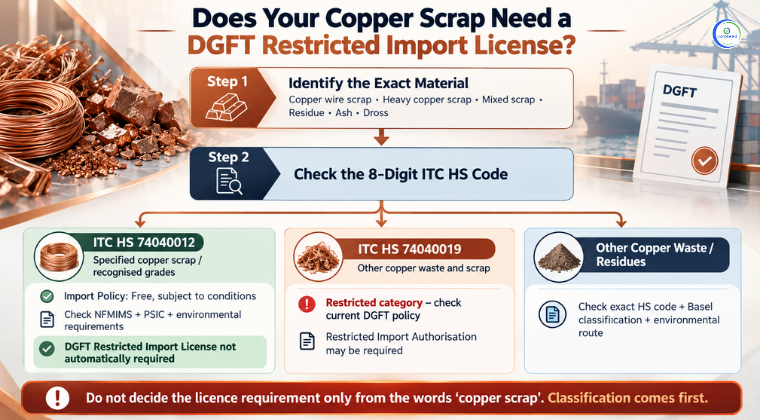
Does Every Copper Scrap Import Require a DGFT Restricted Import License?
No.
One of the most important examples is ITC HS 74040012. DGFT's Handbook of Procedures expressly lists 74040012 “Copper scrap” among metallic waste and scrap whose import is free, subject to the metallic-scrap conditions in Para 2.54. The item is also one of the copper tariff codes notified for compulsory NFMIMS registration.
The position is different for some residual copper-scrap classifications.
Which Types of Copper Scrap Can Be Imported into India?
Copper scrap is traded under many commercial names, but those names alone do not establish its legal classification. Common materials may include:
Copper Wire Scrap
Bare copper wire, clean copper wire, and certain recognised wire-scrap grades may fall within 74040012 when they meet the applicable tariff description.
Heavy Copper Scrap
Specified heavy copper scrap covered by recognised ISRI terminology is included within the detailed description of 74040012.
Copper Wire Nodules
Certain copper wire nodule grades are also expressly included in the tariff description.
Light Copper Scrap
Light copper scrap matching the recognised grade described for 74040012 may follow the same tariff classification.
Insulated Copper Wire Scrap
The tariff description for 74040012 also refers to copper wire scrap with various types of insulation under the relevant ISRI code.
Copper Cable Scrap
A description such as “cable scrap” is not enough by itself. The importer needs to know the conductor material, insulation, contamination, attachments, and whether the material fits an identified scrap specification.
Mixed Copper Scrap
Mixed material does not necessarily mean that it qualifies under 74040012. The inclusion of other metal types, insulation, residues, attachments, or contamination may impact classification and disposal.
Copper Ash, Dross and Residue
These materials require particular care. A substance generated during smelting, refining, polishing, or industrial processing may be a waste/residue rather than ordinary metallic scrap. Depending on composition and the Basel/Schedule III entry involved, MoEFCC permission and actual-user requirements may arise.
The practical rule is simple: scrap, residue, ash, and dross should not be treated as interchangeable descriptions.
What Are the ITC HS Codes for Copper Scrap Imports in India?
Heading 7404 covers copper waste and scrap, but Customs clearance takes place at a more detailed tariff level. For regulatory assessment, the eight-digit item matters.
Key Copper Scrap Tariff Items
| ITC HS Code | Description | Import-policy point | Main compliance consideration |
| 74040012 | Specified copper scrap, including listed ISRI grades | DGFT HBP treats the item as free subject to metallic-scrap conditions; also covered by NFMIMS | NFMIMS + HBP Para 2.54 + PSIC/exemption + Customs/environmental review |
| 74040019 | Other - of copper | Current Customs-facing ITC-HS data lists this residual line as Restricted | DGFT Restricted Import Authorisation and connected scrap/waste compliance |
| Other 7404 lines | Copper-alloy and other scrap categories | Different tariff treatment can apply | Check exact eight-digit classification |
DGFT's own tariff description for 74040012 is detailed rather than generic. It identifies particular scrap types using ISRI code words.
This is why using “7404” alone is not sufficient. An importer may have two shipments that are both commercially described as copper scrap but fall under different eight-digit lines.
Recognised Copper Scrap / ISRI Grades Under 74040012
The description of ITC HS 74040012 refers to specific internationally recognised scrap grades. DGFT material identifies the following.
| ISRI code word | Broad description appearing in tariff material |
| Barley, Berry, Birch | Copper wire scrap |
| Candy | Heavy copper scrap |
| Cliff | Unalloyed copper scrap |
| Clove, Cobra, Cocoa | Copper wire nodules scrap |
| Dream | Light copper scrap |
| Palms | Muntz metal tubes |
| Drove | Certain miscellaneous copper-containing skimmings, grindings, ashes, irony brass/copper, residues and slags |
| Druid | Copper wire scrap with various types of insulation |
The ISRI name is useful, but it should not be treated as a substitute for classification evidence. The importer should be able to support the grade with the actual material description, photographs, specifications, composition and supplier documents.
The presence of words such as “ash”, “residue” or “slag” in a tariff description also does not remove environmental-law questions. The Hazardous and Other Wastes Rules have to be checked independently.
Copper Scrap Import Rules in India
DGFT Import Policy
The first check is the eight-digit tariff item.
FTP 2023 states that Restricted goods can be imported only under the relevant authorisation, permission, or prescribed procedure. It also provides that if an import requires an authorisation, the default position is that the Actual User imports the goods unless DGFT specifically dispenses with that condition.
For 74040012, Para 2.54 of the HBP expressly places copper scrap in the listed group whose import is free subject to the prescribed metallic-scrap safeguards.
NFMIMS Requirements
| Particular | Current requirement |
| Authority / system | Government of India NFMIMS |
| Copper coverage | 46 notified Chapter 74 HS codes |
| Is 74040012 included? | Yes |
| Earliest application | Not earlier than 60 days before expected arrival |
| Latest point under 2026 amendment | Before Customs “Out of Charge” |
| Registration validity | 75 days |
| Registration fee | ₹500 as stated on the Ministry of Mines portal |
| Bill of Entry | Registration number and expiry details required |
The Non-Ferrous Metal Import Monitoring System (NFMIMS) applies to specified copper and aluminium tariff lines.
Notification No. 61/2015-2020 of DGFT issued on 31st March 2021 shifted the specified items from “Free” to “Free subject to compulsory registration” under NFMIMS. Annexure I of the said notification lists 46 items.
This means an importer of 74040012 may not need a Restricted Import Authorisation, but NFMIMS still has to be dealt with.
Important 2026 NFMIMS Change
DGFT Notification No. 22/2026-27 dated 30 June 2026 changed the registration timing.
Earlier, registration had to be obtained before the arrival of the import consignment. Under the revised policy, the importer may obtain the NFMIMS registration before final Customs clearance / “Out of Charge.” Registration cannot be applied for earlier than the 60th day before expected arrival, and the automatic registration number remains valid for 75 days.
The Ministry of Mines NFMIMS portal currently states that the registration fee is ₹500, and that the registration number and expiry date must be entered in the Bill of Entry.
NFMIMS Snapshot
NFMIMS should therefore not be described as a copper-scrap licence. It is a separate import-monitoring registration.
Metallic Scrap Import Conditions
Para 2.54 of DGFT's HBP states that metallic waste and scrap must not contain:
- hazardous or toxic waste,
- radioactive contaminated material,
- scrap containing radioactive material,
- arms,
- ammunition,
- mines,
- shells,
- live or used cartridges, or
- other explosive material.
The rules then distinguish shredded from unshredded metallic scrap.
Shredded Scrap
Listed freely importable shredded metallic scrap can be brought through all ports, subject to the specified inspection and documentation requirements. The HBP requires a prescribed PSIC at Customs clearance, unless an applicable exemption operates, and requires the importer-exporter contract to address radioactive contamination.
Unshredded, Compressed or Loose Scrap
Unshredded, compressed, and loose scrap are further regulated through certain measures. Documentation from the PSIC covers weapons, ammunition, explosives, and radiation, the scrap should conform to international standards as metal waste/scrap, and there are port restrictions.
Is PSIC Required for Copper Scrap Import?
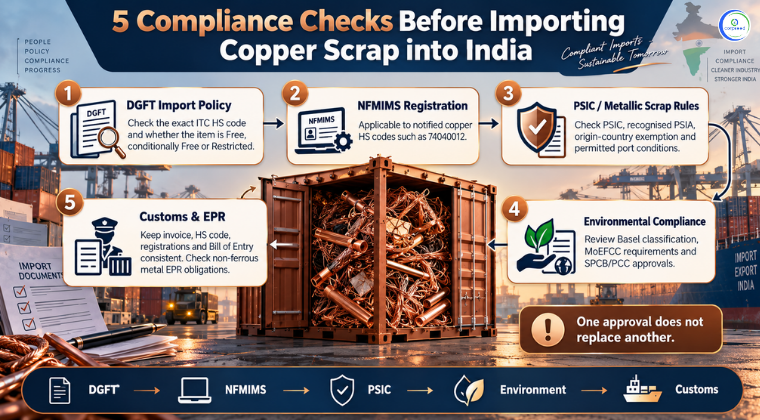
A Pre-Shipment Inspection Certificate (PSIC) is a key requirement under DGFT's metallic-scrap framework, but there is an important exemption.
DGFT's current HBP says metallic waste and scrap, both shredded and unshredded, imported from the USA, UK, Canada, New Zealand, Australia, and the EU do not require a PSIC where the consignment is cleared through these ten ports:
Chennai, Tuticorin, Kandla, JNPT, Mumbai, Krishnapatnam, Mundra, Kattupalli, Hazira and Kamarajar.
In such cases, the consignment must instead carry the required certificate from the supplier/scrap-yard authority confirming that it does not contain radioactive material or explosives, and the consignment remains subject to radiation and explosive checks at the port. Trans-shipment through one of these safe countries or regions does not give the benefit of this exemption.
Imports through the remaining designated ports continue to require PSIC irrespective of the country of origin.
Where PSIC is required, it should be issued by an agency recognised by DGFT under Appendix 2G in the prescribed format.
Environmental and Waste Import Rules for Copper Scrap
Copper scrap should also be examined under the Hazardous and Other Wastes (Management and Transboundary Movement) Rules, 2016, as amended.
This does not mean every copper scrap consignment is hazardous waste.
A useful example appears in an MoEFCC Expert Committee case involving copper scrap under Basel entries B1010, B1070 and B1100. The Committee recorded that B1010 falls in Part D of Schedule III and is eligible for import/export without MoEFCC permission. In contrast, the applicant's proposed B1070 and B1100 imports required separate examination of its ability to process those waste categories.
Recent MoEFCC committee material further records the Part-D approach that B1010 imports may be made by an actual user, or by a trader for use by actual users authorised by the concerned SPCB, subject to Customs verification of the prescribed Schedule VIII documents.
So a business importing clean metallic copper scrap should not automatically apply for MoEFCC permission merely because the word “waste” appears in the tariff heading. Equally, a business importing dross, ash, residues, or a different Basel category should not assume that ordinary scrap rules are enough.
New 2026 Compliance: EPR for Scrap of Non-Ferrous Metals
There is now another compliance layer that copper scrap importers should check.
MoEFCC notified the Hazardous and Other Wastes (Management and Transboundary Movement) Amendment Rules, 2025, G.S.R. 438(E) dated 1 July 2025. The new Chapter VIII on Extended Producer Responsibility for scrap of non-ferrous metals came into force on 1 April 2026. For this framework, non-ferrous metals include copper, aluminium, zinc and their alloys.
The amended rules specifically include a person who imports used devices, products or scrap of non-ferrous metals within the definition of “producer.”
They also require every producer of scrap of non-ferrous metals to register on the prescribed portal and file the required returns.
For importers of used devices, products, or non-ferrous metal scrap, Schedule XI states that the EPR obligation for year Y is 100% of the non-ferrous metal imported in year Y-1.
This EPR obligation is separate from DGFT licensing, NFMIMS, and PSIC.
A business considering its options for trading in copper scrap in 2026 would need to look at CPCB registration under non-ferrous metal EPR while reviewing compliance rather than seeing Customs clearance as the final step.
SPCB / PCC Requirements
SPCB or Pollution Control Committee requirements become particularly important where the Indian business will process, recycle, melt, recover, or otherwise handle regulated waste.
Depending on the material and activity, the facility may need:
- Consent to Establish,
- Consent to Operate,
- Hazardous and Other Waste authorisation,
- authorised recycling capacity,
- approved material/waste categories, and
- records demonstrating the intended recycling or utilisation route.
MoEFCC's own consideration of copper scrap applications looks at the applicant's pollution-control equipment, CTO, waste authorisation and authorised processing capacity before allowing waste categories requiring Ministry permission.
The authorisation should cover the material the plant actually proposes to process. A general recycling approval should not be assumed to cover every copper-bearing waste.
Customs Requirements
Customs sees the transaction through the documents presented at clearance. The following information should tell the same story:
- Bill of Entry,
- invoice,
- purchase contract,
- ITC HS code,
- product description,
- weight and quantity,
- CIF value,
- supplier details,
- country of origin,
- DGFT authorisation, if needed,
- NFMIMS registration, where applicable,
- PSIC or the permitted alternative certificate,
- environmental documentation, and
- end-use/actual-user information.
A description such as “metal scrap” on one document and “copper residue” on another can raise a classification or regulatory question even if the commercial transaction itself is genuine.
Who Can Import Copper Scrap into India?
The answer is contingent upon the policy that applies to the specific commodity. Some of the importers may be:
- copper recyclers,
- secondary copper producers,
- smelters,
- foundries,
- manufacturers of cables/wire,
- electrical equipment producers,
- metal processing facilities,
- other industrial actual users, and
- importers in situations where the relevant foreign trade and environmental regulations allow the importation by traders.
Regarding a freely importable article, as per FTP 2023, any individual can generally import the goods without any Restriction. In case any importation is subject to authorisation, then it shall automatically satisfy the Actual User condition unless DGFT dispenses with it.
Environmental rules can impose a separate condition. For example, the B1010 route discussed by MoEFCC permits import by an actual user or by a trader for use of authorised actual users, subject to the stated SPCB and Customs conditions.
This is why the statement “traders can import copper scrap” is too broad. The answer changes with the tariff code and waste classification.
Who Can Apply for a DGFT Copper Scrap Import License?
Where the exact copper scrap tariff item is restricted, the applicant would normally need:
- valid IEC,
- active DGFT registration,
- proper eight-digit ITC HS Code classification,
- details of product and technology,
- supplier and place of manufacture data,
- import quantity and CIF value,
- import purpose or end-use,
- Actual User if applicable,
- pollution control clearances if applicable, and
- commercial and regulatory documentation.
In this respect, FTP 2023’s Actual User provision comes into play since if there is a need for authorisation, then Actual User is the default importer, except where DGFT waives this requirement.
A Copper Scrap Import License Consultant or DGFT Compliance Consultant should therefore verify eligibility before the business incurs shipment costs.
Eligibility Requirements for a DGFT Restricted Copper Scrap Import License
1. Valid IEC
The importer company must have a valid IEC code and proper business details.
2. Active DGFT Profile
It is important for the DGFT profile of the applying entity to be active.
3. Correct Eight-Digit ITC HS Code
Classification needs to be determined prior to the submission of the application for a licence. It would be very dangerous to apply 74040012 based on the fact that the product contains copper.
4. Clear Product Description
The application needs to specify the material used. The following may be useful:
- type of scrap,
- composition,
- form,
- grade (ISRI),
- insulation/attachments,
- specification,
- photographs, and
- inspection/test results.
5. Supplier and Country-of-Origin Details
The identity and source of suppliers play an important role in the documentation for business as well as certain PSIC-based issues.
6. Quantity and CIF Value
Transaction documents must be able to substantiate the proposed quantity, measure, and CIF value. Transaction documents also impact the DGFT application charge for Restricted items.
7. End-Use/Import Reason
If DGFT is looking for justification of import, then the use mentioned must align with the operations at the Indian factory.
8. Actual-User Condition
This is specifically important if there is any requirement for authorisation from the Tariff Line. The FTP 2023 imposes an Actual User Condition on authorisation imports, except where DGFT waives this.
9. NFMIMS
Only apply NFMIMS if the HS Code falls within the notified codes. For the case of HS Code 74040012, it applies.
10. PSIC
PSIC is to be filed where the condition of Para 2.54 calls for it, and the safe country/port exemption is not applicable.
11. Environmental Permission
The clearance will depend on the environment or waste classification and not necessarily on the trade name of the material.
12. SPCB/PCC Approvals
A recycler or actual user should confirm that its consent and authorisation cover the proposed activity and material.
DGFT Approval vs NFMIMS vs PSIC vs Environmental Approval
These are separate compliances.
| Compliance | Purpose | Authority / system | When it may apply | Does it replace DGFT approval? |
| Restricted Import Authorisation | Permission to import a Restricted tariff item | DGFT | Where ITC HS policy is Restricted | - |
| NFMIMS | Import monitoring and registration | DGFT / Ministry of Mines system | Notified copper HS codes including 74040012 | No |
| PSIC | Checks metallic scrap for prohibited/radioactive/explosive material | DGFT-recognised PSIA / Customs framework | Metallic scrap unless an applicable exemption operates | No |
| MoEFCC permission | Controls specified transboundary waste movements | MoEFCC | Waste categories requiring Ministry permission | No |
| SPCB/PCC approvals | Facility and pollution-control regulation | State Board / PCC | Recycler/actual-user activities and prescribed waste categories | No |
| CPCB non-ferrous EPR | EPR registration and obligations for non-ferrous scrap/products | CPCB framework | Covered producers, including importers of non-ferrous scrap | No |
| Customs clearance | Final assessment and release of goods | Customs / CBIC | Every import | No |
For example, having NFMIMS registration for 74040012 does not replace PSIC requirements. Likewise, a DGFT Restricted Import Authorisation does not by itself establish that the importer's recycling plant has the required environmental approvals.
What Documents Are Required for a DGFT Copper Scrap Import License?
The document list depends on the type of copper scrap and the approvals required. Common documents include:
- IEC, PAN, GST and company registration documents
- DGFT profile details and previous authorisation, if any
- Copper scrap description, ITC HS code, grade and specifications
- Supplier details, invoice, purchase order and CIF value
- End-use and recycling/manufacturing details
- PSIC, where required
- NFMIMS registration details for applicable HS codes
- SPCB/PCC, MoEFCC or other environmental documents, where applicable
All documents should show the same product description, HS code, and quantity. Any mismatch between the invoice, PSIC, NFMIMS details and Bill of Entry can create problems during Customs clearance.
How to Apply for a DGFT Restricted Import License for Copper Scrap
How to Apply for a DGFT Restricted Import License for Copper Scrap
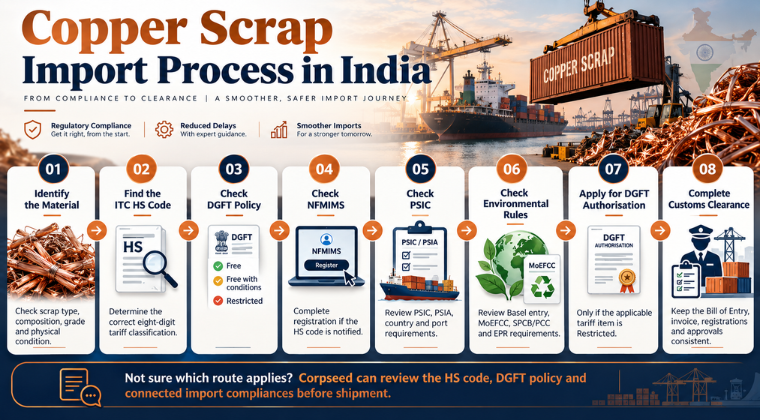
Step 1 - Determining the Precise Material
Begin with the product, not with the application form for the licence. Identify:
- the nature of the consignment in relation to being metallic waste, residues, ash, or dross,
- the copper content,
- copper content,
- physical condition,
- scrap grade,
- whether it is shredded or unshredded,
- contamination or attached material, and
- intended use in India.
Step 2 - Determine the Eight-Digit ITC HS Code
Check whether the goods actually meet 74040012 or fall under another tariff item such as the residual copper-scrap category.
Step 3 - Check the Current DGFT Import Policy
Determine whether that tariff item is:
- Free,
- Free subject to registration/conditions,
- Restricted, or
- subject to another policy requirement.
FTP 2023 requires Restricted goods to follow the prescribed authorisation or permission route.
Step 4 - Check NFMIMS Applicability
If the HS code appears in the notified copper list, obtain the required automatic registration.
For 74040012, NFMIMS applies. Under the 2026 amendment, registration must be completed before final Customs “Out of Charge”, it may not be applied for earlier than 60 days before expected arrival and remains valid for 75 days.
Step 5 - Check PSIC and Metallic-Scrap Conditions
Confirm whether:
- PSIC is required,
- the supplier/port qualifies for the safe-country exemption,
- the PSIA is recognised,
- the consignment is shredded or unshredded, and
- the proposed port is permitted.
Step 6 - Assess Environmental Requirements
Identify the applicable Basel/Schedule III category, if any.
Do not apply for MoEFCC permission merely because the shipment is scrap. B1010 may follow a no-Ministry-permission route subject to the Rules, while B1070/B1100 and other categories can require separate permission.
Also check SPCB/PCC and the new non-ferrous metal EPR framework.
Step 7 - Prepare the DGFT Application
Where the tariff line is actually Restricted, compile:
- applicant information,
- product details,
- ITC HS code,
- quantity,
- CIF value,
- supplier details,
- origin,
- end use, and
- supporting documents.
Step 8 - File Through DGFT's Import Management System
DGFT's current ANF-2M instructions state that the process is completely electronic. The route is through DGFT's Import Management System under Import Authorization for restricted imports → Apply for new authorization. ANF-2M is provided as a reference, paper or scanned copies of the form are not the filing route.
Step 9 - Respond to Queries
A DGFT query should be answered against the actual question raised. Responses should remain consistent with:
- supplier records,
- tariff classification,
- invoice,
- product specification,
- quantity/value,
- Indian facility,
- end use, and
- environmental documents.
Step 10 - Review the Issued Authorisation
Check the approval before proceeding further, particularly:
- product description,
- ITC HS code,
- quantity,
- value,
- validity,
- actual-user condition,
- end-use or other special condition.
FTP allows authorisations to contain conditions relating to description, quantity, value, Actual User status and validity.
Step 11 - Complete Shipment-Linked Compliance
If necessary, secure the PSIC prior to shipment. Do the NFMIMS within its allowable period, not exceeding the Customs Out-of-Charge stage.
Step 12 - Customs Clearance
The Bill of Entry and supporting documents should match the approved/regulatory position. Do not rely on the idea that a Restricted shipment can always be regularised after arrival.
FTP 2023 expressly says the facility for clearing goods against an authorisation obtained after shipment/arrival is not available to Restricted items unless DGFT specifically permits it.
What Is the Government Fee for a DGFT Copper Scrap Import License?
DGFT Appendix 2K prescribes the fee for an import licence for a Restricted item/permission/certificate as one per thousand, or part thereof, of the CIF value, subject to a minimum of ₹500 and a maximum of ₹1,00,000. One per thousand is equivalent to 0.1%.
Cost Components
| Cost | Type | Amount / basis | When relevant |
| DGFT Restricted Import Authorisation application | Government | 0.1% of CIF value, minimum ₹500, maximum ₹1,00,000 | Where Restricted authorisation is required |
| DGFT Restricted Import Authorisation application | Government registration | ₹500 as stated on current Ministry of Mines portal | Notified HS codes such as 74040012 |
| PSIC | Third-party inspection | Depends on recognised PSIA and shipment | Where required |
| Environmental approvals/testing | Government / laboratory / professional | Case-specific | Depending on waste classification |
| Corpseed professional service | Professional | Scope-based | If consultancy is engaged |
| Customs/logistics/storage | Transaction-specific | Case-specific | At import/clearance |
The DGFT application fee should not be mixed with consultant fees, PSIC charges, or Customs costs.
How Long Does It Take to Get a DGFT Copper Scrap Import License?
There is no single approval period that should be promised for every copper-scrap Restricted Import Authorisation.
The time can depend on:
- correctness of the tariff classification,
- completeness of the application,
- product composition,
- quantity and CIF value,
- end-use explanation,
- Actual User details,
- DGFT scrutiny,
- queries and deficiencies,
- environmental issues, and
- consultation with another department, where needed.
A DGFT Import License Consultant can help remove avoidable filing errors, but cannot guarantee the date on which the Government will approve an application.
NFMIMS is different. It is an automatic registration system for covered tariff lines rather than the same discretionary authorisation process.
What Is the Validity of a DGFT Restricted Import Authorisation?
Under the current DGFT Handbook of Procedures, an Import Authorisation for Restricted items is normally valid for 18 months.
This is an important point because older compliance material may still mention other validity periods.
The authorisation actually issued by DGFT should always be read carefully. A product-specific approval can contain different conditions or a specific validity where permitted under the applicable framework.
DGFT also has procedures for amendments and revalidation. Revalidation should not be treated as automatic.
What Happens After Getting a DGFT Copper Scrap Import License?
A licence is not the final step. Prior to clearance, one needs to review:
- authorized ITC HS code,
- description of material,
- allowed quantity,
- CIF/Value Limits,
- authorization period,
- Actual User conditions,
- end-use conditions,
- origin/supplier conditions, if any,
- port conditions,
- PSIC,
- NFMIMS,
- environmental documents,
- CPCB/SPCB, and
- Bill of Entry details.
It is also possible that EPR responsibilities for covered non-ferrous scrap importers may continue even after clearance by customs, since the EPR scheme works independently of the DGFT licence. Keep invoices, Bills of Entry, licences, registration records, PSICs, environmental approvals, and regulatory correspondence available for compliance records.
Can Copper Scrap Be Imported Without a DGFT Restricted Import License?
Yes, some copper scrap can.
ITC HS 74040012 is the clearest example. DGFT's HBP expressly lists the item as freely importable subject to the conditions in Para 2.54. The importer still has to deal with NFMIMS and the applicable metallic-scrap requirements.
So “Free” should be read as:
No Restricted Import Authorisation merely because of the tariff policy.
It should not be read as:
No compliance is required.
A Free or conditionally Free shipment can still involve:
- IEC,
- NFMIMS,
- PSIC,
- approved ports,
- radiation/explosive safeguards,
- Hazardous and Other Wastes Rules,
- SPCB/PCC compliance,
- CPCB non-ferrous EPR,
- Customs declarations.
On the other hand, where the eight-digit tariff line is Restricted, the appropriate DGFT authorisation should be obtained before relying on the shipment for Customs clearance.
Copper Scrap Import by Actual Users vs Traders
| Point | Actual User | Trader / Importer |
| Role | Uses/recycles/processes the imported material itself | Imports for commercial supply to another user |
| Restricted tariff item | FTP allows authorised imports subject to approval and conditions | May not qualify where Actual User condition applies unless DGFT/policy permits |
| Processing facility | Usually relevant where material is to be recycled/recovered | Trader may not operate a recycling facility |
| SPCB/PCC position | Facility approvals may be required | Environmental route may require supply to an authorised actual user |
| B1010 route | Can be eligible subject to the HOWM Rules | MoEFCC material recognises a trader route for use by SPCB-authorised actual users, subject to stated conditions |
| Records | Import + utilisation/recycling records | Import + onward supply/actual-user linkage records may be relevant |
| EPR | Role-specific 2026 EPR obligations should be checked | Import of non-ferrous scrap can bring the importer within the producer definition |
Separately, MoEFCC has recorded that B1010 Part-D waste can be imported by an actual user or a trader for use by actual users authorised by the SPCB, subject to the prescribed Customs/document conditions.
What Happens If Restricted Copper Scrap Is Imported Without DGFT Authorisation?
Where a tariff item is Restricted, and the required permission has not been obtained, Customs clearance can be affected. Depending on the facts, issues may include:
- detention or hold of the goods,
- further examination,
- document queries,
- inability to obtain normal clearance,
- adjudication proceedings,
- confiscation exposure,
- penalty exposure,
- re-export complications,
- demurrage,
- container detention or storage cost, and
- disruption of manufacturing schedules.
Section 111(d) of the Customs Act provides for confiscation of goods imported contrary to a prohibition imposed under the Customs Act or another law, and Section 112 provides for penalties in relation to improper importation. The actual legal outcome depends on the facts and applicable conditions in the case.
For this reason, a Restricted shipment should not be planned on the assumption that a licence can be obtained after the vessel arrives.
How Can Corpseed Help With DGFT Copper Scrap Import License in India?
Copper scrap import work often involves more than one portal and more than one authority. Corpseed can support businesses in identifying the regulatory route before filing begins.
1. DGFT Regulatory Applicability Assessment
Corpseed can evaluate:
- type of material,
- physical state,
- composition,
- ISRI grade,
- proposed use,
- ITC HS code,
- DGFT import regulation,
- applicability of NFMIMS,
- requirement of PSIC, and
- environmental aspects.
This helps answer the first commercial question: does the transaction actually need a Restricted Import Authorisation?
2. ITC HS Code Classification Support
Classification support can review:
- technical description,
- composition,
- photographs,
- supplier specification,
- physical form,
- grade, and
- end use.
For a Copper Scrap Import Compliance Consultant, identifying the correct tariff item before shipment is more valuable than correcting an incorrect declaration after the consignment reaches India.
3. DGFT Restricted Import License Services
Where the applicable tariff item is Restricted, Corpseed's DGFT Restricted Import License Services can include:
- application-data preparation,
- document checklist,
- product-description review,
- ITC HS details,
- quantity and CIF value review,
- supplier/origin information,
- end-use information,
- online filing assistance, and
- pre-submission document review.
These DGFT Import License Services are relevant only after the need for authorisation has been established.
4. DGFT Query and Clarification Support
In case DGFT issues a deficiency notice or clarification, Corpseed will help you with:
- understanding the problem pointed out,
- analyzing the initial submission,
- drafting the response,
- arranging relevant documents, and
- correcting genuine discrepancies through the allowed process.
5. NFMIMS Registration Assistance
For covered copper imports, Corpseed can offer services for NFMIMS registration including:
- HS-code applicability,
- registration information,
- portal filing support,
- expected-arrival details,
- registration timing, and
- validity checks.
Businesses looking for an NFMIMS Registration Consultant should remember that NFMIMS is separate from DGFT Restricted Import Authorisation.
6. PSIC and Metallic Scrap Compliance Support
The type of support can be:
- Whether PSIC is relevant,
- Safe country/Port assessment,
- Recognised PSIA,
- Document check,
- Importer-Exporter agreement review,.
7. Environmental Compliance Assessment
Corpseed can review this as per the following criteria:
- Hazardous and other Wastes rules,
- Schedule III,
- related Basel list,
- MoEFCC permission for imports,
- actual user criteria, and
- Schedule VIII permissions.
The aim is to find out the appropriate process, not that every copper scrap imported will need MoEFCC permission.
8. SPCB / PCC Compliance Assistance
For facilities, the assistance will include:
- Consent to Establish,
- Consent to Operate,
- hazardous waste authorisation,
- authorized materials list,
- recycling actual-user permissions, and
- facility-capacity records.
9. IEC and DGFT Profile Support
Where required before the import application, Corpseed can assist with:
- IEC registration,
- IEC modification,
- DGFT profile issues, and
- authorised-user information.
10. Import Documentation Review
Pre-shipment/pre-clearance examination is based on comparison of:
- purchase order,
- contract,
- invoice,
- packing list,
- description of the supplier,
- PSIC,
- NFMIMS data,
- DGFT authorization, and
- Bill of Entry data.
The aim is to identify inconsistent descriptions before they become a clearance issue.
11. Customs-Readiness Support
Corpseed can help organise the regulatory documentation required for the proposed clearance and identify missing approvals before filing.
Final Customs assessment and Government approval remain with the competent authorities.
Why Work With a DGFT Consultant for Copper Scrap Import?
Copper scrap illustrates why import consultancy should begin before an application is filed.
If the consignment falls under 74040012, filing for a Restricted Import Authorisation merely because the material is called “scrap” may be the wrong approach. If the material instead falls into a Restricted residual tariff line, assuming that NFMIMS alone is sufficient can create the opposite problem.
A DGFT Import License Consultant can help answer four questions:
- What exactly is the material?
- Which ITC HS code applies?
- What does the current import policy say?
- Which additional NFMIMS, PSIC, environmental, and EPR requirements follow from that classification?
The function of being a Copper Scrap Import License Consultant for Corpseed may start from this classification process onwards, depending on whether there is any need for it in the transaction.
Connect With Corpseed
Connect with the Corpseed team to discuss your requirements at IVR: 7558640644 or hello@corpseed.com. It takes 20–25 minutes to discuss the requirement.
Dedicated Manager
Once you discuss the requirement, we will align a dedicated Account Manager to understand your business needs and assist throughout the process.
Real Time Update
Track the progress of your application and always know what’s in progress and what’s done.
Job Completed
Once the job is completed, you will receive registrations & certifications directly to your email ID and at your doorstep.
Frequently Asked Questions
Quick answers to common questions about this service.
Is a DGFT license required to import copper scrap into India?
It is not the case with all shipments. A DGFT Copper Scrap Import License is required depending on the specific eight-digit ITC HS code and the import policy at the time. Some copper scrap is free, based on the criteria, while restricted copper scrap requires DGFT clearance.
Can copper scrap be imported freely into India?
Yes, some specified copper scrap, e.g., 74040012 under ITC HS, can be freely imported, based on specific conditions.
What is the HS code for copper scrap in India?
Copper scrap and waste usually come under heading 7404. The major classifications are 74040012 and 74040019.
What is ITC HS 74040019?
ITC HS 74040019 covers “other” copper waste and scrap. Where this tariff line is restricted, the importer may need a DGFT Restricted Import License for Copper Scrap.
What is the difference between Free and Restricted copper scrap?
There is no need for Restricted Import Authorisation for free copper scrap, as it falls under the import policy category. Restricted copper scrap needs to be imported with DGFT authorisation.
Is NFMIMS registration mandatory for copper scrap?
NFMIMS applies only to notified copper HS codes. ITC HS 74040012 is covered, so importers under this code require NFMIMS Registration for Copper Import.
When should NFMIMS registration be obtained?
Under the 2026 rules, NFMIMS registration can be completed before final Customs “Out of Charge”. The registration remains valid for 75 days.
Under the 2026 rules, NFMIMS registration can be completed before final Customs “Out of Charge”. The registration remains valid for 75 days.
PSIC for copper scrap import may be required according to the metallic scrap rules of DGFT. Some imports from certain countries via certain ports might be exempted from such requirements based on certain conditions.
Can a trader import copper scrap into India?
This depends on the HS Code, DGFT rules, and environmental classification of the material. There are certain routes that permit traders to import certain kinds of waste.
Is MoEFCC permission required for copper scrap?
Not for every copper scrap import. MoEFCC permission depends on the applicable waste classification, Basel entry, and Schedule III requirements.
Is SPCB authorisation required for a copper scrap importer?
SPCB/PCC approval may be required where the importer will recycle, process, or handle regulated copper waste. The exact requirement depends on the material and facility activity.
How do I apply for a DGFT Restricted Import Authorisation?
A DGFT Restricted Import License application is filed online through DGFT’s Import Management System with the required business, product, and transaction documents.
What is the government fee for a DGFT copper scrap import license?
For Restricted imports, the DGFT application fee is generally one per thousand of the CIF value, subject to the prescribed minimum and maximum. NFMIMS registration has a separate fee.
How long does DGFT approval take?
There is no standard timeframe for all DGFT Restricted Import License applications, which depend on the completeness of documents, HS coding, product description, and DGFT review.
What is the validity of a Restricted Import Authorisation?
A DGFT Restricted Import Authorisation is normally valid for 18 months, unless a different validity or condition is stated in the issued authorisation.
Can copper scrap be shipped before getting DGFT approval?
Restricted copper scrap should not normally be shipped before obtaining the required DGFT authorisation. Free or conditionally Free imports must still meet NFMIMS, PSIC, environmental and Customs timelines.
Can a DGFT consultant help with copper scrap import compliance?
Yes. A Copper Scrap Import License Consultant can assist with ITC HS classification, DGFT authorisation, NFMIMS registration, PSIC, environmental compliance, document review, and DGFT query handling.
Need help?
Talk to an Expert
Get free guidance on the right service, improved documents & timeline.






















