
Alteration of MOA
Alteration of MOA helps a company update its goals, identity, or structure as it grows. This change follows a set legal path under the Companies Act 2013. Every MOA alteration supports smooth expansion, compliance, and clarity. The process demands careful steps, approvals, and filings to make the updated Memorandum of Association valid.
Schedule a Call Back
Why wait? Start now!
Get Support AnytimeLast updated:
What is a Memorandum of Association (MOA)?
A Memorandum of Association stands as the main charter document that tells everything about a company. It shows the company’s name, where it is located, what work it will do, how much money it can use, and who started it. This document sets clear rules so the company always works within the law. It also helps people know what the company can and cannot do from the very beginning. Each clause in the MOA holds legal value and creates the base for business operations.
The Memorandum of Association guides regulators, investors, creditors, and the public about the company’s purpose. It ensures that every activity remains within the permitted scope. Any action outside the MOA becomes void under the doctrine of ultra vires. The Articles of Association work together with the MOA, but the MOA always stays superior.
Once registered with the Registrar of Companies, the MOA becomes a permanent public document. Any modification in the MOA requires proper approvals, including a board resolution, a special resolution, and filings with the ROC. MOA alteration takes place only in specific situations, such as name change, office change, capital change, or objective change. This makes the document both stable and adaptable as the company grows.
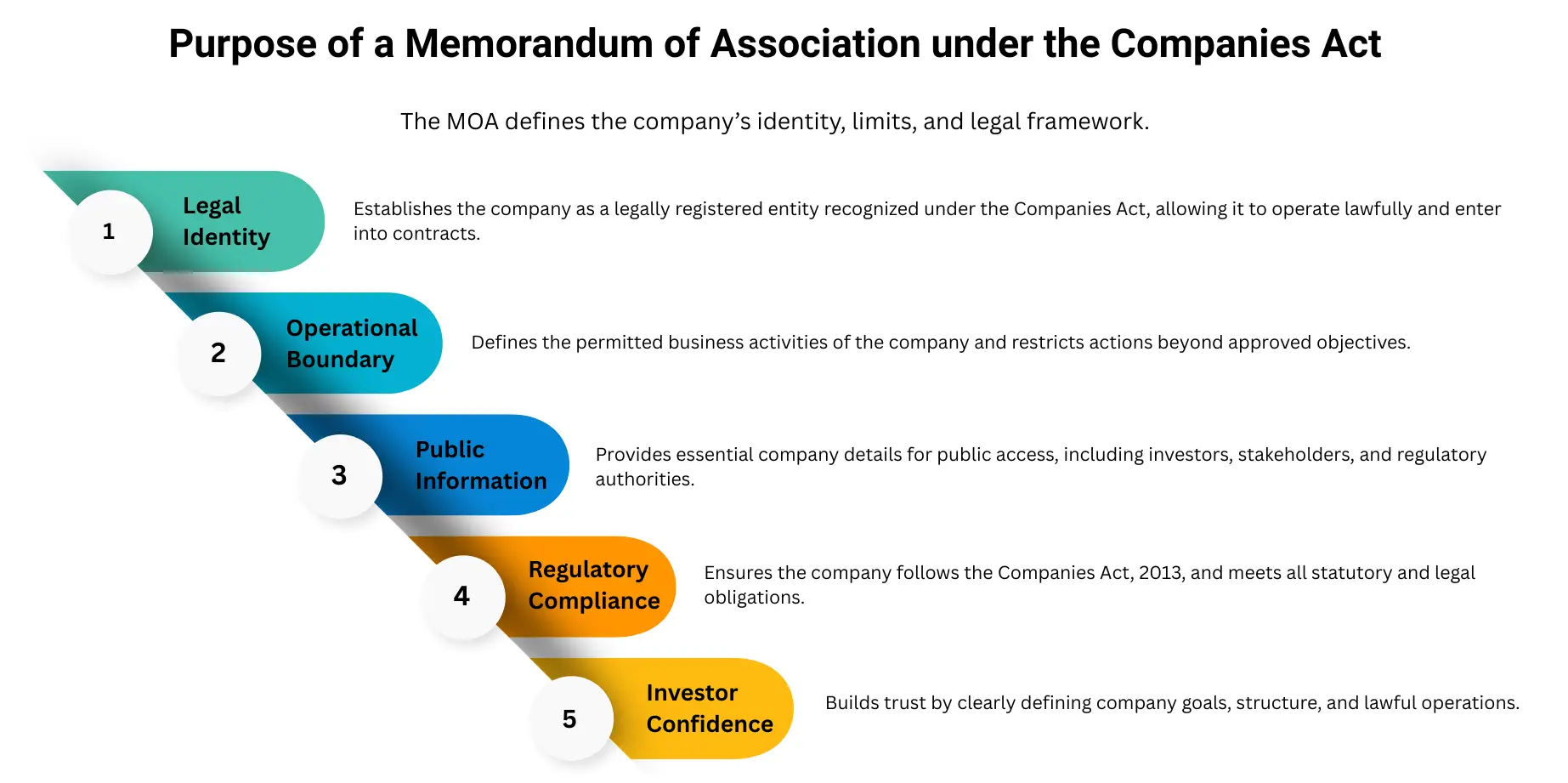
Purpose of a Memorandum of Association under the Companies Act 2013
To explain its purpose clearly, here are the main points:
- Legal Identity: This shows that the company is properly created and accepted by law. It proves that the company is real and allowed to do business.
- Operational Boundary: This explains what the company can and cannot do. It helps the company stay within its allowed work and not go beyond its purpose.
- Public Information: It gives basic information about the company to everyone, which includes people, investors, and government offices. It helps everyone to understand what the company wants to do.
- Regulatory Compliance: The MOA ensures the company follows the Companies Act 2013 and obeys all important rules.
- Investor Confidence: When a company has clear goals and simple rules, investors feel safer and trust the company more.
Key Clauses of a Memorandum of Association
The Memorandum of Association has several important parts that explain what a company is, what work it can do, and how it should operate. These parts act like simple rules that guide the company and help it follow the law correctly. Here are the clauses of the MOA:
- Name Clause in MOA: This clause shows the official name of the company. The name must be unique and must follow the rules under the Companies Act. If the company wants to change its name, it must get approval and update the MOA.
- Registered Office Clause: This clause shows the official state and address where the company receives notices and documents. A shift within or outside the state requires MOA alteration.
- Object Clause and MOA Alteration Needs: This clause defines the permitted goals and activities of the company. Expansion or change in business scope often leads to alteration of the object clause.
- Liability Clause: This clause states the liability limits of members, defining whether their liability is limited by shares or guarantee.
- Share Capital Clause: This clause describes the company’s authorized share capital and division. Any increase or alteration requires shareholder approval.
- Subscription Clause: This clause records the initial subscribers who created the company and their share commitments.
When is Alteration of MOA allowed under the Companies Act 2013?
A company can change its Memorandum of Association only in a few special situations mentioned in the Companies Act, 2013. The MOA cannot be changed freely because it shows the company’s main identity, purpose, and rules. Any change must follow the law and must be approved by the shareholders. Here are the situations when changes are allowed:
- Change in Objectives: If a company wants to add new work, change its business plan, or start a new activity, it must update its MOA. This makes sure the company does only the work that is legally allowed.
- Change in Name: When a company wants a new name for branding, a merger, or any other reason, it must alter its MOA. The new name must also be approved by the Registrar of Companies.
- Change in Registered Office: If the company moves its registered office from one state to another, the MOA needs to be changed. This helps the ROC keep correct records and send notices to the right address.
- Change in Authorized Share Capital: If the company wants more capital and plans to issue more shares, it must first increase its authorized share capital by updating the MOA.
- Any Change Required by Law: Sometimes, the government or a new rule may ask companies to update their MOA. In such cases, the company must make the required changes to follow the law.
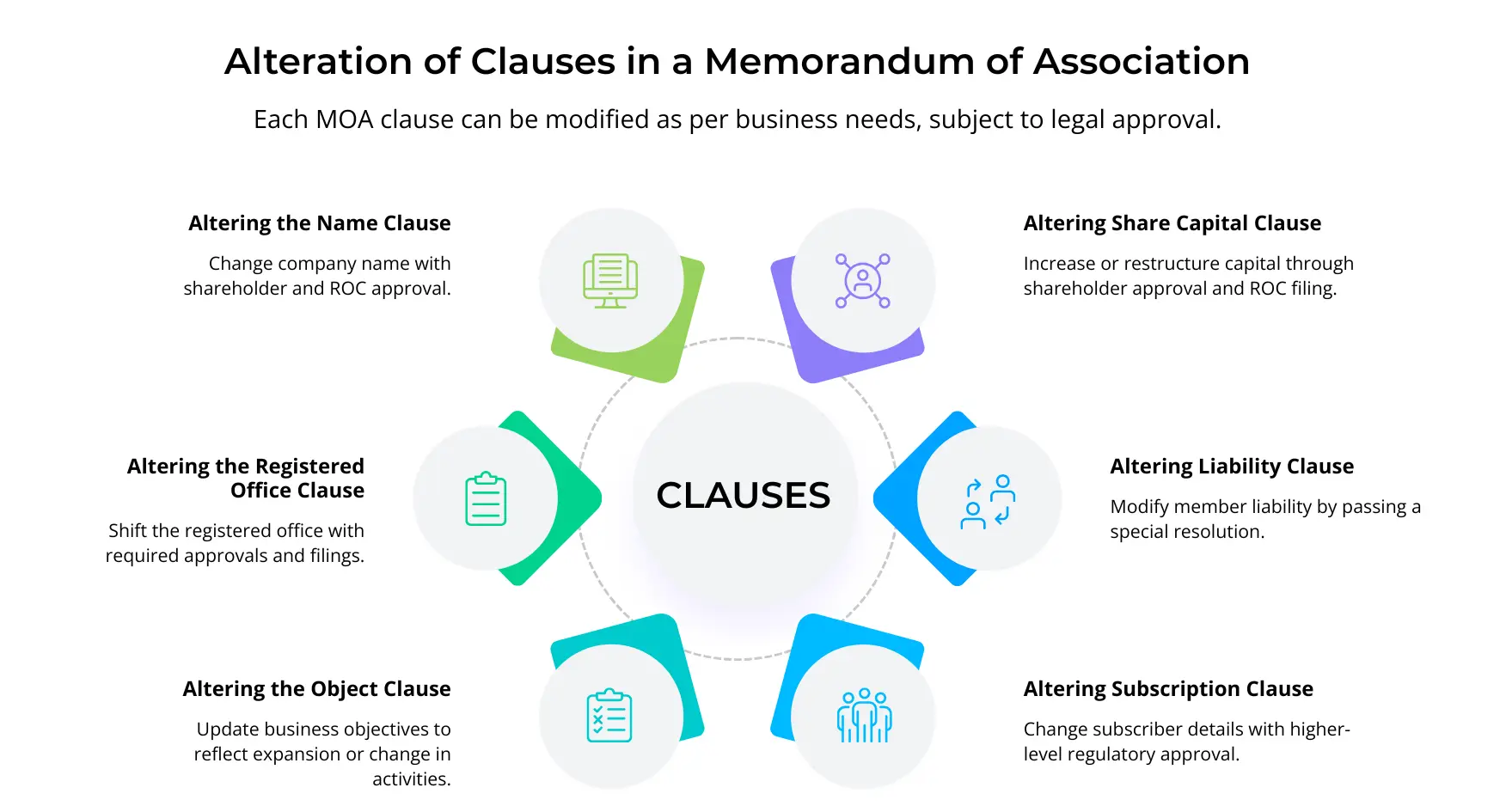
Alteration of Clauses in a Memorandum of Association
Each clause in the MOA can undergo modification based on business requirements. Alteration impacts legal identity, capital, or business scope. Such changes must follow the alteration of the MOA procedure under the Companies Act 2013. To understand how each clause is updated in compliance with the law, here are:
- Altering the Name Clause: Changing the name requires approval from shareholders, ROC, and, in some cases, the Central Government.
- Altering the Registered Office Clause: Shifting the registered office within the same state or to another state requires special approval and filings.
- Altering the Object Clause: Expansion or change in the business plan often leads to modification in the object clause through an MOA Amendment.
- Altering Share Capital Clause: Changes such as increasing or restructuring authorized capital require ROC filing and shareholder approval.
- Altering Liability Clause: Any increase or change in the liability of members requires strict compliance and special resolution.
- Altering Subscription Clause: Alteration in the subscription clause is rare and requires high-level approval because it affects founding details.
Documents Required for Alteration of MOA
The alteration of MOA requires proper documents to support the approval process and ROC filings. These documents help verify board decisions, member approvals, and updated clauses. To understand what documents support a complete MOA alteration filing, some of them are:
- Notice of the board meeting
- Board resolution approving MOA alteration
- Draft altered MOA showing changes
- Notice of Extraordinary General Meeting
- Form MGT-14 for filing resolutions
- ROC-required attachments
- Supporting documents, depending on the clause, are altered
Procedure for Alteration of MOA
The alteration of the MOA procedure follows a strict legal path under the Companies Act 2013. This ensures that every change is transparent and correctly recorded. Companies must follow board approvals, member approvals, and filings to complete any MOA Amendment. To understand how to alter MOA smoothly and legally, here are:
- Notice for Board Meeting: A formal notice is sent to the directors to call a board meeting. It includes the proposed MOA changes and the draft amendment for discussion.
- Board Meeting Approval: The Board reviews the proposed alteration, approves the draft change, and decides to conduct an Extraordinary General Meeting (EGM) for shareholder approval.
- Notice for EGM: A notice is shared with all members explaining the reasons for altering the MOA. It also includes the draft amended MOA for review.
- Shareholder Approval in EGM: Members vote on the resolution. A special resolution with at least 75% approval is required to finalize the MOA amendment.
- Filing with Registrar of Companies: The company submits the special resolution, updated MOA, and ROC forms, such as Form MGT-14, to complete the alteration process.
Why Corpseed?
Corpseed is one of the top consulting firms, offering comprehensive assistance in statutory compliance and guiding businesses through the necessary processes. Our team works with companies to make the alteration of MOA smooth, correct, and fully compliant with the Companies Act 2013. The process becomes easy because every step is handled with care, proper planning, and expert support. To explain how we help, here are the key points:
- Complete Legal Guidance: We help companies understand the legal rules for MOA alteration and explain each step in simple words.
- Drafting of MOA Amendments: We prepare the required MOA changes, resolutions, and supporting documents with full accuracy.
- Board and EGM Support: We guide businesses in issuing notices, drafting resolutions, and completing meeting-related formalities.
- Filing with ROC: We handle the preparation and submission of forms like MGT-14 and updated MOA documents to the Registrar of Companies.
- End-to-End Compliance Check: We ensure the entire MOA alteration process follows the Companies Act 2013 and all legal requirements.
- Continuous Assistance: We stay connected until the company receives final approval from the ROC, ensuring a smooth and stress-free experience.
Connect With Corpseed
Connect with the Corpseed team to discuss your requirements at IVR: 7558640644 or hello@corpseed.com. It takes 20–25 minutes to discuss the requirement.
Dedicated Manager
Once you discuss the requirement, we will align a dedicated Account Manager to understand your business needs and assist throughout the process.
Real Time Update
Track the progress of your application and always know what’s in progress and what’s done.
Job Completed
Once the job is completed, you will receive registrations & certifications directly to your email ID and at your doorstep.
Frequently Asked Questions
Quick answers to common questions about this service.
How does alteration in MOA and AOA take place?
Alteration in MOA and AOA takes place by passing a special resolution, preparing the updated documents, and filing the required forms with the Registrar of Companies.
How is alteration in object clause of MOA done?
Alteration in the object clause of the MOA is done when a company wants to change or expand its business goals. A special resolution and ROC approval are required.
How is alteration of capital clause of MOA carried out?
Alteration of the capital clause of the MOA is done when a company plans to increase or change its authorised share capital. The updated clause must be filed with the ROC.
Why is alteration of object clause of MOA needed?
Alteration of the object clause of the MOA is needed when the company wants to start new activities or change its business direction.
How is an altered MOA prepared?
An altered MOA is prepared after shareholders approve the changes. The document is rewritten with updated clauses and then filed with the ROC.
Is an altered MOA format available for use?
Yes, an altered MOA format is available, and it includes updated clauses that reflect the approved changes.
Can MOA be altered anytime?
MOA can be altered only when the Companies Act 2013 allows it and only after passing a special resolution.
Is there a format of special resolution for alteration of MOA?
Yes, a format of special resolution for alteration of MOA is used to record shareholder approval and must follow legal wording.
How to alter MOA and AOA step by step?
To alter MOA and AOA, the company must hold board and general meetings, pass a special resolution, and file the altered documents with the ROC.
How is MOA alteration completed legally?
MOA alteration is completed by passing a special resolution, preparing the updated MOA, and filing it with the ROC for approval.
How does MOA and its alteration work?
MOA and its alteration work as a legal process where changes are made only with shareholder approval and proper filings.
How does the procedure for alteration of MOA begin?
The procedure for alteration of MOA begins with a board meeting where proposed changes are discussed and approved.
What is the process of alteration of MOA?
The process of alteration of MOA includes issuing notices, passing resolutions, updating clauses, and filing documents with the ROC.
How is a resolution for alteration of MOA drafted?
A resolution for the alteration of the MOA is drafted in a formal format that includes the proposed changes and approval by shareholders.
Which clause of MOA cannot be altered easily?
The liability clause and subscription clause of MOA cannot be altered easily because they require strict legal compliance.
How does alteration in MOA happen legally?
Alteration in MOA happens legally through special resolution approval and ROC filing.
When is alteration of liability clause of MOA required?
Alteration of the liability clause of the MOA is required when a company changes the nature of members’ liability.
How is a board resolution for the alteration of MOA passed?
A board resolution for the alteration of the MOA is passed in a board meeting where directors approve the proposed changes.
What documents support alteration in MOA?
Documents include the special resolution, altered MOA, notices, and filing forms like MGT-14.
Need help?
Talk to an Expert
Get free guidance on the right service, improved documents & timeline.






















