Tyre Pyrolysis Plant Setup In India
The recycler of the Tyre Pyrolysis plant should register his business as an entity. It can be a sole proprietorship or partnership or company. If the recycler owns a company, he should register it with the Registrar of Companies.
Schedule a Call Back
Why wait? Start now!
Get Support AnytimeBusinesses we've worked with
Showing 348 clients- Plant setup clients (DPR, CTE, CTO)
- Servotech Renewable Power System · Intangles Lab · Alten India · Saurya Urja Company of Rajasthan · 20Cube Logistics Solutions · Adit Buildwell · Bake Wish · Ecowise Trading · Magnum Aluminium · PMS Waste Management · GS E-Commerce · Beaucience India · Jiva Ayurveda Pharmacy · Radical Aftermarket Services · SNS Metpro Industries · Enershell Alloys and Steel · Gorevive · Innovation Elephants · P P Bafna Ventures · Sun Mobility · Daebak India Recycler · Ganesh Foundry & Cast · Ganix Rubber Recycling · Pashidaa E Waste Copper Battery Recycling PLT Company · RSV Seeds & Agro Chemicals Products · Boulevard Hotel and Resorts · Dev Plast Privat E · Flexfit Activewear · Resurge Green Tech · SAM Constructions · Abhinandan Jan Kalyan Society · GCM Carbon · Infrathon Projects · Inland Speciality Metals · Moore Pipe India · R K Laxmi General Sales · S G Overseas · Shreeji Anand Resort · SR Polygrain · Switch 2 Nature · Blubble · M-Swasth Solutions · Krisba Healthcare · Meritech India · Proximise · Enzolt Energy · Rays Global Energypower · Champion EL COM · +45 more
An Overview of Tyre Pyrolysis Plant Setup In India
The growth of the automobile industry in India also resulted in the generation of tyre waste on a large scale. Tyre waste degrades over time and releases harmful gas into the air and chemicals into the soil and water which causes pollution to the environment. The solution is the recycling of waste tyres and one of the popular tyre recycling methods is Tyre Pyrolysis Plant.
This is a profitable business opportunity as well as a solution to waste tyre-caused pollution. But before someone sets up a Tyre Pyrolysis Plant, he needs to understand the technical, financial and legal requirements to set up such a facility. The central government prescribes a framework for recyclers to follow. In the absence of such compliance, legal action may be taken against such recyclers and penalty may be incurred.
What is Tyre Pyrolysis Plant?
Tyre Pyrolysis Plant is a recycling plant that converts waste into energy. It can recycle various substances including tyres. It can convert the tyre waste into fuel oil. It also gives the by-products such as steel wires, carbon black, and gas. It heats the waste which generates a gas. Then the recycler condenses this gas into liquid form and in this manner, we get the fuel oil also known as pyrolysis oil.
Benefits of Tyre Pyrolysis Plant Setup
Tyre Pyrolysis Plant has many benefits to the environment, consumers and manufacturers of tyres. Some of the major benefits are as follows-
- Environmental Benefits
The source of waste tyres is the consumers and other entities that are involved in the business of tyres or dumping yards. Automobile repair shops may have stocks of old tyres as it provides tyre replacement service. These tyres are usually dumped into junkyards where they cause serious harm to nature. The recyclers at the pyrolysis plant collect all these waste tyres and save the environment from potential damage.
- Economic Benefits for Recyclers
Tyre Pyrolysis plant also provides economic benefits to not just the recyclers but also the manufacturers. The recyclers collect or buy the waste tyres at a very low cost while they sell the end products generated through the recycling process at a higher cost and enjoy the profit.
- Economic Benefits for Manufacturers
Tyre Pyrolysis plant generates steel, carbon black and fuel oil as the end product. The recyclers sell these items to the manufacturers. The manufacturers use this recycled raw material and fuel source instead of costlier new resources. Hence the manufacturers also enjoy the financial benefits of the Tyre Pyrolysis Plant.
Types of Tyre Pyrolysis Plant Setup
There are two types of Tyre Pyrolysis Plants. Their working principles are the same but both the machinery uses different methods to reach the same result. The two types of Tyre Pyrolysis Plants are as follows-
- Batch Type Tyre Pyrolysis Plant Setup
This type of Tyre Pyrolysis Plant uses the batch method for the processing of raw materials. The waste tyres are fed into this machinery in batches. The recyclers collect the generated oil and by-products from the machinery before feeding the next batch. This method is labour-intensive and incurs more operational costs in comparison to the Continuous Type Tyre Pyrolysis Plant. This method is suitable for recyclers operating at a lower scale.
- Continuous Type Tyre Pyrolysis Plant Setup
This type of Tyre Pyrolysis Plant uses a continuous mechanism for the feeding of raw material. The recyclers do not need to wait for the process to complete before feeding more raw material. The machinery automatically processes the waste tyres and collects the generated products. This method is not labor-intensive and incurs less operational costs in comparison to the Batch Type Tyre Pyrolysis Plant. This method is suitable for recyclers operating at a higher scale.
What are the Requirements of Tyre Pyrolysis Plant Setup?
A recycler should keep various points in mind when setting up a Tyre Pyrolysis Plant. The ultimate requirement of this plant is the waste tyres so the recycler should ensure that the raw material supply is always available as it is necessary to keep the plant running. The recycler should also consider the size of the supply and accordingly choose the type of Tyre Pyrolysis plant. He should also ensure that the plant is following the legal provisions as prescribed for the recyclers in the respective jurisdiction. To successfully run this business for a considerable amount of time he also needs to make contact with the regular buyers of his products. Lastly, no one without the knowledge and experience in recycle industry be able to survive the day-to-day challenges in this work hence these skills are necessary for the recycler who is setting up a Tyre Pyrolysis Plant.
Machinery Required For Tyre Pyrolysis Plant Setup
As previously discussed, there are two methods of Tyre Pyrolysis. And both of these methods require different machinery. So you need to figure out the size and supply of your Tyre Pyrolysis plant first and then accordingly buy a Pyrolysis machine for the plant. Along with it, the recycler will need a tyre shredding machine and an oil purification machine. If he wants to also utilise the remaining steel and rubber waste then he can also buy the fibre and steel separator, fibre crusher and balers etc.
Documents Required For Tyre Pyrolysis Plant Setup
The Government of India has classified tyre waste as hazardous waste under the Hazardous Waste Management Rules, 2016 and also prescribed EPR obligations for Tyre Producers under the amendment made to these rules in 2022. Considering the harmful nature of tyre waste, the pollution control authorities closely monitor all the stakeholders involved in the transport, storage and processing of waste tyres. Hence recyclers need to follow the prescribed guidelines carefully and prepare all the required documents in advance to avoid any future penalties. The major documents required for Tyre Pyrolysis Plant Setup are as follows-
- Business Registration
- MSME Registration
- GST and VAT Registration
- Factory Licence
- Labour Licence
- CTE/CTO from the State
- Trade Licence
- NOC (Town Planning, Fire/Electricity, Municipality, Pollution Board)
- EPF and ESIC
The recycler may need a slightly different list of documents for his Tyre Pyrolysis Plant based on the size, capital investment, location and jurisdiction of the plant. For example, Small Enterprises need MSME registration, a partnership requires a partnership deed and a company requires registration under the Registrar of Companies.
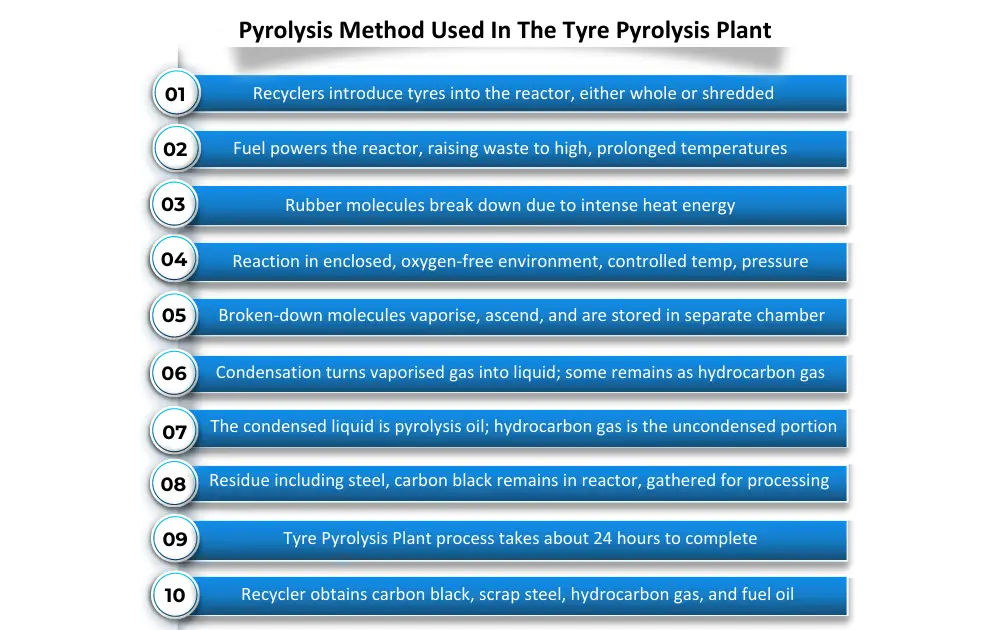
Pyrolysis Method Used in the Tyre Pyrolysis Plant
The recyclers use the following pyrolysis method to convert the tyre waste into valuable substances using the Tyre Pyrolysis Plant-
- The recyclers fed the tyres into the reactor in whole or shredded pieces.
- They use fuel to power the reactor and heat the waste to a high temperature for a long duration.
- The molecules of the rubber start breaking down into smaller particles because of the excessive heat energy.
- This reaction takes place in an enclosed oxygen-free environment with controlled temperature and pressure.
- These broken-down molecules vaporise and travel upwards where the system captures them and store them in a separate chamber.
- This oily gas is there condensed and converted into liquid form but a portion of it does not get condensed because of the smaller size of the molecules.
- This left-out gas is called hydrocarbon gas and the liquified gas is called pyrolysis oil.
- The waste including the steel and carbon black remains in the reactor which is collected for further segregation and processing.
- This is the complete process that takes place in a Tyre Pyrolysis Plant and requires twenty-four hours to complete.
- The recycler receives carbon black, scrap steel, hydrocarbon gas and fuel oil from a Tyre Pyrolysis Plant.
How to Setup a Tyre Pyrolysis Plant In India?
The processes of setting up a Tyre Pyrolysis Plant involve obtaining the required registrations, licenses, NOCs, authorizations and certifications. These steps are elaborately described below-
Tyre Pyrolysis Plant Registration In India
The recycler of the Tyre Pyrolysis plant should register his business as an entity. It can be a sole proprietorship or partnership or company. If the recycler owns a company, he should register it with the Registrar of Companies. While in the case of a partnership, he should sign a partnership deed with his partners. If the enterprise qualifies for registration under the Ministry of Small, Micro and Medium Enterprises, the recycler should register his Tyre Pyrolysis Plant under the MSME Act. It allows you to claim various government benefits for MSMEs. The recyclers should also register the Tyre Pyrolysis Plant for GST and VAT. The central government has a web portal for this purpose and the process can be completed online.
Tyre Pyrolysis Plant Licence in India
The recycler should obtain the licence for his factory, labour and trade. This licence gives permission to the recycler to run a factory at the specified location, hire labourers on wages and trade the raw materials and well as the generated products from his plant within the specified limits. These Tyre Pyrolysis Plant Licenses have a validity attached to them and the recycler needs to renew the duration of these licences before the date of expiry.
Tyre Pyrolysis Plant Authorisation In India
The recycler should also obtain the consent of the respective state to run the Tyre Pyrolysis Plant. The state government gives this consent in two parts to ensure that the recyclers are working as per the specified guidelines. One is Consent to Establish and another is Consent to Operate. The recyclers can complete this process online through the state-managed online web portal by providing all the requisite information about their plant, and the involved process.
NOCs for Tyre Pyrolysis Plant In India
The recycler should acquire the Non-Objection Certificates (NOCs) from the electricity department, fire department, municipality, and town planning by submitting the respective application form. These NOCs help the administration to keep track of the extensive activities happening in the jurisdiction. It ensures that the entrepreneurs are using only the designated locations to construct any commercial facility or industrial institution so that the supply of electricity is adequate, the fire department is capable of managing any emergencies, and it does not interfere with the day-to-day activity of civilians. The authorities check these perimeters before issuing a NOC.
Other Compliances for Tyre Pyrolysis Plant In India
Apart from the steps mentioned above, the recyclers should adhere to other compliances related to their Tyre Pyrolysis Plant in India. If the number of employees and their salary qualifies for registration under EPF (Employee’s Provident Fund) and ESIC (Employees State Insurance Corporation) then the recycler has to follow the EPF and ESIC rules. The recyclers also need to sell EPR certificates to the producers after recycling their tyre waste. They also need to submit the details of the number of recycled tyres, generated products, and sold recycling certificates on the CPCB portal online. They also need to submit details of quarterly and annual returns.
Cost of Operating a Tyre Pyrolysis Plant In India
To set up a Tyre Pyrolysis Plant, the recycler must consider several costs such as land, machinery, raw materials, labour salary, utility bills and fees for legal documents. The cost of land depends on ownership. It is minimal if you own it, maximum if you buy it, and you have to pay monthly rent and a security deposit if you lease it. The size of the land also affects the cost. If you have many raw material suppliers, you can start a large plant otherwise a small-scale plant is better. A small-scale plant may cost around thirty to fifty lakh rupees while a large-scale one may cost up to one crore rupees. The cost mainly goes towards land and machinery.
Validity and Renewal of Tyre Pyrolysis Plant Setup
The validity of a Tyre Pyrolysis Plant Setup depends on the durability of the machines but that is not the concern here. Here the validity which matters more is the validity of documents sought out to establish the Tyre Pyrolysis Plant in India. The different authorities that issued the documents have prescribed the validity for each of them and the recycler is responsible to renew this permission from time to time as long as he is running the plant and recycling the waste tyres.
Why Corpseed?
We, at Corpseed, have a team having extensive knowledge relating to various horizons of environmental laws and business regulations applicable in India as well as the compliances of running a recycling plant. We perform desk-based research, documentation, and coordination to provide consultation to clients in establishing their businesses and fulfilling the necessities as prescribed by the applicable rules.
Connect With Corpseed
Connect with the Corpseed team to discuss your requirements at IVR: 7558640644 or hello@corpseed.com. It takes 20–25 minutes to discuss the requirement.
Dedicated Manager
Once you discuss the requirement, we will align a dedicated Account Manager to understand your business needs and assist throughout the process.
Real Time Update
Track the progress of your application and always know what’s in progress and what’s done.
Job Completed
Once the job is completed, you will receive registrations & certifications directly to your email ID and at your doorstep.
Frequently Asked Questions
Quick answers to common questions about this service.
What is Tyre Pyrolysis Plant?
A tyre pyrolysis plant is a recycling facility that recycles tyre waste into fuel oil. This fuel oil is also known as pyrolysis oil and is used as fuel in the manufacturing industry.
What is the need for a Tyre Pyrolysis Plant?
A Tyre Pyrolysis Plant plays a crucial role to keep the number of waste tyres available in circulation in check and keep the environment free from toxic gas released by these tyres when left in the open.
What are the benefits of a Tyre Pyrolysis Plant?
A tyre Pyrolysis Plant provides various benefits including a safe environment, disposal of tyre waste, business opportunities, manufacturing cost savings, and encouragement of a recycling culture.
What are the types of Tyre Pyrolysis Plants?
Tyre Pyrolysis Plants are divided into two parts based on their working mechanism-
- Batch Type Tyre Pyrolysis Plant
- Continuous Type Tyre Pyrolysis Plant
What are the requirements to set up a Tyre Pyrolysis Plant In India?
Any person or business entity can set up a Tyre Pyrolysis Plant if it knows tyre waste processing and has experience in the recycling industry. He must have sufficient funds, the raw material (tyre waste) suppliers and potential buyers. If he is committed to learning the technicalities and following all the legalities, then he can set up a Tyre Pyrolysis Plant in India.
Which machines are required to set up a Tyre Pyrolysis Plant In India?
The recycler needs various machines to establish a Tyre Pyrolysis Plant in India. These machines include the Tyre Shredder, Pyrolysis Reactor, Fibre and Steel Separator, Magnetic Separator, Oil Purifier, Weighing Balers etc.
What documents are required to set up a Tyre Pyrolysis Plant?
A recycler needs the following documents to set up a Tyre Pyrolysis plant and start recycling tyre waste-
- Business Registration
- MSME Registration
- GST and VAT Registration
- Factory Licence
- Labour Licence
- CTE/CTO from the State
- Trade Licence
- NOC (Town Planning, Fire/Electricity, Municipality, Pollution Board)
- EPF and ESIC
What method is used by the Tyre Pyrolysis plant for oil extraction from tyres?
As the name suggests, Tyre Pyrolysis Plants use the Pyrolysis Method to extract oil from waste tyres. The pyrolysis reactor heats these waste tyres, breaks and converts them into small light molecules that fly in the gaseous state and are collected in a separate chamber. This chamber liquifies this collected gas and converts it into liquid oil using a condensation process.
How to register a Tyre Pyrolysis Plant?
The recycler needs to register his plant as a business entity. It can be a proprietorship, partnership or company. He should also obtain the MSME registration, GST registration and VAT registration for Tyre Pyrolysis Plant.
How to obtain the required licences for Tyre Pyrolysis Plant?
The recycler needs to acquire the requisite licences for the Tyre Pyrolysis Plant. These licenses include the factory licence, labour licence and trade licence. They provide permission for a limited time to the recycler for establishing and operating a factory, hire the labourers and trade the goods. These licenses for Tyre Pyrolysis Plant are subject to the validity attached to them and should be renewed from time to time.
What authorisations have to be acquired for the set up of a Tyre Pyrolysis Plant?
The recycler should obtain permission from the State Pollution Control Board for the set up of his Plant. This is called the authorisation of the Tyre Pyrolysis Plant. Under this authorisation, the recycler gets two certificates, the consent to establish and the consent to operate abbreviated as CTE and CTO. These consents can be obtained through the web portal by submitting the application form online.
How to get NOCs for Tyre Pyrolysis Plant Setup?
You need the NOCs to establish and run your Tyre Pyrolysis Plant. You can obtain these NOCs from the offices of the respective departments of electricity, fire, pollution etc. after submitting the required details of your plant.
Is there any EPR Compliance for Tyre Pyrolysis Plant Setup?
Is there any EPR Compliance for Tyre Pyrolysis Plant Setup?
What is the cost of operation for a Tyre Pyrolysis Plant?
The cost of setting up and operating a Tyre Pyrolysis Plant varies depending on the size and location of the plant. For a small-scale plant, you need around thirty to fifty lakhs of capital investment while for a large-scale plant, you may need more than one crore of the investment.
Are there any validities and renewals involved in the Tyre Pyrolysis Plant Setup?
Yes, the documents prepared for the Tyre Pyrolysis Plant Setup have some validity attached to them. The recyclers need to renew these documents including licences, certifications, NOCs and the authorisations for the Tyre Pyrolysis Plant from time to time.
Need help?
Talk to an Expert
Get free guidance on the right service, improved documents & timeline.