
EPR Plastic Registration for Importers
EPR Plastic Registration for Importers is for those importing plastic packaging or packaged goods into India. Corpseed helps with CPCB EPR registration, documentation, application submission, packaging classification, annual reporting, and other plastic waste management requirements in India.
Schedule a Call Back
Why wait? Start now!
Get Support AnytimeBusinesses we've worked with on plastic EPR
Showing 1948 of 1,700+ clients served since 2018- Chemicals and materials
- Brenntag Ingredients India · Reliant Packaging Films · Taurus Packaging · Axel Polymers · Lintec India · Kumar Organic Products · HP Adhesives · DDP Speciality Products India · +5 more
- Electronics and technology
- Colt Technology Services India · Emerson Automation Solutions Intelligent Platforms · Intangles Lab · Shindengen India · Emerson Process Management (India) · Lianchuang Electronic India · Emerson Process Management Chennai · Hayakawa Electronics India · +5 more
- Pharma and healthcare
- Beryl Drugs · Ascent Meditech · Eli Lilly and Company (India) · Q-Line Biotech · Rajasthan Antibiotics · G D Pharmaceuticals · Micro Labs · ADK Health Care · +5 more
- Engineering and manufacturing
- Essel Mining & Industries · Juki India · Hilti India · Bundy India · Hilti Manufacturing India · KJS Cement (I) · Mangalam Cement · Birla Precision Technologies · +5 more
- Food and consumer goods
- Onest · AVT McCormick Ingredients · Akay Natural Ingredients · Ugraya Foods and Feeds · AVT Natural Products · Jalpaiguri Food Industries · Param Dairy · Esther Parfumerie · +5 more
- Logistics and trade
- Siddhartha Logistics · Siddhartha Logistics Ftwz · Honda Trading Corporation India · Dksh India · MOL Logistics (India) · Fibs Logistics India · Zenexpress Logistics · +4 more
- More clients
- Nilkamal
What is EPR Plastic Registration for Importers
Importing plastic packaging or finished goods packed in plastic? Your company could be required to register with EPR Plastic Registration for Importers under the Plastic Waste Management Rules, 2016 (amended).
The requirement depends on your import activities, the packaging categories and the quantities involved. You'll need business documents and import records, and you'll pay the applicable EPR registration fees when filing on the CPCB portal.
Registration is only the first step. Importers must also understand annual EPR targets, recycling certificates, recycled-content requirements, annual returns and penalties for non-compliance.
Corpseed provides CPCB EPR registration services, from checking applicability and classifying packaging to preparing documents, filing applications, handling regulatory queries and supporting plastic waste compliance. Contact our team to discuss your registration requirements and costs.
Understanding EPR Plastic Registration for Importers
Under Extended Producer Responsibility (EPR), companies that place plastic packaging on the market must ensure responsibility for those products. In India, the system is regulated by the Plastic Waste Management Rules, 2016, along with its amendment, the EPR Guidelines that came into effect on 16 February 2022.
The rules cover Producers, Importers and Brand Owners (PIBOs), along with other specified entities. Importers dealing in plastic packaging or products packed in plastic must obtain the applicable registration and meet their prescribed EPR obligations.
Consider a company importing kitchen appliances. Each product may arrive in a plastic tray, protective film and outer wrapping. Although the company sells appliances rather than plastic, the imported packaging may still fall under the EPR requirements.
CPCB EPR registration for importers is carried out through the Common EPR Portal. Registration enables businesses to manage applicable reporting and compliance activities.
Getting registered does not mean the compliance work is finished. Importers must also meet their applicable annual EPR targets, maintain records and submit the required returns.
Who Needs EPR Plastic Registration in India?
Businesses importing plastic packaging or finished goods containing plastic packaging may require EPR registration. The requirement depends on the material type, how it is used and the importer's activities.
| Type of importer | Examples | EPR registration consideration |
| Plastic packaging importer | Bottles, jars, containers and packaging material | Plastic packaging EPR obligations generally apply where covered by the rules. |
| Finished-goods importer | Electronics, cosmetics, toys and household products packed in plastic | Plastic packaging around imported goods may create an EPR obligation. |
| Flexible or multilayer packaging importer | Plastic films, pouches, sachets and composite packaging | Applicable packaging categories and quantities need to be declared. |
| Plastic raw-material importer | Plastic films, pouches, sachets and composite packaging | Specific registration and reporting requirements may apply. |
| Intermediate-material importer | Films, preforms and materials used to make plastic packaging | Applicability depends on the material and the business activity. |
Importers of finished products should pay particular attention to packaging. A business importing cosmetics in plastic bottles or electronics in plastic trays may have an EPR obligation even though the goods themselves are not plastic packaging.
The Plastic Waste Management (Amendment) Rules, 2024, expanded the definition of an importer to include plastic raw materials and intermediate materials used to manufacture plastic packaging.
Importers of plastic raw materials have additional requirements. Rule 13 provides for registration with the concerned State Pollution Control Board (SPCB) or Pollution Control Committee (PCC). The EPR framework also identifies raw-material importers among entities covered by centralised registration provisions.
Businesses involved in more than one activity should examine each applicable registration category separately.
Types of Plastic Packaging Covered Under EPR
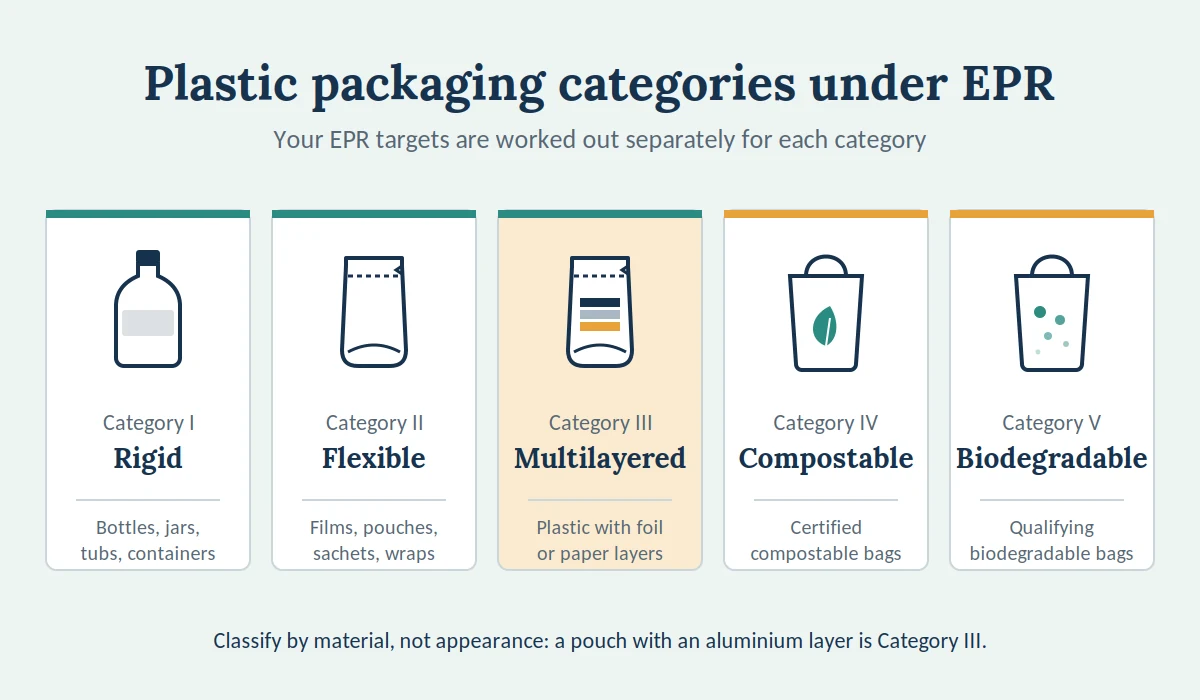
The EPR framework classifies plastic packaging into five categories. These categories help determine the applicable reporting requirements and EPR obligations.
| EPR category | Type of plastic packaging | Common examples |
| Category I | Rigid plastic packaging | Plastic bottles, jars, rigid tubs and containers |
| Category II | Flexible plastic packaging, plastic sheets, carry bags, sachets and pouches | Films, plastic-only multilayer pouches and flexible wrappers |
| Category III | Flexible plastic packaging, plastic sheets, carry bags, sachets and pouches | Plastic-aluminium pouches and certain composite packs |
| Category IV | Plastic packaging made of compostable plastics | Qualifying compostable carry bags and packaging sheets |
| Category V | Plastic packaging made of biodegradable plastics | Qualifying biodegradable carry bags and packaging sheets |
The correct category depends on the actual material composition.
For example, a flexible pouch made entirely of different plastic layers may fall under Category II. A pouch containing plastic and aluminium foil may fall under Category III.
An imported product can also involve several packaging components. A cosmetic product may have a rigid bottle, plastic cap and flexible wrapping, each of which needs to be assessed as applicable.
Compostable and biodegradable claims must meet the relevant legal and technical requirements. A supplier describing packaging as environmentally friendly is not sufficient evidence for placing it under Category IV or V.
Benefits of EPR Registration for Importers
Obtaining the required EPR registration for plastic waste is very important for importers to comply with their legal obligations.
Some of the advantages that one can derive from the process include:
- Compliance with regulations: The registration process helps covered importers comply with the registration obligations under the Plastic Waste Management Rules.
- EPR targets management: Registered importers can use the portal to report packaging quantities and manage targets.
- Better record management: Maintaining organised packaging, import and compliance records makes regulatory reporting and verification easier.
- Business documentation: EPR registration details may be requested by retailers, distributors or other commercial partners during supplier checks.
- Reduced compliance risks: Proper registration and accurate reporting help businesses avoid violations caused by missing or incorrect information.
Registration alone does not replace annual compliance, product-specific approvals or other permissions required for import activities.
Documents Required for EPR Plastic Registration
Importers applying for CPCB EPR registration need to provide business details, authorised person information and records of the plastic packaging associated with their imports.
The required documents may vary according to the business structure, operating locations and information requested through the CPCB portal.
Business Documents
- PAN of the business
- GST registration details and supporting certificate
- Certificate of Incorporation or other applicable proof of business constitution
- Importer Exporter Code (IEC)
- Registered office and unit address details
- Supporting documents relating to the company category, where required
The CPCB importer registration manual includes IEC details in the application requirements. Businesses that need an IEC can seek assistance through Corpseed's Import Export Code Registration service.
Authorised Person Details
- Details of the authorized person, including name and designation
- PAN number and other details as per the portal
- Mobile number and e-mail ID of the registered person
- Authorization letter / Board Resolution, if any
- Signature and necessary declarations
Import and Plastic Packaging Records
- List and description of imported products
- Representative photographs of plastic packaging
- Category-wise plastic packaging quantities
- Relevant import invoices and Bills of Entry
- Financial-year-wise packaging information
- State-wise pre-consumer and post-consumer plastic packaging details, where applicable
- Export quantities, if relevant
- Covering letter and other supporting declarations
CPCB's current importer registration guidance asks for packaging information for the previous two financial years, with the reporting period linked to the year the business started operating.
Importers should check that their declared quantities agree with the available commercial and customs records. Incorrect packaging classification, inconsistent company details or unsupported quantities can lead to queries about the application.
Get Assistance with EPR Registration Documents
EPR Plastic Registration Process for Importers
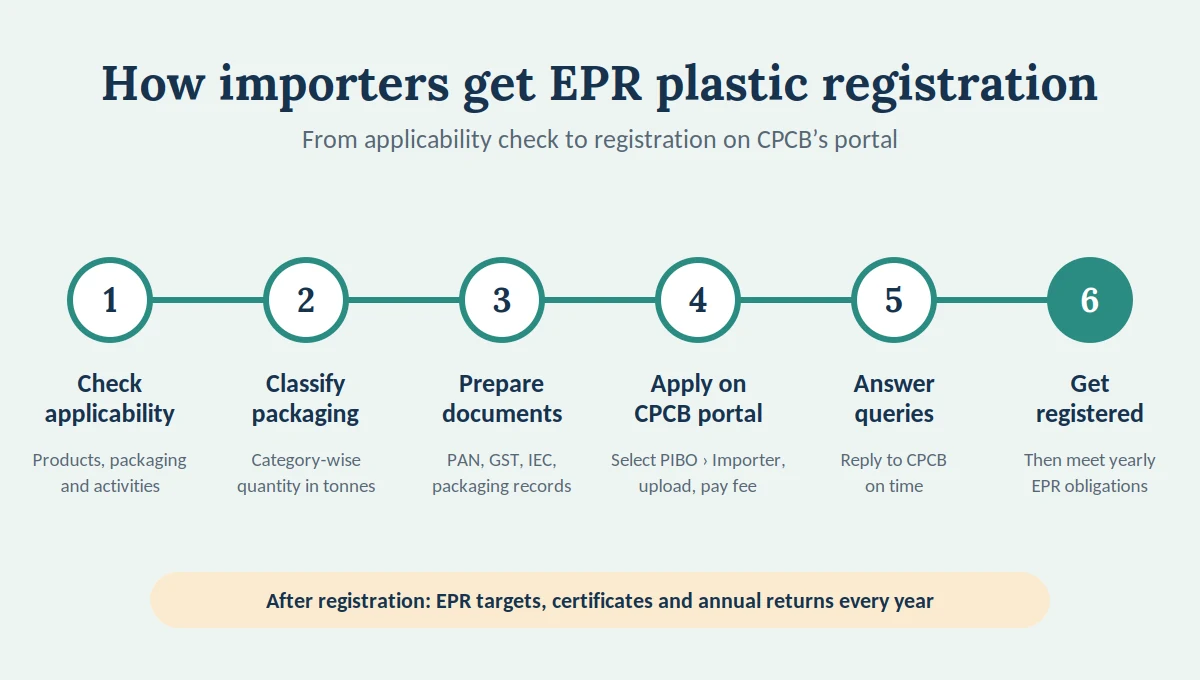
Importers in India complete the EPR registration process online through the CPCB Common EPR Portal.
The main steps are explained below.
The EPR registration process for importers in India covers these application stages and the checks needed before submission.
Step 1: Check EPR Applicability
Review the products, packaging materials and quantities the business imports. Determine whether the business needs to register as an importer under the PIBO framework or requires any other registration.
Step 2: Identify Plastic Packaging Categories
Examine the imported packaging and classify it under the EPR categories. Compute the packaging quantities in tonnes for each category.
Step 3: Prepare the Required Documents
Collect the business PAN, GST details, IEC, authorised person information and packaging records.
Check the documents before filing to identify differences in company names, addresses and reported quantities.
Step 4: Apply Through the CPCB Common EPR Portal
Visit the CPCB Common EPR Portal and complete the registration and onboarding process.
For the applicable PIBO importer route:
- Select Plastic Waste Management.
- Choose PIBO as the applicant category.
- Select Importer.
- Complete the required company and packaging information.
- Upload the supporting documents.
- Review the application and pay the applicable government fee.
The portal lets you save your application before submitting.
Step 5: Application Processing and Clarifications
Following submission and payment of the required fee, the application will be forwarded to the relevant authority for review.
The authority may request additional information or clarification. It is the responsibility of the applicant to follow up on their application and respond to any queries raised.
Step 6: Get Your EPR Registration
Once your application is approved, you can retrieve the registration from the portal.
An EPR certificate for importers refers to the registration approval and should not be confused with the separate waste-processing certificates used to meet annual EPR targets.
The importer must then maintain the relevant records and complete the applicable annual compliance activities.
If a business operates under more than one PIBO category, the portal allows separate category registrations under the same Common EPR account, subject to its requirements.
Apply for EPR Registration with Corpseed
EPR Plastic Registration Fees and Processing Time
The EPR plastic registration cost in India is determined by various factors. CPCB's current Common EPR Portal guidance specifies the following application fees for PIBOs based on plastic waste generation.
CPCB EPR registration fees (PIBO government application fee):
| Plastic waste generation per year | Government application fee |
| Less than 1,000 tonnes (TPA) | ₹10,000 |
| 1,000–10,000 tonnes (TPA) | ₹20,000 |
| More than 10,000 tonnes (TPA) | ₹50,000 |
These amounts are the application fees listed in CPCB's PIBO registration guidance. The portal calculates and displays the final amount payable.
In addition to the government fee, an importer may incur other expenses.
When comparing EPR registration cost estimates, check whether the quote includes the CPCB application fee, professional support and any annual compliance services.
- Professional consultation fees: Charges for document preparation, application filing and assistance with regulatory queries.
- Annual compliance expenses: Costs relating to record management, EPR target fulfilment and return filing.
- Cost of obtaining EPR certificates: Costs incurred to obtain the required EPR certificates.
- Other charges: Other charges that may be applicable as per the relevant portal/regulatory requirements.
How Long Does EPR Plastic Registration Take?
Processing time depends on document readiness, application accuracy and the review undertaken by the concerned authority.
Applications requiring corrections or additional information may take longer. A fixed approval timeline should not be assumed without confirmation from the current regulatory procedure.
Importers can contact Corpseed for a quotation covering professional EPR registration services and assistance with the application process.
Request EPR Registration Fee Details
EPR Targets and Annual Compliance Requirements for Importers
EPR registration is a one-time requirement under the relevant PIBO provisions, but importers remain responsible for complying with applicable EPR obligations.
The scope of EPR compliance for importers depends on their packaging categories, business activities and the financial year involved.
Importers must track packaging quantities, fulfil prescribed targets and submit the required compliance information.
EPR Target Calculation
EPR targets are determined under Schedule II of the Plastic Waste Management Rules, using the applicable category-wise packaging data.
The CPCB portal calculates and displays relevant EPR targets based on the information the applicant submits.
Supporting documents need to be kept by importers for the amounts that will be used in these computations.
EPR Certificates and Obligations for Recycling
Importers can satisfy their obligation to process plastic waste in accordance with EPR certificates that are issued through Plastic Waste Processors (PWPs).
The certificates must correspond to eligible processing activities and quantities. Transactions should be properly recorded through the designated system.
Businesses can also seek assistance with EPR Compliance for plastic waste and ongoing target and certificate-related requirements.
Recycled Plastic Content Requirements
The Plastic Waste Management (Amendment) Rules, 2026, notified on 31 March 2026, contain specific recycled-content obligations for importers.
For the financial year 2026-27, the notified category-wise targets are:
| Plastic packaging category | Recycled-content target for FY 2026–27 |
| Category I - Rigid plastic packaging | 40% |
| Category II - Flexible plastic packaging | 10% |
| Category III - Multilayered plastic packaging | 5% |
These figures represent the prescribed recycled-content obligation as a percentage of imported plastic packaging for the year, subject to the provisions and exemptions in the rules. For Category III, the obligation is limited to the weight of the plastic layers.
The amendment specifies that recycled plastic already used in imported material cannot be counted towards fulfilling the importer's obligation. Instead, it provides for an equivalent-quantity certificate mechanism involving Producers, Importers and Brand Owners that have exceeded their recycled-content obligations.
CPCB is responsible for developing the mechanism for these certificate exchanges.
The rules also provide exemptions where recycled plastic use is not permitted under an applicable law, regulation or mandatory standard. Such exemptions must be supported by the relevant legal provision.
Do not confuse these recycled-content certificates with ordinary EPR waste-processing certificates.
EPR Annual Return Filing
Registered importers must file the applicable annual EPR return, reporting relevant packaging quantities, targets and compliance activities.
FY 2025-26 filing update: The Ministry of Environment, Forest and Climate Change issued an Office Memorandum dated 28 August 2026 extending the annual-return deadline for PIBOs to 31 December 2026.
Nevertheless, according to CPCB’s Common EPR Portal as of 27 October 2026, the annual return module for FY 2025-26 is not available yet, and a new filing schedule will be provided once the functionality is available.
Importers should follow subsequent CPCB instructions before submitting their returns.
Maintaining EPR Compliance Records
Importers should retain their packaging calculations, supporting import records, certificate transactions, annual return information and relevant regulatory correspondence.
These documents help substantiate the information reported through the portal.
Penalties for Non-Compliance with Plastic EPR Rules
Businesses covered by the Plastic Waste Management Rules must comply with the applicable registration, reporting and EPR obligations.
Non-compliance may trigger statutory action, depending on the type of non-compliance.
1. Non-Registration While Operating
Non-registration while performing the covered activity could attract statutory action under the relevant law.
2. Non-Compliance with EPR Obligations
Environmental compensation may be imposed for failure to meet the prescribed EPR obligations. Paying compensation will not absolve liability.
3. False or Inaccurate Reporting/Declaration
False or inaccurate reporting or declaration could lead to a query from the regulatory authority, rejection of the application or other statutory action.
4. Suspension/Cancellation of Registration
Suspension or cancellation of registration could be imposed in situations where it is allowed by the relevant statutory provision.
5. Other Statutory Penalties
Violation could attract penalties under the Environment (Protection) Act, 1986, and its relevant provisions.
The consequences depend on the relevant violation and the action taken by the concerned authority. Importers should maintain accurate records and regularly review their compliance status.
How Can Corpseed Help with EPR Plastic Registration?
An importer may deal with several types of plastic packaging across different products. Preparing the application requires identifying the right categories, calculating packaging quantities and submitting records that support the information provided to the regulatory authority.
Corpseed provides professional EPR registration assistance for importers across India.
Businesses seeking EPR Plastic Registration for Importers can consult an EPR registration consultant about their documentation, application requirements and applicable registration costs.
EPR Registration Services for Importers
Our services include:
- EPR Applicability Assessment: We review your imported products, packaging materials and business activities to identify the relevant registration requirements.
- Packaging Category Assessment: We classify plastic packaging under the applicable EPR categories and prepare the related quantity information.
- Document Preparation: Our team assists with organising the business documents, authorised person details and import records needed for the application.
- CPCB Portal Registration: We assist with completing and submitting the online application through the applicable registration portal.
- Application Follow-Up: We help track the application and prepare responses to regulatory queries where required.
- Annual EPR Compliance Assistance: Corpseed also supports businesses with applicable targets, certificate-related compliance, documentation and annual return filing.
Importers who are starting a business or dealing with different packaging categories can discuss their requirements with Corpseed before preparing the application.
Our team can review the available information and explain the relevant registration procedure, required documents and professional service charges.
Need help with CPCB EPR registration for importers? Contact Corpseed for professional registration and compliance assistance.
Connect With Corpseed
Connect with the Corpseed team to discuss your requirements at IVR: 7558640644 or hello@corpseed.com. It takes 20–25 minutes to discuss the requirement.
Dedicated Manager
Once you discuss the requirement, we will align a dedicated Account Manager to understand your business needs and assist throughout the process.
Real Time Update
Track the progress of your application and always know what’s in progress and what’s done.
Job Completed
Once the job is completed, you will receive registrations & certifications directly to your email ID and at your doorstep.
Frequently Asked Questions
Quick answers to common questions about this service.
Is EPR registration mandatory for importers in India?
EPR registration is compulsory for importers under the applicable Plastic Waste Management Rules. This applies to importers of plastic packaging material and plastic-packed products. Importers of plastic raw materials may have additional registration and reporting requirements.
How can I apply for EPR plastic registration as an importer?
You can apply through CPCB's Common EPR Portal by selecting the relevant importer category, completing the application, providing packaging details, uploading documents and paying the government fee. The application is then reviewed by the concerned authority.
What documents are required for CPCB EPR registration?
The registration process usually requires PAN, GST, IEC, business documents, authorized personnel information, and plastic packaging documentation. In addition, the portal may ask for packaging pictures, quantity per financial year, and other supporting declarations.
How long does EPR plastic registration take?
Processing time depends on the completeness of the documents, the information submitted and regulatory review. Applications requiring additional clarification may take longer. A fixed approval period should not be assumed without checking the current procedure.
Do importers of finished goods need EPR registration?
These entities might be required to register if the products that they import have plastic packaging within the scope of EPR. For instance, electronics imported in plastic trays and cosmetics imported in plastic bottles fall under the scope of EPR.
Is an IEC required for EPR plastic registration?
CPCB's current importer registration manual includes the Importer Exporter Code (IEC) among the details and documents to be uploaded. Importers should keep their IEC information consistent with their business registration records.
Is EPR registration valid for a lifetime?
The Plastic Waste Management (Second Amendment) Rules, 2023, allow PIBOs to register once. However, regulators may still take action, and importers must continue meeting applicable reporting, EPR and information-update requirements.
What are the annual EPR obligations for importers?
Importers must meet their EPR targets, maintain packaging records, comply with certificate requirements, and file returns. In some cases, recycled content requirements may also apply, depending on the type of packaging and financial year.
Can an importer buy EPR certificates to meet recycling targets?
EPR provides importers with the possibility to utilize qualifying certificates that have been issued by registered Plastic Waste Processors for meeting their waste processing requirements. These must adhere to the required standards and guidelines.
What happens if an importer fails to comply with EPR requirements?
Non-compliance may result in environmental compensation, regulatory action or other applicable penalties. Providing incorrect information can also affect an application or registration. The consequences depend on the relevant legal provisions and the nature of the violation.
Need help?
Talk to an Expert
Get free guidance on the right service, improved documents & timeline.






















