
Drug Retail License
Planning to open a medical store or take over a pharmacy? Before you sell a single strip of tablets, you need a drug retail license from your State Drugs Control Department. It is the legal permission that lets you stock and sell medicines to the public. The process isn't hard, but it is detailed. The right form, a premises that meets the rules, a registered pharmacist and a clean inspection all have to line up.
Schedule a Call Back
Why wait? Start now!
Get Support AnytimeBusinesses we've worked with on drug licence
Showing 315 of 40+ clients served since 2018- Clients include
- Cure and Care Wellness · 1008 Digital Health · Nfilade Security Solutions · Evoq Technologies · Kantika Import Export and Trading · Rock Well Industries · Abhay Healthtech · Hind Svasthya Healthcare · Pridus Global Pharma · Arka Brenstech · Believe Cosmetics · Imedicndr Healthcare · Katre Enterprises · Soapsquare Healthcare · Xsourcee · +12 more
What Is a Drug Retail License?
A drug retail license is a licence issued by the State Licensing Authority under the Drugs and Cosmetics Act, 1940 and the Drugs and Cosmetics Rules, 1945. It allows a business to sell medicines directly to patients and customers, usually across a counter and against a prescription where one is required.
It is different from a wholesale drug license, which covers selling to other pharmacies, hospitals and dealers. If you plan to do both, you can apply for retail and wholesale licences together, provided your premises meet the combined requirements.
Who Needs a Retail Drug License?
Anyone who sells or stocks medicines for retail sale needs one. This includes:
- Independent medical stores and chemist shops
- Pharmacies inside hospitals, clinics and nursing homes that sell to patients
- Pharmacy chains, where each outlet needs its own licence
- Businesses that sell certain over-the-counter medicines in general stores, under a restricted licence
Selling drugs without a valid licence is prohibited under Section 18 of the Drugs and Cosmetics Act, and Section 27 sets out punishment that can include imprisonment and fines.
Types of Retail Drug Licenses (Which Form Do You Need?)
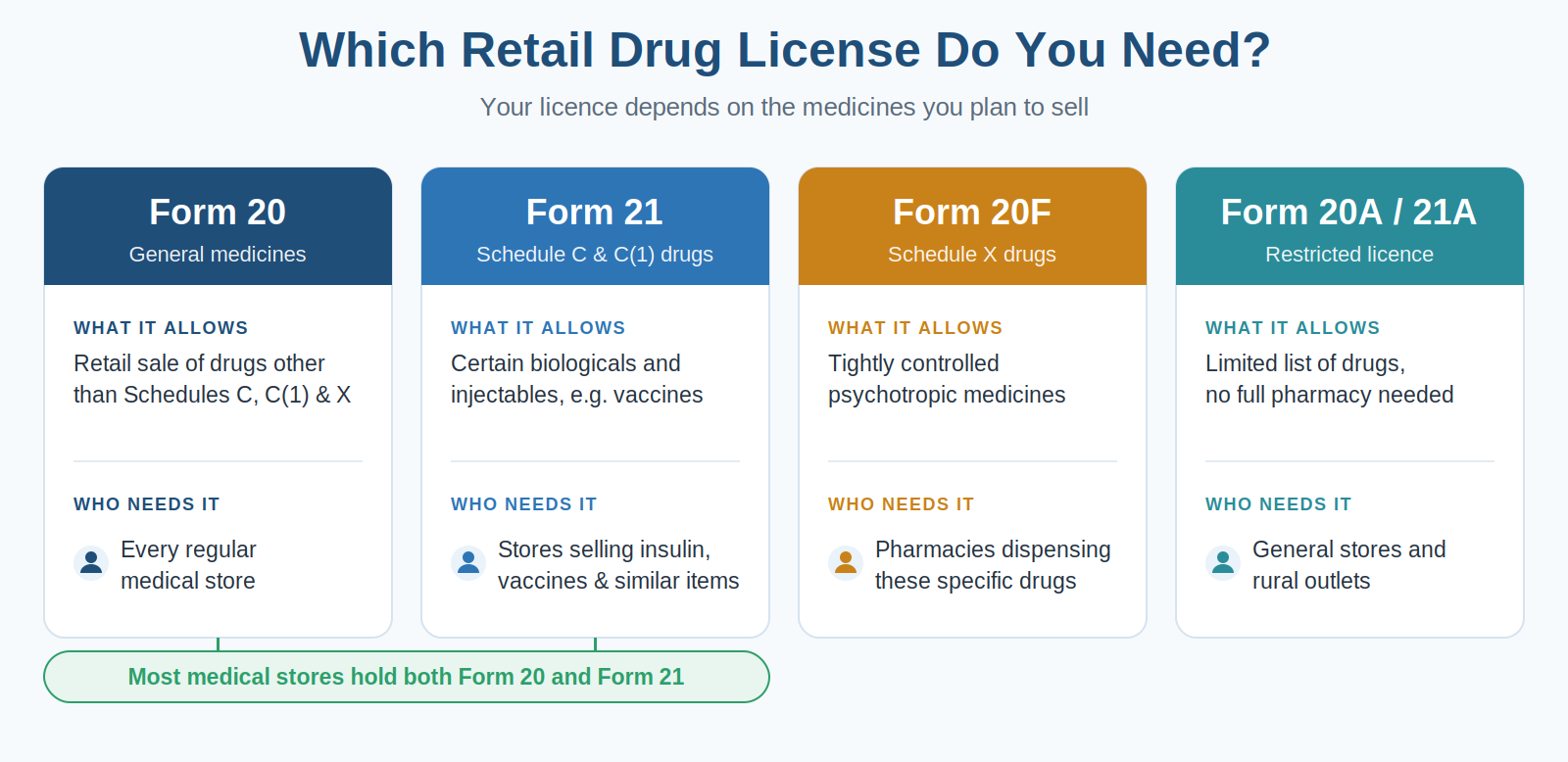
The licence you need depends on which categories of medicines you plan to sell. Most medical stores apply for both Form 20 and Form 21.
| Licence form | What it allows | Who usually needs it |
| Form 20 | Retail sale of drugs other than those in Schedules C, C(1) and X | Every regular medical store |
| Form 21 | Retail sale of drugs in Schedules C and C(1), such as certain biologicals and injectables | Stores that sell vaccines, insulin and similar products |
| Form 20F | Retail sale of Schedule X drugs (tightly controlled psychotropic medicines) | Pharmacies that dispense these specific medicines |
| Form 20A / 21A | Restricted licence for limited drugs, often for general stores or areas without a pharmacy | Small retailers and rural outlets |
Not sure which one fits? Our team reviews your product list and business model and tells you exactly which forms to apply for. Importing or manufacturing instead? See our CDSCO registration service.
Eligibility and Premises Requirements
The State Licensing Authority checks three things: the people, the place and the storage.
A registered pharmacist
Retail sale of medicines must be done by, or under the personal supervision of, a pharmacist registered with the State Pharmacy Council under the Pharmacy Act, 1948. The owner does not have to be a pharmacist. You can employ one full-time, as long as they are present during working hours.
Minimum shop area
Under the Drugs Rules, a retail outlet needs a minimum area of 10 square metres. If you want both retail and wholesale licences in the same premises, the requirement is 15 square metres. Some states also expect a minimum ceiling height, so confirm local rules before signing a lease.
Proper storage
Medicines must be stored as their labels require. In practice, that means a refrigerator for cold-chain products and air-conditioning where storage conditions demand it. The premises should be clean, dry and separate from any residential area.
Documents Required for a Drug Retail License
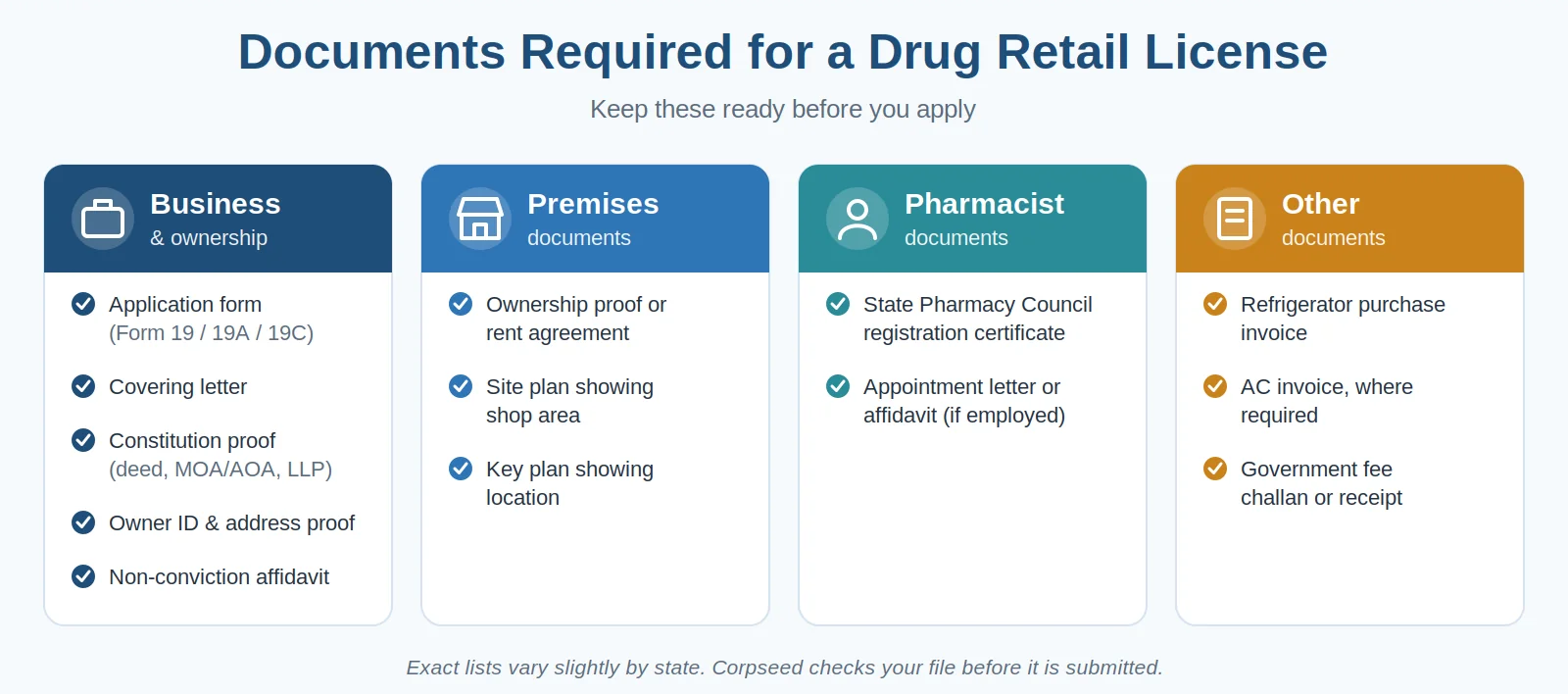
Exact lists vary slightly from state to state. Here is what you will typically need, grouped by purpose.
Business and ownership documents
- Application in the prescribed form (Form 19 for Forms 20 and 21; Form 19A for restricted licences; Form 19C for Form 20F)
- Covering letter with the applicant's name, address and purpose
- Constitution proof, such as a partnership deed, MOA and AOA, or LLP agreement (setting up a company first? See private limited company registration)
- ID and address proof of the proprietor, partners or directors
- Affidavit or declaration that the applicant has not been convicted under the Drugs and Cosmetics Act
Premises documents
- Proof of ownership or a rent agreement for the premises
- Site plan or blueprint of the shop, showing its area
- Key plan showing the location of the premises
Pharmacist documents
- Registration certificate of the pharmacist from the State Pharmacy Council
- Appointment letter or affidavit of the pharmacist, if employed
Other documents
- Purchase invoice for the refrigerator and air-conditioner, where required
- Challan or receipt for the government fee
How to Get a Drug Retail License: Step-by-Step Process
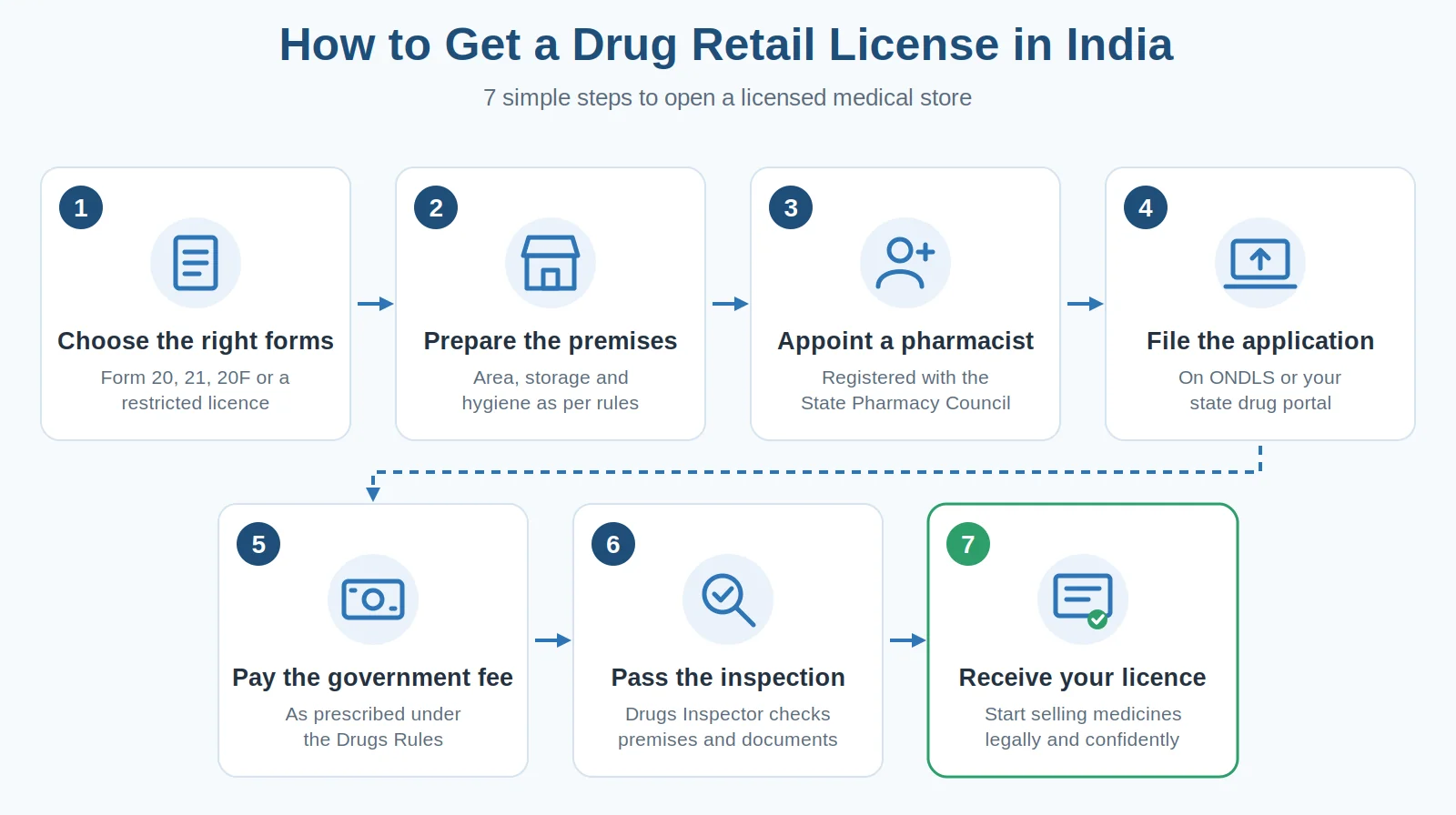
- Choose the right licence forms. Decide between Forms 20, 21, 20F or the restricted licences based on what you will sell.
- Get the premises ready. Make sure the shop meets the area, storage and hygiene rules before you apply.
- Appoint a registered pharmacist. Collect their registration certificate and consent.
- Prepare and file the application. Many states accept applications through the Online National Drugs Licensing System (ONDLS); others use their own state portal. See CDSCO for details.
- Pay the government fee. The fee is prescribed under Rule 61 of the Drugs Rules and is paid online or by challan.
- Face the inspection. A Drugs Inspector visits to verify the premises, storage and documents.
- Receive the licence. Once the inspector's report is satisfactory, the licensing authority grants the licence.
Drug Retail License Fees and Validity
The government fee for each licence form is fixed under the Drugs and Cosmetics Rules and can change through amendments. Corpseed confirms the current fee for your state and licence category before filing, so there are no surprises.
Under the amended Drugs Rules, a retail drug licence no longer needs to be renewed in the old way. It stays valid as long as you pay the licence retention fee every five years. Missing that payment can lead to late fees and, eventually, cancellation.
How Long Does It Take?
Timelines depend on how complete your application is, how quickly the inspection is scheduled and the workload of your state department. A well-prepared file with a ready premises moves much faster. We'll give you a realistic estimate for your state after reviewing your documents.
Common Reasons Applications Get Delayed or Rejected
- The shop is smaller than the required area
- The pharmacist's registration is expired or from another state's council without transfer
- Missing site plan, or the plan doesn't match the actual premises
- No refrigerator for products that need cold storage
- Mismatched names or addresses across documents
Corpseed checks your file against each of these before it is submitted.
Compliance After You Get the Licence
Getting the licence is step one. Staying compliant protects it.
- Display the licence and the pharmacist's name prominently in the store
- Sell prescription drugs only against a valid prescription
- Maintain the Schedule H1 register and keep records for the period the rules require
- Issue proper bills for every sale
- Inform the licensing authority about changes to the pharmacist, premises or constitution
- Pay the retention fee on time
Other Registrations a Medical Store May Need
A drug licence is the core approval, but most stores also need:
- GST registration, if your turnover crosses the threshold or you buy from GST-registered suppliers
- Shop and Establishment registration from your state labour department
- FSSAI license, if you sell nutraceuticals, health supplements or baby food
- Trade license from the local municipal body, where applicable
Why Choose Corpseed for Your Drug Retail License?
- Clear advice on the right forms, so you don't apply for too little or too much
- Document review before filing, which cuts the back-and-forth with the department
- Inspection readiness guidance, so you know what the Drugs Inspector will check
- Updates at every stage, from filing to licence grant
- One partner for related registrations, including GST, FSSAI and business registration
Ready to Open Your Medical Store?
Tell us about your store, and our compliance experts will map out the licences you need, the documents to collect and a realistic timeline. No guesswork, no generic checklists.
Connect With Corpseed
Connect with the Corpseed team to discuss your requirements at IVR: 7558640644 or hello@corpseed.com. It takes 20–25 minutes to discuss the requirement.
Dedicated Manager
Once you discuss the requirement, we will align a dedicated Account Manager to understand your business needs and assist throughout the process.
Real Time Update
Track the progress of your application and always know what’s in progress and what’s done.
Job Completed
Once the job is completed, you will receive registrations & certifications directly to your email ID and at your doorstep.
Frequently Asked Questions
Quick answers to common questions about this service.
What is a drug retail license?
It is a licence from the State Drugs Control Department that allows you to sell medicines directly to customers. It is issued under the Drugs and Cosmetics Act, 1940 and the Drugs and Cosmetics Rules, 1945.
Can a non-pharmacist open a medical store?
Yes. The owner does not need a pharmacy qualification, but a registered pharmacist must handle or supervise the sale of medicines during working hours.
What is the difference between Form 20 and Form 21?
Form 20 covers medicines other than those in Schedules C, C(1) and X, while Form 21 covers Schedule C and C(1) drugs such as certain biologicals. Most medical stores hold both.
What is the minimum area required for a medical store?
A retail outlet needs at least 10 square metres. If you want both retail and wholesale licences at the same premises, you need at least 15 square metres.
How long is a drug retail license valid?
Under the amended Drugs Rules, the licence remains valid as long as the retention fee is paid every five years. Missing the payment can lead to late fees or cancellation.
Can I apply for a drug retail license online?
Yes, in most states. Many use the Online National Drugs Licensing System (ONDLS), while some run their own portals.
Is a physical inspection required?
Yes. A Drugs Inspector usually visits the premises to check the area, storage facilities, pharmacist details and documents before the licence is granted.
Do I need a separate licence for each branch?
Yes. Each outlet is licensed for its specific premises, so every branch needs its own licence and its own registered pharmacist.
Do I need a drug license to sell medicines online?
Online sellers of medicines still need a valid drug licence for the premises they dispense from. Dedicated e-pharmacy rules were released in draft form in 2018 and have not been finalised as of this page's last update, so take expert advice before launching.
Can I sell health supplements with a drug license?
No, not on the drug licence alone. Nutraceuticals and health supplements fall under food law, so you also need an FSSAI license or registration.
Need help?
Talk to an Expert
Get free guidance on the right service, improved documents & timeline.






















