
DGFT Restricted Import License for Tyre in India - New & Used
Importing tyres into India starts with checking the type of tyre, ITC HS code, current DGFT import policy and other approvals linked to the product. The requirements are not the same for new, used, retreaded and waste tyres. A DGFT restricted import license for tyre import, officially called a Restricted Imports Authorisation, is relevant only where the applicable import policy requires such permission. Importers may also need to check BIS certification, CPCB EPR registration, environmental approvals and Customs requirements before shipment.
Schedule a Call Back
Why wait? Start now!
Get Support AnytimeBusinesses we've worked with on import-export and DGFT
Showing 1538 of 250+ clients served since 2018- Electronics and technology
- Advantech Industrial Computing India · Smiths Detection Systems · Areca Embedded Systems · Motorola Solutions India · Trinity Mobile APP Lab · +2 more
- Pharma and healthcare
- Motorica India · Glocal Healthcare Systems · Tablets (India)Limited
- Food and consumer goods
- Auroras TEA Company · Surabhi Aqua Minerals
- Logistics and trade
- Solankili Logistics Management · ATG Freight India
- Jewellery
- Janki Jewellers · Viindhya Bullion
- More clients
- Esskay Compuservices · Welgrow Technologies · Ample Technologies · Aprodite Infotech · Floroma Infinity · Moonlight Technology · NJ Power · Ample Digital · Augustdevices India · Automap Software and Technologies · SNS Metpro Industries · Webmeditech Healthcare · Anagh Traders · Meritech India · Zipped Solutions · Metanovo Health · Kapemai Lifestyle · Zexcorp Services · Agricapita Innotech · Meticulous Networks · Nexavarge · Arng · D13 Business Ventures · Datalux Systems India · +21 more
What Is a DGFT Restricted Import License for Tyre Import?
A DGFT restricted import license for tyre import, officially referred to as a restricted imports authorisation, is used where the applicable ITC HS classification places an imported product in the restricted category.
A Restricted product is different from a prohibited product. Restricted goods may be imported where the required approval is obtained, and the conditions attached to the authorisation are followed. Before filing an application, the importer should check:
- Correct ITC HS code,
- tyre type and specifications,
- current DGFT import policy,
- quantity and CIF value,
- country of origin,
- foreign supplier details,
- intended use, and
- Other applicable approvals.
The application is handled through DGFT's import management system. Businesses that are unfamiliar with classification or filing can seek support from a DGFT import license consultant or DGFT compliance consultant for document preparation, application filing and query handling.
A DGFT authorisation does not replace BIS certification, EPR registration, environmental permission or Customs compliance where those requirements separately apply.
Why Is a DGFT License Required for Importing Certain Tyres into India?
India controls imports under the Foreign Trade Policy and the ITC HS system. The requirement for obtaining a DGFT license for a specific tyre depends upon the tariff code for the product.
DGFT Notification No. 12/2015-2020 dated 12 June 2020 changed nine specified new pneumatic tyre tariff lines from Free to Restricted. These covered certain motor-car, bus, lorry, motorcycle, scooter and bicycle tyres.
However, the currently accessible consolidated DGFT ITC HS schedule displays these same tariff lines as Free. This creates an important difference between the 2020 notification and the consolidated schedule.
For this reason, an importer should not assume that every tyre automatically requires a DGFT tyre import license. The live policy position should be checked against the exact eight-digit ITC HS code before filing an application or arranging shipment.
A DGFT License Consultant can be useful when there is uncertainty about the product classification or the current import-policy position.
Which Tyres Require a DGFT Import License in India?
There is no single rule stating that all imported tyres need a Restricted Imports Authorisation.
The first step is to identify whether the shipment contains:
- new pneumatic tyres,
- used tyres,
- retreaded tyres,
- waste tyres, or
- tyre scrap.
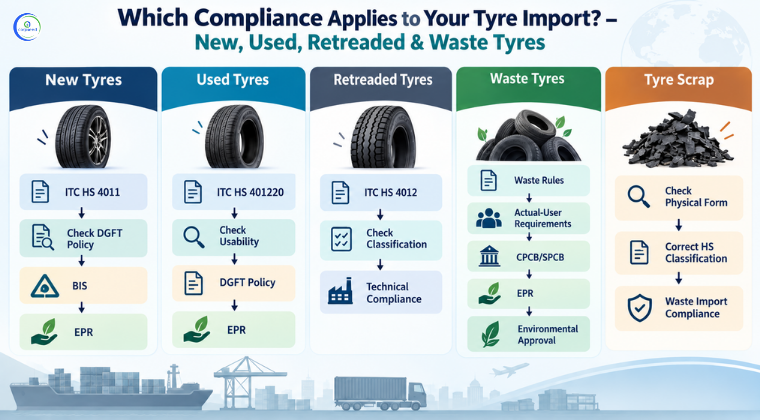
1. New Pneumatic Tyres
DGFT's 12 June 2020 notification covered the following groups:
| Tyre Category | ITC HS Codes Covered in 2020 Notification | 2020 Position | Currently Accessible Consolidated DGFT Schedule |
| Motor car tyres | 40111010, 40111090 | Restricted | Free |
| Bus and lorry tyres | 40112010, 40112090 | Restricted | Free |
| Motorcycle/scooter tyres | 40114010, 40114020, 40114090 | Restricted | Free |
| Bicycle tyres | 40115010, 40115090 | Restricted | Free |
The difference between the notification and the current consolidated schedule makes a fresh DGFT import policy review important before proceeding.
2. Used Tyres
Used pneumatic tyres generally fall under ITC HS 401220.
The currently accessible DGFT schedule lists:
- 40122010 - buses, lorries, earth-moving equipment and light commercial vehicles,
- 40122020 - passenger automobiles, including two-wheelers and three-wheelers, and
- 40122090 - other used pneumatic tyres, as Free.
This does not mean that used tyres are exempt from all regulatory requirements. The importer still needs to establish that the goods are genuinely reusable tyres and not waste material.
3. Retreaded Tyres
Retreaded tires usually belong to tariff items like the following:
- 40121100,
- 40121200,
- 40121300,
- 40121910, and
- 40121990
These entries are also shown as Free in the currently accessible consolidated schedule.
4. Waste Tyres
Waste tyres follow a different compliance route. Their import can involve environmental permissions, actual-user conditions, CPCB/SPCB requirements and EPR obligations.
Therefore, the need for a DGFT Restricted Import License should always be decided after checking the exact product rather than simply using the word "tyre".
What Are the Eligibility Requirements for a DGFT Restricted Tyre Import License?
Eligibility depends upon the particular product and relevant DGFT policy. The usual requirements are:
1. Valid IEC and DGFT Profile
The applicant should hold a valid Importer Exporter Code and maintain the required profile on the DGFT portal.
2. Correct ITC HS Classification
The correct eight-digit tariff code should be identified before filing.
3. Complete Product Details
The importer should have details such as:
- tyre type,
- tyre size,
- technical specifications,
- quantity,
- CIF value,
- manufacturer,
- country of origin,
- foreign supplier, and
- Intended use.
4. Applicable BIS and EPR Compliance
Where BIS, EPR or environmental requirements apply, these should be considered before shipment rather than waiting for Customs clearance.
5. Import Justification
Where DGFT requires an explanation of the purpose or end use, the information submitted should match the underlying commercial documents.
A DGFT Restricted Import License Consultant can review the eligibility position before the business proceeds with formal filing.
Who Can Apply for a DGFT Tyre Import License in India?
Where the applicable tyre is classified as Restricted, businesses involved in legitimate commercial or industrial imports may apply, subject to DGFT requirements.
Applicants can include:
- tyre importers and distributors,
- automotive-parts importers,
- automobile and vehicle manufacturers,
- industrial users,
- mining and construction businesses,
- machinery manufacturers,
- importers of specialised tyres, and
- businesses dealing with used or retreaded tyres.
The applicant should generally have a valid IEC and an active DGFT profile.
Before filing, it is useful to consult a DGFT Consultant in India when the importer is unsure about tariff classification, policy status or connected regulatory approvals.
What Are the ITC HS Codes for Tyre Imports in India?
Correct ITC HS classification is one of the most important parts of tyre import compliance.
ITC HS 4011 - New Pneumatic Tyres
Heading 4011 generally covers new pneumatic tyres of rubber, including tyres designed for:
- passenger cars,
- buses and lorries,
- motorcycles and scooters,
- bicycles,
- aircraft,
- agricultural machinery,
- construction equipment, and
- industrial vehicles.
ITC HS 4012 - Used and Retreaded Tyres
Heading 4012 generally covers retreaded or used pneumatic tyres of rubber, along with certain solid or cushion tyres, tyre treads and flaps.
Waste Tyres and Rubber Scrap
Once tyres are cut, shredded, processed or treated as waste material, their classification may change. Rubber waste may fall under a different tariff heading depending on its physical form and intended use.
An importer should therefore avoid selecting a code only from a commercial description such as "truck tyre" or "used tyre".
Corpseed can provide ITC HS Code Classification Services as part of its Tyre Import Compliance Services before a DGFT application or Customs filing.
Tyre Import Rules in India for New, Used, Retreaded and Waste Tyres
Different tyre categories can follow different regulatory routes.
- New Tyres: Usually classified under ITC HS 4011. Importers should check the current DGFT policy along with applicable BIS and EPR requirements.
- Used Tyres: Usually classified under ITC HS 401220. Their actual condition and remaining usability should be clear because a reusable used tyre should not be confused with a waste tyre.
- Retreaded Tyres: Generally covered under ITC HS 4012. The importer should check the vehicle category, technical description and current import policy.
- Waste Tyres: Environmental and waste-management rules become particularly important. Permission may depend on actual-user status, recycling facilities and pollution-control approvals.
- Tyre Scrap: Cut, shredded or processed tyre material should be classified according to its actual condition instead of automatically using the original tyre code.
A proper classification review helps determine whether the business needs DGFT License Services, BIS approval, EPR registration, environmental permission or a combination of these compliances.
What Compliance Requirements Apply to Tyre Imports in India?
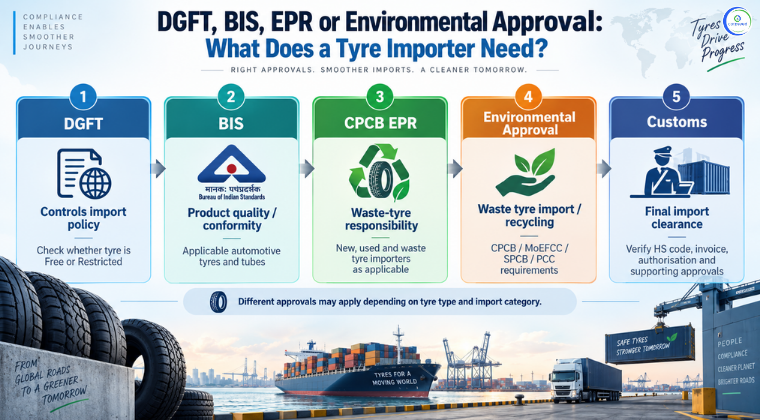
A DGFT tyre import license is only one part of tyre import compliance. Depending on the product, several requirements may need to be checked.
DGFT Import Policy
The exact eight-digit ITC HS code should be checked to determine whether the product is Free, Restricted or subject to another policy condition.
BIS Certification for Imported Tyres
Covered automotive tyres and tubes fall within India's compulsory BIS certification framework.
Important standards include:
- IS 13098 - automotive tubes for pneumatic tyres,
- IS 15627 - pneumatic tyres for two- and three-wheeled motor vehicles,
- IS 15633 - pneumatic tyres for passenger-car vehicles, and
- IS 15636 - pneumatic tyres for commercial vehicles.
For foreign manufacturers, the appropriate BIS license may need to be obtained through the Foreign Manufacturers Certification Scheme (FMCS). BIS confirms that the foreign manufacturer, rather than the Indian importer, applies for the FMCS license. FMCS applications are now accepted through the online route.
Businesses can take assistance from a BIS Certification Consultant for Tyres when the product falls under mandatory certification.
EPR Registration for Tyre Importers
The CPCB Waste Tyre framework should also be checked separately.
CPCB's FAQ states that EPR obligations apply to producers importing both new and used tyres. For waste-tyre importers, the EPR obligation for year Y is 100% of the quantity imported in year Y-1.
An EPR Registration Consultant for Tyre Importers can assist businesses in understanding registration and ongoing EPR requirements.
Environmental Compliance for Waste Tyres
CPCB's waste pneumatic tyre import procedure refers to actual-user status, valid Consent to Establish, Consent to Operate, fire clearance, facility evidence and a valid IEC among the relevant requirements.
Import of waste tyres for producing pyrolysis oil or char is prohibited under the waste tyre EPR framework.
Customs Compliance
The product description, ITC HS code, quantity, invoice, DGFT authorisation and other approvals should remain consistent during Customs clearance.
What Documents Are Required for a DGFT Tyre Import License?
Documents can vary depending on whether the shipment contains new, used, retreaded or waste tyres. Common documents may include:
- Business Documents: Certificate of Incorporation or registration, PAN, GST details, registered office information and authorised signatory details.
- IEC and DGFT Documents: Valid IEC, DGFT profile details and previous authorisation information, where relevant.
- Tyre Product Documents: Product catalogue, tyre size, technical specification, vehicle application and new/used/retreaded condition.
- Foreign Supplier Documents: Supplier information, manufacturer details, country of origin, quotation and pro forma invoice.
- Commercial Documents: Purchase order, commercial invoice, quantity, value and CIF details.
- End-Use Documents: End-use statement, project or manufacturing requirement and import justification, where applicable.
- BIS Documents: Foreign manufacturer's BIS license, applicable Indian Standard, brand and manufacturing-unit details, where applicable.
- Used or Retreaded Tyre Records: Product-condition details, photographs, inspection information and intended use where required.
- EPR and Environmental Documents: CPCB EPR registration, SPCB/PCC approvals, environmental permissions and recycling-facility information, where applicable.
Before filing, a DGFT Import License Consultant should ideally check that the product description, ITC HS code, supplier, quantity and invoice details are consistent across the application.
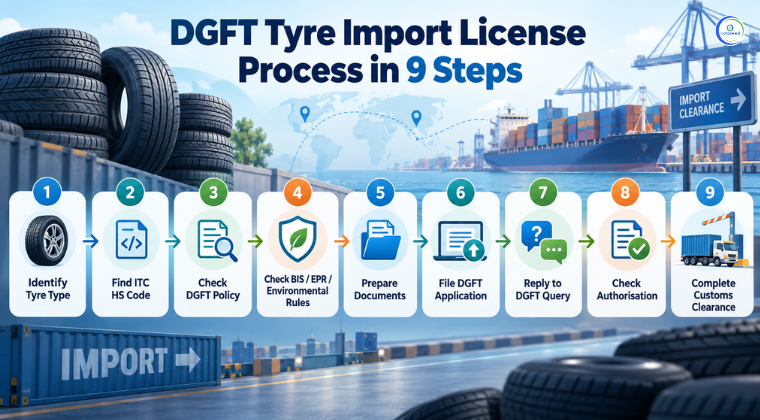
How to Apply for a DGFT Restricted Import License for Tyre Import?
The application process should begin before shipment planning is finalised.
Step 1 - Identify the Tyre Category
Determine whether the product is:
- new,
- used,
- retreaded,
- waste, or
- tyre scrap.
Step 2 - Find the Correct ITC HS Code
Identify the complete eight-digit tariff item instead of relying only on headings 4011 or 4012.
Step 3 - Check the Current DGFT Import Policy
Verify whether the tariff line is currently Free, Restricted or subject to another policy condition.
This is especially important because the 2020 tyre notification and the currently accessible consolidated DGFT tariff document do not show the same policy status for the nine identified new-tyre codes.
Step 4 - Check BIS, EPR and Environmental Requirements
Review all connected compliance requirements before arranging the shipment.
Step 5 - Prepare Documents
Collect business, product, technical, supplier and transaction documents.
Step 6 - File the Restricted Imports Authorisation Application
Where a Restricted Imports Authorisation is actually required, file the application through DGFT's Import Management System. Businesses may use DGFT Import License Services or engage a DGFT License Consultant for preparation and filing support.
Step 7 - Respond to DGFT Queries
If DGFT seeks clarification, the reply should directly answer the question and remain consistent with the original application.
Step 8 - Check the Issued Authorisation
Review:
Step 9 - Complete Customs Clearance
Restricted Import Authorisations issued for EDI ports are issued electronically and transmitted to Customs under DGFT's current electronic process.
What Is the Cost of a DGFT Tyre Import License in India?
The cost of a DGFT tyre import license depends on the CIF value and any connected compliance requirements.
Under DGFT Appendix 2K, the application fee for an import license for a restricted item is one per thousand, or part thereof, of the CIF value, subject to a minimum fee of ₹500 and a maximum of ₹1,00,000.
Other costs may include DGFT consultancy services, BIS certification, laboratory testing, EPR compliance, environmental approvals and Customs-related expenses.
Since every transaction is different, the total cost should be calculated only after confirming the ITC HS code, tyre category and regulatory approvals required for the proposed import.
How Long Does It Take to Get a DGFT Tyre Import License?
DGFT does not provide one guaranteed approval period that can be applied to every Restricted Import Authorisation. Processing time can vary depending on:
- Classification of ITC HS code,
- completeness of documents,
- specifications of products,
- quantity and value information,
- scrutiny by DGFT,
- necessity for technical observations,
- clarification issues, and
- reference to other ministries/departments, if required.
Incomplete or inconsistent documentation can extend the process. A DGFT Import License Consultant can help reduce avoidable delays by checking the application before submission, but no consultant can guarantee the government's approval date.
What Is the Validity of a DGFT Restricted Import Authorisation?
Under the current DGFT Handbook of Procedures, an Import Authorisation for Restricted items is normally valid for two years from the date of issue, unless a different period is specified for the particular case.
The importer should check the issued authorisation carefully for the approved product, ITC HS code, quantity, value, validity and any special conditions.
DGFT also provides routes for amending and revalidating authorisations. Revalidation should not be treated as automatic, as it falls under the applicable DGFT procedure.
The shipment should therefore be planned within the validity and conditions stated in the issued DGFT Restricted Import Authorisation.
What Happens After Getting a DGFT Tyre Import License?
Receiving the DGFT authorisation does not end the importer's compliance responsibilities. Prior to clearance at Customs, the importer should:
- Verify the terms of the authorization,
- Determine the authorized quantity and value,
- Ensure the shipment conforms with the authorized description,
- Arrange for the Bill of Entry and documentation,
- Verify BIS compliance, where applicable,
- keep EPR registration active, where required, and
- maintain relevant import and regulatory records.
Documents such as invoices, Bills of Entry, authorisations, BIS licenses and regulatory correspondence should be properly retained.
Businesses using ongoing DGFT Compliance Services should also review whether any post-import EPR or environmental obligations continue after Customs clearance.
What Are the Common Mistakes in DGFT Tyre Import License Applications?
Many application problems can be avoided before filing. Common mistakes include:
- Using the wrong ITC HS code: A wrong classification can lead to the wrong import policy assessment.
- Assuming every tyre requires a DGFT license: The license requirement must be checked against the current tariff entry.
- Confusing used tyres with waste tyres: A tyre imported for recycling cannot simply be described as reusable to avoid waste-import rules.
- Giving incomplete product details: Descriptions such as "rubber tyre" or "truck tyre" may not be enough.
- Ignoring BIS certification: DGFT approval is no substitute for a separate BIS requirement.
- EPR registration missing: Importers of tyres need to separately look at CPCB requirements.
- Misstatement in supplier details or invoice: Discrepancies in quantities, model, brand, price, or product may warrant an inquiry.
- Using outdated policy information: Older notifications or articles should not be relied upon without checking the current DGFT position.
A qualified DGFT Compliance Consultant can review these points before the application is filed.
What Happens If Restricted Tyres Are Imported Without DGFT Authorisation?
Where a tyre is legally classified as Restricted, and the required authorisation has not been obtained, Customs clearance may be affected.
Consequences that may arise, depending on the facts of each case, may include the following:
- Goods detention,
- Delay in the valuation by Customs,
- Need for further information,
- Confiscation of goods,
- Problems associated with re-export of goods,
- Applicable penalties,
- Demurrage and storage charges, and
- Disruption to supply promises.
Each of these legal consequences will depend on the particular transaction and relevant law. Consequently, businesses are advised to verify the policy of the DGFT prior to shipment of goods.
How Can Corpseed Help With DGFT Tyre Import License in India?
Tyre imports can involve DGFT, BIS, CPCB, MoEFCC, SPCB/PCC and Customs requirements. Corpseed provides DGFT Consultancy Services and Tyre Import Compliance Services based on the actual product being imported.
1. DGFT Regulatory Applicability Assessment
Prior to filing, Corpseed can verify:
- type of tyre,
- intended use,
- technical details,
- ITC HS code,
- DGFT guidelines at present,
- whether BIS applies, and
- EPR requirements.
This helps determine whether the business actually needs a DGFT Restricted Import License or another approval.
2. ITC HS Code Classification Support
Our team can review product specifications and assist with identifying the appropriate tariff classification before the importer files a license application or Bill of Entry.
3. DGFT Restricted Import License Services
Where the applicable import policy requires an authorisation, Corpseed can assist with the DGFT Restricted Import License for Tyre Import.
Our DGFT Import License Services can include:
- application-data preparation,
- document review,
- quantity and value details,
- product-description review,
- online application support, and
- pre-submission checks.
4. DGFT Query and Clarification Support
Where DGFT raises a query, Corpseed can assist in preparing a clear reply supported by the relevant documents.
5. BIS Certification Support for Imported Tyres
Where mandatory BIS requirements apply, Corpseed can assist businesses in understanding:
- the applicable Indian Standard,
- BIS certification requirements,
- FMCS requirements for foreign manufacturers,
- documentation, and
- certification-process requirements.
Businesses looking for a BIS Certification Consultant for Tyres can use this support alongside DGFT compliance.
6. EPR Registration for Tyre Importers
Corpseed can support eligible tyre importers with:
- EPR applicability checks,
- CPCB producer registration,
- documentation,
- portal-related support, and
- understanding ongoing EPR obligations.
This service can also support businesses searching for an EPR Registration Consultant for Tyre Importers.
7. Waste Tyre Import Compliance
For waste tyres or tyre scrap, support may include review of:
- actual-user requirements,
- environmental permissions,
- facility documents,
- CPCB/SPCB compliance,
- EPR requirements, and
- intended recycling or utilisation route.
8. IEC and DGFT Compliance Support
Where a business needs IEC or DGFT profile support before filing, Corpseed can assist with the related requirements.
Why Work With a DGFT Consultant for Tyre Import?
The main benefit of using a DGFT Consultant is not simply filing an online form. The important work happens before filing: identifying the correct product classification, checking whether permission is actually required and ensuring that DGFT, BIS, EPR and environmental documents do not contradict each other.
Corpseed's DGFT License Services are designed around this product-specific approach rather than treating every tyre import in the same way.
Connect With Corpseed
Connect with the Corpseed team to discuss your requirements at IVR: 7558640644 or hello@corpseed.com. It takes 20–25 minutes to discuss the requirement.
Dedicated Manager
Once you discuss the requirement, we will align a dedicated Account Manager to understand your business needs and assist throughout the process.
Real Time Update
Track the progress of your application and always know what’s in progress and what’s done.
Job Completed
Once the job is completed, you will receive registrations & certifications directly to your email ID and at your doorstep.
Frequently Asked Questions
Quick answers to common questions about this service.
Is a DGFT license required to import tyres into India?
A DGFT license is required only where the applicable ITC HS code or policy condition requires Restricted Import Authorisation. The current policy should be checked before shipment.
Can used tyres be imported into India?
Used tyres may be imported subject to correct classification, condition and applicable regulations. Importers should also check EPR and environmental requirements before placing the order.
What is the HS code for new tyre imports in India?
New pneumatic tyres generally fall under ITC HS heading 4011. The exact eight-digit code depends on vehicle type, tyre specification and intended application.
What is the HS code for used and retreaded tyres?
Used and retreaded pneumatic tyres generally fall under ITC HS heading 4012. The exact classification depends on tyre condition, vehicle category and product description.
Is BIS certification mandatory for imported tyres?
BIS certification is mandatory for tyres falling under an applicable Quality Control Order. The importer must verify the relevant Indian standard before making the shipment.
Is EPR registration required for tyre importers?
CPCB states that EPR obligations apply to producers importing new and used tyres. Specific EPR requirements also cover waste-tyre importers.
What documents are required for a DGFT tyre import license?
Common documents include IEC details, product specifications, supplier records, invoice, quantity and value information, end-use details and applicable BIS, EPR or environmental documents.
How can I apply for a DGFT tyre import license?
Where the product is restricted, the importer can apply through DGFT's Import Management System with the required commercial, technical and regulatory documents.
How long does a DGFT tyre import license take?
There is no fixed approval period for every case. Processing depends on classification, document completeness, DGFT scrutiny, clarification requirements and any inter-departmental consultation.
What is the cost of a DGFT tyre import license?
DGFT charges one per thousand of the CIF value for restricted-import applications, subject to the prescribed minimum and maximum. Other compliance costs may apply.
What is the validity of a DGFT Restricted Import Authorisation?
Restricted Import Authorisations are normally valid for two years from issue, unless DGFT specifies another validity period for the particular authorisation.
What is the difference between a DGFT license and BIS certification?
DGFT authorisation deals with permission to import a restricted product, while BIS certification deals with the conformity of covered products to applicable Indian Standards.
Can waste tyres be imported into India?
Waste-tyre imports are subject to environmental and actual-user requirements. The importer should check CPCB, MoEFCC, SPCB/PCC and EPR conditions before importing.
Is an IEC required for commercial tyre imports?
A valid Importer Exporter Code is generally required for commercial imports. The importer should also keep the corresponding DGFT profile and business information up to date.
Can a DGFT consultant help with tyre import compliance?
Yes. A DGFT Import License Consultant can assist with ITC HS classification, policy checks, document preparation, authorisation filing and connected BIS or EPR compliance.
Need help?
Talk to an Expert
Get free guidance on the right service, improved documents & timeline.






















