
Console Agent Registration
The Indian freight forwarding, air cargo, and sea cargo consolidation sector is expanding very quickly. But without appropriate Console Agent Registration in India, it will not be possible for companies to lodge House Bills, file consolidated shipping documents, or work directly on the ICEGATE platform. The agent will have to rely on a third party, which reduces the profit margin, delays the cargo clearance process, and restricts the company from having any control over its consignments.
Schedule a Call Back
Why wait? Start now!
Get Support AnytimeWhat is Console Agent Registration?
Think of Console Agent Registration as your official ID card with Indian Customs. Without it, you cannot legally consolidate cargo shipments, meaning you cannot combine multiple smaller shipments from different customers into one larger shipment for export or import, and file the related paperwork with Customs.
Console Agent Registration is the legal permission that allows an entity to combine cargo from various clients and submit the information on such consolidated cargo to Indian Customs via ICEGATE. It is the distinction between mere facilitation of cargo movement and being recognized as an official consolidator by Customs.
A Console Agent (also called a consolidator) is a business that groups together several smaller cargo consignments, usually from different shippers, into a single larger shipment. This is common in both air cargo (House Airway Bills, or HAWBs, bundled under a Master Airway Bill) and sea cargo (House Bills of Lading, or HBLs, bundled under a Master Bill of Lading).
Because a Console Agent is handling cargo on behalf of many different exporters or importers, Customs needs a way to identify, track, and hold that agent accountable. That's what registration does. Once approved, the agent is issued a unique identifier and can legally file consolidated manifest and shipment data electronically with Indian Customs.
What is a Console Agent Registration Number (CARN)?
The Console Agent Registration Number, or CARN, is the unique identification number Customs assigns to a registered console agent. Think of it like a driving license for your business, it proves you're authorized to do a specific job (consolidate and file cargo documentation), and it's checked every time you interact with the system.
Once you have a CARN, it gets tied to every House Bill or House Airway Bill you file. This lets Customs and the airline or shipping line you're working with instantly identify which registered agent is responsible for a given consolidated shipment.
Role and Responsibilities of a Console Agent
A Console Agent isn't just a middleman who bundles boxes together. Once registered, the agent takes on real regulatory responsibility, including:
- Accurate House Bill filing, declaring correct details for each shipper's cargo bundled inside the consolidation
- Timely electronic submission of shipment data, usually before the vessel or aircraft departs or arrives
- Coordination with the carrier (airline or shipping line) to ensure the master and house-level documents match
- Maintaining records of each shipment inside the consolidated cargo, in case Customs asks for backup documentation
In short, once you hold a CARN, Customs treats you as a recognized, accountable party in the supply chain, not just an intermediary.
Difference Between a Console Agent, Freight Forwarder and NVOCC
These three terms get used interchangeably in everyday conversation, but they mean different things to Customs, and understanding the difference helps you register under the right category.
- Freight Forwarder: A broader term for a business that arranges shipping and logistics on behalf of a shipper. A freight forwarder may or may not consolidate cargo.
- Console Agent: Specifically refers to the role of consolidating multiple smaller shipments into one and issuing House Bills for each. A freight forwarder often acts as a console agent, but the console agent registration is tied to this specific consolidation activity.
- NVOCC (Non-Vessel Operating Common Carrier): A company that functions as a shipper, providing its own Bills of Lading and carrier liability without being in possession of any vessels itself. An NVOCC also combines cargo; however, its registration requirements under SCMTR are slightly more extensive than those for a regular console agent.
If you provide consolidation and house level documentation services alone, then Console Agent Registration is the option you require. If you also issue your own Bills of Lading as a carrier, then you might have to register yourself as an NVOCC or Authorised Sea Agent according to SCMTR guidelines. Corpseed can assist you in deciding which category you belong to.
Why is Console Agent Registration Mandatory?
Indian Customs works on a principle of traceability. Every shipment that enters or leaves the country needs a documented trail, who sent it, who is carrying it, who is receiving it, and who is responsible if something goes wrong.
Once cargo is consolidated, then the path becomes much more complicated. A single container could have items from twenty different shippers in it. In case something is either misdeclared, delayed, or selected for inspection by the Customs officers, then they should be able to trace the exact party who carried out the process of consolidation.
The registration process forms the core of SCMTR as well as the overall ICEGATE system. According to the system regulations, only registered parties have the right to file electronic manifest information. Unless you are registered, you do not have the legal right to file House Bills, and therefore your company cannot function in any Indian port or airport.
Legal Framework Governing Console Agent Registration
The legal regime governing the registration of console agents for sea cargo is provided in the Sea Cargo Manifest and Transhipment Regulations (SCMTR), 2018, under the Customs Act, 1962. This new SCMTR framework has replaced the earlier manifest filing regime with a structured, role-based SCMTR Console Agent Registration system, where every stakeholder- carriers, agents, custodians, and terminal operators- must be registered before filing manifests electronically with Customs.
For air cargo consolidation, the Console Agent Registration Number (CARN) and manifest filing process are carried out through the airline/console agent message exchange facility on ICEGATE, allowing consolidators to file House Airway Bill data directly with Customs.
In both cases, registration is processed entirely online through the ICEGATE portal, and the jurisdictional Customs officer approves document verification there's no need for physical visits to a Customs office for the registration itself.
Benefits of Console Agent Registration
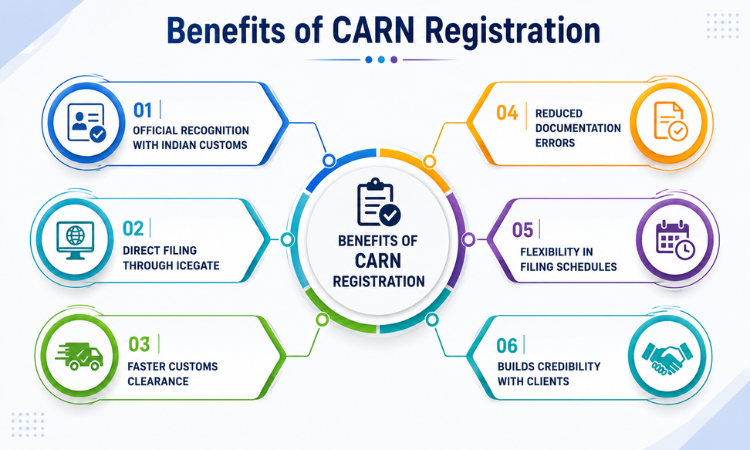
Here's what having a valid CARN actually does for your business:
- Puts your business on official record with Indian Customs as an approved, accountable stakeholder, without it, your consolidated shipments can't be processed.
- Lets you file House Bills and manifests directly through ICEGATE, so you're no longer at the mercy of airlines or shipping lines filing on your behalf.
- Speeds up Customs clearance, since your shipment data ties back to a verified entity and needs fewer manual checks.
- Reduces documentation errors as you are uploading files in standardized digital format, not depending on the paperwork prepared by another party.
- Provides you the liberty to manage your filing schedules since this is very important for the limited window period before leaving.
- Builds real credibility with clients, larger exporters and importers increasingly want proof of direct Customs registration before they sign on.
Who Should Apply for Console Agent Registration?
Here's who actually needs a CARN to operate legally in India:
- Freight Forwarders: If you combine cargo from multiple clients into single shipments and file House Bills for each shipper, this registration is what separates you from a mere shipping arranger.
- Air & Sea Cargo Consolidators: This fits you best. Console Agent Registration is essential if your main activity is consolidation; this is an integral part of your operating license.
- Non-Vessel Operating Common Carriers (NVOCCs): Usually register under a broader SCMTR category like Authorised Sea Agent, but many also need Console Agent Registration if they perform consolidation functions too.
- Multi-Modal Transport Operators (MTOs): These operators are involved in consolidated cargo movement through sea, air, road, and rail transportation and would require this type of registration.
- Third-Party Logistics (3PL) Companies: If your services extend into cargo consolidation and Customs documentation, not just transport and warehousing, this registration applies to you too.
Not sure which category applies to your business? Corpseed's compliance team can assess your operations and tell you exactly what registration you need, no guesswork.
Eligibility Criteria for Console Agent Registration
These are the key eligibility requirements your business must meet to apply for Console Agent Registration in India:
- Entity Requirements of the Business: The business entity has to be legally recognized in India, either in the form of a Private Limited Company, LLP, Partnership, or Proprietorship, with proper registration papers.
- PAN, GSTIN and IEC Requirements: Three registrations constitute the eligibility criteria for getting approved for CARN Registration, i.e., PAN, GSTIN, and IEC issued by DGFT. Since these registrations are verified against government databases, any mismatch will delay your ICEGATE Console Agent Registration approval.
- Office and Infrastructure Requirements: Proof of your operating office is required in the form of a rent agreement, utility bill, or any other property document, and not just a mailing address.
- Financial and Operational Eligibility: In general, financial stability, proper bank account details, and a bank solvency certificate or guarantee are required, particularly in the case of Authorised Sea Agents.
- Customs Compliance Requirements: No history of pending Customs violations, along with accurate KYC details of all the authorized individuals mentioned in your Console Agent Registration application.
Documents Required for Console Agent Registration
Getting your documents right the first time is the single biggest factor in how fast your registration gets approved. Here's what you'll typically need, organized by category.
Business Registration Documents
- Certificate of Incorporation or Partnership Deed / Proprietorship proof
- MOA/AOA (for companies)
- Board resolution or authorization letter naming the person authorized to apply
Tax Registration Documents
- PAN card of the business entity
- GST registration certificate
- IEC certificate issued by DGFT
Identity and Address Proofs
- PAN and Aadhaar (or passport, for foreign nationals) of authorized signatories
- Registered office address proof, utility bill, rent agreement, or property document
- Passport-size photographs of authorized persons
Financial and Solvency Documents
- Cancelled cheque or bank account proof
- Bank solvency certificate, where applicable to the specific role
- Bank guarantee or bond documentation, if required by the relevant Customs regulation for that role
Operational and Port-Related Documents
- Digital Signature Certificate (DSC) of the authorized signatory, used for signing electronic filings
- Details of the port(s) or airport(s) where you intend to operate
- Existing ICEGATE registration credentials, if already registered for other filings
Self-Declarations and Authorisation Letters
- A self-declaration confirming the accuracy of submitted information
- Authorization letters for each person who will be operating the ICEGATE profile on behalf of the business
Unsure which documents apply to your specific business type? Corpseed reviews your documentation before submission to catch errors before Customs does.
Step-by-Step Console Agent Registration Process
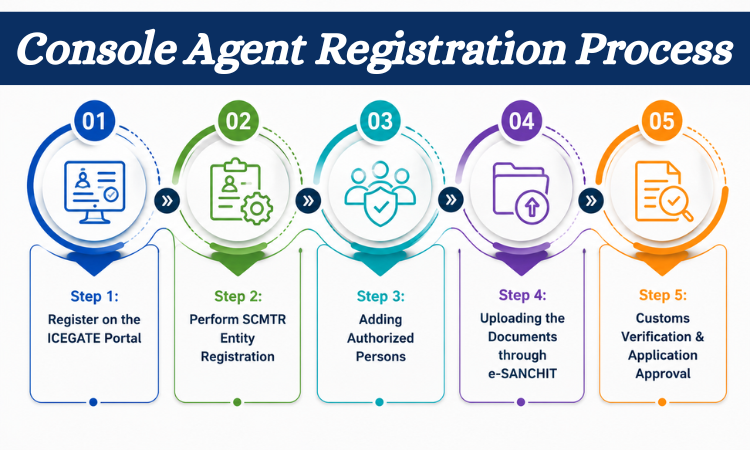
Most applicants don't get stuck because the process is hard. They get stuck because ICEGATE and SCMTR involve a few connected digital steps, and missing the order slows everything down.
Step 1: Register on the ICEGATE Portal
The first step requires you to have a functional ICEGATE account, since nothing else in your Console Agent Registration process can happen without one. Start by providing your business PAN and linking it to your Digital Signature Certificate (DSC).
Step 2: Perform SCMTR Entity Registration
Go to the SCMTR entity registration widget on your ICEGATE portal and choose the console agent role. Provide all your entity information along with the commercial code and port at which you want to get registered under the SCMTR guidelines.
Step 3: Adding Authorized Persons
Everyone who will handle signing of papers and managing filing should be added with their KYC documents, proof of ID and address, along with their photographs. This way, you can assign them roles according to their needs within your ICEGATE Console Agent Registration profile.
Step 4: Uploading the Documents through e-SANCHIT
Consider e-SANCHIT your online folder for documents, from where you can upload your files and get an Image Reference Number (IRN) for each one. You should map each IRN to the correct field of your application. Proper document mapping is crucial for CARN Registration; otherwise, it can lead to rejection of your application.
Step 5: Customs Verification & Application Approval
The jurisdictional Customs officer of the selected port will verify your application against their records. Once verified, you will be assigned a Console Agent Registration Number (CARN), and you will be able to file House Bills through it.
Feeling overwhelmed by the ICEGATE and e-SANCHIT steps? Corpseed handles the entire filing process for you, start to finish.
Console Agent Registration Fees and Processing Time
Console Agent Registration in India doesn't come with a heavy government fee, most of the cost comes from getting your Digital Signature Certificate, preparing documents, and, if you choose one, hiring a compliance expert to manage your ICEGATE and SCMTR filing. Government charges for the CARN application itself are minimal, since it works more like a regulatory approval than a paid license.
Processing time for Console Agent Registration depends on how clean your application is. A well-coordinated submission, with matching PAN, GSTIN, and IEC numbers along with proper e-SANCHIT document mapping, processes faster than an application with mismatches. Timelines may also vary slightly depending on the Customs port and current application volume.
Factors Influencing Processing Time
- Inconsistencies in PAN, GST, and IEC numbers across documents
- Incorrect or incomplete e-SANCHIT document mapping
- Missing KYC information for authorized persons
- High volume of applications at a particular Customs port
- Extra scrutiny for applicants with prior compliance issues
Want an exact timeline for your CARN Registration? Get Corpseed's personalized Console Agent Registration processing time estimate.
Common Reasons for Application Rejection
The main reasons for rejection are:
- Incorrect Business Information: Small spelling errors, incorrect addresses, or GSTIN numbers may all cause rejection, as Customs cross-references every detail with their database.
- Documentation Errors: Poor-quality scanned documents, expired certificates, and mismatched names are some of the most common causes of Console Agent Registration application rejection.
- ICEGATE or e-SANCHIT Submission Issues: A wrongly mapped IRN or an unattached document can stall your CARN registration, even if the paperwork itself is correct.
- Non-Compliance with Customs Requirements: Any unresolved Customs-related issue tied to your business or authorized persons can hold up or delay your Console Agent Registration Number approval.
How to Avoid Registration Delays
- Ensure every document, including PAN, GST, and IEC entries, is verified against your official certificates
- Always use high-resolution scans for every e-SANCHIT document upload
- Make sure KYC details of every authorized person are up-to-date and accurate
- Get your Console Agent Registration application reviewed by a compliance expert before submission
Don't risk a rejected application. Let Corpseed's team review your filing before it goes to Customs.
Post-Registration Compliance and Ongoing Obligations
Getting your CARN is just the beginning, staying compliant is what keeps it valid.
- Filing Electronic Manifests Through ICEGATE: File House Bills and shipment data accurately and on time under your CARN for every consolidated shipment.
- Updating Business and Authorized Person Details: Make sure to update your ICEGATE registration if there are any changes to your business address, directors, or authorized persons to prevent inconsistencies that lead to heightened inspection.
- Record Maintenance Requirements: Maintain records at shipment level for all consolidations, and not just master records, in case they are needed for inspection by Customs.
- Validity of Console Agent Registration: Your CARN stays valid as long as you meet eligibility norms and file compliantly, but confirm exact renewal timelines with your jurisdictional Customs office.
- Renewal and Modification of Registration: Any significant changes such as change of port, entity structure, or authorized persons have to be done using the modification form on ICEGATE only.
- Consequences of Non-Compliance: Missed filings or ignored Customs notices can lead to penalties, suspension, or cancellation of your Console Agent Registration Number.
Compliance doesn't end at approval. Corpseed provides ongoing Console Agent Registration support, from ICEGATE updates to CARN renewals, so your business stays audit-ready year-round.
Why Choose Corpseed for Console Agent Registration?
CARN registration and compliance with ICEGATE, SCMTR, and e-SANCHIT is not only about the proper completion of a form. It involves many things, and to be successful, you need an expert. Corpseed is here for you at all stages of your Console Agent Registration process.
- Full Support for End-to-End Console Agent Registration: Corpseed takes care of the entire Console Agent Registration process, from eligibility analysis and document preparation to ICEGATE registration, SCMTR profile creation, e-SANCHIT document upload, Customs coordination, and post-approval assistance. You don't have to manage any part of it alone.
- Expert Knowledge on Customs, ICEGATE & SCMTR Regulations: Our team stays deeply familiar with Indian Customs regulations, ICEGATE processes, SCMTR rules, and electronic filing requirements, giving your business the right guidance at every stage of your CARN Registration journey.
- Complete Documentation Analysis Before Submitting Application: Before your Console Agent Registration application goes to Customs, we thoroughly analyze every document to catch missing information or inconsistencies, minimizing the chances of queries or rejection.
- Compliance Manager Assigned to Each Client: Every client gets a dedicated compliance expert who provides ongoing assistance, handles updates, responds to queries, and tracks the application until final CARN approval.
- PAN-India Assistance at All Main Ports & Airports: Whether your business operates through major sea ports, ICDs, air cargo terminals, or logistics facilities anywhere in India, you get the same consistent Console Agent Registration Service support.
- Post-Approval Assistance & Profile Modifications Assistance: Our support doesn't end at approval. We continue assisting with ICEGATE profile modifications, authorised person changes, and ongoing compliance long after your Console Agent Registration Number is issued.
Ready to get your Console Agent Registration Number (CARN) without the back-and-forth? Talk to Corpseed's ICEGATE and SCMTR compliance experts today, get a free eligibility check and let us handle your registration, start to finish.
Connect With Corpseed
Connect with the Corpseed team to discuss your requirements at IVR: 7558640644 or hello@corpseed.com. It takes 20–25 minutes to discuss the requirement.
Dedicated Manager
Once you discuss the requirement, we will align a dedicated Account Manager to understand your business needs and assist throughout the process.
Real Time Update
Track the progress of your application and always know what’s in progress and what’s done.
Job Completed
Once the job is completed, you will receive registrations & certifications directly to your email ID and at your doorstep.
Frequently Asked Questions
Quick answers to common questions about this service.
What is Console Agent Registration in India?
It's the official Customs approval that allows a business to consolidate cargo shipments and file House Bills electronically through ICEGATE.
What is CARN registration?
CARN stands for Console Agent Registration Number, the unique ID Customs issues once your Console Agent Registration is approved.
Is Console Agent Registration mandatory for freight forwarders?
Yes. Any freight forwarder consolidating cargo and filing house-level documents with Customs must hold a valid CARN.
How do I apply for CARN registration online?
You apply through the ICEGATE portal by completing SCMTR entity registration and uploading documents via e-SANCHIT.
What are the eligibility criteria for CARN registration?
A legally registered business entity with valid PAN, GST, IEC, and verifiable office infrastructure in India.
How much does Console Agent Registration cost in India?
Government charges are minimal, costs mainly involve DSC, documentation, and optional professional consultancy fees.
How long does ICEGATE Console Agent Registration take?
Timelines vary by port and application accuracy, error-free applications typically move faster through Customs review.
What is e-SANCHIT document upload for Console Agent Registration?
It's the online system for uploading your documents, each assigned an Image Reference Number (IRN) for Customs verification.
What is SCMTR Console Agent Registration?
It's the registration process under the Sea Cargo Manifest and Transhipment Regulations, 2018, required for sea cargo console agents.
Can a Console Agent operate at multiple ports?
Registration is generally tied to one primary port, though this can vary by role and operational structure.
Why do Console Agent Registration applications get rejected?
Typical rejections are due to inconsistencies between PAN, GST, and IEC numbers, low-quality scanning of documents and wrong mapping on e-SANCHIT.
Is CARN registration renewal required?
Valid till compliance; any significant business changes entail modification on ICEGATE.
Need help?
Talk to an Expert
Get free guidance on the right service, improved documents & timeline.






















